
AOI concept · layered composition
Trilayerism is presented here as an AOI-developed approach to composition: one layer establishes a setting, a second gives the image its subject, and a third changes how that subject is read. The layers remain distinguishable but depend on one another. The aim is a meaningful relationship, not simply an image file containing three layers.
An A⊕I –[-.+] creαt¡ve c⊕ncept, n⊕t αn estαbl¡she∂ h¡st⊕r¡cαl m⊕vement.

A visual introduction
Select an image for a closer look. Use the thumbnails, arrow keys or a swipe to compare examples. Zoom in to inspect details, or share the image that inspires you.


Creative toolbox · take this style further
Choose an input and a destination. Search sends your words to the chosen site; Copy & open puts them on your clipboard to paste there.
Create with AI
Turn your chosen input into an image prompt or a new creative direction.
ChatGPT
Copy your input and paste it into a ChatGPT conversation or image request.
Copy & open ChatGPT (new tab)Claude · Anthropic
Develop an image prompt or explore the style in a new Claude conversation.
Copy & open Claude · Anthropic (new tab)Midjourney
Paste your input into the Imagine bar on the Create page.
Copy & open Midjourney (new tab)Adobe Firefly
Copy your input, open Firefly, and paste it into the prompt field.
Copy & open Adobe Firefly (new tab)Leonardo.Ai
Copy your input, open Leonardo, and paste it into the generation field.
Copy & open Leonardo.Ai (new tab)Image search
Find visual references. Short, concrete keywords usually work best.
Lexica
Search AI images and prompts using your selected input.
Search with this input Lexica (new tab)Pexels
Search the photo and video library. Short keywords often work best.
Search with this input Pexels (new tab)Pixabay
Search photos, illustrations and other images.
Search with this input Pixabay (new tab)Unsplash
Search photographs using the style name or your own keywords.
Search with this input Unsplash (new tab)Wikimedia Commons
Search photographs, artworks and historical images. Check each file for its source and reuse terms.
Search with this input Wikimedia Commons (new tab)Art & research
Explore artists, collections and the ideas behind a style.
Wikipedia
Search for background reading. A style may not have its own article.
Search with this input Wikipedia (new tab)WikiArt
Copy your input into WikiArt’s search to explore artists and artworks.
Copy & open WikiArt (new tab)Europeana
Paste your keywords into the search to explore European museum, library and archive collections.
Copy & open Europeana (new tab)Inspiration
Discover portfolios and visual ideas from creative communities.
Instagram hashtags
Search a hashtag made from your input: spaces and punctuation are removed. Instagram may require sign-in.
Search with this input Instagram hashtags (new tab)ArtStation
Paste your input into artwork search for concept art, environments, characters and visual development.
Copy & open ArtStation (new tab)Behance
Paste your input into project search for illustration, design and visual storytelling.
Copy & open Behance (new tab)A closer look
Look for a quiet field, a recognisable focal form and a selective interruption: a translucent veil, a cut opening, an offset echo or a contour that crosses a boundary. Each has a different visual job. The strongest overlap is usually local, leaving enough clear space to understand what has changed.
An explicit proposal, with a useful constraint
This guide develops an experimental AOI concept rather than documenting an established historical movement. The earlier entry attached the term to famous artists without adequate evidence. Those attributions are not a foundation for the definition used here. Layered imagery has many histories; this proposal makes no claim to have invented layering itself.
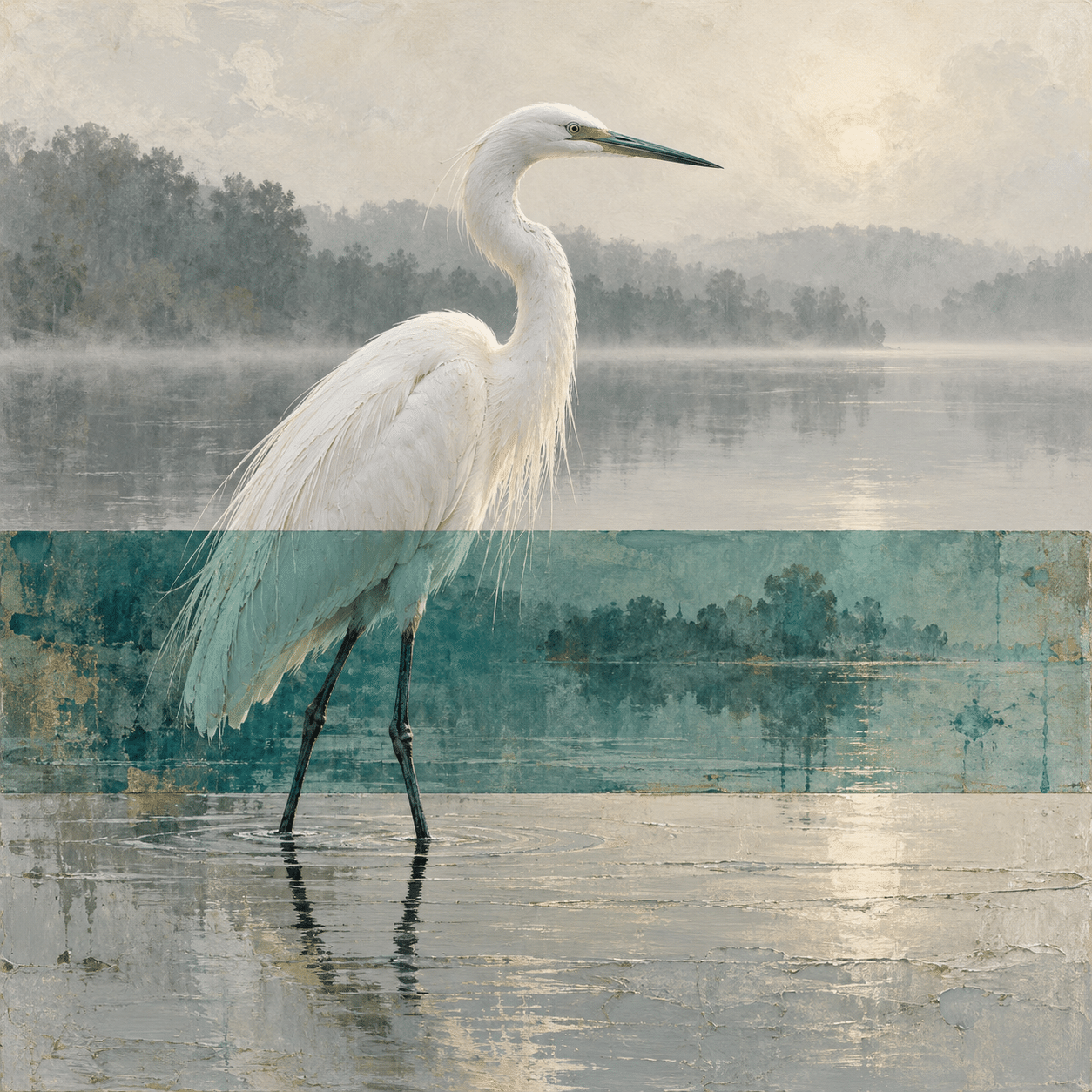
The working question is simple: can three distinguishable visual roles produce a richer reading than any one of them alone? A landscape might establish distance, a bird provide a focus, and a translucent current cross both. The current becomes meaningful when it alters our reading of the bird or its environment; a decorative stripe added at the end may do very little.
Layer one: establish the field
The field supplies conditions: space, atmosphere, scale or a repeated rhythm. It can be a painted landscape, a sheet of textured paper, a photographic interior or a largely empty colour area. Its job is to make the next decision legible. Keep its contrast restrained when the subject needs a strong silhouette.
A field is not necessarily the most distant object. In a flat composition it can be the supporting pattern against which another shape becomes visible. Think of it as the image’s first proposition: a quiet room, a cold expanse, a dense city or an orderly arrangement.
Layer two: give the eye something to recognise
The subject introduces a focal form or event. A single vessel, a standing figure, an arch or an irregular disc can do the job. Recognition does not require photographic realism; a clear silhouette and a few decisive internal details may be enough.
Choose one dominant scale and protect its important features. If every object competes equally, the second layer becomes another field. Establish the subject before adding the third layer so that its later transformation has something clear to act upon.
Layer three: change the reading
The intervention supplies a second interpretation of what we see. A contour can continue from the field across the subject; a translucent plane can reveal one area while obscuring another; a displaced echo can suggest memory or movement. Use a visible rule so the interruption feels intentional.
Keep at least one boundary where all three roles can be understood together. In a bird study, for example, a narrow translucent band might cross the distant shoreline and the lower body while leaving the head and legs readable. The band links spatially separate things without turning the whole picture into fog.
The intervention need not be transparent. A carefully placed opening or opaque shape can work equally well. Its success depends on what it reveals, conceals or connects, not on a fashionable material effect.
Three roles are not three software layers
A digital artist may need many masks, adjustment layers and paint layers to construct these three perceptual roles. Conversely, a painting on one support can imply them through edges, opacity and texture. Count the roles visible in the finished work, not the hidden items in a software panel.
Foreground, middle ground and background describe spatial placement. Trilayerism, as proposed here, describes a relationship between setting, subject and intervention. The two systems can coincide, but they need not. Three side-by-side panels form a different compositional problem; a triptych does not automatically demonstrate this method.
Connections to existing practices
MoMA’s glossary distinguishes collage, made by attaching fragments to a support, from assemblage, which combines materials in three dimensions. It also defines mixed media through the use of more than one artistic medium. [1] These are useful neighbouring terms, not evidence for a historical Trilayerist school.
A Trilayerism exercise can use collage, but its three-role constraint is an additional compositional choice. A digital image can suggest a relief without being a physical assemblage. MoMA’s collage and assemblage collections provide real works for comparison; their artists should not be relabelled as members of this AOI proposal. [2–3]
Palette, edges and material behaviour
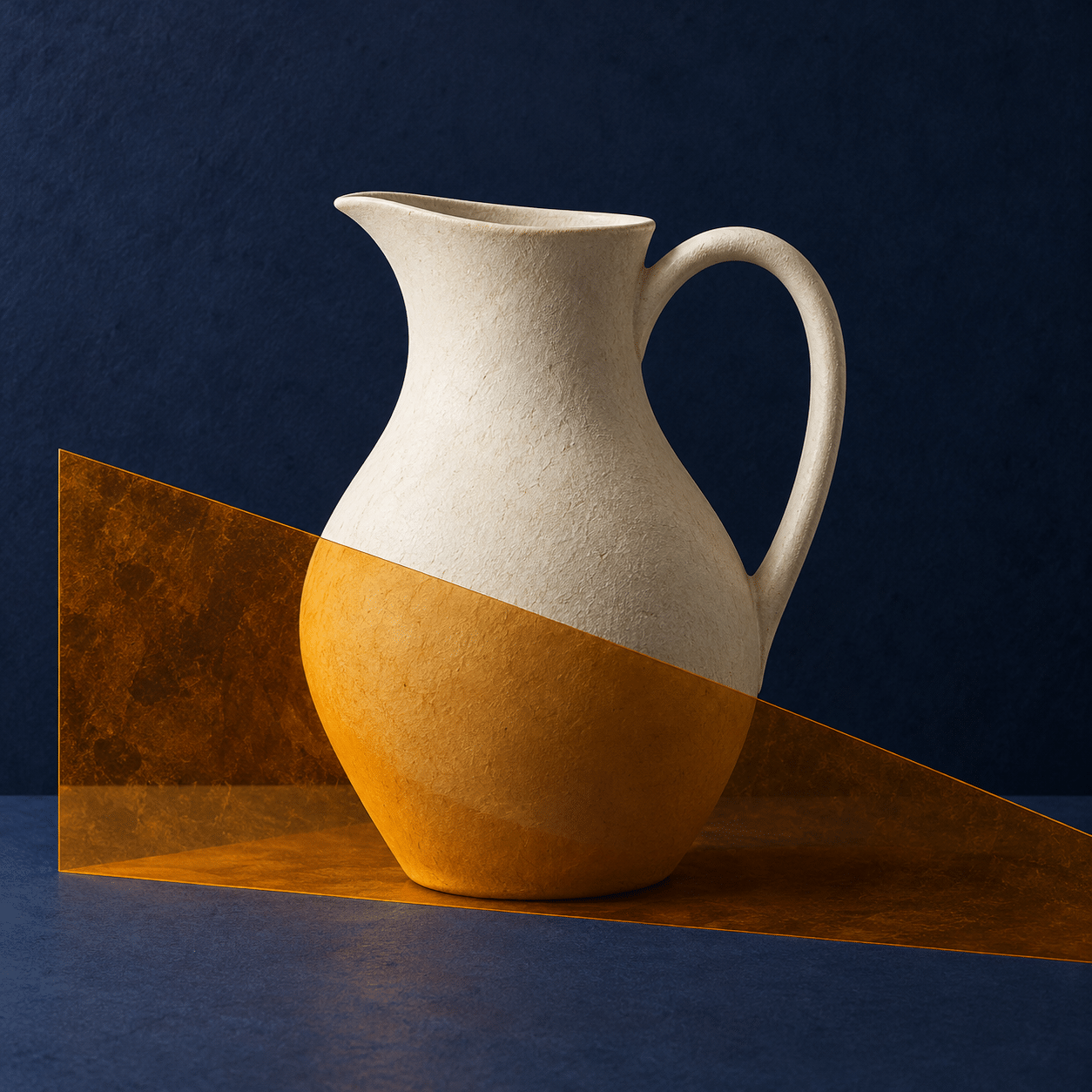
Start with a restrained field colour, a contrasting subject and one connecting accent. An indigo field, pale ceramic vessel and amber overlay are one possibility. A monochrome field with one red interruption is another. There is no mandatory palette: colour should help distinguish the roles while repeating enough information to unite them.
Vary edge behaviour deliberately. The field may be soft, the subject sharply cut and the intervention partly translucent. Preserve texture where materials meet. If a simulated paper edge casts a shadow, that shadow should agree with the image’s light rather than float independently.
Do not make every layer equally transparent. That often produces muddy colour and uncertain structure. Give the viewer a firm area to understand, then introduce ambiguity at a chosen meeting point.
Five studies, five different problems
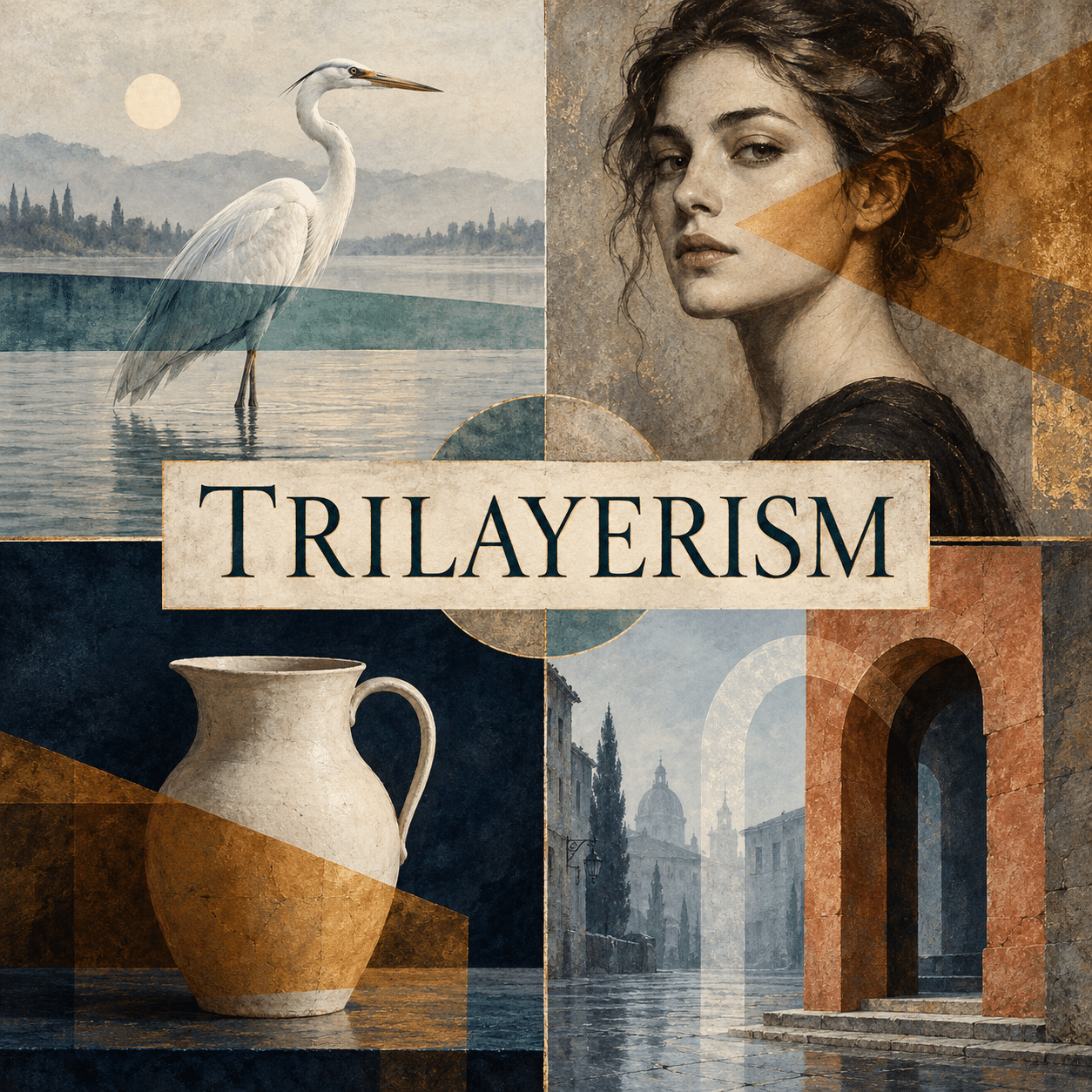
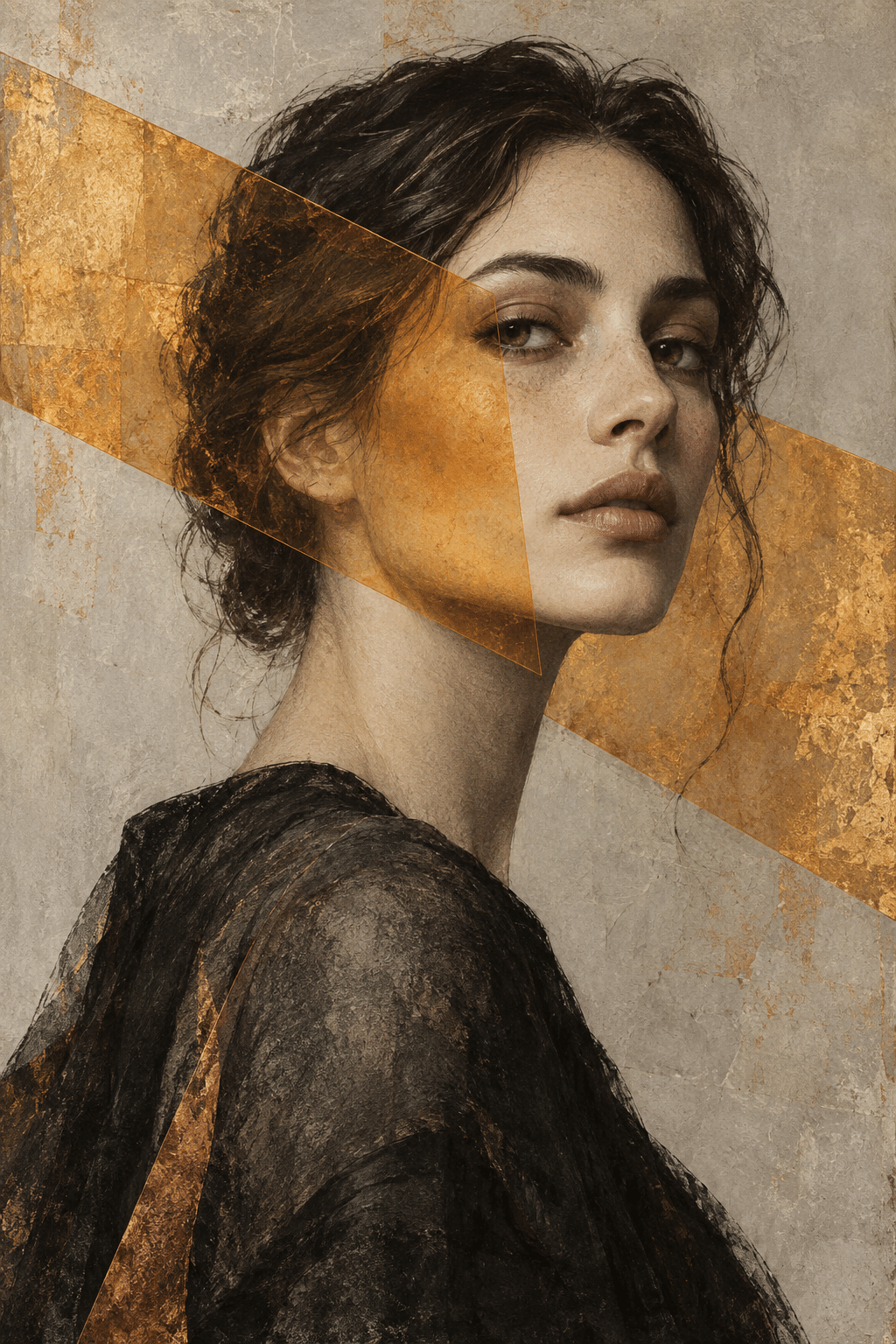
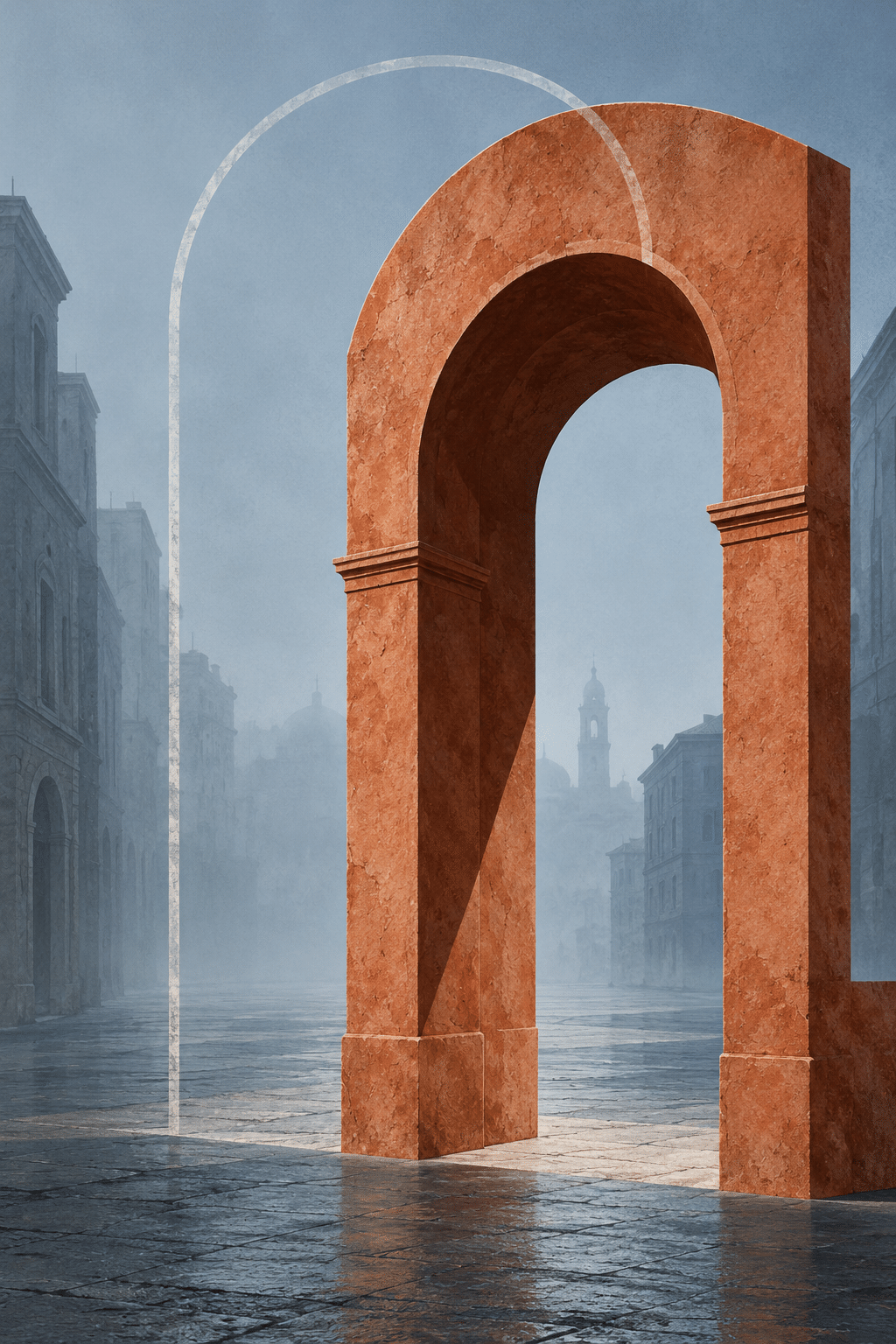
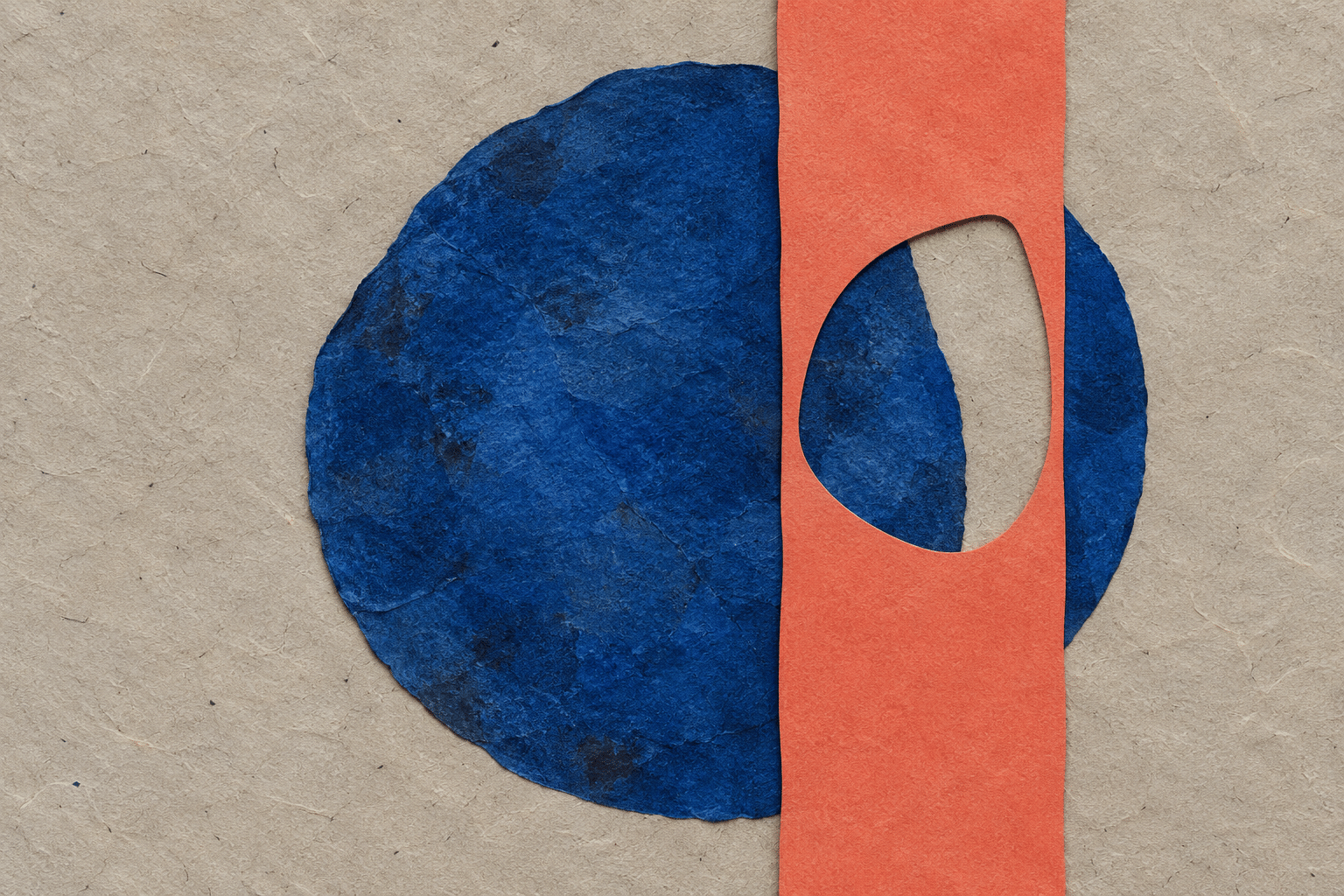
The new gallery explores a bird and water, an adult portrait, a ceramic still life, a city threshold and non-objective geometry. Each applies the same three-role question to a different subject and material treatment. The banner gives a wide introduction; the titled collage compares several applications.
These are AI-generated interpretations of the proposal, not historical examples or photographs of manufactured objects. Treat an image as a successful study only where its roles can actually be read. A caption cannot repair an overlap that the picture fails to show.
A practical studio exercise
Begin with a field and one subject. Save or photograph that state. Introduce one intervention and compare the two versions: what has become connected, hidden or newly significant? If the answer is only “there is more texture,” revise its position or simplify it.
Try the same intervention at three sizes, then choose one. Check the result as a thumbnail and at full size. Keep one quiet area, one clear focal feature and one decisive overlap. This constraint is especially useful for illustration, conceptual covers and studies of memory; it is less useful when exact object documentation must remain unambiguous.
Positive editorial assessment — AI-authored
The proposal makes layering accountable. A field, subject and intervention give the artist three distinct decisions and a way to judge their relationship. Its strongest images reward a second look while retaining an immediate focal point.
Critical editorial assessment — AI-authored
The method becomes generic when every example receives the same translucent ribbon or when three roles are asserted only in the caption. Avoid turning the constraint into a formula. Remove the third layer temporarily: if the meaning scarcely changes, give it a more precise job or leave it out.
Neutral editorial assessment — AI-authored
Trilayerism is an AOI compositional proposal that can be explored through painting, collage, digital illustration or relief-like imagery. It offers a repeatable exercise rather than a verified historical lineage, a fixed material recipe or proof that a composition is unique.
A small poetic detour
Original words from the AOI studio.
Poetry
First, a room for light to stay.
Then, a shape that asks for sight.
Last, a crossing in its way—
a seam that makes the room less certain.
Keep one edge and lose another;
let a colour travel through.
What the layers take from each other
is the image coming into view.
The prompt workshop
Original creative exercises. These prompts create new illustrations, not documentary evidence.
One vessel, one interruption
Create an original three-role composition: a quiet textured indigo field, one pale ceramic vessel with a clear silhouette, and a translucent amber plane crossing only its lower half and continuing onto the field. Preserve the rim and handle, restrained colour, convincing material boundaries, no text.
A threshold remembered
Create a layered city-threshold illustration: an atmospheric muted street establishes the field, a sharply cut terracotta arch forms the subject, and a displaced pale contour of the arch crosses both as a memory-like intervention. Clear focal hierarchy and one decisive overlap, no signage or lettering.
Test the rule without a subject
Create a non-objective three-role image: a quiet warm-grey paper field, a large irregular cobalt disc, and a narrow opaque coral plane with an opening that reveals both field and disc. Deliberate edge relationships, broad empty space, no labels or diagram arrows.
A smile from the studio
Jokes
The third layer asked for more space. The first two suggested it make a meaningful contribution first.