
Sculpture · found materials, construction and transformed relationships
Assemblage brings separate objects or materials into a three-dimensional artwork. The components may retain clues to their earlier uses while gaining new relationships through arrangement, joining, colour and display. The central act is not collecting a large number of interesting things. It is making their encounter mean something that none could say alone.
Creative toolbox · take this style further
Choose an input, adjust it, then open a tool. Search links pass your text to the destination. Copy & open copies it for you to paste into the generator; you start generation there.
ChatGPT
Copy your input and paste it into a ChatGPT conversation or image request.
Copy & open ChatGPT (new tab)Claude · Anthropic
Develop an image prompt or explore the style in a new Claude conversation.
Copy & open Claude · Anthropic (new tab)Midjourney
Paste your input into the Imagine bar on the Create page.
Copy & open Midjourney (new tab)Adobe Firefly
Copy your input, open Firefly, and paste it into the prompt field.
Copy & open Adobe Firefly (new tab)Leonardo.Ai
Copy your input, open Leonardo, and paste it into the generation field.
Copy & open Leonardo.Ai (new tab)Lexica
Search AI images and prompts using your selected input.
Search with this input Lexica (new tab)Pexels
Search the photo and video library. Short keywords often work best.
Search with this input Pexels (new tab)Pixabay
Search photos, illustrations and other images.
Search with this input Pixabay (new tab)Unsplash
Search photographs using the style name or your own keywords.
Search with this input Unsplash (new tab)Wikipedia
Search for background reading. A style may not have its own article.
Search with this input Wikipedia (new tab)WikiArt
Copy your input into WikiArt’s search to explore artists and artworks.
Copy & open WikiArt (new tab)Instagram hashtags
Search a hashtag made from your input: spaces and punctuation are removed. Instagram may require sign-in.
Search with this input Instagram hashtags (new tab)A closer look
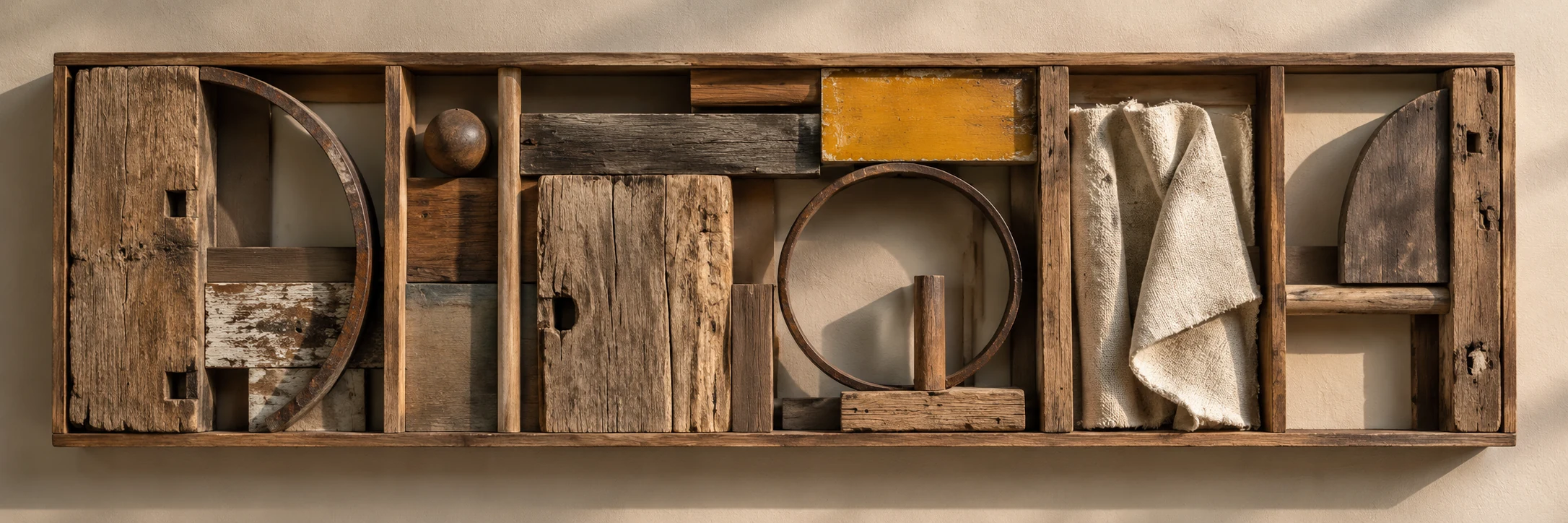
The original AI banner proposes a shallow relief of wood offcuts, metal rings, fabric and an ochre fragment. The depicted depth and shadows explain the intended construction. This is a digital concept rather than a photograph of a physically assembled work.
From the recognisable part to the new whole
A fragment of furniture may remain recognisable after it enters an artwork. That memory can work with or against its new role: a former handle becomes a curve, a box becomes a chamber, a fabric scrap softens an otherwise rigid structure. Meaning arises through the change of relationship.
Louise Nevelson’s Sky Cathedral, 1958, is a useful example. MoMA identifies its medium as painted wood and describes found wooden elements organised into a unified black construction. The components retain varied forms while the shared treatment encourages us to read the larger structure. [1]
That example is not a rule that all assemblage should be wooden, monochrome or architectural. It demonstrates how a deliberate decision can connect disparate parts. Another work may preserve every colour and use the differences as its main source of tension.
Depth is not an optional extra
Unlike a purely flat arrangement of images, an assemblage occupies space. Parts cast shadows, hide one another and change their relationships as the viewer moves. A shallow relief can exploit these effects just as deliberately as a freestanding construction.
Look at the gaps. An opening can separate two objects, frame a view or make a dense passage feel lighter. If every cavity is filled, the work may lose the spaces that allow its components to remain intelligible. Absence can be as active as another found object.
The banner uses a few curved metal forms against more angular wood. Cloth introduces another kind of edge. The ochre accent is intended to focus attention without becoming a painted label. These relationships are the subject of the study, not the supposed rarity of the materials.
Keep the neighbouring practices in view
Collage and assemblage overlap, especially where pasted materials acquire substantial relief. The distinction is useful rather than absolute: ask how the work uses actual depth, objects and the viewer’s movement. A digital collage may depict an assemblage without becoming a physical one.
A readymade raises related questions about selection and presentation, but it need not involve combining multiple components into a new structure. Arte Povera provides another historical comparison; using ordinary objects does not automatically place an assemblage within that movement.
Avoid romantic stories about found materials unless their histories are known. A weathered board may suggest prior use, but its appearance cannot prove a particular building, owner or event. An honest caption can distinguish documented provenance from an association proposed by the artist.
Build a small work with a clear decision
Select five ordinary components that vary in one meaningful way: weight, curvature, texture or former function. Arrange them without fixing them first. Photograph several versions and compare the negative spaces as well as the objects. Remove any component that contributes only more stuff.
For a physical work, plan stable supports and suitable joins. For an AI concept, inspect whether the depicted pieces actually connect and whether shadows describe consistent depth. Keep concept imagery separate from photographs of the finished object, if you later make one.
Try one unifying change, such as limiting colour or repeating a direction, and one deliberate exception. The exception will matter only if the rest establishes a relationship. A successful assemblage lets the objects retain some memory while giving the viewer a new structure to explore.
A small poetic detour
Original words from the AOI studio.
Poetry
The handle forgets the door;
its curve remembers a hand.
The prompt workshop
Original creative exercises. These prompts create new illustrations, not documentary evidence.
Join a small vocabulary
Original assemblage concept with five wood and metal components in a shallow relief, deliberate gaps and cast shadows, one ochre accent, no replica of a named artwork.
Original AOI exercise; a generated image is not historical or documentary evidence.
Make the depth readable
Invented box relief of weathered wood offcuts, curved metal rings and folded fabric, visible plausible joints, directional light and varied shallow depth, AI proposal rather than a photograph of an actual sculpture.
Original AOI exercise; a generated image is not historical or documentary evidence.
Test one unifying decision
Arrange the same five components in two assemblage concepts: one united by a single colour, the other retaining their different surfaces. Compare the whole structure and the recognisability of each part.
Original AOI exercise; a generated image is not historical or documentary evidence.
People & works to explore
References discussed in this article. Consult the sources below for context.
Artists and practitioners
Louise Nevelson — discussed through Sky Cathedral
Paintings and other works
Louise Nevelson, Sky Cathedral, 1958