
Television animation reference · not a historical art movement
Aaahh!!! Real Monsters is a Nickelodeon animated series, not the name of an art movement. It belongs in a visual reference database because its characters offer an effective lesson in comic exaggeration: bodies can be awkward, startling and immediately readable at the same time. This guide separates the programme’s documented identity from practical observations you can use to invent creatures of your own.
A visual introduction
Open any image to look closer, then browse the examples.
Creative toolbox · take this style further
Choose an input, adjust it, then open a tool. Search links pass your text to the destination. Copy & open copies it for you to paste into the generator; you start generation there.
ChatGPT
Copy your input and paste it into a ChatGPT conversation or image request.
Copy & open ChatGPT (new tab)Claude · Anthropic
Develop an image prompt or explore the style in a new Claude conversation.
Copy & open Claude · Anthropic (new tab)Midjourney
Paste your input into the Imagine bar on the Create page.
Copy & open Midjourney (new tab)Adobe Firefly
Copy your input, open Firefly, and paste it into the prompt field.
Copy & open Adobe Firefly (new tab)Leonardo.Ai
Copy your input, open Leonardo, and paste it into the generation field.
Copy & open Leonardo.Ai (new tab)Lexica
Search AI images and prompts using your selected input.
Search with this input Lexica (new tab)Pexels
Search the photo and video library. Short keywords often work best.
Search with this input Pexels (new tab)Pixabay
Search photos, illustrations and other images.
Search with this input Pixabay (new tab)Unsplash
Search photographs using the style name or your own keywords.
Search with this input Unsplash (new tab)Wikipedia
Search for background reading. A style may not have its own article.
Search with this input Wikipedia (new tab)WikiArt
Copy your input into WikiArt’s search to explore artists and artworks.
Copy & open WikiArt (new tab)Instagram hashtags
Search a hashtag made from your input: spaces and punctuation are removed. Instagram may require sign-in.
Search with this input Instagram hashtags (new tab)A closer look
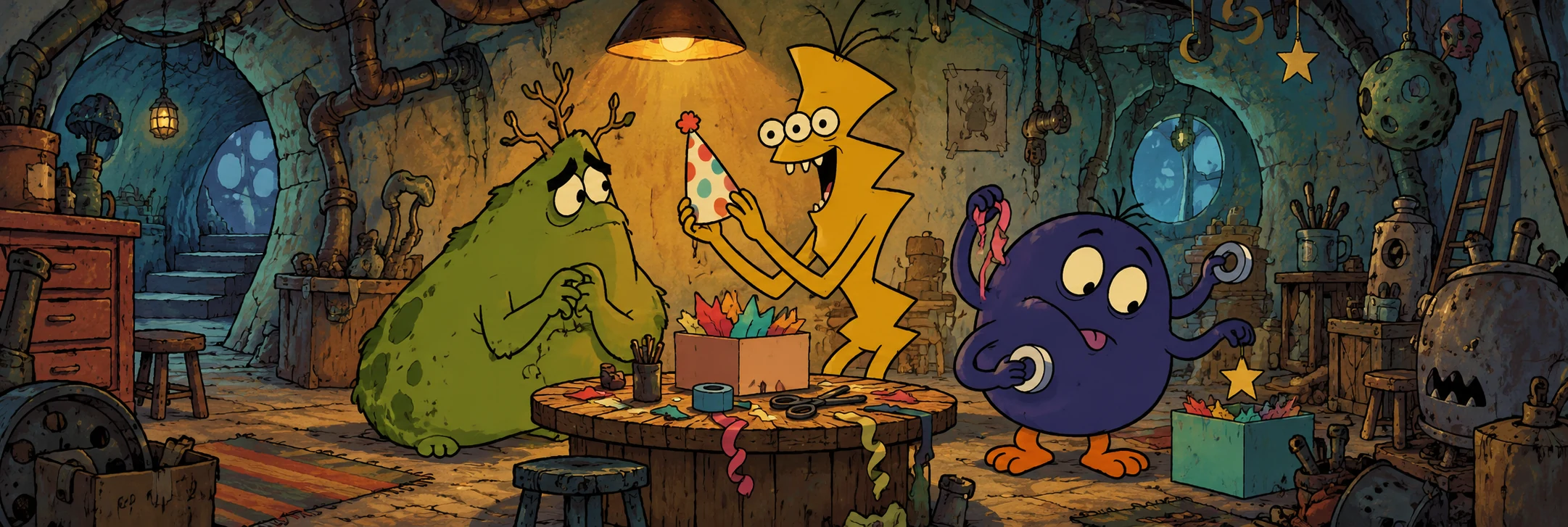
The new banner shows an original trio of odd creatures in a crooked underground workshop. Contrasting silhouettes, uneven teeth and expressive poses make their reactions readable before the smaller textures register. These are AOI inventions, not Ickis, Oblina or Krumm, and the image is not a production still or licensed programme artwork.
A specific programme with a specific premise
Nickelodeon’s official catalogue presents the series as the adventures of monster students learning to scare humans. Its creator profile identifies Gabor Csupo and Peter Gaffney. Paramount’s programme catalogue dates the series to 1994. Those sources provide a sounder foundation than an invented movement history or an unsourced list of awards. [1][2][3]
Source note: the legacy Nickelodeon Animation catalogue and creator URLs remain indexed but redirected to Nickelodeon’s general homepage during this review. The Paramount programme listing is the direct viewing reference. We retain the legacy citations with that limitation rather than presenting them as currently accessible profiles.
The characters’ schooling creates a useful comic reversal: what frightens a human can be routine work, social embarrassment or an examination for a monster. That reversal gives the creature designs something to do. Their strange bodies are part of a situation rather than a catalogue of abnormalities.
When discussing television animation, distinguish series creators from the many artists who contribute to design, boards, backgrounds and animation. A credit for creating a show does not mean that one person drew every frame. For individual production claims, consult the relevant episode credits.
Silhouette is the first sentence
Look at how the main trio differ in overall proportion and outline: Ickis, Oblina and Krumm are not one body shape with three colours applied. Their contrasting designs let a viewer identify a character quickly, even when a shot is busy. This is visual analysis of the programme’s character imagery, not a claim about an undocumented production rule.
For your own trio, begin with three black shapes. Make one broad and low, another narrow and curved, and the third compact with an unusual balance. If they become indistinguishable at thumbnail size, more scales, spots or eyelashes will not solve the problem.
Exaggeration works best when it has a centre of gravity. A creature may have impossible anatomy, but the audience still benefits from knowing where its weight rests and which way it is looking. Let one dominant feature organise the rest rather than making every feature equally loud.
The grotesque can carry vulnerability
Comic ugliness is more versatile than constant aggression. A huge mouth can hesitate; a lopsided body can try to stand formally; a startling eye can look worried. The gap between appearance and behaviour gives a design emotional range.
Our original banner uses that gap. The creatures occupy a grubby, crooked space, but their interaction reads as a small social event. Warm light gathers around their faces while the background stays comparatively subdued. The viewer has time to read the joke before inspecting the pipes and discarded objects.
This suggests a useful editorial choice: decide whether a scene is about fear, embarrassment, anticipation or friendship. Give the poses that job. Adding more teeth to an embarrassed character may be less effective than turning its feet inward or making its gaze avoid another creature.
Build a world that supports the action
A crooked doorway, oversized drain or patched surface can make an invented setting feel incompatible with tidy human life. Yet a background still needs a usable floor, clear entrances and enough separation around the characters. Deliberate distortion is different from losing the staging.
Keep the strongest value contrast near the important gesture. Repeat a few shapes across the room so that the setting feels designed, then leave some quiet areas. If every corner competes for attention, the joke becomes a search exercise.
A generated image can imitate the broad appearance of a cartoon while failing at continuity. Check that feet meet the floor, pupils agree about the direction of a glance and a creature’s limbs do not merge with a pipe. For sequential work, compare the same features across shots.
An original creature exercise
Invent three creatures preparing for a harmless surprise party in an underground workshop. One is confidently wrong, one is carefully prepared and one would rather go home. Draw a silent scene in which their attitudes are evident without captions.
Borrow the design problem—contrasting silhouettes, expressive distortion and comic staging—rather than copying a named character. The useful inheritance of a memorable cartoon is not merely a set of shapes. It is the discovery that a strange shape can behave like somebody we understand.
A small poetic detour
Original words from the AOI studio.
Poetry
Three shadows rehearse a fright.
One forgets the entrance.
The darkness tries not to laugh.
The prompt workshop
Original creative exercises. These prompts create new illustrations, not documentary evidence.
Start with silhouettes
Invent three comic monsters from contrasting silhouettes: broad and low, tall and curved, compact and angular. Show them as clear flat shapes first. Do not reproduce existing television characters.
Original AOI exercise; a generated image is not historical or documentary evidence.
Stage a silent joke
Draw the original trio preparing a surprise party in a crooked underground workshop. One is confident, one anxious, one distracted. Express the relationships through gaze, hands and spacing; no words.
Original AOI exercise; a generated image is not historical or documentary evidence.
Check continuity
Create front and side views of the same invented creature with consistent eyes, limbs and proportions. Use expressive linework, limited flat colour and a plain background. Inspect each feature before making another scene.
Original AOI exercise; a generated image is not historical or documentary evidence.
People & works to explore
References discussed in this article. Consult the sources below for context.
Artists and practitioners
Gabor Csupo and Peter Gaffney — series creators named by Nickelodeon
Paintings and other works
Aaahh!!! Real Monsters — Nickelodeon animated television series (1994)