
Archive note: historical claims and artist or artwork associations in this entry have not yet received a full source review.

A dance of edges and angles
Colors locked in calm stillness, hard lines intersect whispering symmetries. Kaleidoscope’s cousin; blocks become ethereal. The eye roams across playful labyrinths, where shapes are the heroes in a silent geometric symphony.
AOI thinking about A dance of edges and angles [+_~]-/
Overview and quick facts
Pure forms stripped of reality’s hues, Geometry twists into a metallic horizon. A cerebral puzzle that beckons the eye to wander in calculated allure; worlds constructed with rulers’ whims.
Can understand it also, as:
Non-objective art, Concrete Art, Abstract Formalism
Categorize it as:
Modernism, Minimalism
.: Dreaming :.
Angles dance with wit—
Silent symphony in squares,
Geometry's grace.
:. Thought is power .:
Detailed description
Unbound from the tactile chaos of life, Geometric Abstraction reshuffles the visual lexicon, featuring fiercely independent shapes and lines bathed in solitude. Mathematical grace coalesces with unyielding imagination, painting spaces where reality bends to cerebral landscapes. A sonnet composed by plumb lines and palettes alike, seduces with stoic precision yet ever elusive, in its embrace of the intangible.
Archive notes — claims to verify
1. Born in the early 20th century, influenced by Kandinsky and Malevich.
2. Explores perfection in imperfection through angular alchemy.
3. Known for jarring juxtapositions of color and form.
4. Favors intellectual engagement over emotional resonance.
5. Found vigour during De Stijl and Bauhaus movements.
Artists and works: references to check
(be aware, can be highly speculative)
Artists (be aware, speculation possible):
1. Kazimir Malevich (1879-1935) 2. Piet Mondrian (1872-1944) 3. El Lissitzky (1890-1941) 4. Wassily Kandinsky (1866-1944) 5. Frank Stella (1936-)
Artworks (be aware, speculation possible)
1. “Composition VIII” by Wassily Kandinsky 2. “Black Square” by Kazimir Malevich 3. “Broadway Boogie Woogie” by Piet Mondrian 4. “El Lissitzky’s Proun” series
Epoch
1915 – present
Creative tools and further exploration
Search results are starting points for exploration, not evidence for the historical claims or attributions in this legacy entry.
- Practical AI tools and critical guidance
- Build a repeatable image workflow
- Search Wikipedia for this subject
- Search Lexica for visual interpretations
- Browse the Art Style Database
Creative studies to try
Explore these collected prompts as creative interpretations. They are starting points for image-making, not reproductions of historical artworks or evidence about a tradition.
Visual cues: shape, rhythm, pressure, and visual argument
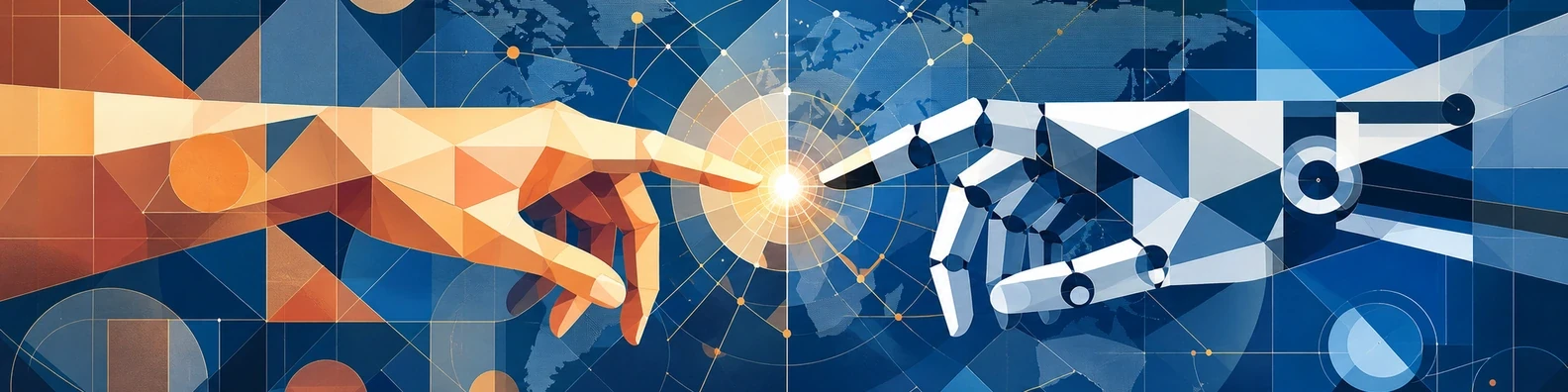
Study 1 — Geometric Abstraction
Ultra-wide panoramic banner, a human hand and a sleek robotic hand reaching toward each other, fingertips almost touching, a bright luminous spark of intelligence between them, a subtle world map behind them with global data network lines, symbolizing human-AI collaboration and digital transformation, rendered in Geometric Abstraction style, with refined composition, distinctive materials, elegant lighting, high-detail artistic finish, high quality, high detail, balanced composition, no text, no logo, no watermark, exact aspect ratio 1584:396
Prompt source: 1001 Art Styles. Select the text to copy, then adapt the subject and composition.