
Art history · matter, process and encounters in space
Arte Povera emerged in Italy in the late 1960s and challenged expectations about the materials and boundaries of art. Its works can involve ordinary substances, industrial elements, living processes and the space around them. The phrase does not mean badly made art, a cheap decorating style or any object assembled from rubbish.
Creative toolbox · take this style further
Choose an input, adjust it, then open a tool. Search links pass your text to the destination. Copy & open copies it for you to paste into the generator; you start generation there.
ChatGPT
Copy your input and paste it into a ChatGPT conversation or image request.
Copy & open ChatGPT (new tab)Claude · Anthropic
Develop an image prompt or explore the style in a new Claude conversation.
Copy & open Claude · Anthropic (new tab)Midjourney
Paste your input into the Imagine bar on the Create page.
Copy & open Midjourney (new tab)Adobe Firefly
Copy your input, open Firefly, and paste it into the prompt field.
Copy & open Adobe Firefly (new tab)Leonardo.Ai
Copy your input, open Leonardo, and paste it into the generation field.
Copy & open Leonardo.Ai (new tab)Lexica
Search AI images and prompts using your selected input.
Search with this input Lexica (new tab)Pexels
Search the photo and video library. Short keywords often work best.
Search with this input Pexels (new tab)Pixabay
Search photos, illustrations and other images.
Search with this input Pixabay (new tab)Unsplash
Search photographs using the style name or your own keywords.
Search with this input Unsplash (new tab)Wikipedia
Search for background reading. A style may not have its own article.
Search with this input Wikipedia (new tab)WikiArt
Copy your input into WikiArt’s search to explore artists and artworks.
Copy & open WikiArt (new tab)Instagram hashtags
Search a hashtag made from your input: spaces and punctuation are removed. Instagram may require sign-in.
Search with this input Instagram hashtags (new tab)A closer look
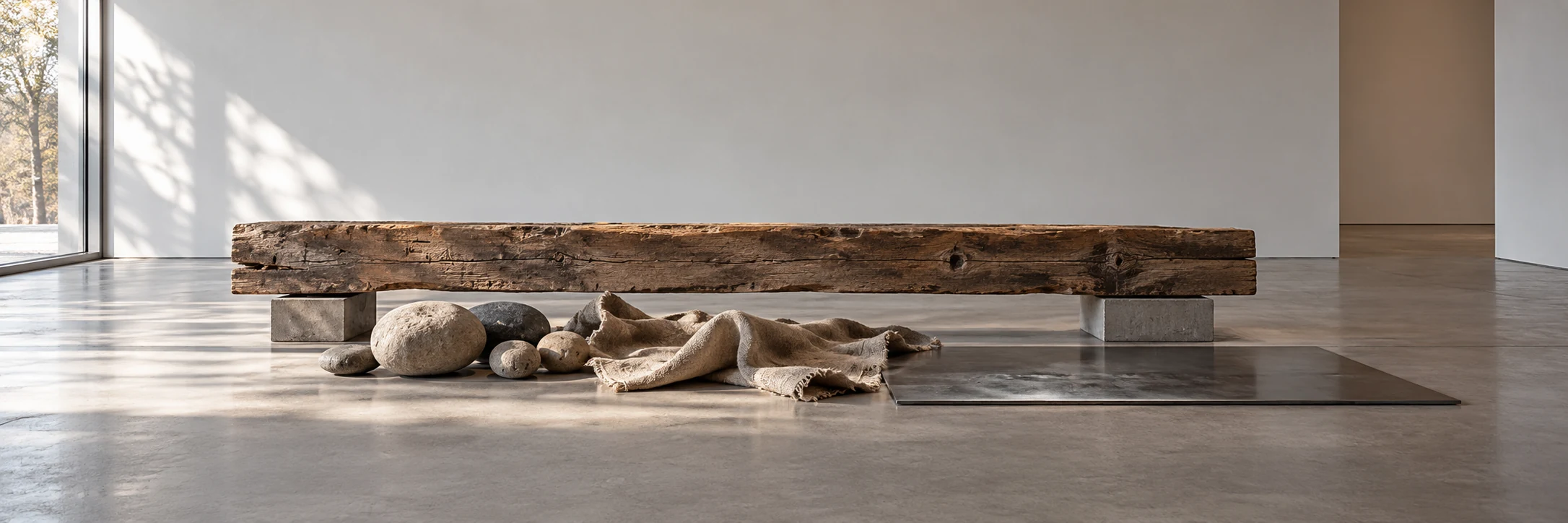
The original AI banner proposes an imagined encounter between timber, stones, cloth and steel in a gallery. It is a visual concept, not a photograph of an actual installation or a claim to membership in the historical movement. Its materials are depicted rather than physically present.
A historical movement, not a shopping list
Critic and curator Germano Celant introduced the term Arte Povera in 1967. The National Galleries of Scotland explains its relationship with unconventional materials and the challenge to established artistic practices. The label identifies a historical context; merely choosing inexpensive supplies does not reproduce that context. [1]
The useful question is what a material does in a particular work. It may sag, resist, carry traces of use or change over time. Its relation to another substance can create tension between the organic and industrial, the temporary and durable, or a bodily experience and an abstract idea.
A pile of materials does not become compelling through its inventory alone. Arrangement, process, scale and the viewer’s position determine what kind of encounter occurs. Start with those relationships before assigning a grand symbolic meaning to every stone.
Correctly identify the work you discuss
Jannis Kounellis’s 1969 installation at Rome’s L’Attico gallery involved twelve horses. MAXXI’s account places this work within his use of nontraditional materials, living animals and expanded exhibition space. The animals were not chickens, and the work should not be reduced to a generic anecdote about strange gallery objects. [2]
That example raises questions about presence, time and the institution that frames an encounter. A photograph can document an aspect of it, but cannot deliver the same spatial or living situation. Historical description and present-day interpretation need to remain distinguishable.
Other artists associated with Arte Povera developed different practices. MoMA’s collection overview connects works by Marisa Merz, Mario Merz, Giovanni Anselmo, Giuseppe Penone and Alighiero Boetti, among others. The range is a reason to examine individual works rather than invent one signature appearance for everyone. [3]
Look for an active relationship
Imagine the timber in our banner replaced by polished plastic. The shape might remain, yet the encounter with the steel and cloth would change. That comparison helps separate the effect of material from the effect of outline. Ask also whether a surface appears worked, weathered, folded or newly manufactured.
The empty floor is part of the proposal. It establishes distance, lets shadows articulate the objects and gives the viewer a possible route. Cropping tightly around a picturesque texture would turn the study into a different kind of image, more concerned with surface than with an installation in space.
These are editorial observations about a generated illustration. They cannot establish actual weight, smell, temperature or decay. Be especially careful when a caption claims physical qualities that the image merely suggests. Material art makes the difference between depiction and presence unusually important.
Develop a proposal without manufacturing provenance
For an initial exercise, choose two ordinary materials with contrasting behaviours. Write down what each can physically do, then propose a simple relationship between them. Make a small, stable study or a clear drawing. Avoid adding objects solely because they look convincingly avant-garde.
Use AI to compare layouts, lighting and possible viewing distances. If the work depends on a real process, test that process separately. A generated image of balance or transformation does not demonstrate that the arrangement can stand or that the transformation occurs.
Describe the result as a contemporary material study informed by your research. It need not impersonate a historical artwork to be interesting. A precise question about two ordinary things can carry more force than a room full of borrowed artistic gestures.
A small poetic detour
Original words from the AOI studio.
Poetry
The cloth yields; the stone does not.
Between them, the room changes.
The prompt workshop
Original creative exercises. These prompts create new illustrations, not documentary evidence.
Compare two materials
Original contemporary installation concept pairing rough timber and folded cloth in an empty gallery, clear scale and side light, stable arrangement, an AI proposal rather than a historical Arte Povera work.
Original AOI exercise; a generated image is not historical or documentary evidence.
Make space part of the study
Invented material study with a low supported timber beam, river stones, coarse cloth and a steel plate, deliberate intervals and cast shadows, generous floor space, no replica or live animals.
Original AOI exercise; a generated image is not historical or documentary evidence.
Test substitution
Generate two concept views of one stable material arrangement: timber with cloth, then the same form in polished plastic with cloth. Compare what changes visually and test physical behaviour separately.
Original AOI exercise; a generated image is not historical or documentary evidence.
People & works to explore
References discussed in this article. Consult the sources below for context.
Artists and practitioners
Jannis Kounellis
Marisa Merz
Mario Merz
Giovanni Anselmo
Giuseppe Penone
Alighiero Boetti
Paintings and other works
Jannis Kounellis, Untitled (Twelve Horses), 1969, L’Attico, Rome
Sources and further exploration
[1] National Galleries of Scotland — Arte Povera
Creative studies to try
Explore these collected prompts as creative interpretations. They are starting points for image-making, not reproductions of historical artworks or evidence about a tradition.
Visual cues: object logic, staged tactility, handmade construction; Humble matter and poetic juxtaposition
Study 1 — Arte Povera
Ultra-wide panoramic banner, a human hand and a sleek robotic hand reaching toward each other, fingertips almost touching, a bright luminous spark of intelligence between them, a subtle world map behind them with global data network lines, symbolizing human-AI collaboration and digital transformation, rendered in Arte Povera style, with refined composition, distinctive materials, elegant lighting, high-detail artistic finish, high quality, high detail, balanced composition, no text, no logo, no watermark, exact aspect ratio 1584:396
Prompt source: 1001 Art Styles. Select the text to copy, then adapt the subject and composition.
Study 2 — Arte Povera
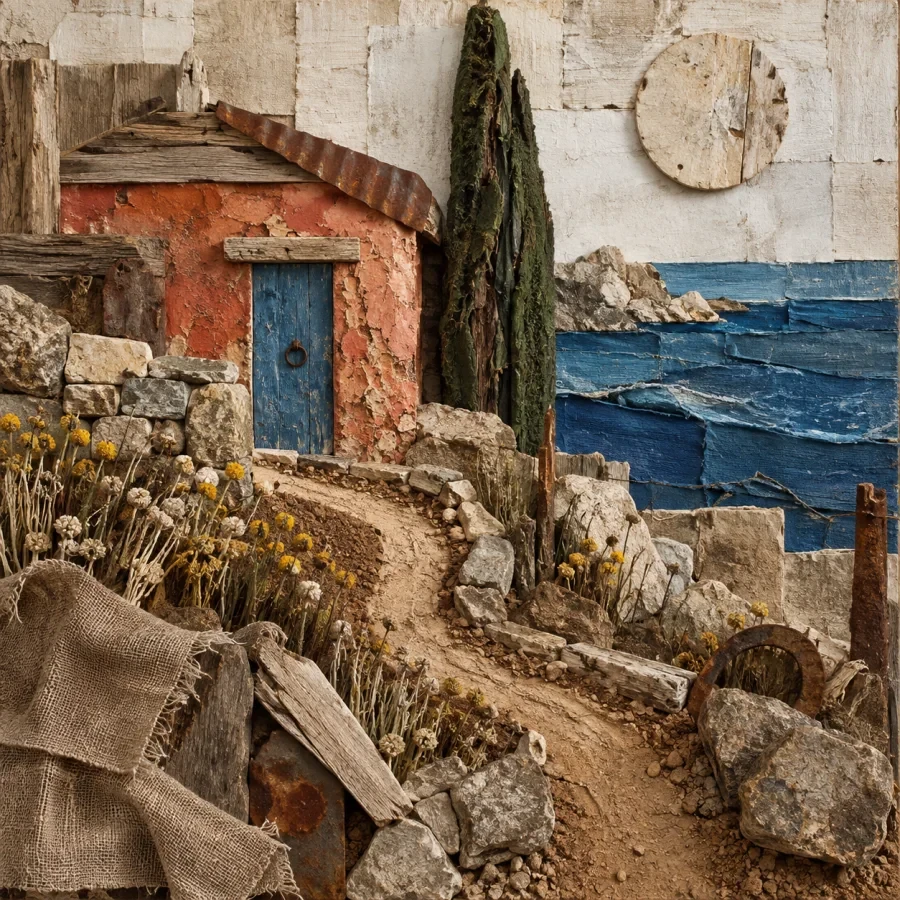
Apply the following visual approach to my subject or project, preserving its core content and purpose. Interpret the subject through raw wood, earth, cloth, stone, and simple industrial fragments arranged in a materially direct, quietly surprising installation. Treat this as a contemporary interpretation, not a historical artifact. Adapt the composition to my subject. Do not add text unless my project calls for it.
Prompt source: Emergent Mind Style Atlas. Select the text to copy, then adapt the subject and composition.