
Art and technology · embodied practice and speculative imagery
Cyborg art investigates relationships between living bodies and technological systems. The phrase needs context: it can describe artistic work with altered perception and bodily interfaces, or, more loosely, imagery of organic and mechanical hybrids. A painted metal face and an artist’s lived sensory experiment are different kinds of work. Understanding that difference makes both more interesting.
A visual introduction
Open any image to look closer, then browse the examples.
Creative toolbox · take this style further
Choose an input, adjust it, then open a tool. Search links pass your text to the destination. Copy & open copies it for you to paste into the generator; you start generation there.
ChatGPT
Copy your input and paste it into a ChatGPT conversation or image request.
Copy & open ChatGPT (new tab)Claude · Anthropic
Develop an image prompt or explore the style in a new Claude conversation.
Copy & open Claude · Anthropic (new tab)Midjourney
Paste your input into the Imagine bar on the Create page.
Copy & open Midjourney (new tab)Adobe Firefly
Copy your input, open Firefly, and paste it into the prompt field.
Copy & open Adobe Firefly (new tab)Leonardo.Ai
Copy your input, open Leonardo, and paste it into the generation field.
Copy & open Leonardo.Ai (new tab)Lexica
Search AI images and prompts using your selected input.
Search with this input Lexica (new tab)Pexels
Search the photo and video library. Short keywords often work best.
Search with this input Pexels (new tab)Pixabay
Search photos, illustrations and other images.
Search with this input Pixabay (new tab)Unsplash
Search photographs using the style name or your own keywords.
Search with this input Unsplash (new tab)Wikipedia
Search for background reading. A style may not have its own article.
Search with this input Wikipedia (new tab)WikiArt
Copy your input into WikiArt’s search to explore artists and artworks.
Copy & open WikiArt (new tab)Instagram hashtags
Search a hashtag made from your input: spaces and punctuation are removed. Instagram may require sign-in.
Search with this input Instagram hashtags (new tab)A closer look
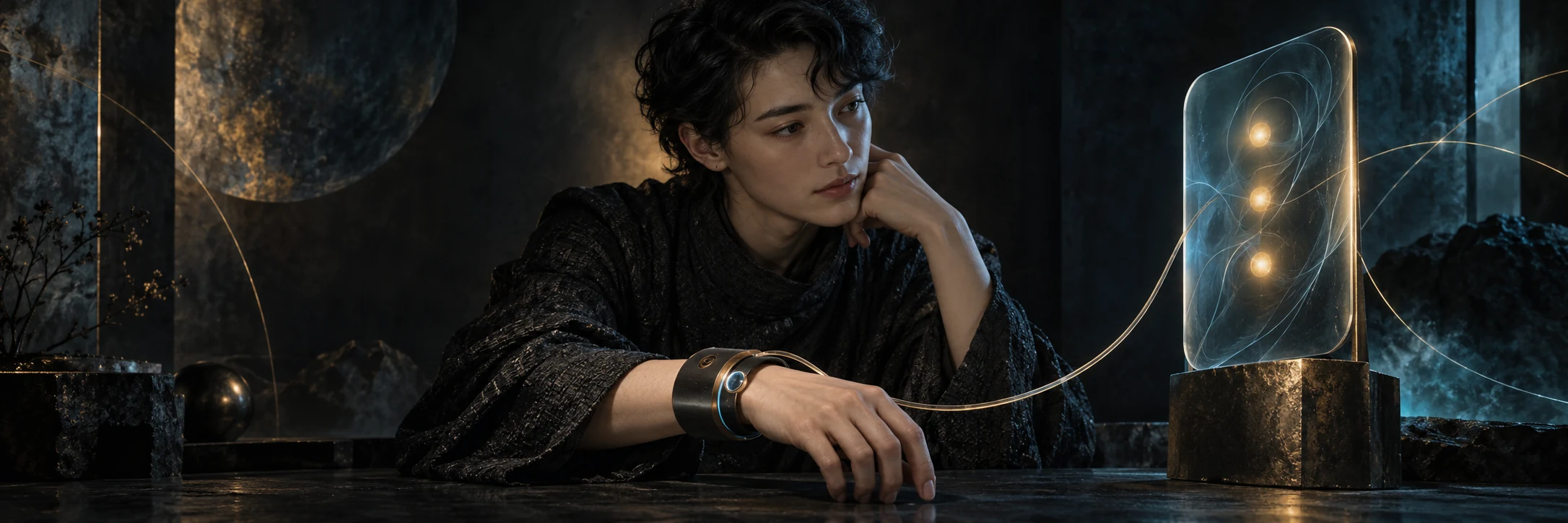
Our banner is an invented visual study of a clothed adult wearing an external sensing apparatus. A hand, a delicate cable and a luminous response panel form a readable circuit across the composition. The equipment is fictional: the illustration demonstrates a design question, not a functioning device, medical intervention or portrait of a documented artist.
An image of a cyborg is not the whole field
In speculative illustration, the body can carry seams, sockets, prosthetic forms or unfamiliar sensors. These features invite questions about identity and function, but they can also become ornament. Before adding another chrome plate, decide what the device receives, what it changes and what the person experiences.
The Cyborg Foundation uses a more specific definition: artists create or extend senses through technology incorporated into the body, with perception itself understood as the artwork. Its history records that Neil Harbisson and Moon Ribas founded the organisation in 2010. This does not support the old entry’s claim that Harbisson coined the term in the early 1990s. [1]
A robot is not automatically a cyborg, and a human-shaped machine is not evidence of a biological component. Conversely, an interface need not resemble a cinematic android to matter artistically. Say whether you are discussing a fictional depiction, a wearable prototype, a performance or an artist’s account of embodied perception.
Follow the signal through a documented work
In its HUMAN+ exhibition material, the CCCB presents the Cyborg Foundation’s Seismic Arm and Sonochromatic Head as sculptures connecting real-time data with the artists’ sensory practices. Its interview with Moon Ribas explains the earthquake-related premise of the Seismic Arm. This is a documented relationship between data and experience, rather than a generic claim that technology makes a person superhuman. [2]
A useful analysis follows the sequence: event, sensor, translation, bodily response, artistic decision. Where does the information come from? What has been simplified or filtered? What can an outside audience perceive, and what remains available principally through the artist’s testimony?
Those questions keep a beautiful device from doing all the intellectual work. A glowing object may communicate technological sophistication while hiding the dependency that makes it meaningful: a power supply, a network, a mapping rule or somebody else’s maintenance.
The body can also become a contested interface
Stelarc’s own biography documents performances involving prosthetics, robotics and networked control, including Third Hand and Fractal Flesh. These projects offer a related but distinct route into questions of bodily agency. They should not be collapsed into a single technique shared by every artist working with bodies and machines. [3]
Control is a compositional subject as well as an ethical one. In a still image, an open hand, a reachable switch or a visible connection can suggest who acts. In performance, timing and feedback may complicate that suggestion. Ask whether the body initiates, responds, negotiates or is acted upon.
Do not treat disability as a convenient metaphor for an incomplete person awaiting technological perfection. An artwork may imagine expanded capacities without ranking human worth by equipment. The person’s choices, relationships and access to repair deserve as much attention as the device’s dramatic appearance.
Design a convincing speculative interface
The banner uses a restrained contrast: soft cloth and skin beside hard connectors and a cool light source. Its external apparatus leaves the person recognisably present rather than turning them into a product display. The cable’s route matters because it gives the eye a simple explanation of a complex idea.
For a fictional design, make a small functional sketch first. Draw the sensor, its input and its output. Then place it on a body in a pose that allows normal movement. Label the design as speculative when publishing it. Photorealistic rendering does not establish that an imagined device is feasible or safe.
An image generator may invent extra fingers, impossible joints or connectors that disappear into clothing. Inspect these before refining reflections. In this subject, a convincing surface can make an incoherent mechanism look deceptively resolved.
A study without modifying a body
Try a storyboard in which a performer responds to three changes in light using an ordinary external prop. Show the same person before the signal, while noticing it and while choosing a response. This is a visual thinking exercise; it requires no implantation or bodily experiment.
The final question is modest and demanding: does the work give us a new way to think about perception, or only a new accessory to look at? A strong cyborg image lets the human consequence remain visible.
A small poetic detour
Original words from the AOI studio.
Poetry
A signal reaches the wrist.
The hand waits.
Response is not yet consent.
The prompt workshop
Original creative exercises. These prompts create new illustrations, not documentary evidence.
Start with a signal
Create an original speculative portrait of a clothed adult with an external wrist sensor and a simple light-response display. Show a plausible cable route and a relaxed hand. No implants, brands or lettering.
Original AOI exercise; a generated image is not historical or documentary evidence.
Build the relationship
Storyboard three moments: an external signal changes, the person notices, the person chooses a response. Keep the same fictional wearable and room. Give agency to the performer rather than the equipment.
Original AOI exercise; a generated image is not historical or documentary evidence.
Inspect the interface
Produce a clear study of the same fictional apparatus at rest and during movement. Check joint clearance, attachment points, reachability and visible power connections; treat it as illustration, not engineering proof.
Original AOI exercise; a generated image is not historical or documentary evidence.
People & works to explore
References discussed in this article. Consult the sources below for context.
Artists and practitioners
Neil Harbisson — sensory practice and Cyborg Foundation co-founder
Moon Ribas — sensory and performance practice
Stelarc — related body, robotics and networked performance practice
Paintings and other works
Cyborg Foundation, Seismic Arm and Sonochromatic Head — documented by the CCCB
Stelarc, Third Hand
Stelarc, Fractal Flesh (1995)