
Creative culture · Black speculative imagination across media
Afrofuturism connects Black experiences and cultural expression with speculative ways of thinking about time, technology and possibility. It can take the form of music, fiction, film, fashion, installation or visual art. A spacecraft may enter the picture, but the more consequential question is who gets to imagine a future—and whose knowledge, history and everyday life that future contains.
A visual introduction
Open any image to look closer, then browse the examples.
Creative toolbox · take this style further
Choose an input, adjust it, then open a tool. Search links pass your text to the destination. Copy & open copies it for you to paste into the generator; you start generation there.
ChatGPT
Copy your input and paste it into a ChatGPT conversation or image request.
Copy & open ChatGPT (new tab)Claude · Anthropic
Develop an image prompt or explore the style in a new Claude conversation.
Copy & open Claude · Anthropic (new tab)Midjourney
Paste your input into the Imagine bar on the Create page.
Copy & open Midjourney (new tab)Adobe Firefly
Copy your input, open Firefly, and paste it into the prompt field.
Copy & open Adobe Firefly (new tab)Leonardo.Ai
Copy your input, open Leonardo, and paste it into the generation field.
Copy & open Leonardo.Ai (new tab)Lexica
Search AI images and prompts using your selected input.
Search with this input Lexica (new tab)Pexels
Search the photo and video library. Short keywords often work best.
Search with this input Pexels (new tab)Pixabay
Search photos, illustrations and other images.
Search with this input Pixabay (new tab)Unsplash
Search photographs using the style name or your own keywords.
Search with this input Unsplash (new tab)Wikipedia
Search for background reading. A style may not have its own article.
Search with this input Wikipedia (new tab)WikiArt
Copy your input into WikiArt’s search to explore artists and artworks.
Copy & open WikiArt (new tab)Instagram hashtags
Search a hashtag made from your input: spaces and punctuation are removed. Instagram may require sign-in.
Search with this input Instagram hashtags (new tab)A closer look
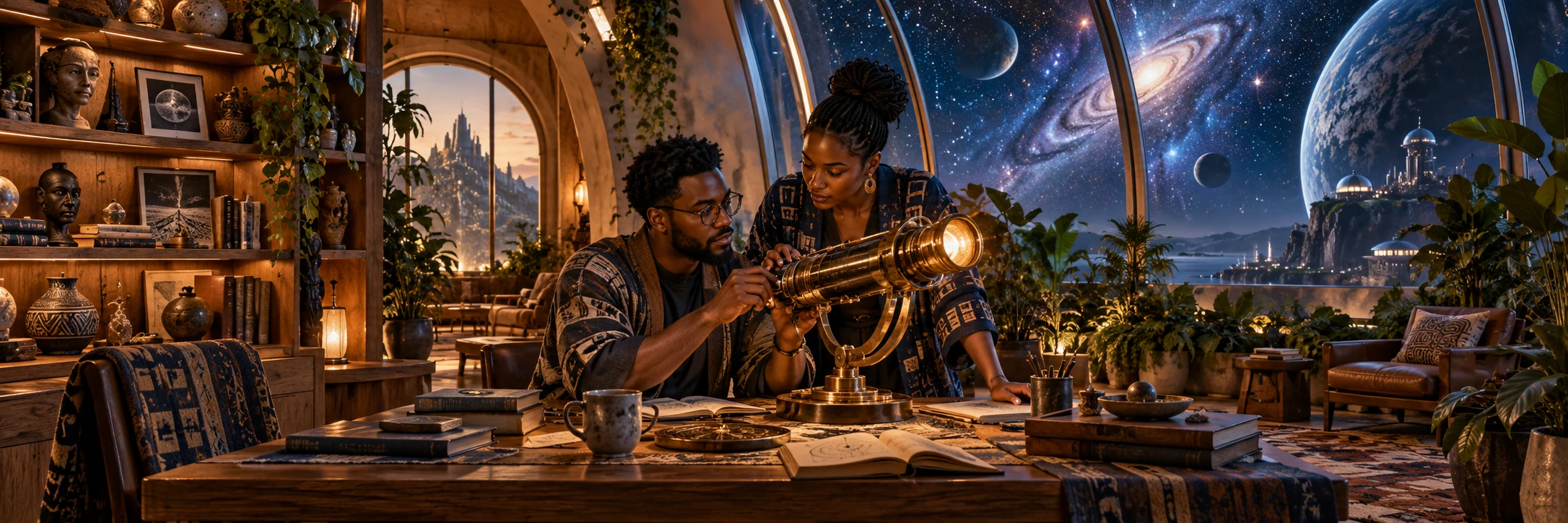
The original banner imagines a community observatory rather than a distant empire: two Black adults work beside an archive, plants and an open view of the cosmos. Warm domestic objects sit against cool celestial light. These invented details suggest that a future can preserve relationships and memory while changing its tools. They do not represent a specific African culture or a documented Afrofuturist artwork.
Begin with agency rather than a costume
Afrofuturism is not a recipe consisting of a Black portrait, metallic jewellery and a purple nebula. Such an image might be visually appealing yet tell us very little about the world its subject inhabits. A stronger reading asks what the person can decide, what they know and what conditions they are trying to change.
The Smithsonian’s overview treats Afrofuturism as a field extending across many creative forms. Its breadth matters: a musical performance, a speculative novel and a designed room do not have to share one surface appearance to participate in a conversation about Black futures. Treating the term as a fixed colour scheme makes that conversation unnecessarily small. [1]
For a visual project, write a premise before collecting motifs. Perhaps an observatory belongs to its neighbourhood, an archive accepts oral histories, or an ordinary kitchen connects several generations. Each premise creates useful design decisions. Who enters, who maintains the equipment, and what remains within reach of a child?
Past and future can occupy the same room
The Met’s installation Before Yesterday We Could Fly responds to Seneca Village, a predominantly Black community displaced in 1857 during the creation of Central Park. The installation imagines possibilities beyond that historical rupture. Its domestic setting brings objects and creative work from different times into a speculative relationship. The museum explicitly describes the room as a constructed space, not an authentic surviving interior. [2]
That distinction offers a practical lesson. Research can establish what happened; imagination can propose what might have happened. Put the boundary where a reader can see it. An invented future is more interesting when it has a considered relationship with history, rather than using an unexplained antique as a shortcut to depth.
Try reading any speculative room through three objects: something inherited, something repaired and something not yet available. Their coexistence can make time legible without a wall of exposition. The point is not to make every object symbolic, but to let a few choices carry a coherent story.
There is more than one way to picture possibility
In its discussion of Cauleen Smith’s video Sojourner (2018), the Smithsonian American Art Museum connects speculative practice with rethinking power, social relations and possible futures. This provides a useful route beyond the assumption that futurity must look like expensive hardware. Film, sound, gathering and landscape can also organise an imaginative proposal. [3]
Avoid describing Africa as a single undifferentiated store of patterns. Name a specific source when using a documented textile, architectural form or historical object. If you do not have that knowledge, invent a pattern and say so. An attractive synthetic motif does not acquire cultural authenticity because a prompt calls it ancestral.
Artists may use Afrofuturism differently, and not every Black artist working with technology adopts the label. Discuss a particular work and its stated context before assigning an entire career to a category. Categories should help us look more closely, not decide in advance what every work must mean.
Look closely at our invented observatory
The banner’s contrast between a warm inhabited foreground and a cool expansive distance gives the scene two scales. People and objects make the room usable; the sky supplies possibility. The figures should remain participants in the scene rather than decorative proof that the image belongs to a category.
This is also a useful test for generated images. Inspect hands, instruments, shelves and pathways. A beautiful control panel that nobody can reach weakens the story of agency. A room with no place to sit may express spectacle more clearly than community. Revise the arrangement before asking for additional ornaments.
Make a future with a reason to exist
Choose one everyday activity—cooking, learning, repairing or remembering—and imagine who could do it differently in your proposed world. Create a small scene around that change. Keep a short note separating researched references from invented elements, and explain the people’s role in a caption.
After generating or drawing, remove the cosmic background in your mind. Does the scene still express a relationship worth considering? If it does, the future has begun to become a place rather than a filter.
A small poetic detour
Original words from the AOI studio.
Poetry
The archive opens toward the stars.
Someone has brought a chair
for the person who remembers.
The prompt workshop
Original creative exercises. These prompts create new illustrations, not documentary evidence.
Start with a lived space
Invent a neighbourhood observatory with Black adult researchers, an oral-history archive, comfortable shared seating and a garden. Show a coherent everyday activity. Warm interior, cool cosmic distance; original designs, no lettering.
Original AOI exercise; a generated image is not historical or documentary evidence.
Build the social world
Design three related scenes from the same fictional community: repairing equipment, sharing a meal and recording a memory. Keep the architecture and objects consistent. Explain who owns and maintains the technology.
Original AOI exercise; a generated image is not historical or documentary evidence.
Test the premise
Rework the observatory without stars or spectacular machinery. Preserve the relationships between people, inherited objects and new tools. Evaluate whether the idea remains readable.
Original AOI exercise; a generated image is not historical or documentary evidence.
People & works to explore
References discussed in this article. Consult the sources below for context.
Artists and practitioners
Cauleen Smith — filmmaker discussed in the Smithsonian source
Hannah Beachler — designer and lead curator of The Met’s Afrofuturist period room
Paintings and other works
Cauleen Smith, Sojourner (2018)
Before Yesterday We Could Fly: An Afrofuturist Period Room — collaborative installation at The Met
Sources and further exploration
[1] Smithsonian National Museum of African American History and Culture — Afrofuturism
[2] The Met — Before Yesterday We Could Fly: An Afrofuturist Period Room
[3] Smithsonian American Art Museum — Beyond Afrofuturism with Artist Cauleen Smith
Creative studies to try
Explore these collected prompts as creative interpretations. They are starting points for image-making, not reproductions of historical artworks or evidence about a tradition.
Visual cues: speculative world-building, machine mythology, era-specific futures
Study 1 — Afrofuturism
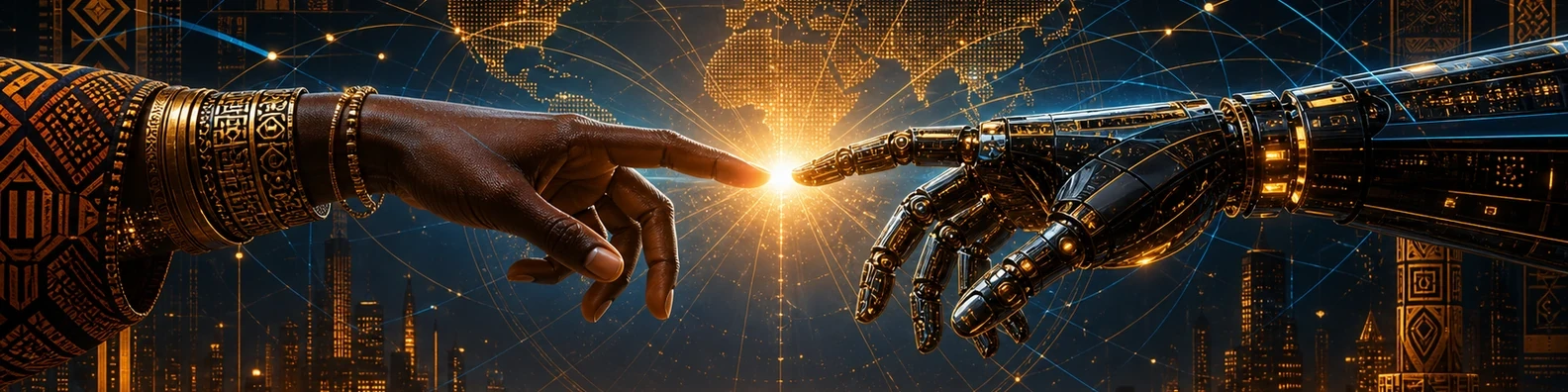
Ultra-wide panoramic banner, a human hand and a sleek robotic hand reaching toward each other, fingertips almost touching, a bright luminous spark of intelligence between them, a subtle world map behind them with global data network lines, symbolizing human-AI collaboration and digital transformation, rendered in Afrofuturism style, with advanced technology atmosphere, glowing interfaces, luminous data streams, cinematic depth, high quality, high detail, balanced composition, no text, no logo, no watermark, exact aspect ratio 1584:396
Prompt source: 1001 Art Styles. Select the text to copy, then adapt the subject and composition.