
Visual culture · Three meanings compared
Futurama can send a conversation in several directions: an animated comedy, a spectacular exhibition at the 1939 New York World’s Fair, or a mistaken reference to Futurism. These subjects all invite thoughts about the future, but they have different makers, purposes and histories. Keeping them distinct makes each more interesting.
A closer look
Ask what kind of image you are looking at before assigning a style: a character-led animation frame, a model of a proposed city, or an artwork associated with a historical movement. A shared interest in machines does not make them the same subject.
The animated series
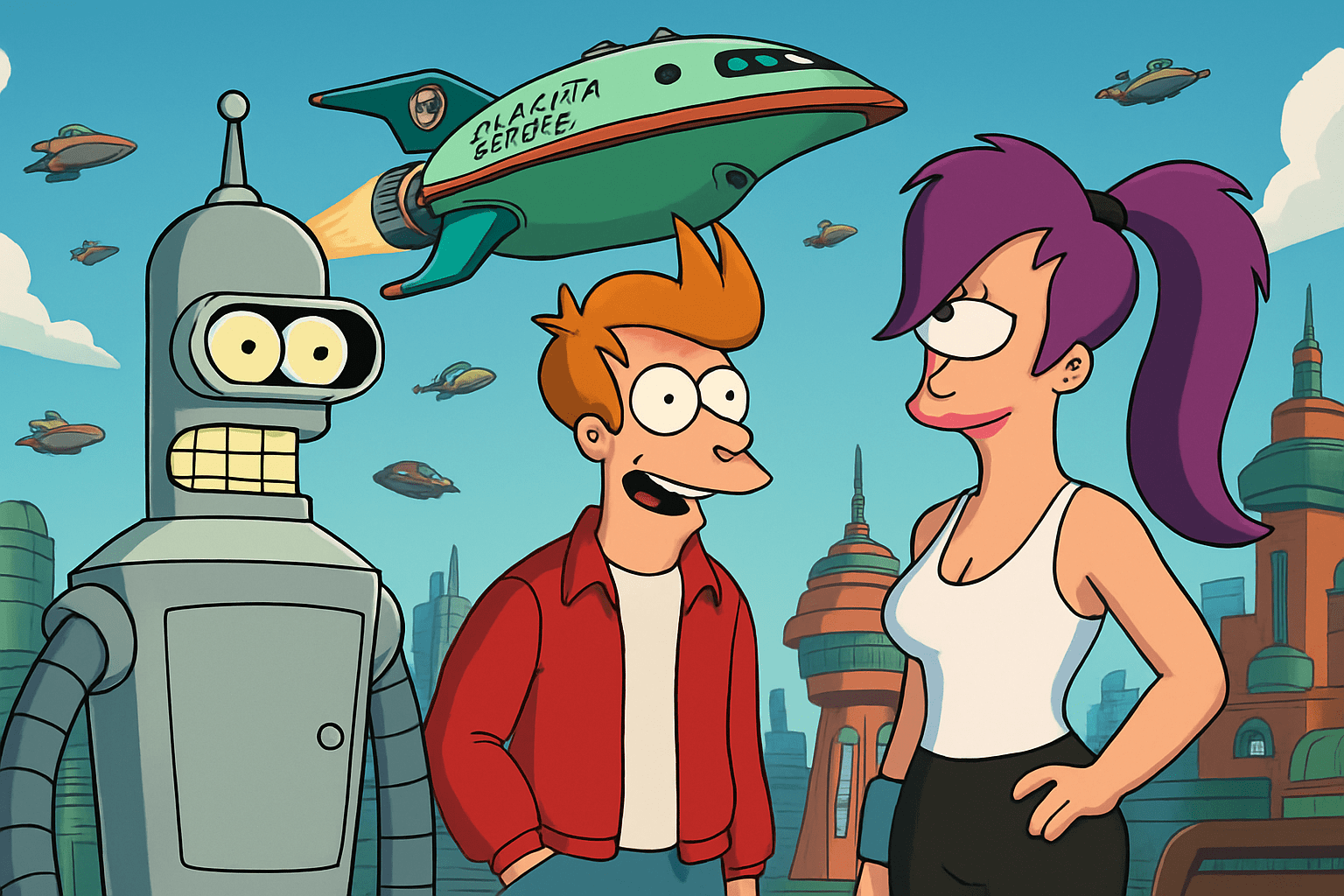
Hulu credits Matt Groening as the creator of Futurama and Groening and David X. Cohen with its development. Its premise follows a man frozen in 1999 who awakens on the eve of the thirty-first century. That setting provides room for imagined technology, unfamiliar creatures and recognizable everyday frustrations. The series is an animated science-fiction comedy, not a movement in early twentieth-century painting.
For a design exercise inspired by that broad idea, study how a character’s silhouette can remain clear inside a busy imagined city. Give an original figure a simple outline and choose background details that support the action. There is no need to invent paintings by fictional characters or present them as real art-history examples. The illustration on this page relates to the series, not to the World’s Fair.
The 1939 exhibition
The Harry Ransom Center documents Norman Bel Geddes’s Futurama design for General Motors at the 1939 New York World’s Fair. Its account emphasizes the combination of architecture and theatrical presentation. The New School Archives also identifies the General Motors commission and its designers. Here the name belongs to an exhibition presenting an imagined future environment, rather than to the later television program.
When looking at records of such an exhibition, ask how the viewpoint guides the visitor. A model city viewed from above turns roads, buildings and landscape into a persuasive overview. That is a design decision: a future presented as a coherent plan feels different from a city encountered through an individual character’s mishaps. This comparison concerns how images persuade, not a claim that both projects share one artistic doctrine.
Futurism is a different term
MoMA’s exhibition Words in Freedom: Futurism at 100 identifies F. T. Marinetti’s first Futurist manifesto with 1909. It describes a movement engaging with industry, machines and war. Those historical commitments require more care than a cheerful label for anything futuristic. Calling every robot illustration Futurist would erase the distinction between a subject matter and a specific movement.
Keep three labels in your notes: series, exhibition and movement. When making your own image, choose the design problem you actually want to explore. It might be the clarity of an invented cartoon cast, the organization of an imagined city model, or an abstract arrangement suggesting motion. The prompt workshop offers original exercises along those lines without claiming that their results are authentic historical works.
Pocket-sized facts
Futurama the series was created by Matt Groening and developed by Groening and David X. Cohen.
The 1939 Futurama exhibition was a General Motors project associated with Norman Bel Geddes.
Futurism’s 1909 manifesto belongs to a distinct historical movement.
The prompt workshop
Original creative exercises. These prompts create new illustrations, not documentary evidence.
An original comic future
An original animated-comedy concept illustration of a forgetful lunar courier and a polite three-legged service robot at a tiny orbital post office, simple readable silhouettes, clean outlines, limited bright colors, a gently absurd everyday problem. Invent new characters; no recognizable franchise cast, logos or text.
A model of tomorrow
An original exhibition-model illustration of an imagined future town, viewed from an elevated visitor walkway, carefully organized roads, gardens and small buildings, warm display lighting and visible model-making materials. Present it as a contemporary speculative design, not a reconstruction or archival photograph of the 1939 exhibit.
Motion without a franchise
An original abstract study of a cyclist’s movement using repeated angular planes, overlapping wheel arcs and a restricted charcoal, cream and red palette. Explore rhythm and direction as a contemporary exercise; do not attribute the result to a historical artist or claim it is an authentic Futurist work.
A small poetic detour
Tomorrow takes a seat.
A model city hums below;
The robot misses lunch.
A smile from the studio
The city of tomorrow was perfectly planned. Nobody had included a place to lose your keys.
Look closer
Explore the image gallery
Select an image to enlarge it. Browse with the arrows, and press Escape to return.
Your next inspiration
Discover another art style
Follow a visual thread to the next subject.

A playful carnival of digital icons
A heart becomes a balloon, a message bubble becomes a ticket booth, and a tiny face joins the parade.


Golden Hour Photography
Golden hour is useful because the direction and color of low sunlight can transform an ordinary subject.