
Paper construction technique
A papercut diorama creates a scene from cut paper arranged at different depths. Overlapping silhouettes, gaps between planes and cast shadows turn flat sheets into a miniature spatial story.
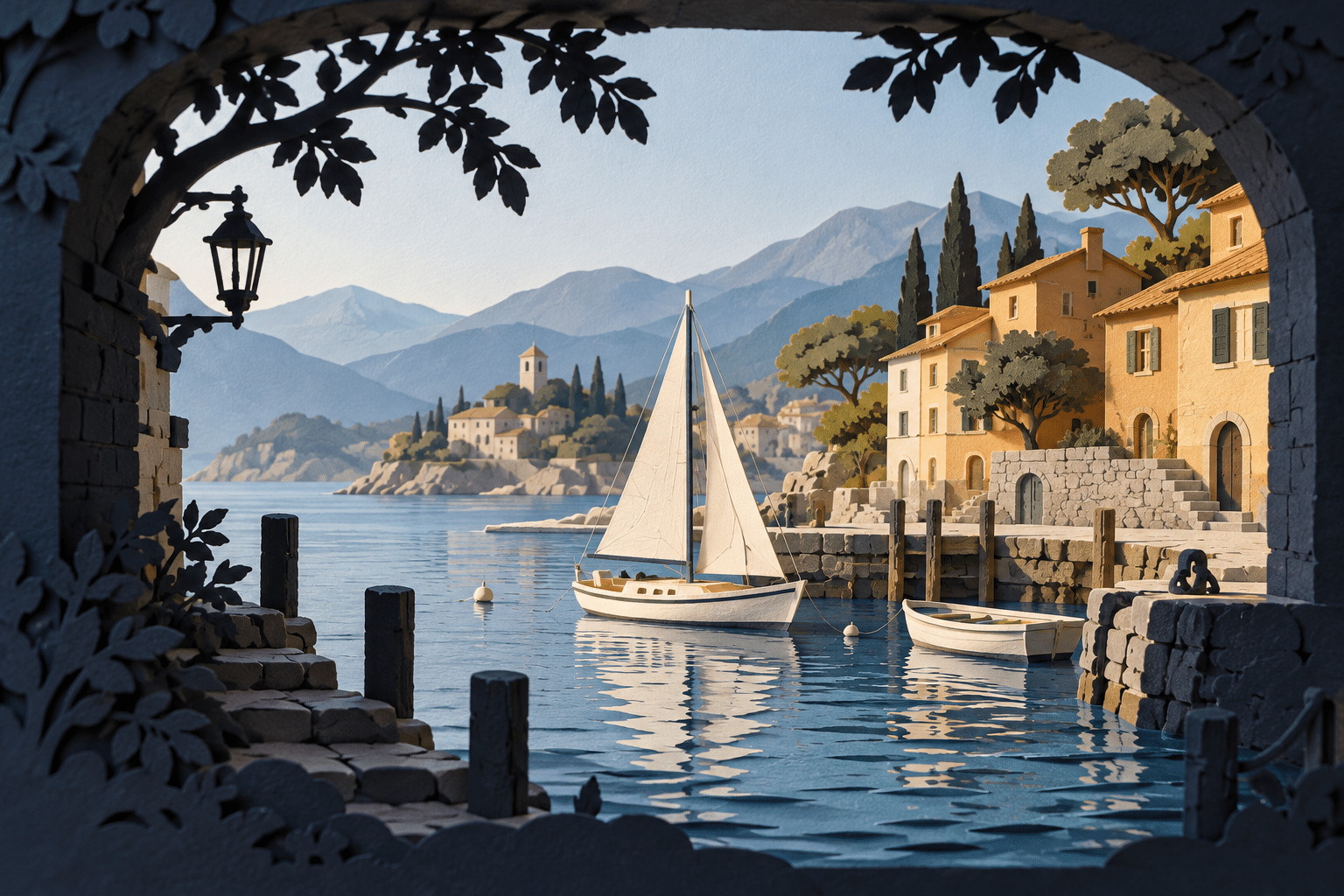
A visual introduction
Original AI-generated interpretations of paper construction. These images are visual studies, not photographs of handmade objects or tested cutting templates.
Select an image for a closer look. Use the thumbnails, arrow keys or a swipe to compare examples. Zoom in to inspect details, or share the image that inspires you.
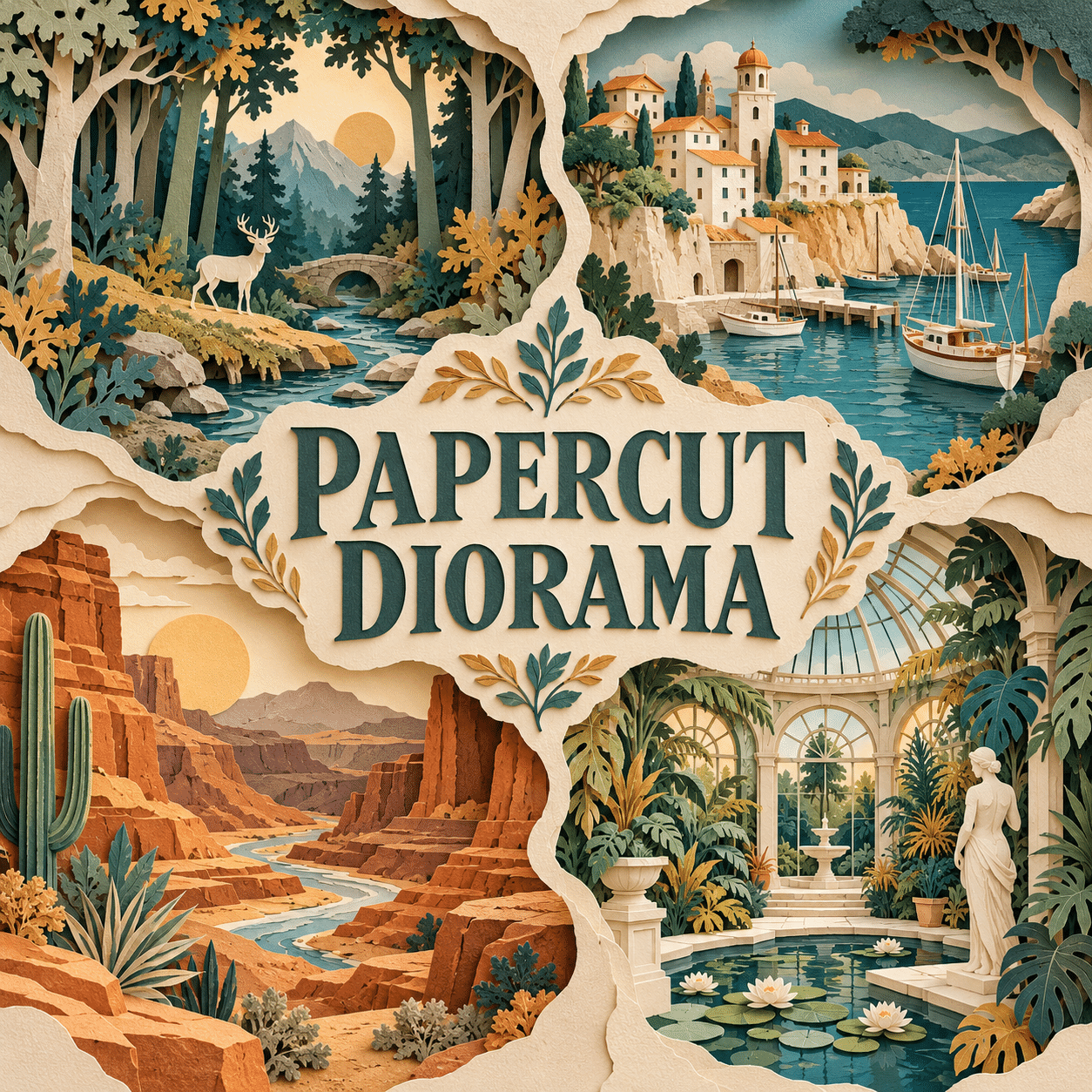
Creative toolbox · take this style further
Choose an input and a destination. Search sends your words to the chosen site; Copy & open puts them on your clipboard to paste there.
Create with AI
Turn your chosen input into an image prompt or a new creative direction.
ChatGPT
Copy your input and paste it into a ChatGPT conversation or image request.
Copy & open ChatGPT (new tab)Claude · Anthropic
Develop an image prompt or explore the style in a new Claude conversation.
Copy & open Claude · Anthropic (new tab)Midjourney
Paste your input into the Imagine bar on the Create page.
Copy & open Midjourney (new tab)Adobe Firefly
Copy your input, open Firefly, and paste it into the prompt field.
Copy & open Adobe Firefly (new tab)Leonardo.Ai
Copy your input, open Leonardo, and paste it into the generation field.
Copy & open Leonardo.Ai (new tab)Image search
Find visual references. Short, concrete keywords usually work best.
Lexica
Search AI images and prompts using your selected input.
Search with this input Lexica (new tab)Pexels
Search the photo and video library. Short keywords often work best.
Search with this input Pexels (new tab)Pixabay
Search photos, illustrations and other images.
Search with this input Pixabay (new tab)Unsplash
Search photographs using the style name or your own keywords.
Search with this input Unsplash (new tab)Wikimedia Commons
Search photographs, artworks and historical images. Check each file for its source and reuse terms.
Search with this input Wikimedia Commons (new tab)Art & research
Explore artists, collections and the ideas behind a style.
Wikipedia
Search for background reading. A style may not have its own article.
Search with this input Wikipedia (new tab)WikiArt
Copy your input into WikiArt’s search to explore artists and artworks.
Copy & open WikiArt (new tab)Europeana
Paste your keywords into the search to explore European museum, library and archive collections.
Copy & open Europeana (new tab)Inspiration
Discover portfolios and visual ideas from creative communities.
Instagram hashtags
Search a hashtag made from your input: spaces and punctuation are removed. Instagram may require sign-in.
Search with this input Instagram hashtags (new tab)ArtStation
Paste your input into artwork search for concept art, environments, characters and visual development.
Copy & open ArtStation (new tab)Behance
Paste your input into project search for illustration, design and visual storytelling.
Copy & open Behance (new tab)A closer look
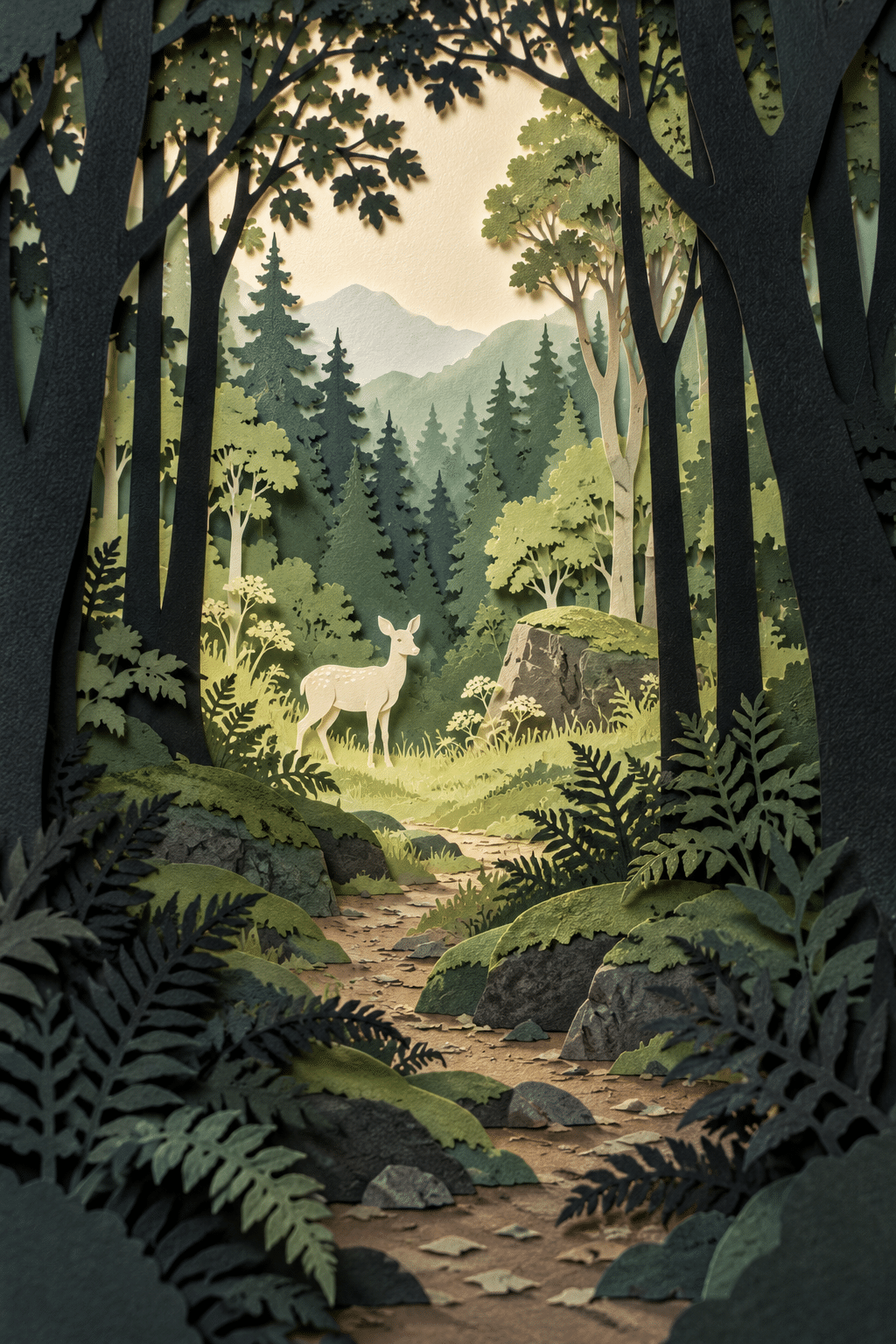
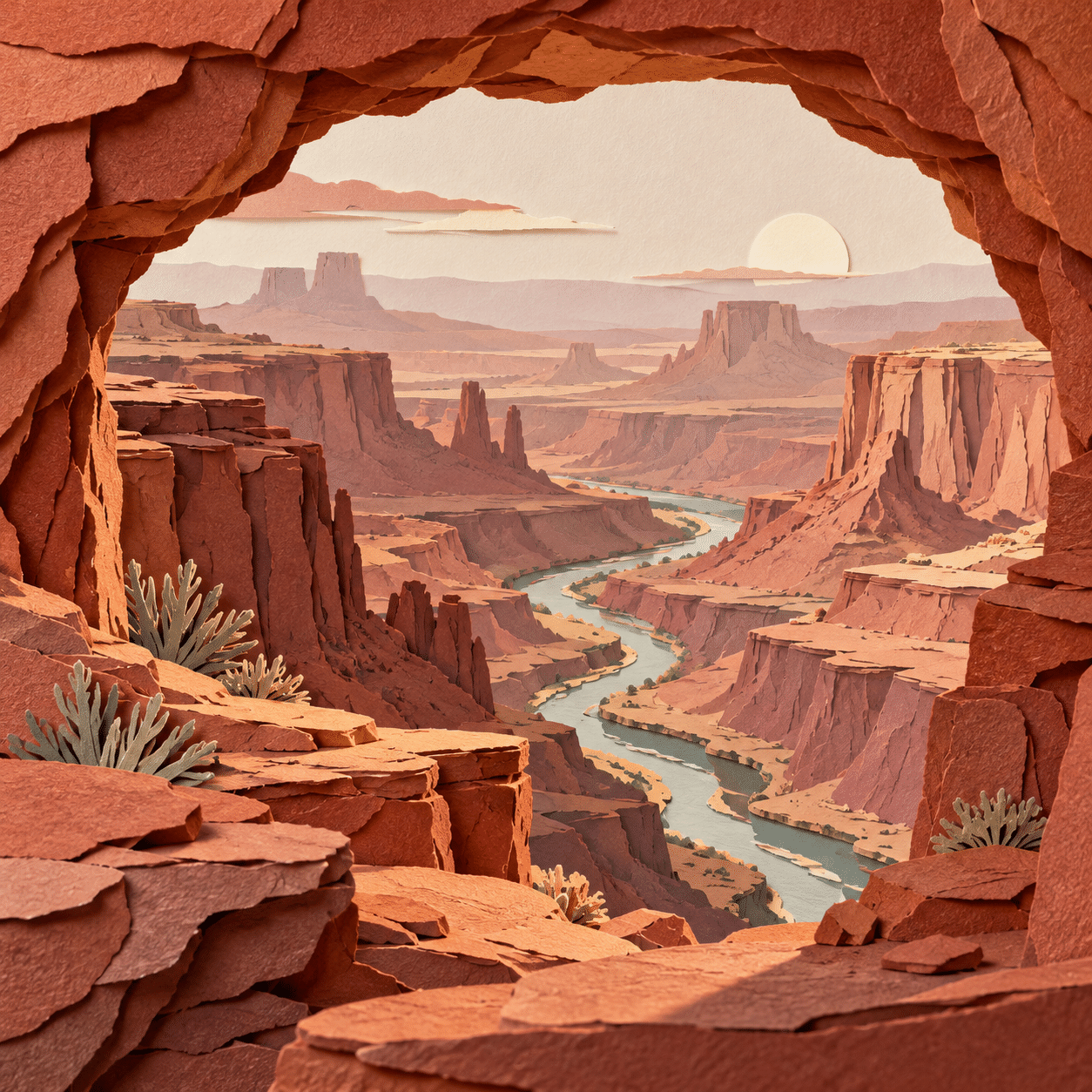
Foreground frames, middle-distance subjects and a quieter background create depth through layered edges, changing scale and controlled light. Paper remains visibly thin even when the imagined world feels expansive.
A scene made from planes
The defining decision is how to divide a scene into layers. A foreground arch might frame a boat, with reeds behind it and a distant hillside on the back panel. Each sheet remains relatively flat, but their spacing and overlap create a view into depth. A box or frame can contain the scene, although the format need not be enclosed.
Papercut diorama is a descriptive category, not one historically unified movement. Paper peepshows offer a useful related tradition. The V&A describes front and back panels with cut-out prints between them, often joined by collapsible bellows. Those objects show how a sequence of flat scenes can become an intimate spatial experience. A contemporary fixed shadow box uses related principles without being the same object.
Give every layer a job
Start by identifying the scene’s focal relationship. A tiny figure crossing a bridge needs a readable gap beneath the bridge and a background that does not swallow the figure. Assign the strongest framing shapes to the front, the principal action to the middle and the broadest quiet masses to the back. This creates a hierarchy before decoration is added.
Do not put a complete illustration on every sheet. Layers should reveal and conceal one another. A large opening in the front can be more useful than intricate cutting everywhere. Repeated branches or arches can lead the eye inward, but vary their intervals and avoid placing every important contour directly behind another.
Color and light make the depth legible
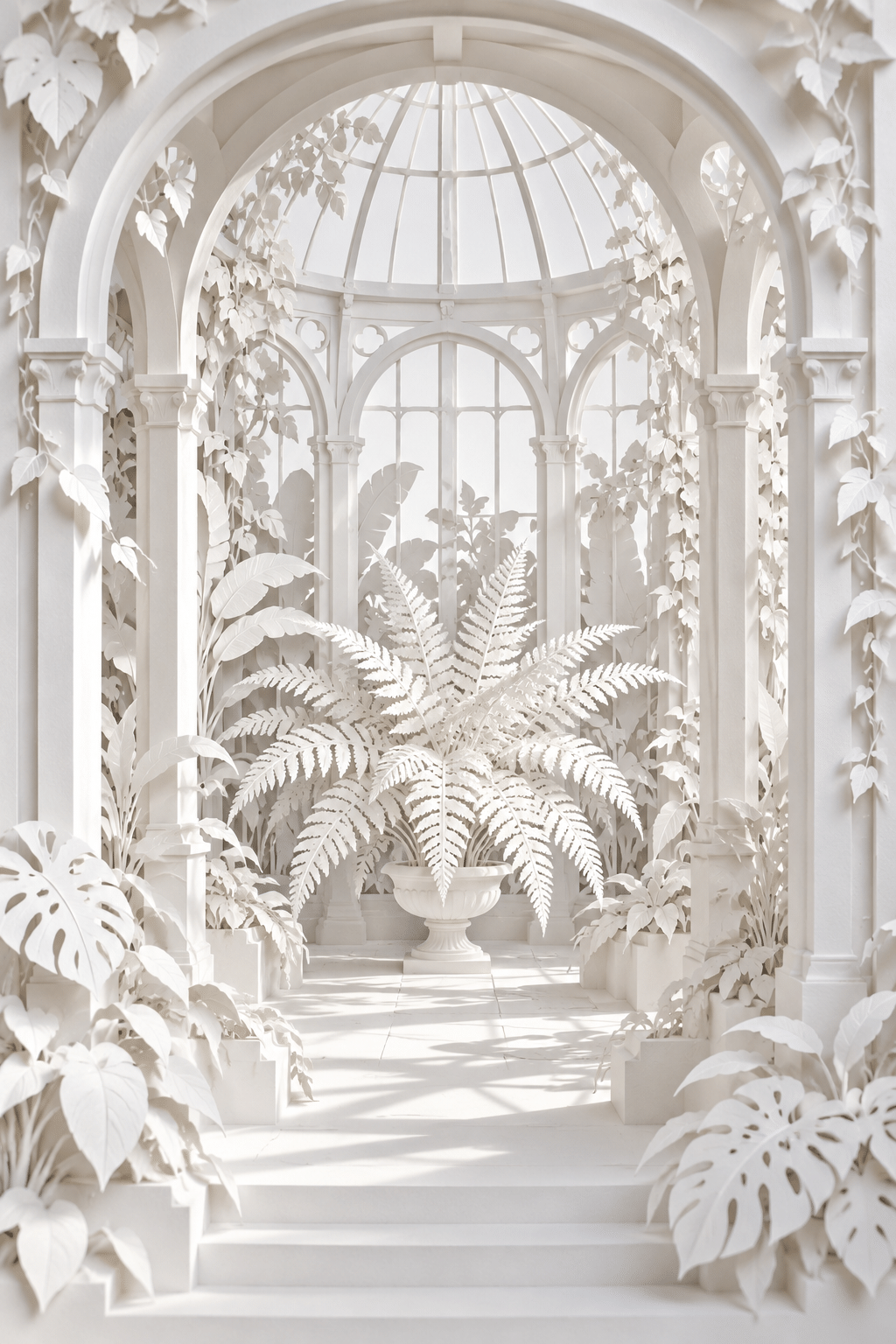
Color can separate planes through value, temperature or saturation. A dark foreground against a lighter distant opening produces a clear silhouette. A monochrome construction can be equally effective because shadows distinguish the sheets. The palette should support the intended atmosphere rather than merely assign a different bright color to each layer.
Side light makes spacing visible through cast shadows. Very frontal light can flatten the construction, while a strong backlight can turn it into a silhouette theatre. Choose the lighting as part of the design. In a generated image, request thin paper edges and believable gaps; thick stone-like slabs or melted transitions undermine the material idea.
Construction begins before cutting
Sketch the layers separately and check them as an assembled view. Keep narrow bridges of paper wide enough to support the surrounding shape. Decide how sheets attach to the frame or spacers, and hide joins where they will not interrupt the image. A design that looks elegant from the front can still be impossible to assemble if every delicate form floats unsupported.
For a physical study, begin with a few sturdy layers and test the effect of different spacing before committing to fine detail. Shadows change when the sheets move farther apart. The V&A’s paper-peepshow activity, designed by Clare Bryan, is a useful practical reference for layered construction. It is a starting point for understanding structure, not a template for every diorama.
Distinct from a freestanding paper sculpture
A diorama usually privileges a scene and a viewing direction. A freestanding 3D papercut instead asks the viewer to read a volume from several sides. Some works combine both, but the distinction helps when planning: are you building an image through depth, or an object that occupies space?
This page’s generated studies should be read as proposals for layered scenes. They do not prove that every visible cut is structurally supported or that a particular paper thickness will work. If you intend to build a design, translate the image into separate layer drawings and make a small test. A beautiful rendering is not a fabrication plan.
Prompt vocabulary and useful variations
Describe the subject, number or hierarchy of layers, foreground opening, focal plane, paper surface and light direction. A layered tidal pool with a dark cut-paper reef framing a pale distant opening gives more useful guidance than an ornate paper masterpiece. Specify no lettering unless typography has a clear role.
Try the same scene in two palettes or with the light coming from opposite sides. Then change the viewpoint slightly and inspect which edges merge. A strong diorama preserves its central relationship while rewarding a closer look. The pleasure comes from a small number of carefully coordinated planes, not simply from maximum intricacy.
A small poetic detour
Original words from the AOI studio.
Poetry
A World Between the Sheets
One branch stands near, one hill waits far,
a boat slips through a paper bay.
The space between two quiet sheets
holds more than either edge can say.
A little light enters the frame;
the flat world learns another name.
The prompt workshop
Original creative exercises. These prompts create new illustrations, not documentary evidence.
A small woodland
Create an original papercut diorama of a woodland path, three to five visibly thin paper planes, dark foreground trunks framing a pale clearing, matte paper and soft side-light shadows, no text.
A miniature harbor
Create an original layered paper harbor scene with a foreground arch, small boat in the middle and distant houses on the back panel. Deliberate cut edges, believable spacers and restrained blue-cream palette; a design interpretation, not a cutting template.
Depth without color
Create an original all-white papercut diorama of an imaginary botanical conservatory. Let overlapping planes, broad openings and cast shadows carry depth, with one clear central plant silhouette and no lettering.
A smile from the studio
Jokes
The paper forest asked for more depth. The artist moved the back row two centimeters away.