
Photographic tool and spatial technique
A wide-angle lens records a broad field of view. Its expressive value comes from how you arrange near and far, choose a camera position, and make the surroundings matter.
A visual introduction
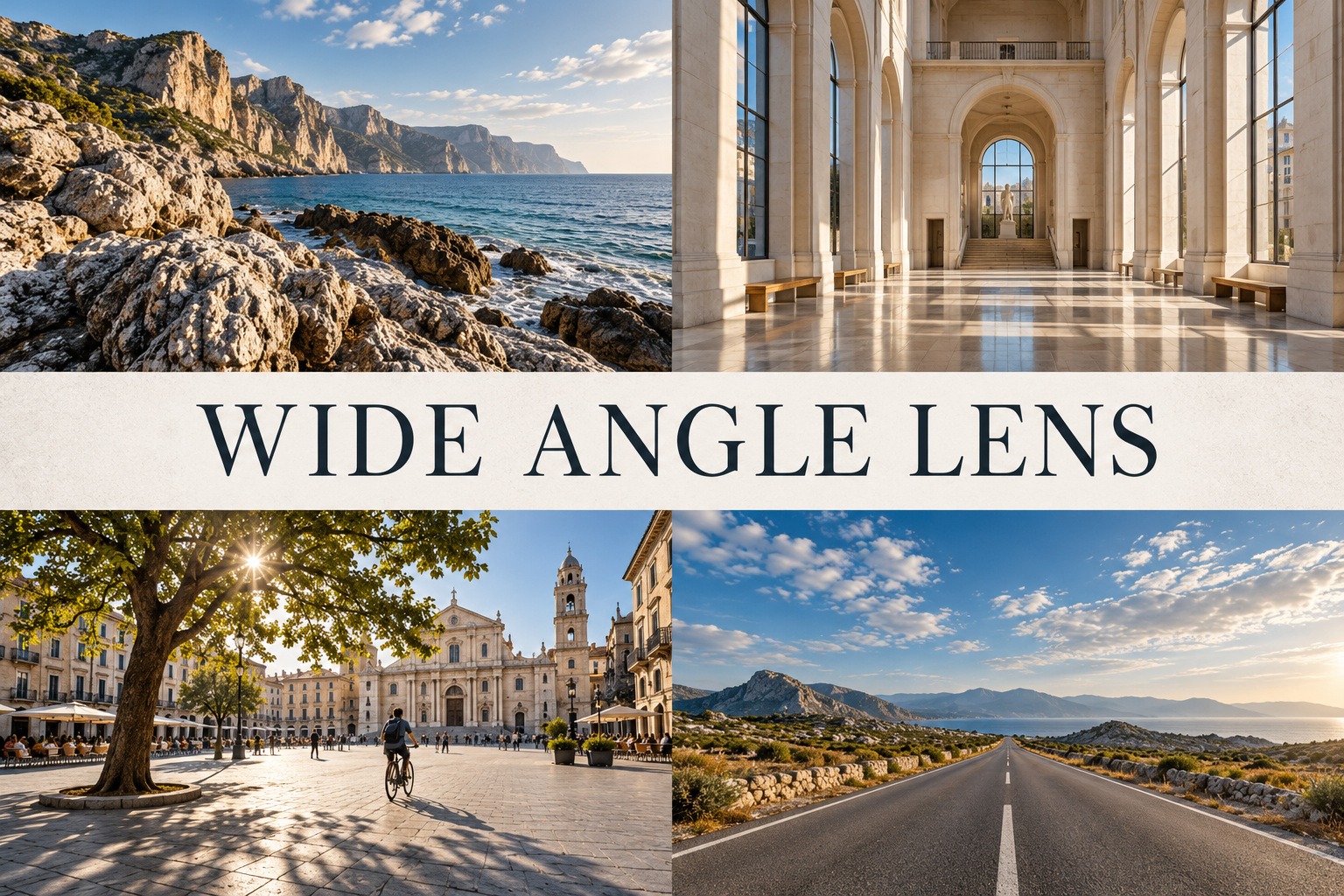
Compare the dedicated banner, central-title collage and three distinct examples. Captions identify new generated studies and retained earlier AOI illustrations.
Select an image for a closer look. Use the thumbnails, arrow keys or a swipe to compare examples. Zoom in to inspect details, or share the image that inspires you.

Creative toolbox · take this style further
Choose an input and a destination. Search sends your words to the chosen site; Copy & open puts them on your clipboard to paste there.
Create with AI
Turn your chosen input into an image prompt or a new creative direction.
ChatGPT
Copy your input and paste it into a ChatGPT conversation or image request.
Copy & open ChatGPT (new tab)Claude · Anthropic
Develop an image prompt or explore the style in a new Claude conversation.
Copy & open Claude · Anthropic (new tab)Midjourney
Paste your input into the Imagine bar on the Create page.
Copy & open Midjourney (new tab)Adobe Firefly
Copy your input, open Firefly, and paste it into the prompt field.
Copy & open Adobe Firefly (new tab)Leonardo.Ai
Copy your input, open Leonardo, and paste it into the generation field.
Copy & open Leonardo.Ai (new tab)Image search
Find visual references. Short, concrete keywords usually work best.
Lexica
Search AI images and prompts using your selected input.
Search with this input Lexica (new tab)Pexels
Search the photo and video library. Short keywords often work best.
Search with this input Pexels (new tab)Pixabay
Search photos, illustrations and other images.
Search with this input Pixabay (new tab)Unsplash
Search photographs using the style name or your own keywords.
Search with this input Unsplash (new tab)Wikimedia Commons
Search photographs, artworks and historical images. Check each file for its source and reuse terms.
Search with this input Wikimedia Commons (new tab)Art & research
Explore artists, collections and the ideas behind a style.
Wikipedia
Search for background reading. A style may not have its own article.
Search with this input Wikipedia (new tab)WikiArt
Copy your input into WikiArt’s search to explore artists and artworks.
Copy & open WikiArt (new tab)Europeana
Paste your keywords into the search to explore European museum, library and archive collections.
Copy & open Europeana (new tab)Inspiration
Discover portfolios and visual ideas from creative communities.
Instagram hashtags
Search a hashtag made from your input: spaces and punctuation are removed. Instagram may require sign-in.
Search with this input Instagram hashtags (new tab)ArtStation
Paste your input into artwork search for concept art, environments, characters and visual development.
Copy & open ArtStation (new tab)Behance
Paste your input into project search for illustration, design and visual storytelling.
Copy & open Behance (new tab)A closer look
Read the foreground first, follow its connection into the distance, then inspect the edges: a successful wide view gives each part a reason to be there.
What makes a lens wide-angle?
Wide angle describes an optical field of view, not an art movement or a fixed color treatment. For the same sensor format, a shorter focal length generally includes a wider angle. The familiar labels 24 mm, 28 mm and 35 mm mean different coverage on different sensor sizes; compare equivalent fields of view rather than numbers alone. Nikon’s focal-length guide illustrates this relationship. A broad frame can connect a person to a workplace, explain an interior, or give a landscape a strong foreground.
The useful creative question is what the wider surroundings contribute. A room full of unrelated furniture can be less informative than a carefully chosen corner. A dramatic sky can overwhelm the person whose story the image is supposed to tell. Wide-angle composition asks for selection inside a generous frame: identify the subject, the supporting space, and the visual route between them.
Viewpoint creates the near–far relationship
Perspective depends on camera position. Moving close to a rock makes it large relative to distant cliffs; using a broad view lets both fit. Changing focal length from the same position changes framing, while moving the camera changes relative spatial relationships. This distinction matters when comparing images described as “wide-angle exaggeration.” Cambridge in Colour’s tutorial explains the camera-distance mechanism; Canon’s interactive examples pair focal length with subject distance.
Try an AOI observation exercise with a mug and a distant doorway. Make one view from close to the mug and another from farther back, keeping the doorway visible. Compare the mug’s apparent size against the doorway. Then remain still and change only the framing. Label the two comparisons separately. The goal is to recognize which decision changed the relationship, rather than credit every difference to the lens name.
Straight lines, curved lines and stretched edges
Rectilinear and fisheye lenses use different projections. A rectilinear design aims to keep straight scene lines straight; a fisheye deliberately allows pronounced curvature to include an exceptionally broad view. Nikon’s account of its fisheye designs provides historical and optical context. Neither projection is inherently more artistic. Choose the spatial behavior that serves the picture, and name it accurately in a prompt or caption.
Converging verticals from tilting a camera upward are a perspective effect, distinct from optical barrel distortion. A level camera can reduce that convergence in an architectural view. Edge expansion in a very broad rectilinear image can also make faces or nearby furniture look stretched even where straight lines remain straight. Inspect curvature, convergence and apparent proportion separately; “distortion” is too vague to diagnose all three.
A usable visual grammar
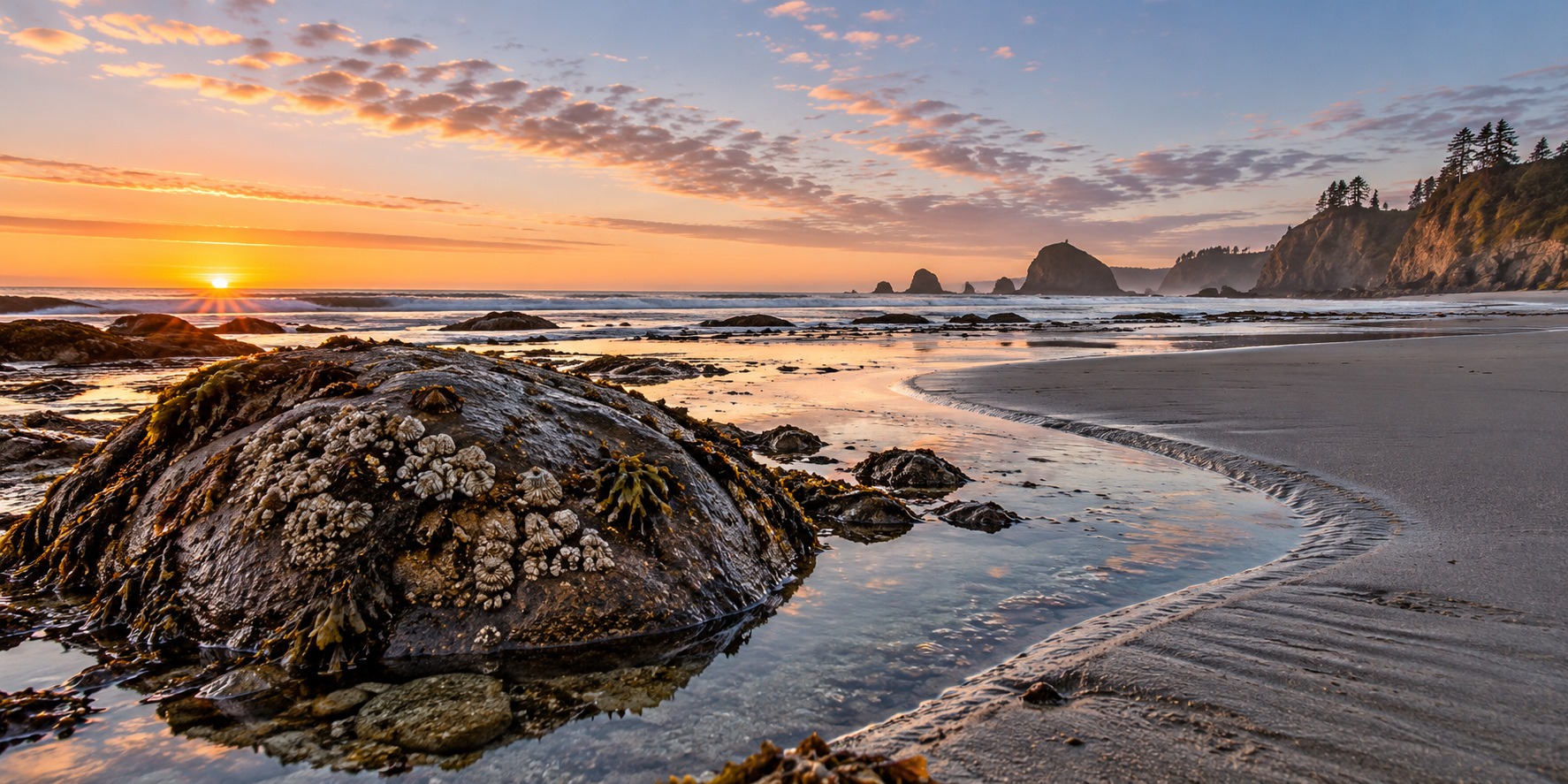
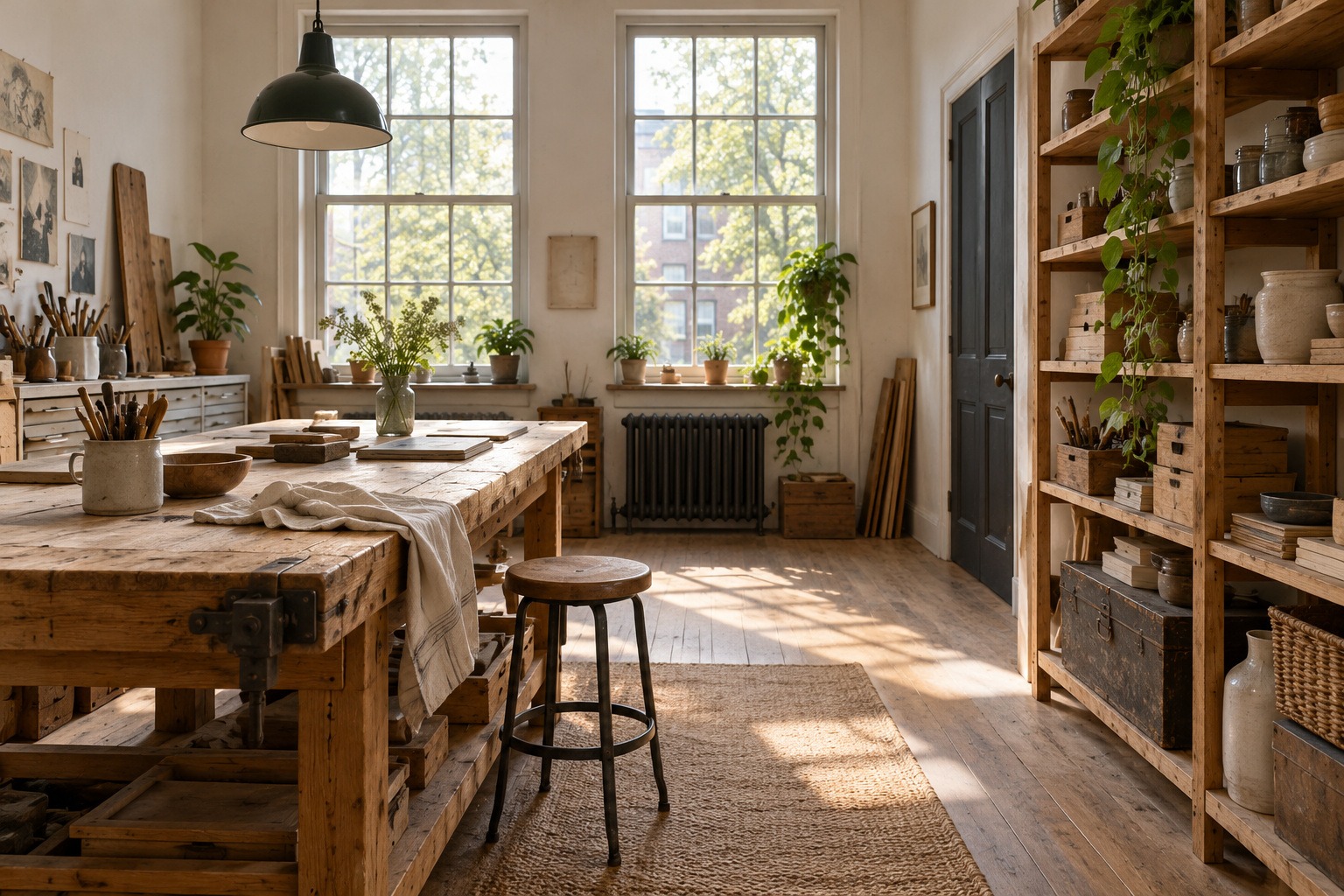
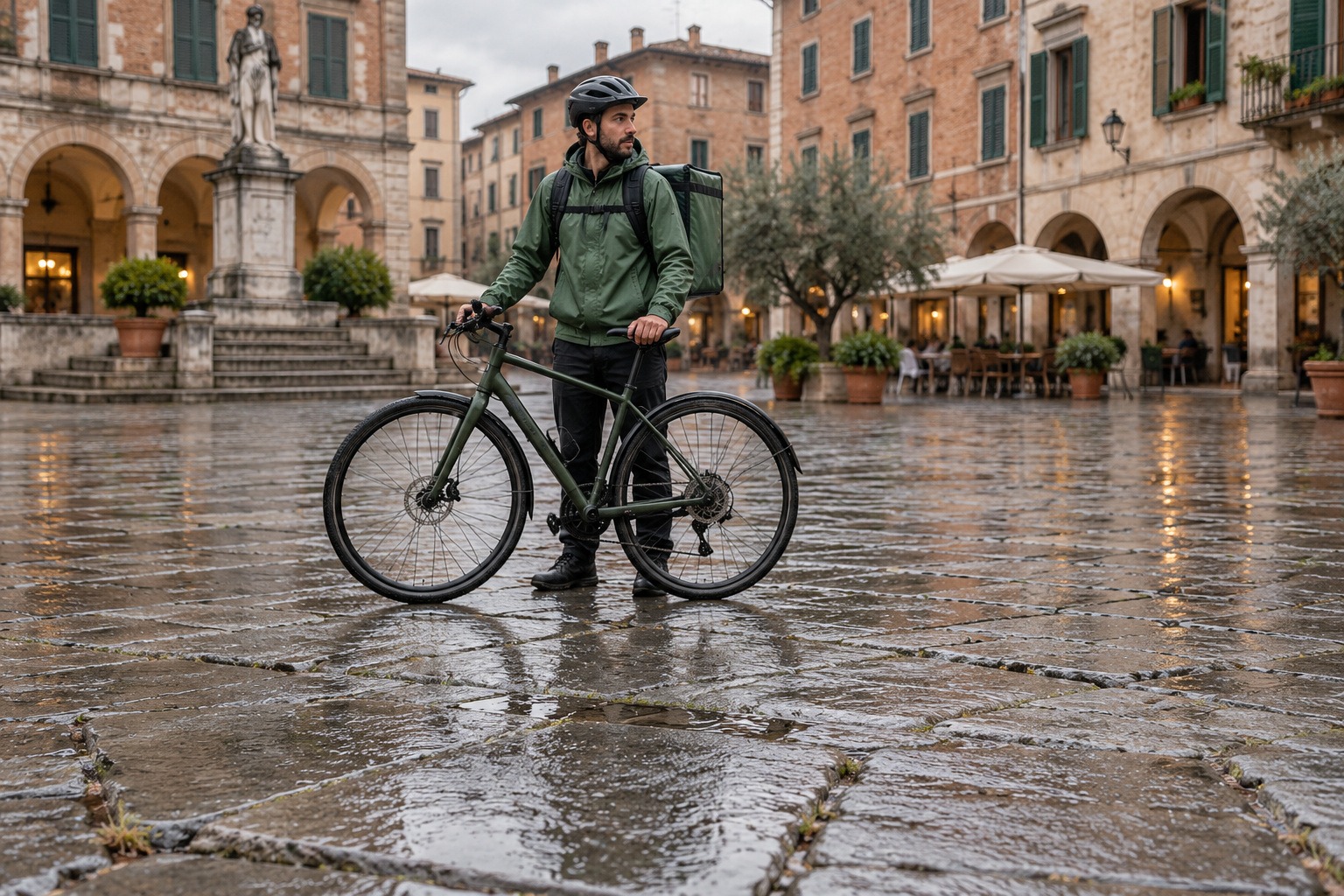
For this guide’s coastal banner, the large foreground rock acts as an entry point and the shoreline carries attention toward smaller distant forms. The workshop uses a table as a spatial bridge. The courier study keeps the person near the center while leaving enough square around them to explain the setting. These are different compositional jobs, not interchangeable examples of maximum width.
Build a frame around one dominant relationship: foreground and horizon, person and workplace, or doorway and room. Keep important overlaps legible. A table edge should not appear to grow from someone’s shoulder, and a nearby post should not split the main face. Scan all four corners before accepting an image. The wider frame offers more opportunities for both useful context and accidental distractions.
Light, palette and focus
There is no required wide-angle palette. The same spatial arrangement can work in neutral daylight, restrained monochrome, or saturated evening color. Decide which area carries the strongest contrast, then check whether bright windows, lamps or sky pull attention away from it. In an interior, a believable relation between window light and shadow is usually more persuasive than indiscriminate brightness.
A broad field of view does not guarantee that every distance is sharp. Aperture and focus choices still matter; Nikon’s aperture guide explains how the opening affects the apparent sharp range. For a practical study, make the intended sharp area explicit and inspect both the nearest object and the background. In AI images, a phrase such as “readable near and far detail” expresses an intention, not measured optical performance.
An original three-pass workshop
First make a simple view with one nearby object and one distant landmark. Ask whether their relationship can be understood at thumbnail size. Next add a middle-distance element that connects them: a path, workbench or line of trees. Finally remove one distracting object. This subtraction pass often improves the result more than asking for additional detail.
For an environmental portrait, keep the person’s face and hands comfortably inside the frame and choose a setting that conveys an activity. Review body proportions, furniture joints and repeated architectural lines. If the background is more interesting than the person, either give it a deliberate narrative role or simplify it. For an interior, check that windows and doors belong to a coherent room rather than several incompatible spaces.
Prompt vocabulary and limits
Useful prompt terms describe relationships: low camera beside a foreground stone; level viewpoint; straight architectural verticals; small distant figures; a clear route through space; restrained edge expansion. Add the intended projection and lighting, then a few concrete exclusions. A focal-length number can suggest a look, but it cannot certify that a generated image follows a real lens model.
Avoid using “wide-angle” as a synonym for panoramic crop, fisheye, extreme sharpness, or cinematic color. A narrow crop can still show wide-angle perspective, and a broad crop can come from a longer lens. The illustrations here are fictional spatial studies. Use actual camera tests and recorded shooting data when assessing equipment, distortion correction or performance.
About this guide and its illustrations
This is an AI-authored AOI guide under Penny Wraiter, AOI’s editorial persona. The linked sources support the historical and technical context; the practical exercises, poem and new illustrations are AOI interpretations. Generated pictures are labelled as such and do not establish historical authorship, material authenticity or physical performance.
A small poetic detour
Original words from the AOI studio.
Poetry
A stone comes close enough to hold the weather.
The far cliff waits, a small blue syllable.
Between them, water draws a patient sentence;
the eye can walk where feet have never been.
A window opens room around a gesture.
A road gives distance somewhere to begin.
Let every corner earn its place in daylight;
let nearness make the distant world more clear.
The prompt workshop
Original creative exercises. These prompts create new illustrations, not documentary evidence.
Start with near and far
Create an original wide-angle-inspired coastal scene from a low position beside one textured rock. Let a clear shoreline connect it to small distant cliffs. Natural light, coherent horizon, no fisheye curvature or lettering.
Give the room a structure
Create an original photograph-like workshop interior with a level viewpoint, straight upright window frames, one table leading from foreground toward the back, plausible furniture joints and restrained daylight. Keep the space readable without filling every corner.
Change the foreground, keep the story
Design two original environmental portrait concepts in the same public square: one with a bicycle close to the viewer and one with the courier as the stronger foreground subject. Keep the person near the center, describe the camera position, and compare the spatial emphasis. These are illustrative concepts, not a calibrated lens test.
A smile from the studio
Jokes
The wide-angle lens invited the whole room into the portrait. The photographer spent the next minute asking three chairs and a lampshade to stop interrupting.