
AOI creative concept · fragmented form and atmospheric transition
Vaporcubism is developed here as an AOI creative interpretation: recognizable subjects are rebuilt from overlapping planes, then selected edges loosen into translucent, vapour-like colour. Its central problem is how a form can remain identifiable while part of its structure seems to disperse. This is a contemporary working proposal, not a documented early-twentieth-century movement.
An A⊕I –[-.+] creαt¡ve c⊕ncept, n⊕t αn estαbl¡she∂ h¡st⊕r¡cαl m⊕vement.
A visual introduction
Select an image for a closer look. Use the thumbnails, arrow keys or a swipe to compare examples. Zoom in to inspect details, or share the image that inspires you.


Creative toolbox · take this style further
Choose an input and a destination. Search sends your words to the chosen site; Copy & open puts them on your clipboard to paste there.
Create with AI
Turn your chosen input into an image prompt or a new creative direction.
ChatGPT
Copy your input and paste it into a ChatGPT conversation or image request.
Copy & open ChatGPT (new tab)Claude · Anthropic
Develop an image prompt or explore the style in a new Claude conversation.
Copy & open Claude · Anthropic (new tab)Midjourney
Paste your input into the Imagine bar on the Create page.
Copy & open Midjourney (new tab)Adobe Firefly
Copy your input, open Firefly, and paste it into the prompt field.
Copy & open Adobe Firefly (new tab)Leonardo.Ai
Copy your input, open Leonardo, and paste it into the generation field.
Copy & open Leonardo.Ai (new tab)Image search
Find visual references. Short, concrete keywords usually work best.
Lexica
Search AI images and prompts using your selected input.
Search with this input Lexica (new tab)Pexels
Search the photo and video library. Short keywords often work best.
Search with this input Pexels (new tab)Pixabay
Search photos, illustrations and other images.
Search with this input Pixabay (new tab)Unsplash
Search photographs using the style name or your own keywords.
Search with this input Unsplash (new tab)Wikimedia Commons
Search photographs, artworks and historical images. Check each file for its source and reuse terms.
Search with this input Wikimedia Commons (new tab)Art & research
Explore artists, collections and the ideas behind a style.
Wikipedia
Search for background reading. A style may not have its own article.
Search with this input Wikipedia (new tab)WikiArt
Copy your input into WikiArt’s search to explore artists and artworks.
Copy & open WikiArt (new tab)Europeana
Paste your keywords into the search to explore European museum, library and archive collections.
Copy & open Europeana (new tab)Inspiration
Discover portfolios and visual ideas from creative communities.
Instagram hashtags
Search a hashtag made from your input: spaces and punctuation are removed. Instagram may require sign-in.
Search with this input Instagram hashtags (new tab)ArtStation
Paste your input into artwork search for concept art, environments, characters and visual development.
Copy & open ArtStation (new tab)Behance
Paste your input into project search for illustration, design and visual storytelling.
Copy & open Behance (new tab)A closer look
Keep a few decisive contours and let the surrounding planes change state. An opaque facet becomes translucent, an edge repeats faintly, and a colour passage drifts into open space. The new images demonstrate this transition through different subjects; they are digital interpretations rather than material experiments with actual vapour.
What this version means
This AOI formulation begins with two operations: divide a subject into deliberately related planes, then dissolve only some of those planes into atmosphere. Neither operation should erase the other. If the geometry remains uniformly hard, the image becomes ordinary faceted illustration. If every edge becomes foggy, the structure disappears.
The name is a working label for the method defined on this page. AOI does not claim that nobody has used similar words or imagined related effects. No historical founder, museum exhibition or exclusive invention is asserted. The value of the proposal lies in its repeatable visual decisions and the quality of the resulting images.
Historical reference is not historical provenance
The Met’s account of Cubism describes the fracturing and realignment of forms, shallow pictorial space and contrasting viewpoints. [1] These are useful reference points for thinking about constructed images. They do not establish Vaporcubism as a historical branch founded by Picasso, Braque or another named artist.
MoMA’s Cubism resources offer documented works for comparison. [2] Study how a subject remains legible through selected cues, then return to the different problem proposed here: the transition between solid planes and an atmospheric field. Keep the museum example and the new experiment separately labelled.
Three decisions that hold the image together
First, choose recognition anchors. A pitcher might retain its handle and rim; a harbour might retain a mast and the meeting of water with a quay. These cues give the eye a route into the image. Preserve them even when surrounding planes disagree about the viewpoint.
Second, choose a transition direction. Let facets loosen from left to right, rise from the subject or spread along a reflection. A consistent direction creates an intelligible movement. Clouds scattered everywhere can look decorative while contributing little to the form.
Third, keep a quiet interval. The vapour-like region needs room to become less definite. Leave a broad area of restrained tone rather than filling every gap with another triangle. The clearest edge and the most open passage should feel deliberately different.
Build a palette with roles
Use one family of colours for the structural planes and a related family for the dissolving passages. Slate and violet can carry the darker construction, while pale cyan or warm grey opens the atmospheric space. A small coral accent may mark the subject’s most important junction.
The palette is flexible. A muted earth-colour study can meet the definition as well as a luminous digital one. Saturation should have a task: separating overlapping planes, locating a focal point or guiding a transition. A rainbow applied uniformly usually weakens those distinctions.
Transparency also needs hierarchy. If every layer is equally transparent, the image can become a pile of glass fragments. Retain opaque masses and vary only a few transitions. The difference between solidity and dispersal gives the effect its force.
Composition across five subjects
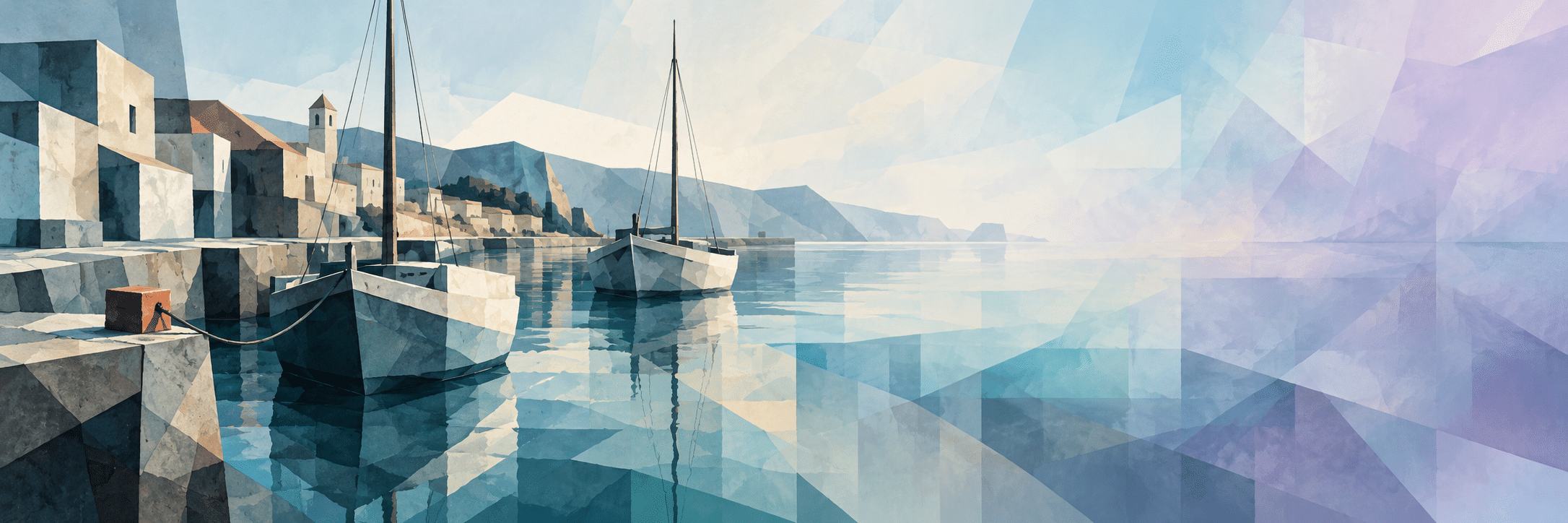
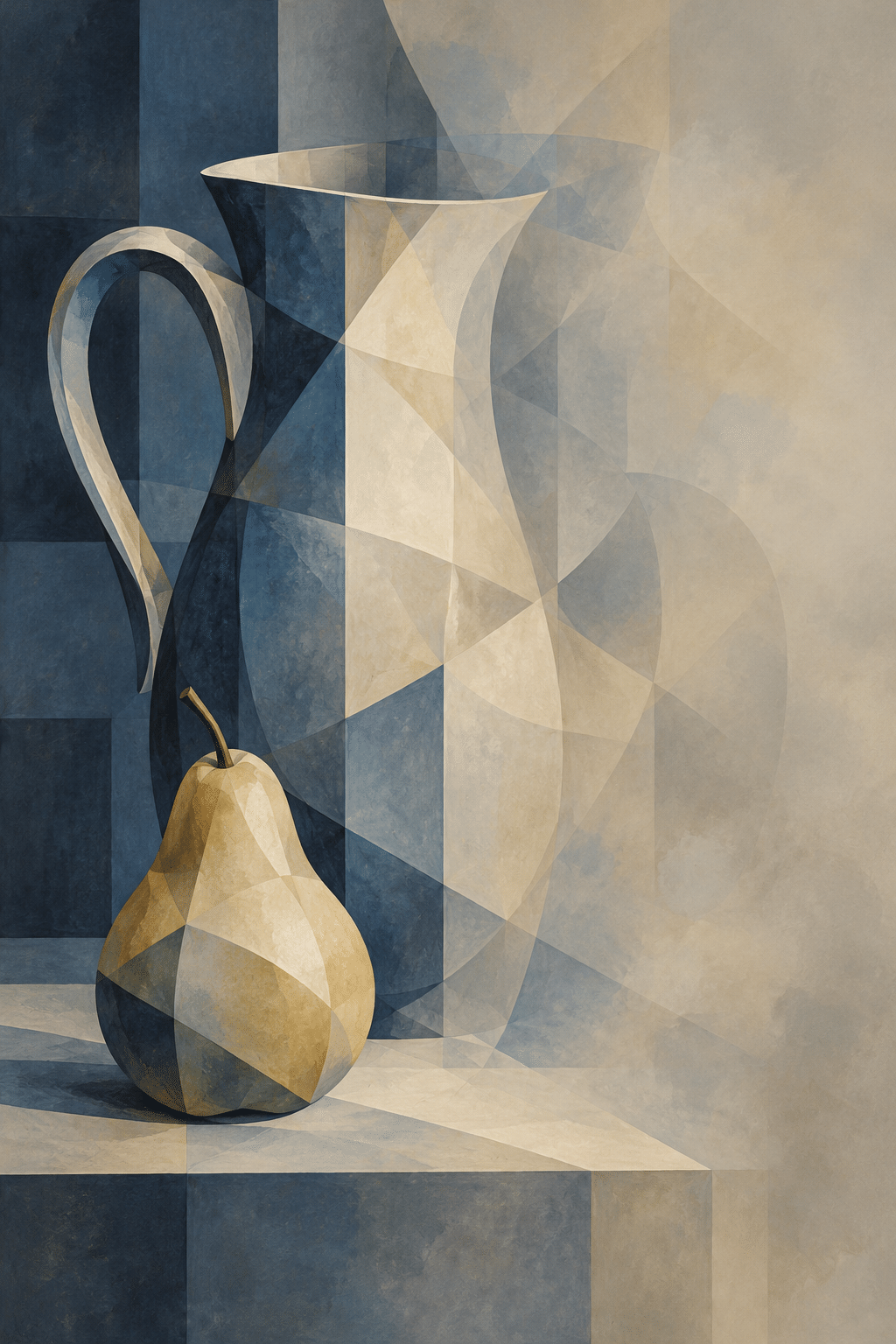
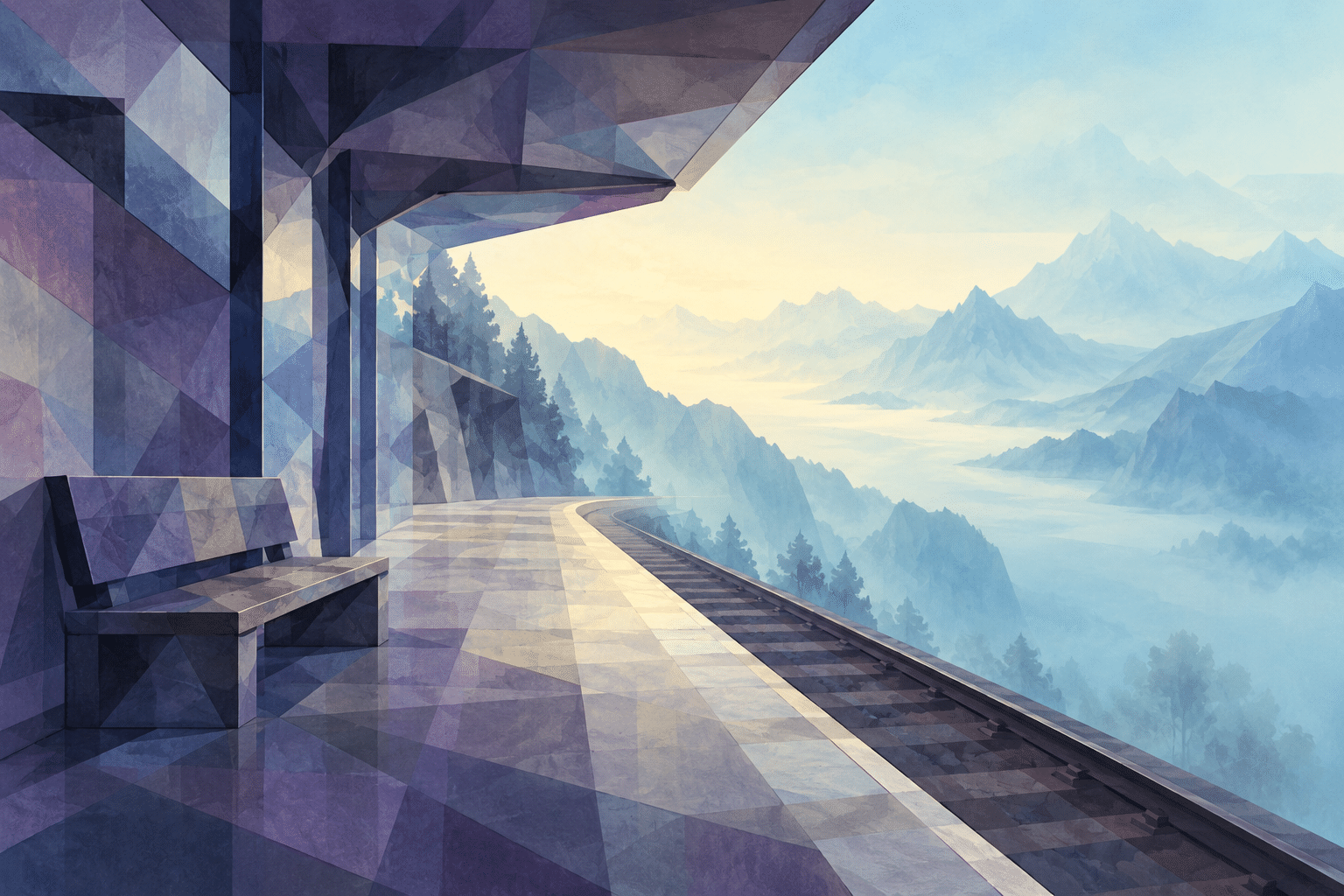
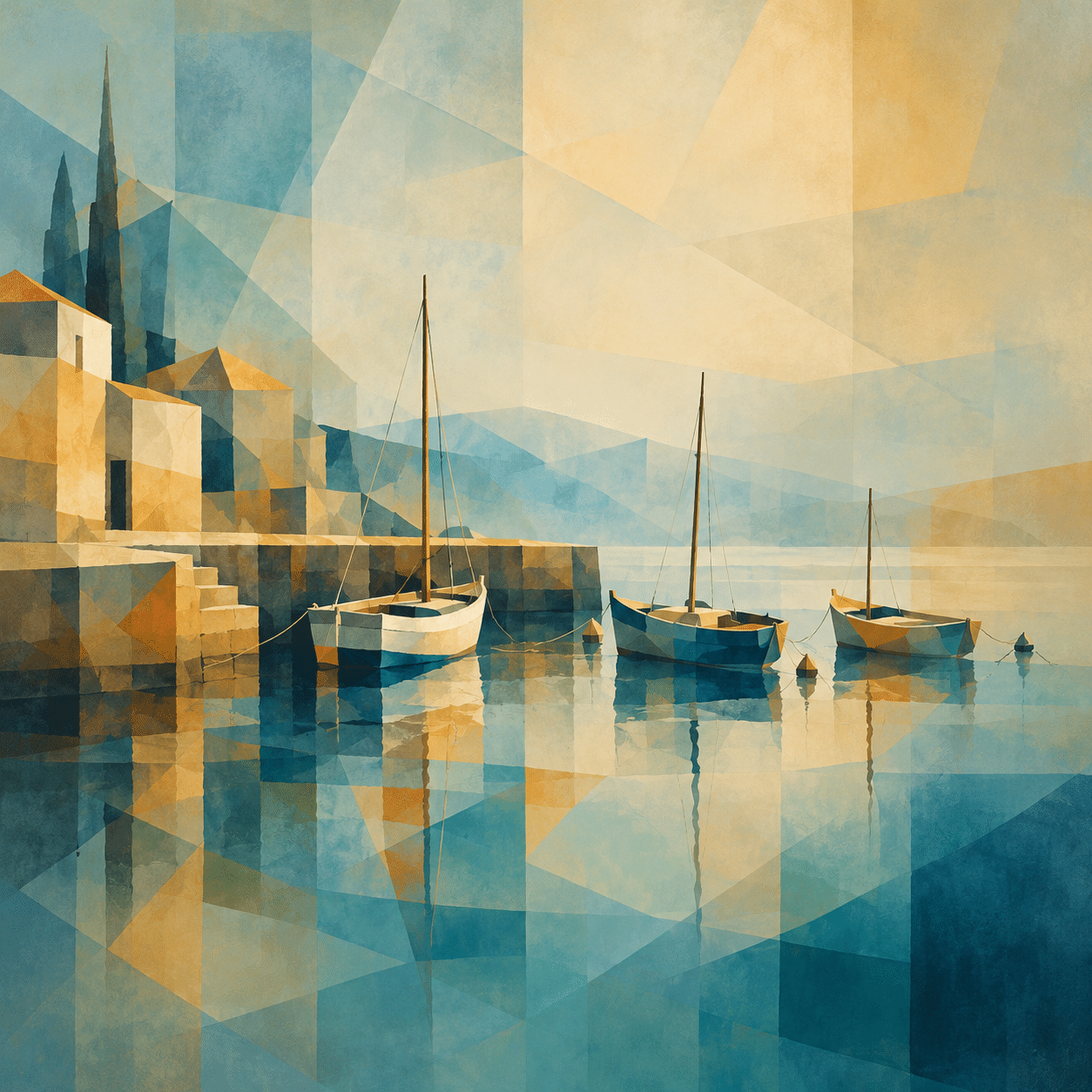
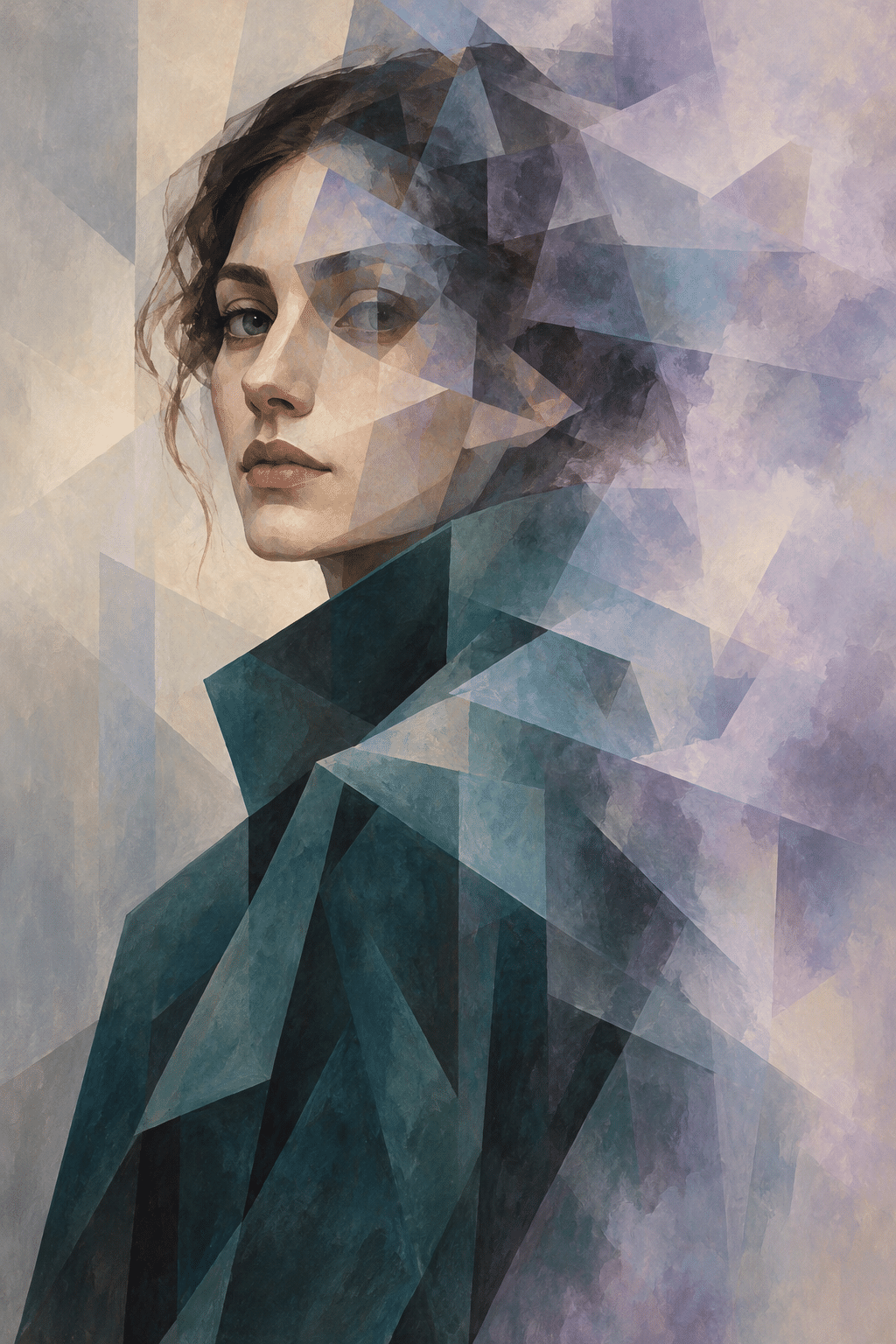
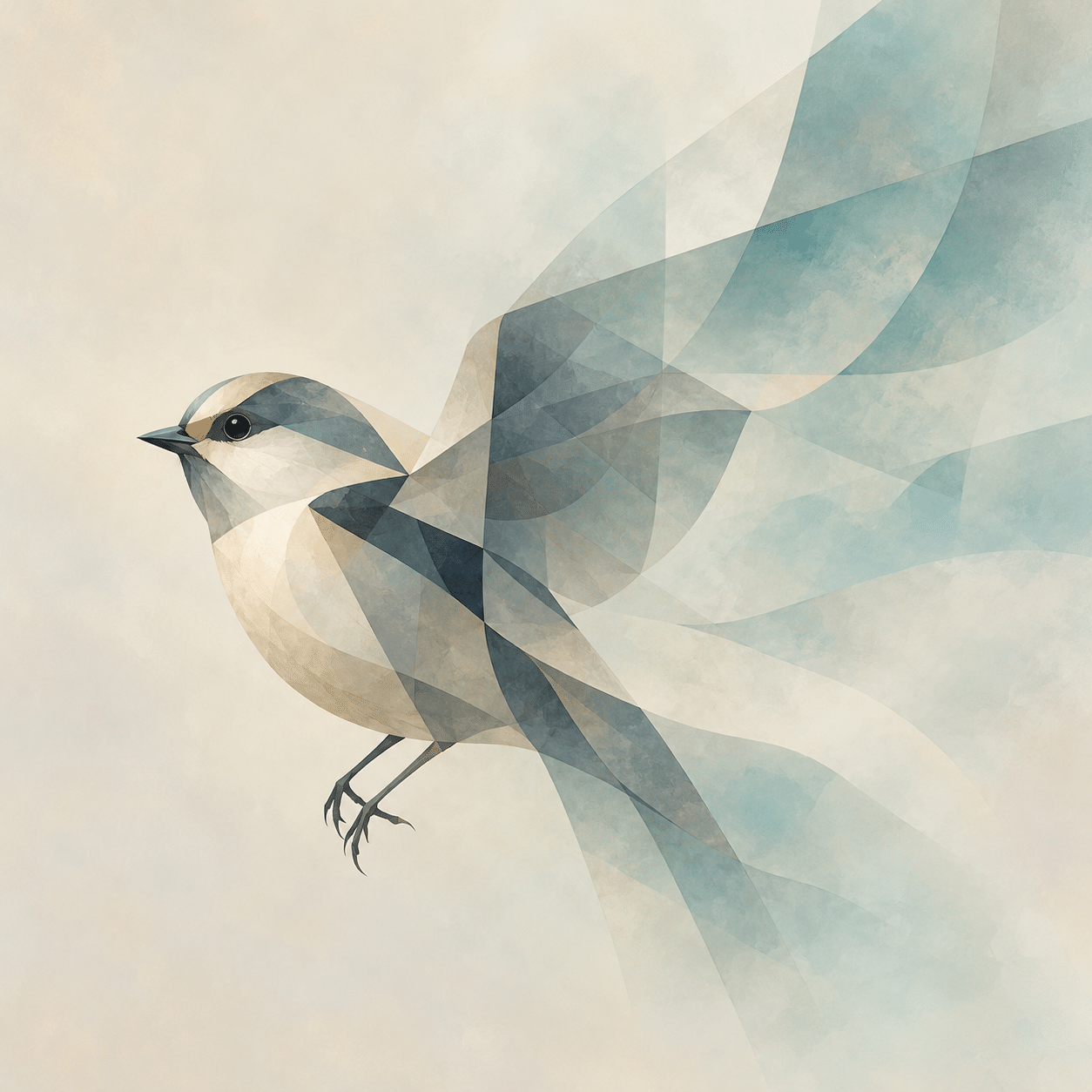
The pitcher study keeps the rim and handle readable while surrounding planes disperse. The platform study uses an architectural edge as its anchor, with distance becoming less certain. The harbour study lets broken reflections echo the construction above the water. A clothed portrait combines a recognisable face with selective displaced planes. A bird study keeps the head and beak clear while the wing geometry opens into atmosphere.
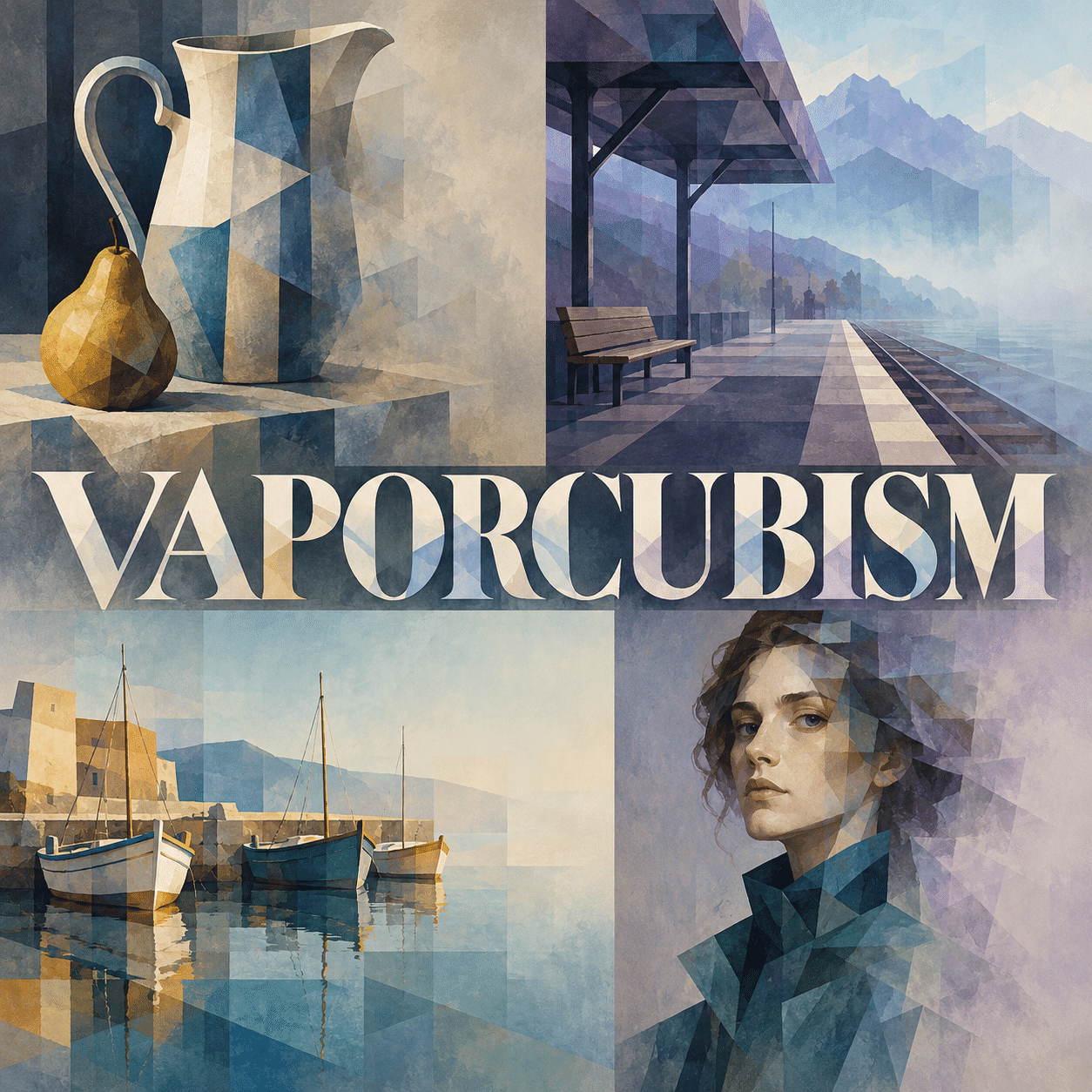
The banner introduces an invented harbour; the centrally titled collage compares several subjects. All examples are AI-generated interpretations of this AOI proposal. They are not authentic historical objects or evidence that a physical material behaved as the picture suggests.
How it differs from nearby approaches
Cubism supplies historical questions about construction and viewpoint; this proposal adds a specific solid-to-atmospheric transition. A low-poly image can use many facets without that transition. A foggy landscape can use atmosphere without any meaningful reconstruction of its objects.
Likewise, retro colour alone does not define this method. Pink and cyan can be used, but neither nostalgic computer imagery nor neon scenery is required. The subject should remain interesting after those fashionable cues are removed. Ask whether the planes and the dispersal actually depend on one another.
A practical workflow and prompt vocabulary
Begin with a clear silhouette or simple observational sketch. Select two or three viewpoints or overlapping shape descriptions rather than fragmenting everything at random. Build the main opaque masses, identify the recognition anchors, and only then introduce transparent echoes and soft-edged passages.
Useful prompt terms include overlapping opaque planes, preserved rim or contour, selective transparent echoes, directional dispersal and a broad quiet field. Specify the subject, palette and transition direction. Avoid relying on the style name alone, because a model may interpret an unfamiliar label inconsistently.
Check the result at a small scale. If the subject is lost, restore an anchor. If the effect reads as smoke pasted over a normal object, let a few structural planes continue into the atmosphere. If it reads as broken glass, reduce shiny edges and introduce larger, calmer areas.
Positive editorial assessment — AI-authored
The strongest images make solidity and uncertainty depend on each other. A single preserved contour can organize a complex field, while the dissolving planes suggest memory, motion or incomplete perception. The method offers a clear experiment that can be tested across still life, portrait and landscape.
Critical editorial assessment — AI-authored
The approach can lapse into generic pastel geometry or decorative fog. Too many facets weaken hierarchy, and atmospheric effects can hide weak construction. Improve the work by choosing fewer anchors, a clearer transition direction and a larger quiet interval rather than adding more visual effects.
Neutral editorial assessment — AI-authored
Vaporcubism is presented here as an AOI creative framework, not an established historical movement. Its proposed criteria are fragmented construction, retained recognition cues and selective atmospheric dissolution. The museum sources explain the historical reference; the new gallery tests the contemporary interpretation.
A small poetic detour
Original words from the AOI studio.
Poetry
The handle holds a cup of air,
the harbour keeps a broken line;
a plane grows pale and leaves us there
with half a shape we still define.
One edge insists; the others go,
the colour loosens from its frame.
We watch the form become less sure
and recognize it all the same.
The prompt workshop
Original creative exercises. These prompts create new illustrations, not documentary evidence.
A form that remains legible
Create an original digital still life of a ceramic pitcher reconstructed from overlapping slate and pale-blue planes. Preserve its rim and handle; let selected right-hand facets become translucent and disperse into a broad warm-grey field. No text, smoke overlay or shattered-glass shine.
Space in transition
Create an original harbour image with boats, quay and reflections rebuilt from overlapping opaque planes. Keep a few masts and the waterline clear. Let the distant right side dissolve gradually into translucent cyan and violet colour, with one coral accent and a large quiet sky.
Test the boundary
Create an original bird study with a clear head, eye and beak, a body built from a few decisive geometric planes, and one wing opening into faint translucent shape echoes. Restrained ivory, slate and muted teal palette; directional dispersal into empty space, no lettering.
A smile from the studio
Jokes
The pitcher asked where its far side had gone. The painter pointed to the atmosphere and said it was still contributing to the composition.