
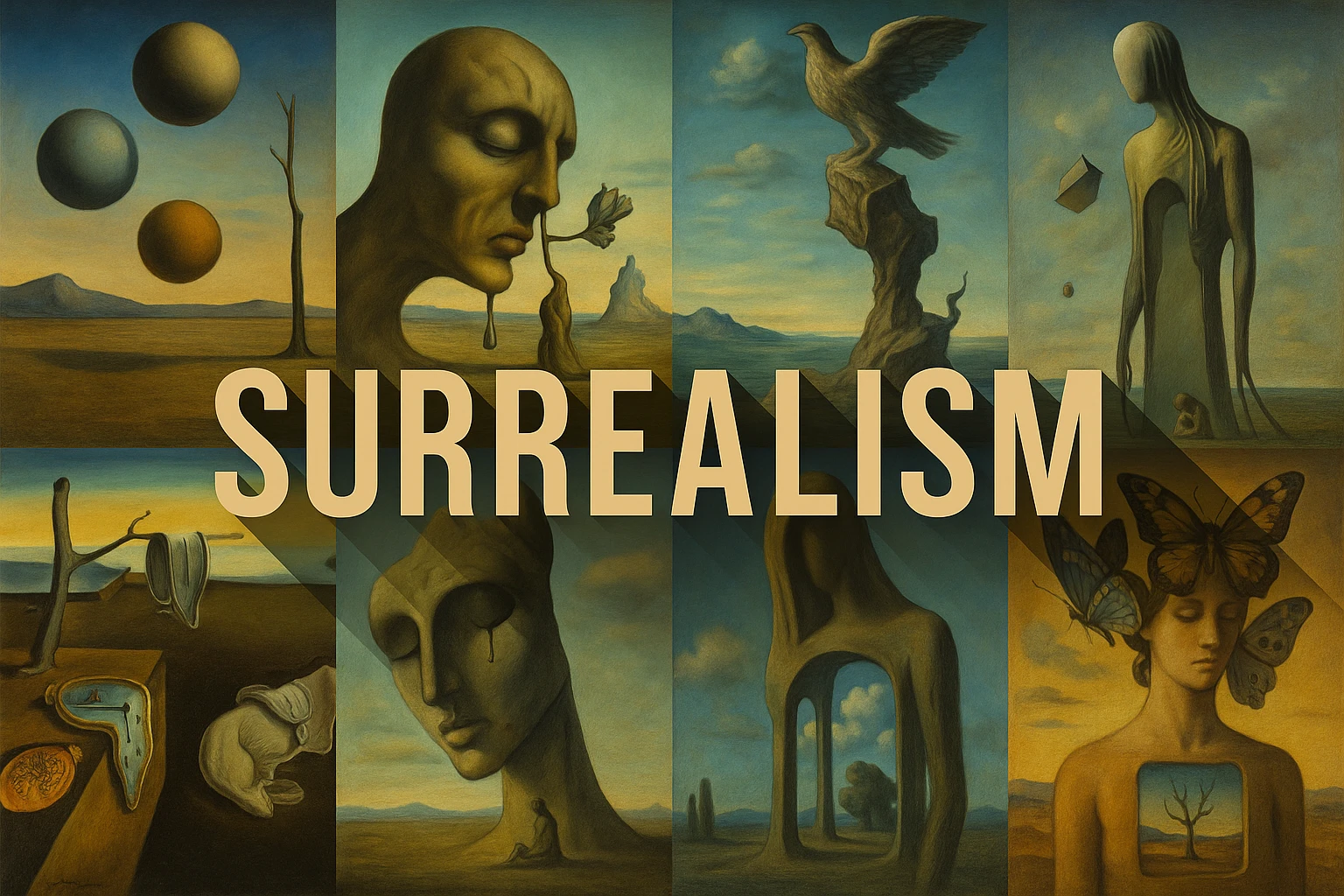
A quick brush with the subject · What catches the eye? · A closer look · Pocket-sized facts · Artists, objects, and paths to explore · The prompt workshop · A small poetic detour · A smile from the studio · Sources and further exploration
A quick brush with the subject
A familiar object can become deeply unfamiliar without changing its outline. A cup grows fur; an ordinary room admits an impossible visitor. Surrealism explores such disturbances, but it also has a history of writing, artistic experiments and arguments about freedom. It is more useful to investigate those methods than to use surreal as a label for anything strange.
What catches the eye?
Look for a conflict between things you recognize and relationships you cannot settle: an object with an unsuitable material, a convincing space containing an impossible event, or marks that seem to develop their own creatures. Meticulous illusion and freer forms can both serve that disturbance. There is no compulsory rainbow palette or single dreamlike filter.
A closer look
Surrealism developed from literary experiments in the late 1910s and early 1920s. André Breton's first Manifesto of Surrealism, published in Paris in 1924, became a key statement. The Met describes automatic writing as an attempt to let associations emerge with less conscious control. Visual artists explored related possibilities through drawing, painting and experimental processes. These were artistic ambitions and methods, not proof that an artwork provides a scientifically reliable picture of the unconscious.
Meret Oppenheim's Object, made in Paris in 1936, is a particularly direct example. MoMA identifies its components as a fur-covered cup, saucer and spoon. Their expected use and their tactile surface pull in different directions. You do not need a vast imaginary landscape for the ordinary world to become uncomfortable. Notice how the work invites you to imagine touch and use before frustrating that expectation. A simple material substitution produces a surprisingly complicated response.
Leonora Carrington's Self-Portrait, about 1937–38, offers a different route. The Met describes Carrington seated near a hyena, with a floating rocking horse behind her and a white horse outside the window. Her world contains memories and imagined creatures without becoming a puzzle with one compulsory solution. Look at the relation between enclosed room and open landscape. That contrast gives you something concrete to discuss while leaving the painting's associations open.
Different methods matter. The Met distinguishes the freer visual automatism associated with artists such as André Masson and Joan Miró from the carefully rendered illusionistic spaces of other Surrealists. A polished surface and a wandering line can therefore belong in the same conversation without being the same procedure. It is misleading to flatten all the movement's artists into one technique, one political position or one kind of dream imagery.
For an experiment of your own, begin with an ordinary relationship rather than a stock symbol. Choose something used for sitting, carrying or listening, then alter one property while keeping the rest convincing. Ask what new association follows. A chair made of folded maps may suggest travel, instability or a place that refuses to stay put; you need not announce one official meaning. When AI helps produce the image, describe it as a contemporary experiment. A generated dreamscape is not automatically an example of the historical movement.
Pocket-sized facts
1924 marks Breton's first Surrealist manifesto, rather than the invention of dream imagery itself.
Surrealist practice includes objects as well as paintings: Oppenheim's Object changes the material experience of a familiar tea service.
Carrington's Self-Portrait is dated about 1937–38 by The Met. Approximate dates should stay approximate.
Artists, objects, and paths to explore
Meret Oppenheim — Object, Paris, 1936. Fur-covered cup, saucer and spoon. Museum of Modern Art, New York. Compare the invitation to touch with the expectation of drinking.
Leonora Carrington — Self-Portrait, about 1937–38, oil on canvas. The Metropolitan Museum of Art. Compare the animals, the room and the landscape beyond its window.
The prompt workshop
Creative corner: original AOI material, not historical evidence.
An invented quiet room containing a chair made from folded street maps, rendered with believable light and material detail. Keep every other object ordinary. Let the contradiction carry the scene; no borrowed composition or historical attribution.
A contemporary drawing experiment: begin with a continuous wandering line, then develop only a few of its accidental shapes into imagined creatures. Leave some passages unresolved. Present the result as an exercise inspired by automatic drawing, not as a diagnostic image of the unconscious.
A small poetic detour
Creative corner: original AOI material, not historical evidence.
The door dreams of rain.
A small cloud waits in my shoe;
No one rings the bell.
A smile from the studio
Creative corner: original AOI material, not historical evidence.
The chair asked where I wanted to sit. I said, 'Here.' It unfolded a map.
Sources and further exploration
The Met — Surrealism: literary origins and differing visual methods
MoMA — Meret Oppenheim, Object
The Met — Leonora Carrington, Self-Portrait
Creative studies to try
Explore these collected prompts as creative interpretations. They are starting points for image-making, not reproductions of historical artworks or evidence about a tradition.
Visual cues: dream logic, impossible atmosphere, symbolic space; Everyday things, impossible worlds
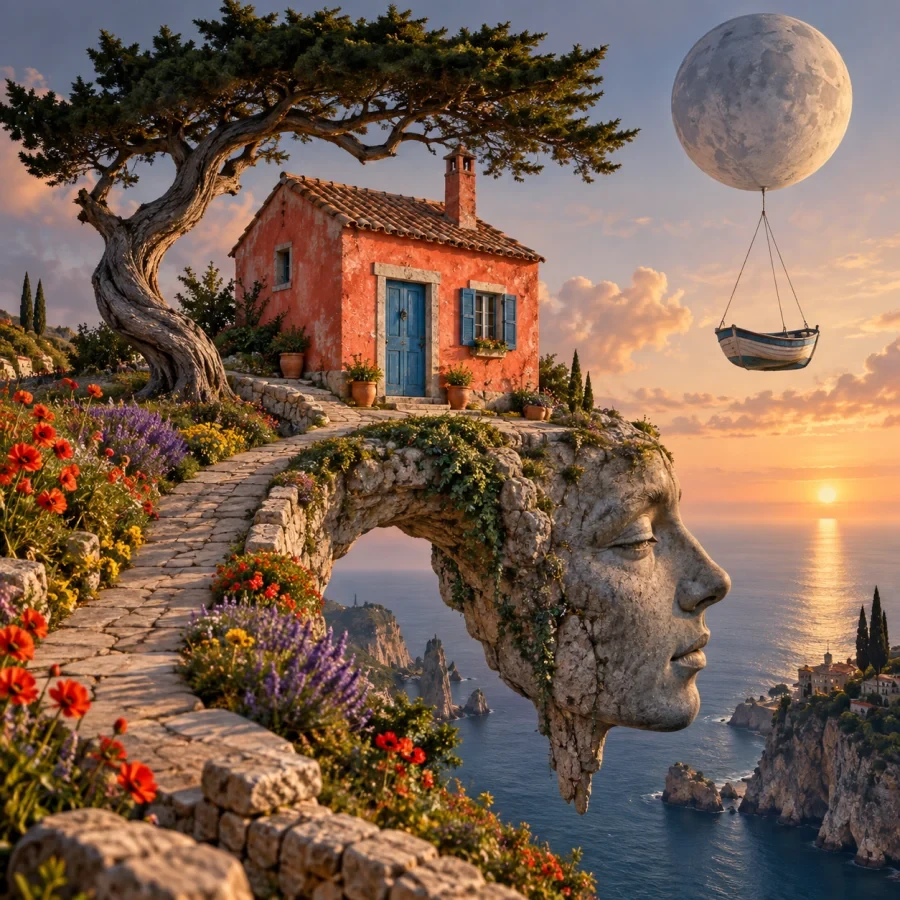
Study 1 — Surrealism
Ultra-wide panoramic banner, a human hand and a sleek robotic hand reaching toward each other, fingertips almost touching, a bright luminous spark of intelligence between them, a subtle world map behind them with global data network lines, symbolizing human-AI collaboration and digital transformation, rendered in Surrealism style, with symbolic atmosphere, impossible light, floating map fragments, poetic visual tension, high quality, high detail, balanced composition, no text, no logo, no watermark, exact aspect ratio 1584:396
Prompt source: 1001 Art Styles. Select the text to copy, then adapt the subject and composition.
Study 2 — Surrealism
Apply the following visual style to my subject or project, preserving its core content and purpose. Create a surrealist image with convincingly rendered familiar forms arranged in an impossible, dreamlike situation. Use unexpected scale, unusual spatial relationships, long shadows, and a quiet atmospheric setting. Make the impossible feel tangible through precise lighting and material detail. Adapt the composition and palette to suit my subject. Do not add text unless my project calls for it.
Prompt source: Emergent Mind Style Atlas. Select the text to copy, then adapt the subject and composition.