
Robotic, mechanical and electronic art · A researched overview and AOI visual synthesis
Explore robotic, mechanical and electronic art through drawing machines, kinetic sculpture, responsive light and original AI artworks combining all three.
A visual introduction
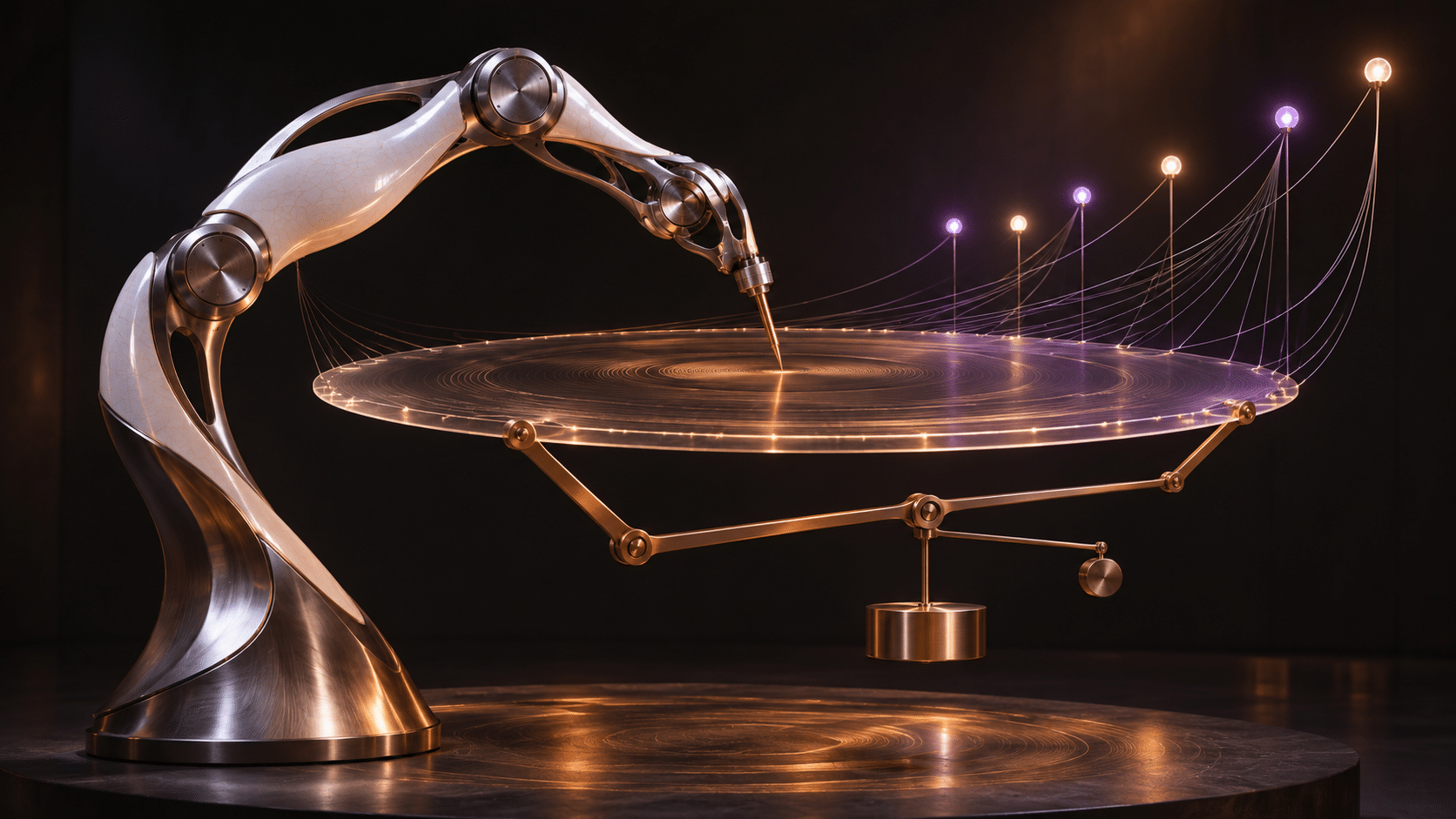
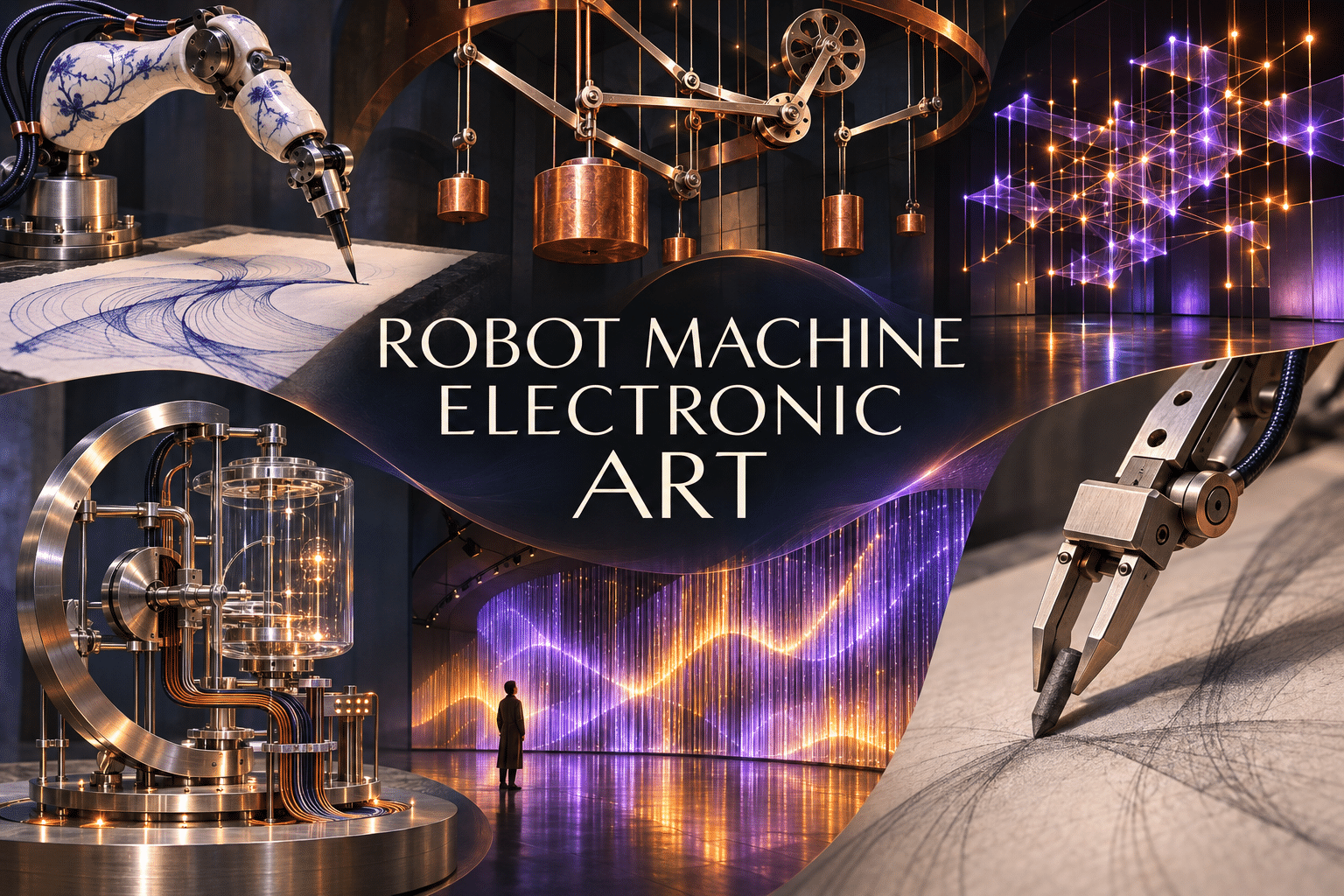
Six original AI-generated studies: one banner, one titled collage and four distinct examples. Imagined mechanisms and installations; not documentary photographs or reproductions of the historical works discussed.
Select an image for a closer look. Use the thumbnails, arrow keys or a swipe to compare examples. Zoom in to inspect details, or share the image that inspires you.
A closer look
Articulated tools, pivoted structures and luminous signals share a deliberate composition. Open spaces expose joints and connections. Paper, patinated copper, glass and light offer contrasting surfaces, while repeated curves or intervals connect movement with marks and illumination.
Three practices, one wider field
A machine can make a drawing, move as a sculpture or turn a visitor’s presence into light. These are different artistic events, even when they share motors, code or electricity. Robot Machine Electronic Art brings them into one overview and develops an original AOI visual synthesis around their relationships. The combined title is an editorial umbrella, not the name of a single documented historical movement.
Robotic art makes a programmed physical action central: a tool draws, a mechanism responds or an apparatus performs. Mechanical art foregrounds the arrangement and transmission of forces, from a hand-driven linkage to a motorized kinetic sculpture. Electronic art uses electronic signals, circuits, screens, sound or controlled light as material. Their boundaries overlap, but none requires the others in every work.
Look for an action, a structure and a signal
To understand an unfamiliar work, ask three questions. What acts? What carries or changes the action? What information enters or leaves the system? A robotic arm can supply the action; linked rods can redistribute motion; a sensor and light sequence can make a response visible. The answer may also be simpler: a suspended sculpture can move in air without an electronic controller.
This framework is useful for images as well as installations. A readable joint suggests a possible movement. A counterweight gives a suspended form a relationship to gravity. A repeated light interval suggests a sequence. Each element should contribute to the composition. Adding gears and neon everywhere makes the subject busier without necessarily making it more intelligible.
Drawing machines: from a mechanical event to programmed images
Museum Tinguely documents Jean Tinguely’s Méta-Matic drawing machines in 1959 and their invitation to public participation. The machine, its user and the resulting marks all mattered. This is a useful starting point because mechanical art can question authorship through an awkward or playful process; it need not demonstrate industrial efficiency. [1]
Harold Cohen’s AARON offers a different case. The Whitney describes software conceived in the late 1960s, named in the early 1970s and developed across decades. Cohen built plotters and painting machines to execute its commands, while some output was intended for monitors or projection. AARON therefore helps separate the image-making program from the physical device that realizes an image. [2]
These examples should not be collapsed into a story in which every machine is the same kind of artist. A linkage that guides a pen and a program that encodes decisions organize the work differently. In either case, the artist’s choices about rules, materials, selection and presentation remain worth examining.
Electronic art: the signal becomes material
Electronic art is broader than pictures of circuit boards. SFMOMA describes Nam June Paik’s 1963 Exposition of Music – Electronic Television, with modified televisions and transformed instruments inviting participation. The electronic apparatus changed what could be seen, heard and performed. A screen was an active material rather than merely a neutral frame around an image. [3]
Rafael Lozano-Hemmer’s Pulse Room, dated 2006 in the artist’s documentation, converts participants’ heart rates into flashing incandescent bulbs. New recordings enter a sequence that retains those of earlier participants. Its meaning depends on the relation between a bodily rhythm, a sensor, recorded information and a shared space of light. It does not need a humanoid robot to connect a person with an electronic system. [4]
A changing light pattern alone does not prove that a work responds to an audience. Distinguish a prearranged sequence from a sensor-driven response, and describe the documented mechanism when discussing an actual artwork. Our generated light study proposes an interaction visually; a still image cannot verify that interaction.
An AOI synthesis: gesture, mechanism, response
The combined approach developed here uses one practical rule: connect a visible gesture to a readable structure and a restrained signal. Give the elements different jobs. A gripper turns a form; rods carry the relation through the structure; light marks an imagined response. This creates a reason for all three approaches to share the same composition.
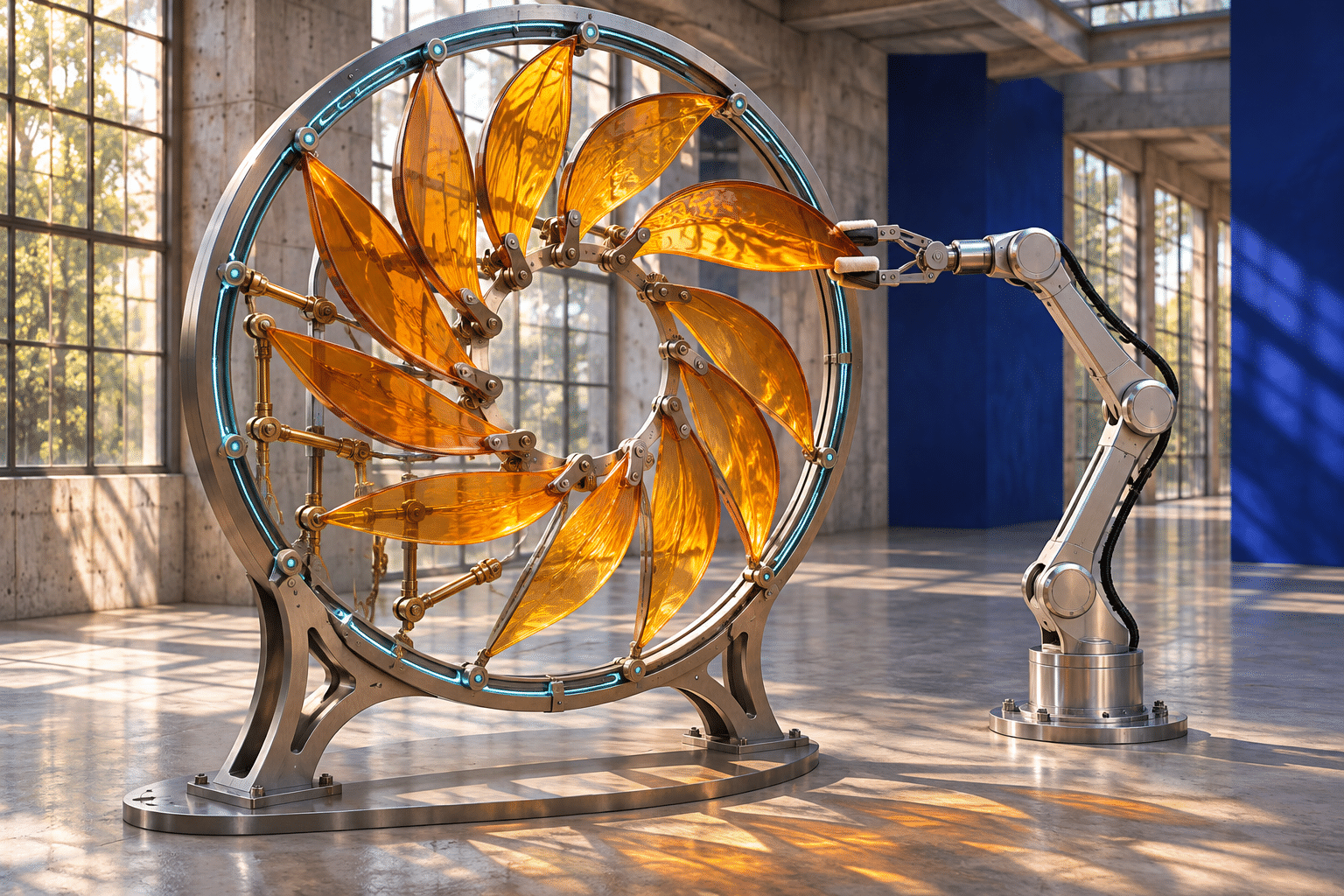
The banner stages a stylus over a translucent disc, framed by articulated supports, a counterweight and luminous nodes. The hybrid example develops an amber glass spiral within a circular frame, approached by a padded robotic gripper. Cyan light follows the rim while warm glass and brass establish the material centre. These are original imagined artworks, not photographs of working machines or historical installations.
An integrated composition needs limits. Choose a dominant curve, a clear action and a small number of material contrasts. Keep some connections visible and leave space around them. Resist the temptation to make every surface equally intricate. The eye should discover relationships rather than search for a place to rest.
Four studies reveal different possibilities
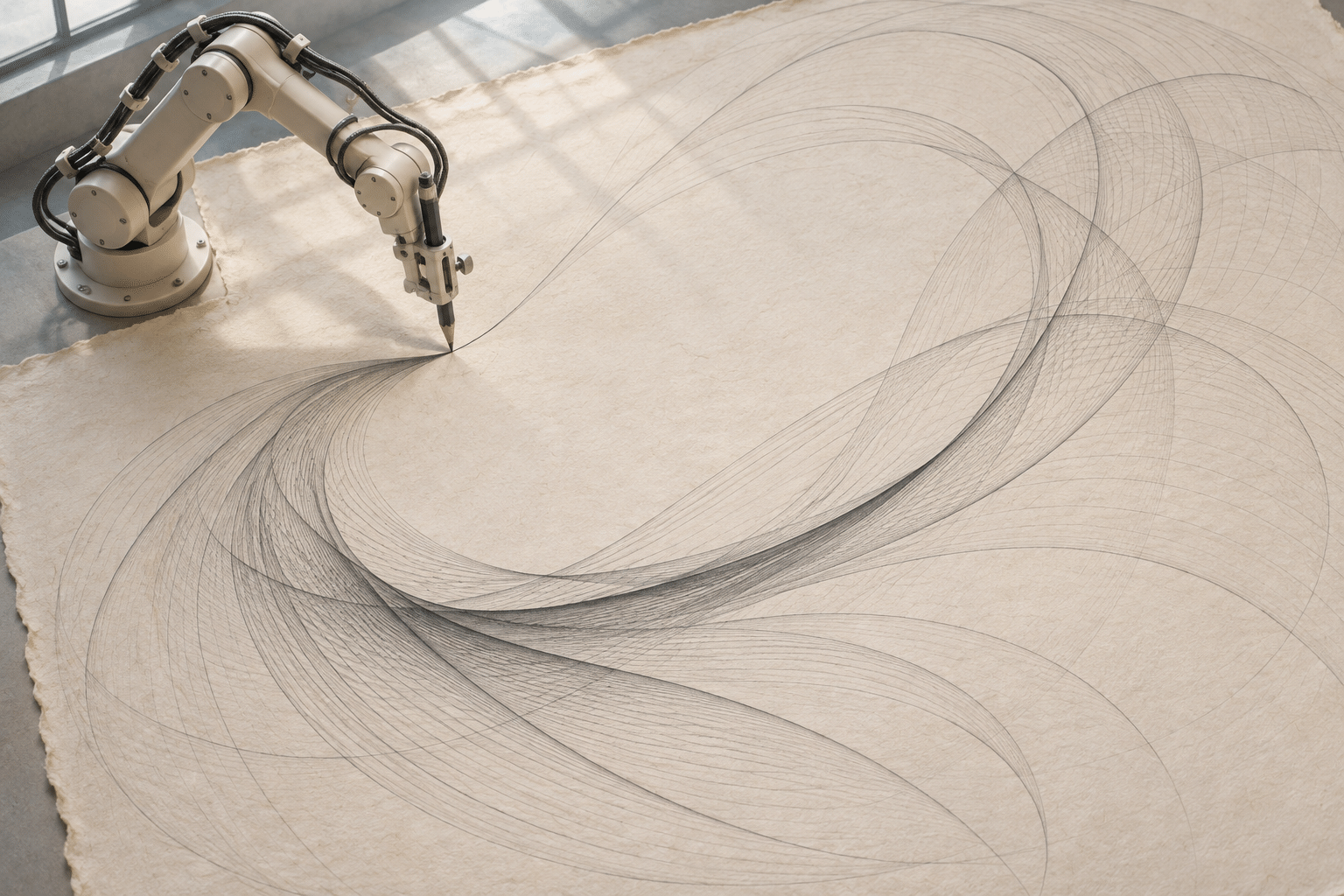
The graphite study brings the viewer close to a robotic pencil and a sweeping family of marks. Its warm paper and subdued daylight emphasize contact, density and the relation between a small tool and a large drawing. It asks whether the trace can hold attention without spectacular lighting.
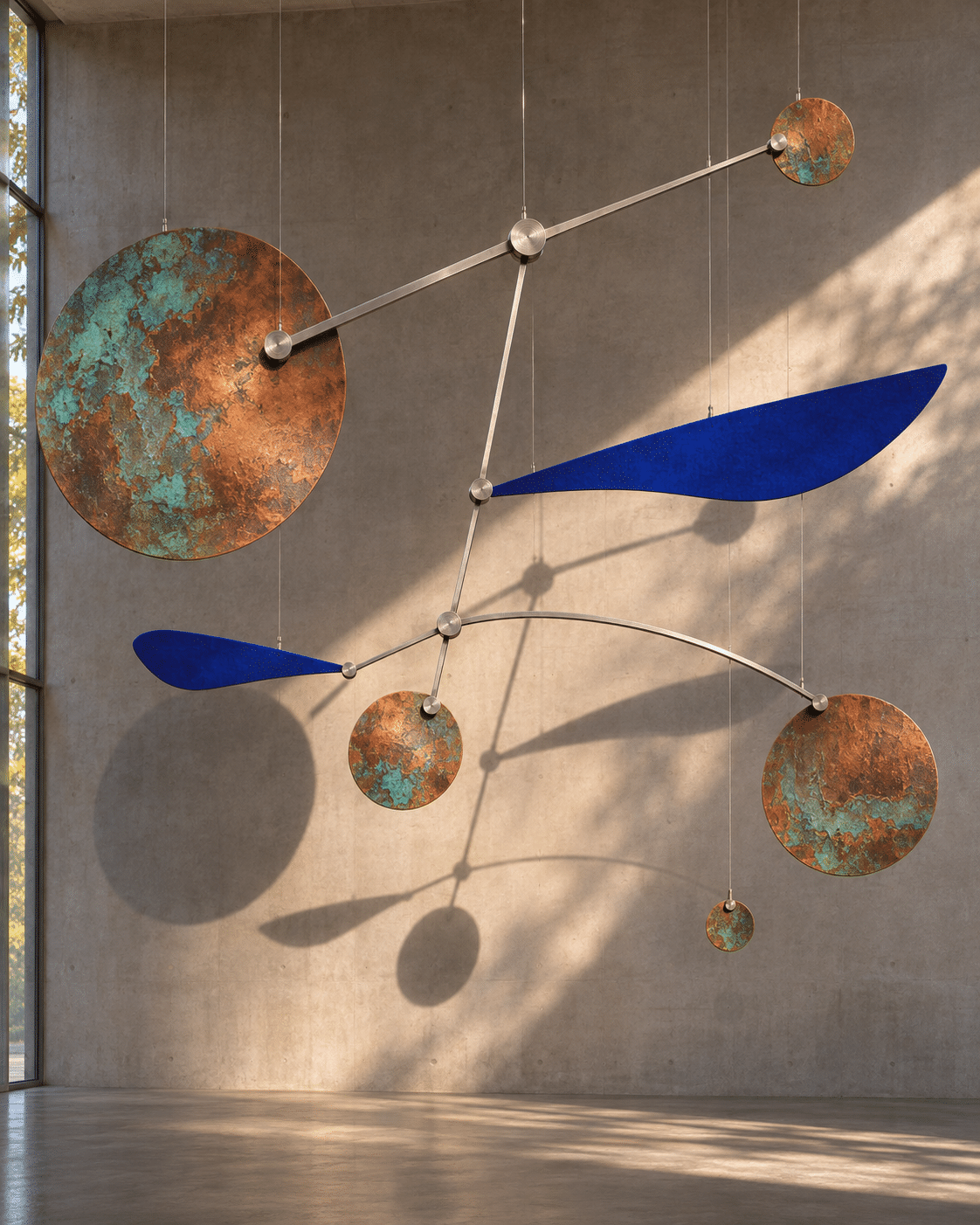
The mechanical study suspends copper discs and blue blades on slender rods. Patina, pivots, intervals and shadows make the composition legible. Motion is suggested by the arrangement; the generated still does not demonstrate a tested balancing system. This example broadens the article beyond polished robot imagery.
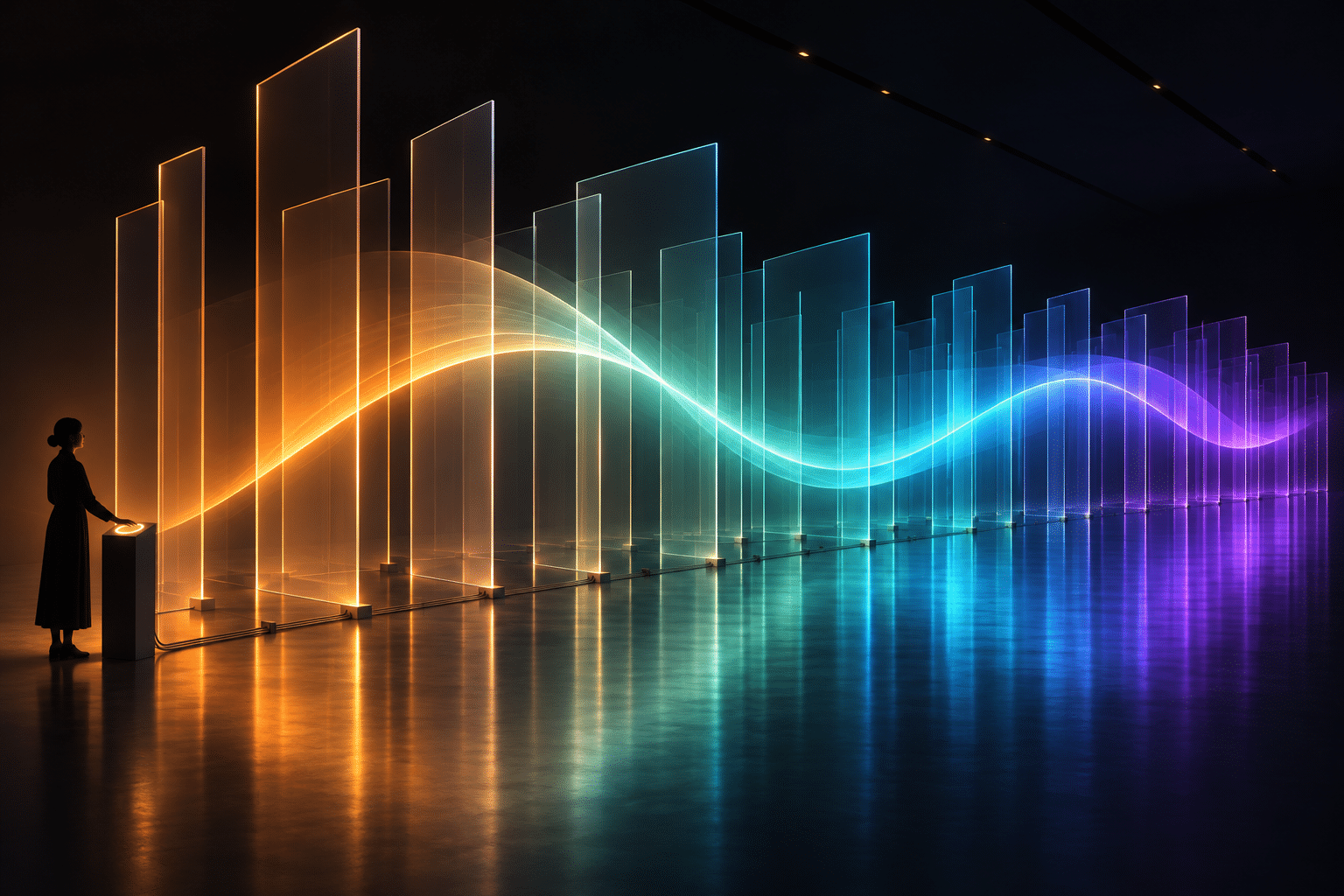
The electronic study uses a wave of amber, cyan and violet across transparent fins, with a visitor beside a small pedestal. Scale, repetition and illumination carry the composition. The final hybrid joins a gripper, amber glass forms, linkages and cyan signals in one gallery object. Compare what each study makes visible, rather than treating the four as interchangeable technology decorations.
Materials, colour and the meaning of time
Metal can establish weight, precision or wear. Paper reveals the consequences of contact. Glass separates edge, reflection and transmitted light. A wire may carry a real connection in a physical work or suggest one in an illustration. Describe which kind of claim you are making. A beautiful cable is not proof of a functioning circuit.
Colour works best when it supports roles: warm copper for structure, pale ceramic for an articulated tool, a limited cool accent for a signal. Other palettes are possible. The important decision is whether colour helps the viewer distinguish parts and follow their relationship.
Actual robotic and kinetic artworks unfold through time. They may repeat, pause, fail, vary or wait for a visitor. A static image can suggest this through an unfinished mark, an asymmetrical balance or a sequence of positions, but it cannot substitute for documentation of behaviour. Where available, study reliable video documentation alongside photographs.
A practical composition workshop
Start with a verb: draw, turn, balance, illuminate or respond. Add one primary material and one contrasting material. Sketch a large silhouette before filling in joints, wires or reflections. If the intended action cannot be understood at thumbnail size, simplify the scene.
For a combined design, draw three small sketches first. One shows only the action, one the supporting mechanism and one the signal or response. Then combine them around a shared path, circle or rhythm. Remove any component that does not strengthen the visual relationship. A diagrammatic sketch can be more useful than a long list of impressive technical nouns.
When using an AI image system, inspect tool contact, joint continuity, support points, repeated parts, reflections and accidental lettering. Generated images may suggest impossible mechanisms even when the rendering looks persuasive. Use them as visual proposals. Physical construction requires its own design, testing and safety assessment.
Authorship, agency and limits
A machine’s visible action can invite us to attribute intention to it. That response is part of the encounter, but it does not establish consciousness. Ask who designed the rules, selected the materials, arranged the interaction and chose what to exhibit. Avoid describing an imagined apparatus as autonomous or intelligent merely because it has a sensor-shaped detail.
This field can expose the habits and consequences of automation, or it can hide them behind seductive surfaces. Repetition may be meditative or monotonous. A responsive installation may create a meaningful relation with a visitor, or reduce participation to a switch. Evaluate what the work changes in the viewer’s experience.
Cyborg art is a related but distinct subject when bodily integration, altered senses or human-machine identity are central. Robot Machine Electronic Art does not require a modified human body. Likewise, a painted robot is a representation of a machine; it is not automatically an artwork made by a robot.
How to use this overview
Use the historical references to investigate particular practices, and use the new images and prompts to explore the combined visual approach. The museum and artist sources document their own works; they do not endorse the AOI umbrella title or our generated examples.
All six new visuals on this page are AI-generated interpretations. They are neither reproductions of the cited works nor evidence that the depicted mechanisms were built. The separate Robotic Art, Electronic Art, Kinetic Art and Cyborg Art entries remain useful routes into more specific questions.
A small poetic detour
Original words from the AOI studio.
Poetry
The pencil waits above the grain.
A hinge remembers only its angle.
Copper takes the weight of a blue blade;
light carries none, yet fills the room.
We give the arm a path to follow,
the signal a threshold, the wheel a turn.
Then stand before the mark that happens
and ask what our instructions learned.
Between command and consequence
a narrow interval remains:
the space in which a viewer notices
the trembling edge of ordered things.
The prompt workshop
Original creative exercises. These prompts create new illustrations, not documentary evidence.
Start with the trace
An original robotic drawing study: one compact articulated arm holds a graphite pencil over warm textured paper, producing a sweeping family of delicate arcs. High diagonal viewpoint, soft daylight, ample untouched paper, precise pencil contact, restrained ivory and graphite palette. Keep the drawing more prominent than the machine. No text or logos.
Inspect the pencil contact and continuity of the arm. The image proposes a drawing process; it does not document one.
Combine gesture, mechanism and signal
Imagine an original gallery artwork joining three approaches: a slender robotic gripper turns a translucent amber form; visible brass rods connect several hinged elements; a restrained cyan light path marks the imagined response. One circular structure, asymmetrical rhythm, readable joints, warm glass against brushed steel, clear negative space, three-quarter view, no labels or decorative clutter.
Check whether each component has a visual role. Keep the result labelled as a concept, not a functioning engineering design.
Translate a response without showing a robot
An imagined electronic installation translates a visitor gesture into a luminous wave across staggered translucent fins. Begin with amber near a simple touch pedestal, move through cyan to violet across a dark gallery. One small visitor silhouette for scale, quiet reflections, crisp light edges, spacious composition. No screens, gears, text or logos.
Compare a timed sequence with a responsive proposal. A still image cannot establish sensing or real-time behaviour.
People & works to explore
References discussed in this article. Consult the sources below for context.
Artists and practitioners
Jean Tinguely
Harold Cohen
Nam June Paik
Rafael Lozano-Hemmer
Paintings and other works
Jean Tinguely — Méta-Matic drawing machines (1959 series)
Harold Cohen — AARON (software developed over decades, with drawing and painting devices)
Nam June Paik — Exposition of Music – Electronic Television (1963 exhibition)
Rafael Lozano-Hemmer — Pulse Room (2006)
A smile from the studio
Jokes
The drawing machine submitted a perfectly straight line. The curator asked for more feeling. It increased the vibration. Both agreed the second version required a longer label.
Sources and further exploration
Museum Tinguely: biography and the 1959 Méta-Matics — machines, participation and drawing
Whitney Museum: Harold Cohen, AARON — software, plotters and painting machines
SFMOMA: Nam June Paik retrospective — the 1963 television experiments and electronic media
Rafael Lozano-Hemmer: Pulse Room (2006) — artist documentation of sensing and light