
Media and technology
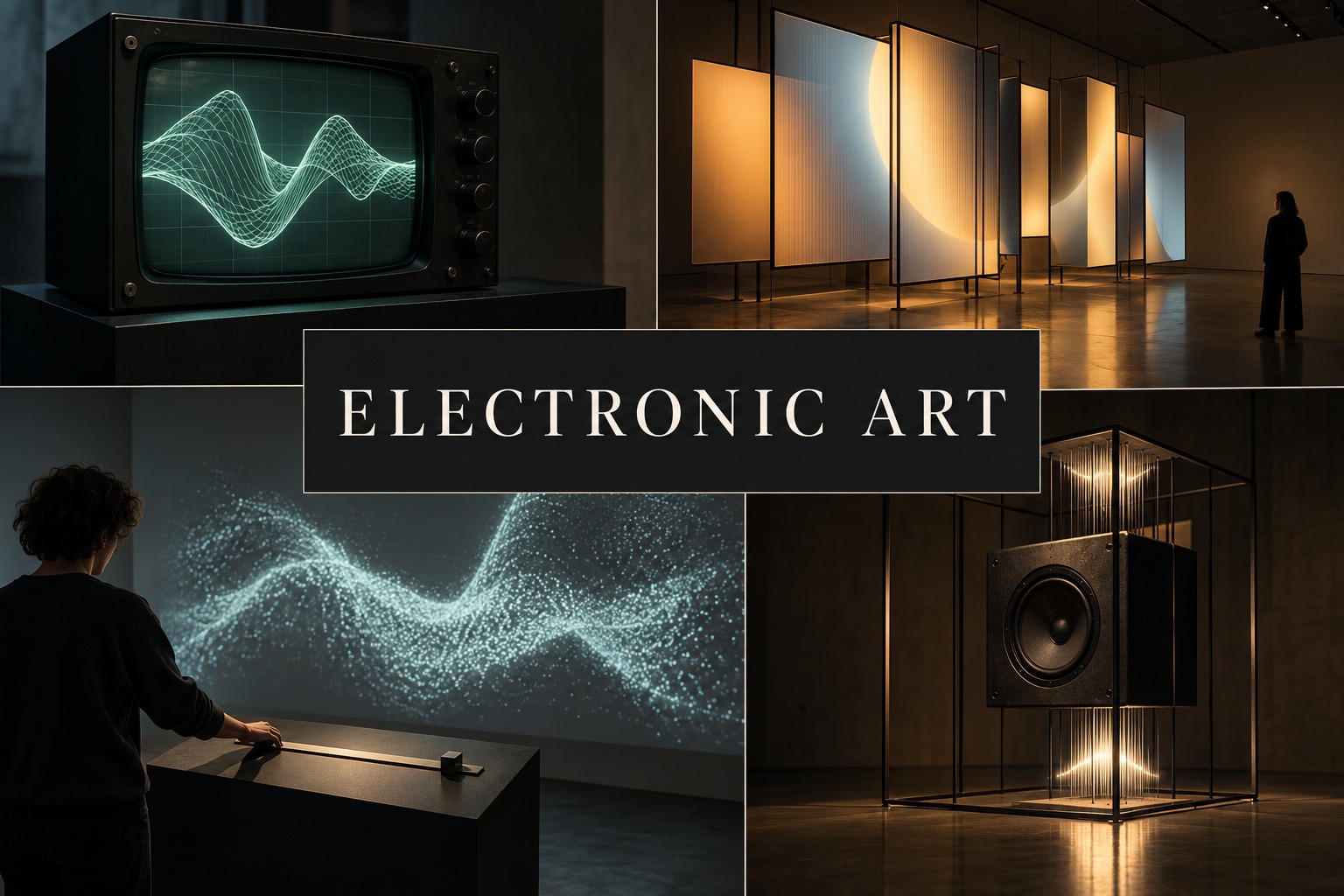
Electronic art uses electronic signals, devices or systems as active artistic material. It includes video, sound, interactive installations and hybrid objects; it is broader than computer-generated imagery.
A visual introduction
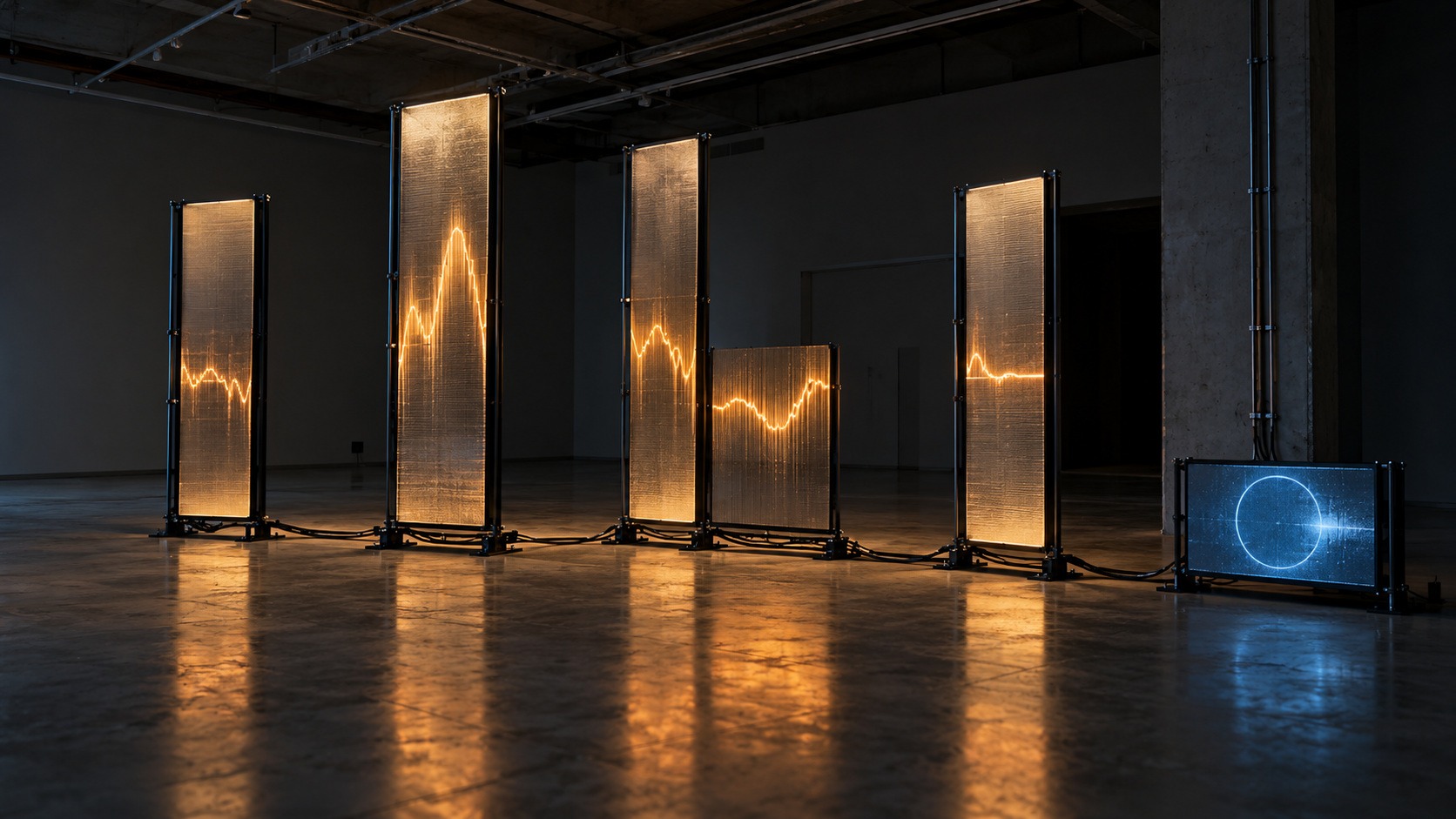
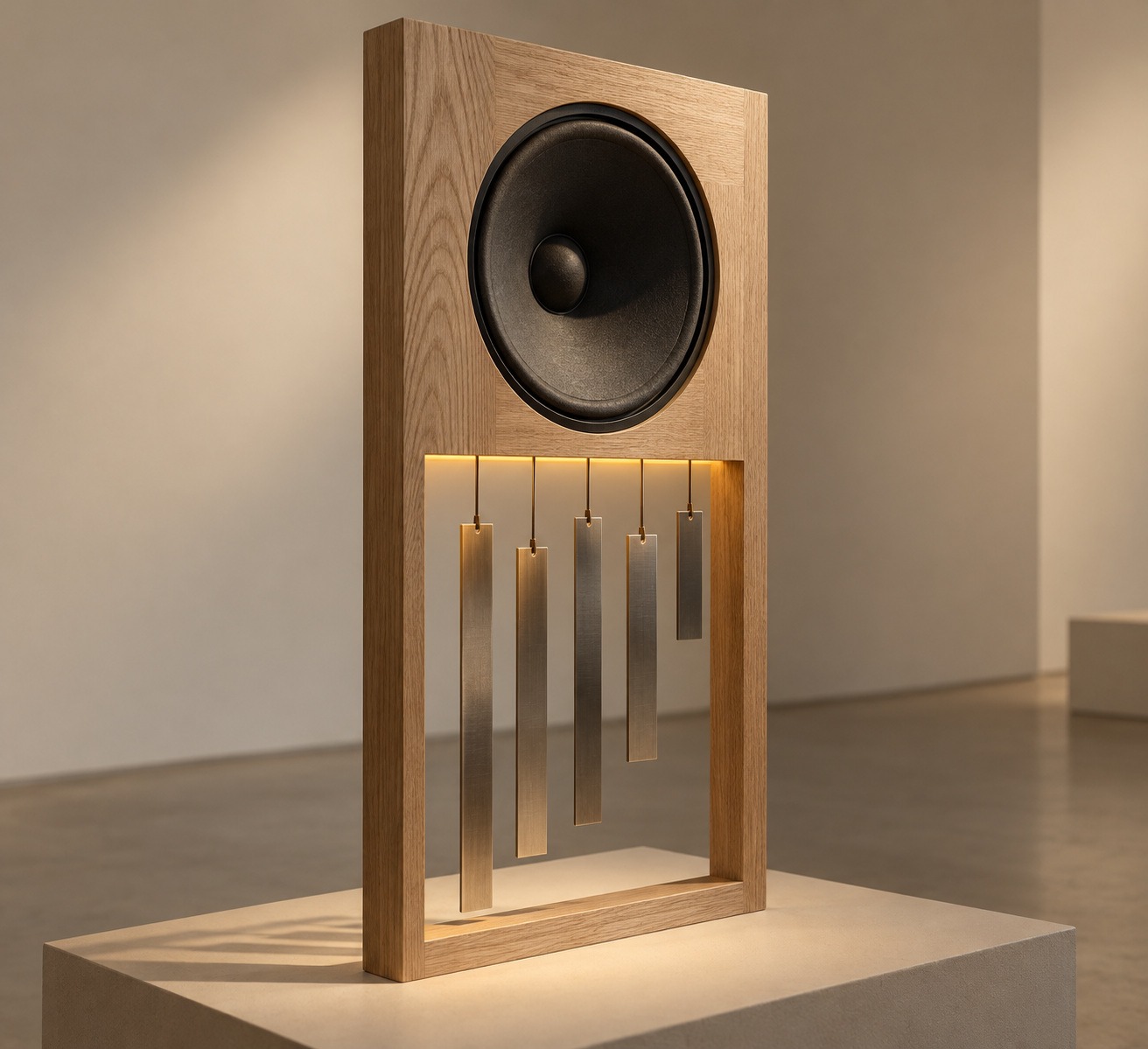
Five original imagined installations examine electronic signals, participation and sound. They are proposals, not documentation of functioning hardware or historical artworks.
Select an image for a closer look. Use the thumbnails, arrow keys or a swipe to compare examples. Zoom in to inspect details, or share the image that inspires you.
Creative toolbox · take this style further
Choose an input and a destination. Search sends your words to the chosen site; Copy & open puts them on your clipboard to paste there.
Create with AI
Turn your chosen input into an image prompt or a new creative direction.
ChatGPT
Copy your input and paste it into a ChatGPT conversation or image request.
Copy & open ChatGPT (new tab)Claude · Anthropic
Develop an image prompt or explore the style in a new Claude conversation.
Copy & open Claude · Anthropic (new tab)Midjourney
Paste your input into the Imagine bar on the Create page.
Copy & open Midjourney (new tab)Adobe Firefly
Copy your input, open Firefly, and paste it into the prompt field.
Copy & open Adobe Firefly (new tab)Leonardo.Ai
Copy your input, open Leonardo, and paste it into the generation field.
Copy & open Leonardo.Ai (new tab)Image search
Find visual references. Short, concrete keywords usually work best.
Lexica
Search AI images and prompts using your selected input.
Search with this input Lexica (new tab)Pexels
Search the photo and video library. Short keywords often work best.
Search with this input Pexels (new tab)Pixabay
Search photos, illustrations and other images.
Search with this input Pixabay (new tab)Unsplash
Search photographs using the style name or your own keywords.
Search with this input Unsplash (new tab)Wikimedia Commons
Search photographs, artworks and historical images. Check each file for its source and reuse terms.
Search with this input Wikimedia Commons (new tab)Art & research
Explore artists, collections and the ideas behind a style.
Wikipedia
Search for background reading. A style may not have its own article.
Search with this input Wikipedia (new tab)WikiArt
Copy your input into WikiArt’s search to explore artists and artworks.
Copy & open WikiArt (new tab)Europeana
Paste your keywords into the search to explore European museum, library and archive collections.
Copy & open Europeana (new tab)Inspiration
Discover portfolios and visual ideas from creative communities.
Instagram hashtags
Search a hashtag made from your input: spaces and punctuation are removed. Instagram may require sign-in.
Search with this input Instagram hashtags (new tab)ArtStation
Paste your input into artwork search for concept art, environments, characters and visual development.
Copy & open ArtStation (new tab)Behance
Paste your input into project search for illustration, design and visual storytelling.
Copy & open Behance (new tab)A closer look
Look for relationships between signal, display, physical arrangement, time and audience. Screens, light and sound may be materials, but neon color and circuit-board decoration alone do not define the field.
Start with the system, not the glow
Electronic art is an umbrella for practices in which electronic processes contribute to the work’s operation or meaning. An analog video feedback loop, a sensor-driven sound installation and a software-controlled light sculpture may all qualify. Digital art emphasizes digital computation or representation; the two fields overlap, but electronic art also includes analog processes. A static picture of a robot can depict technology without itself being an electronic artwork in this stronger sense.
A history of experiments across media
Nam June Paik is a central historical reference because his work joined television, performance, music and sculptural arrangement. ZKM’s account of his practice describes experiments with television in 1963 and the development of a video synthesizer in 1969–70. These examples correct the idea that electronic art suddenly began with contemporary AI image tools. They also show that collaboration and apparatus can be as important as a finished screen image.
ZKM’s Internet Dream account describes a wall of fifty-two monitors that alternate between individual images and a larger overall composition. Here the physical grid, changing rhythm and channels all participate in the work. A photograph conveys the arrangement but cannot reproduce its temporal behavior. Treat such documentation as a partial view, and avoid assigning a particular circuit, software package or algorithm to a work without evidence.
Five decisions that shape the experience
Define an input, a transformation, an output, a duration and a viewer relationship. Input might be a prerecorded signal or a deliberate visitor action; transformation could be delay, filtering or a rule that changes light intensity. Output might be sound rather than an image. A work becomes legible when these relationships are intentional, even if the viewer does not see every mechanism.
For a visual composition, decide whether multiple displays behave like windows, a single fragmented surface or independent voices. Vary scale only when it helps that relationship. Leave darkness around a concentrated light source, or use a bright room to make the apparatus visible. A restricted palette can clarify a signal more effectively than constant multicolor activity. In a still illustration, show the actual proposed arrangement rather than hiding every object in luminous fog.
Interaction should have a consequence
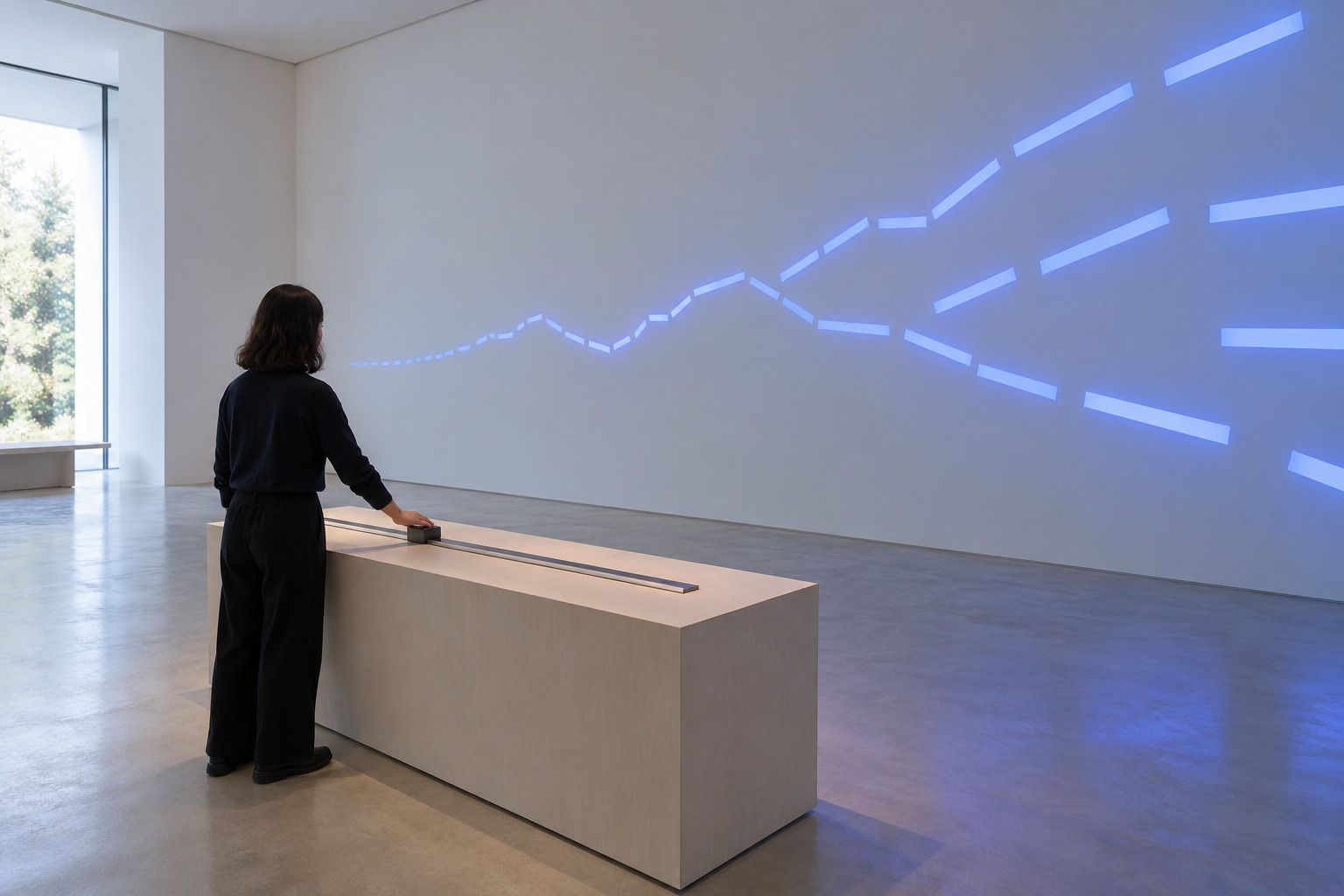
A practical exercise is to design an installation in which one voluntary gesture produces a small, understandable change. Imagine a visitor moving a plain slider that shifts a projected line from continuous to interrupted. Write what happens immediately, what persists and how the work returns to its starting state. The visitor should be able to notice a relationship without needing an engineering diagram.
For a physical implementation, develop and test the system with appropriate expertise; a generated image is a visual proposal, not an electrical plan. Consider accessibility, sound spill, viewing position and an experience that does not depend solely on color. If a camera or microphone is involved, make its role understandable and consider whether the concept works without recording personal information.
Preserve behavior as well as appearance
Electronic artworks can depend on equipment, files and decisions that become difficult to reproduce. Documentation should distinguish an installation photograph from operating instructions, source materials and the artist’s intended behavior. Replacing a monitor may preserve an image while changing scale, light or spatial presence. There is no universal rule that newer hardware is an equivalent substitute.
For AOI prompts, describe visible form and proposed behavior separately. Ask for a coherent installation view, then write the interaction score in prose. Do not claim that a static generated picture contains a functioning neural network, responsive sensor or sound system. The strongest studies make the relationship between object and signal readable without pretending that a still image has already performed the experiment.
About this guide
This AI-authored AOI guide appears under Penny Wraiter, AOI’s editorial persona. Sources support the historical context; exercises, prompts and poetry are original editorial interpretations. Image captions distinguish generated studies from documented works.
Score the behavior in time
Describe a work as a short sequence: what the visitor first notices, what changes after an action, and what happens when nobody interacts. Give each state a deliberate duration or condition. An installation that is visually attractive in a still photograph may remain confusing if its transitions provide no readable connection between action and response.
Test the quiet state as carefully as the busiest one. A restrained idle sequence can establish a rhythm against which an interruption becomes meaningful. Record whether a reset restores the intended starting conditions, and document the controls needed to reproduce the behavior.
For an illustrated proposal, accompany the image with a simple account of the input, transformation and output. This keeps a concept grounded in an experience rather than asking a luminous surface to stand in for an unspecified technology.
A small poetic detour
Original words from the AOI studio.
Poetry
A line arrives before its sound.
The screen returns a borrowed face.
A second pulse interrupts the first,
then leaves an interval of space.
We move; the little field replies.
We wait; the circuit keeps its time.
Between the object and the signal,
a room becomes a changing rhyme.
The prompt workshop
Original creative exercises. These prompts create new illustrations, not documentary evidence.
One signal, one object
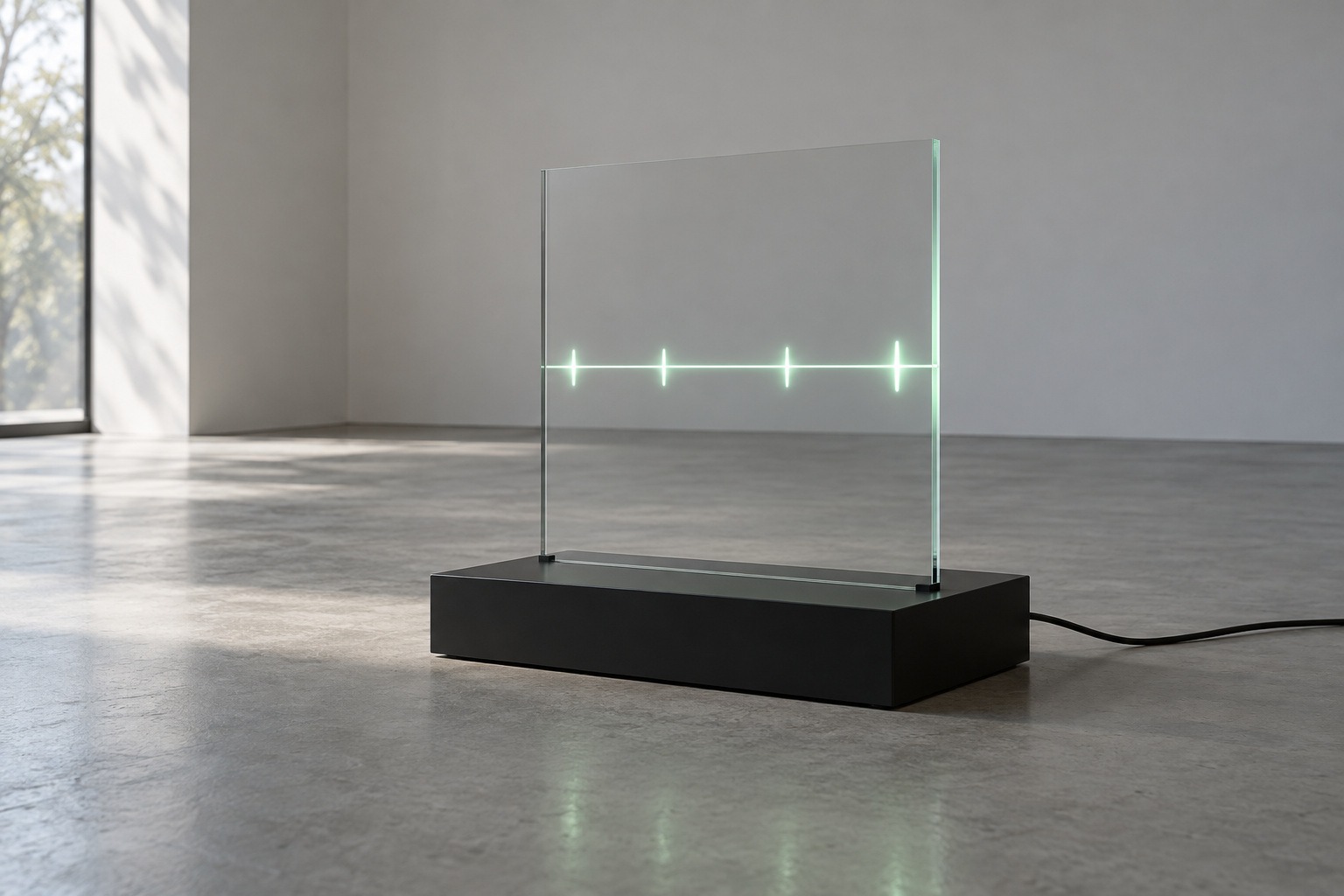
Create a concept photograph of an original electronic-art sculpture: a small translucent panel on a black plinth showing one pale green line that breaks into evenly spaced pulses. Visible cable routing, believable construction, soft neutral gallery light. No text or brands. This is an imagined installation, not proof of functioning electronics.
Independent voices
Design a gallery installation with seven differently proportioned screens, each showing a related monochrome wave at a different phase. Arrange them as a deliberate spatial rhythm with open intervals, visible supports and one standing adult visitor for scale. No copied Paik artwork, fake software labels or neon city scenery.
Make the interaction legible
Visualize a quiet interactive installation where a visitor uses a large accessible slider beside a projected horizontal line. Show an uncluttered room, clear reach space and restrained amber light. Separately describe input, transformation, response and reset behavior. Do not present the illustration as a tested engineering design.
A smile from the studio
Jokes
The screen asked for creative freedom. The artist gave it a carefully considered delay.