
Animated character and visual reference
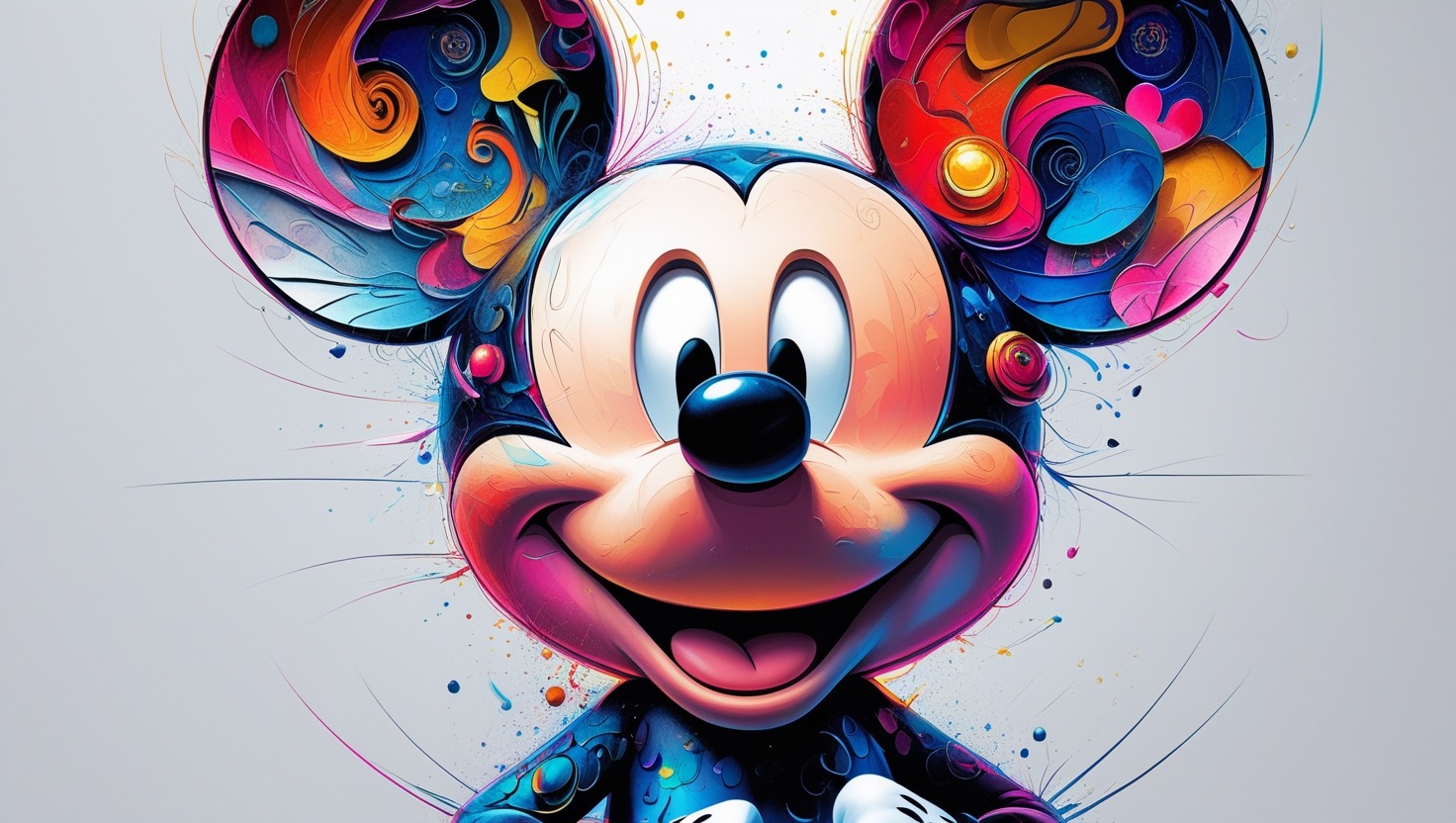
Mickey Mouse is a character, not a single art movement. Explore how his circular silhouette, contrasting shapes, expressive poses and changing screen designs turn a simple drawing into a readable personality.
A visual introduction
Select an image for a closer look. Use the thumbnails, arrow keys or a swipe to compare examples. Zoom in to inspect details, or share the image that inspires you.
Creative toolbox · take this style further
Choose an input and a destination. Search sends your words to the chosen site; Copy & open puts them on your clipboard to paste there.
Create with AI
Turn your chosen input into an image prompt or a new creative direction.
ChatGPT
Copy your input and paste it into a ChatGPT conversation or image request.
Copy & open ChatGPT (new tab)Claude · Anthropic
Develop an image prompt or explore the style in a new Claude conversation.
Copy & open Claude · Anthropic (new tab)Midjourney
Paste your input into the Imagine bar on the Create page.
Copy & open Midjourney (new tab)Adobe Firefly
Copy your input, open Firefly, and paste it into the prompt field.
Copy & open Adobe Firefly (new tab)Leonardo.Ai
Copy your input, open Leonardo, and paste it into the generation field.
Copy & open Leonardo.Ai (new tab)Image search
Find visual references. Short, concrete keywords usually work best.
Lexica
Search AI images and prompts using your selected input.
Search with this input Lexica (new tab)Pexels
Search the photo and video library. Short keywords often work best.
Search with this input Pexels (new tab)Pixabay
Search photos, illustrations and other images.
Search with this input Pixabay (new tab)Unsplash
Search photographs using the style name or your own keywords.
Search with this input Unsplash (new tab)Wikimedia Commons
Search photographs, artworks and historical images. Check each file for its source and reuse terms.
Search with this input Wikimedia Commons (new tab)Art & research
Explore artists, collections and the ideas behind a style.
Wikipedia
Search for background reading. A style may not have its own article.
Search with this input Wikipedia (new tab)WikiArt
Copy your input into WikiArt’s search to explore artists and artworks.
Copy & open WikiArt (new tab)Europeana
Paste your keywords into the search to explore European museum, library and archive collections.
Copy & open Europeana (new tab)Inspiration
Discover portfolios and visual ideas from creative communities.
Instagram hashtags
Search a hashtag made from your input: spaces and punctuation are removed. Instagram may require sign-in.
Search with this input Instagram hashtags (new tab)ArtStation
Paste your input into artwork search for concept art, environments, characters and visual development.
Copy & open ArtStation (new tab)Behance
Paste your input into project search for illustration, design and visual storytelling.
Copy & open Behance (new tab)A closer look
Round ears and a clear head silhouette; a contrasting face area; economical facial features; an elastic line of action; gloves and shoes used as readable accents in many later designs; a background organized around the performance.
A character whose design has a history
Mickey Mouse was developed by Walt Disney and Ub Iwerks in 1928. Steamboat Willie premiered on November 18 that year and became the character’s breakthrough release. MoMA credits Iwerks’s design and animation and Disney’s direction. Earlier Mickey shorts had already been made, so first production and first successful public release should not be treated as the same event.
The value of this reference for artists lies in more than a familiar costume. Mickey’s design shows how silhouette, proportion, timing and facial economy can sustain an expressive performance. Different films and later reinterpretations make different choices. A request for “Mickey Mouse style” is therefore incomplete until it identifies the intended visual approach.
Early graphic economy and later volume
The Walt Disney Family Museum describes changes from the early inkblot vocabulary and flexible rubber-hose limbs to later treatments. It notes that the gloves appeared in The Opry House in 1929, helping separate the hands from the dark body. Their practical readability matters as much as their familiarity.
D23 identifies The Pointer, 1939, as an important redesign, with a more pear-shaped body and pupils that expanded facial expression. The museum also distinguishes the special 1932 color appearance in Parade of the Award Nominees from The Band Concert, 1935, the first standard Mickey cartoon made in color. These distinctions help avoid mixing every familiar feature into an allegedly exact 1928 reconstruction.
Read the silhouette before the details
The head and ears create a strong first recognition, but the pose carries the action. Place the hands, feet and body so the gesture remains understandable in a small thumbnail. A hand crossing a dark torso needs separation; a shoe aligned with a background shape may lose its direction. Negative spaces around limbs are part of the drawing.
Simple forms still need consistent relationships. Keep the head, muzzle and eyes coordinated as the character turns. Treat the ears as a graphic design decision within the chosen version rather than as a demand for literal animal anatomy. Adding realistic fur and complex lighting changes the visual language and can weaken the clarity that made the construction effective.
Expression is a whole-body event
Curiosity can begin with a forward lean and a small pause in the hands. Confidence can open the chest and widen the stance. Surprise can interrupt a previously balanced pose. The face should reinforce that action rather than carry every emotion by itself. A mouth shape alone cannot explain what the character wants.
For a still illustration, choose a moment that implies a before and after: reaching for a runaway hat, steadying a wobbly stack, or discovering an unexpected object. For animation planning, distinguish anticipation, action and recovery. The change between poses often matters more than the decorative finish of any one frame.
Color and background serve the performance
A small number of strong color masses can keep the character legible. In a familiar later color interpretation, black forms, a pale face, white gloves, red shorts and yellow shoes provide a recognizable hierarchy. That palette should not be projected indiscriminately onto every historical version.
Backgrounds need not be busy. A quieter wall, sky or floor can make a small gesture easier to read. Reserve high contrast and precise edges for the important interaction. If a scene includes elaborate architecture or props, arrange them so they support the line of action and do not merge confusingly with the ears, hands or feet.
Sound, rhythm and visual invention
MoMA’s account of Steamboat Willie emphasizes the coordination of action and sound: ordinary objects and animals become part of a rhythmic performance. The useful artistic lesson is coordination. A scene feels purposeful when repeated shapes, gestures and timing contribute to the same comic event.
For an original study, invent a simple action and build the composition around its rhythm. A row of bouncing balls, a changing trail of paper or an unsteady stack can establish a beat without copying an existing film frame. The gallery uses newly generated, unofficial character illustrations; it does not present them as Disney production art, historical cels or frames from the films discussed.
A practical design-study workflow
Choose a broad approach first: monochrome rubber-hose interpretation, later color cartoon, pencil animation study or a deliberately graphic poster-like illustration. Make one clear pose, test it as a silhouette, then add expression and selected details. Keep the background subordinate until the action reads.
When prompting, name the character, the action, the chosen rendering approach and the framing. Ask for a specific emotional beat rather than a catalogue of adjectives. Review hand structure, ear placement, costume consistency and contact with the ground. An appealing image can still fail as a useful study if its anatomy or action is ambiguous.
Positive editorial assessment — AI-authored
Mickey’s design demonstrates how a few coordinated shapes can support a wide expressive range. Clear silhouettes and economical features make small gestures visible, while changes in pose and staging allow the character to feel active rather than merely emblematic.
Critical editorial assessment — AI-authored
Recognition can become a shortcut. Repeating the familiar grin and costume without a specific action produces an icon but little performance. Mixing incompatible design eras can also create a confusing study. Choose the intended approach, give the character a concrete problem and let the pose carry the idea.
Neutral editorial assessment — AI-authored
Mickey Mouse is useful as a case study in character design and animation history. His many appearances cannot be reduced to one unchanging style. An analytical article should distinguish documented production history from contemporary interpretations and assess each image through clarity, construction and expressive purpose.
Pocket-sized facts
Steamboat Willie premiered on November 18, 1928.
The Opry House (1929) introduced Mickey’s gloves.
The Pointer (1939) is an important redesign discussed by Disney’s archival reference.
Generated illustrations here are unofficial contemporary studies, not historical production art.
A small poetic detour
Original words from the AOI studio.
Poetry
A circle turns to hear the rain;
a lifted hand delays the fall.
The smallest pause begins a tale,
a shadow waits beside the wall.
A line leans forward, finds its feet,
and gives a simple shape a chance:
not every drawing needs to speak
to make the room expect a dance.
The prompt workshop
Original creative exercises. These prompts create new illustrations, not documentary evidence.
A clear comic action
Create a new unofficial illustration of Mickey Mouse trying to catch a plain hat lifted by a small gust of wind. Use a clean later-color 2D cartoon interpretation, readable round-ear silhouette, expressive balanced pose, clear white-gloved hands, red shorts and yellow shoes, a simple pale-blue park background and one strong line of action. No logos, signatures or copied film composition.
A monochrome movement study
Create a new unofficial monochrome rubber-hose-inspired illustration of Mickey Mouse balancing a stack of three blank boxes on a quiet stage. Bold black and white masses, elastic but coherent limbs, a clear silhouette, comic anticipation and an economical background. This is a contemporary interpretation, not an exact historical model sheet. No text or faux archival marks.
A quiet expressive moment
Create a new unofficial pencil animation-study illustration of Mickey Mouse examining a tiny sprouting plant on a windowsill. One thoughtful pose, readable eye direction, light construction lines, carefully organized hands and ears, generous blank paper around the figure, no labels, signatures or imitation production stamps.
Your next inspiration
Discover another art style
Follow a visual thread to the next subject.
Cartoon Drawing: Character, Exaggeration and Visual Timing
Study the broader principles of expressive cartoon drawing.

Digital Drawing: Line, Layers and Deliberate Visual Decisions
Consider digital drawing as a production method.
A smile from the studio
Jokes
The animator asked for a little more anticipation. The hat replied that it had been waiting three drawings already.