
Established
Mathematical Art is a broad field in which geometry, symmetry, topology, iteration, algorithms and quantitative relationships become artistic material. It spans drawing, painting, sculpture, textiles, architecture and digital work, with many visual languages rather than one fixed look.
A visual introduction
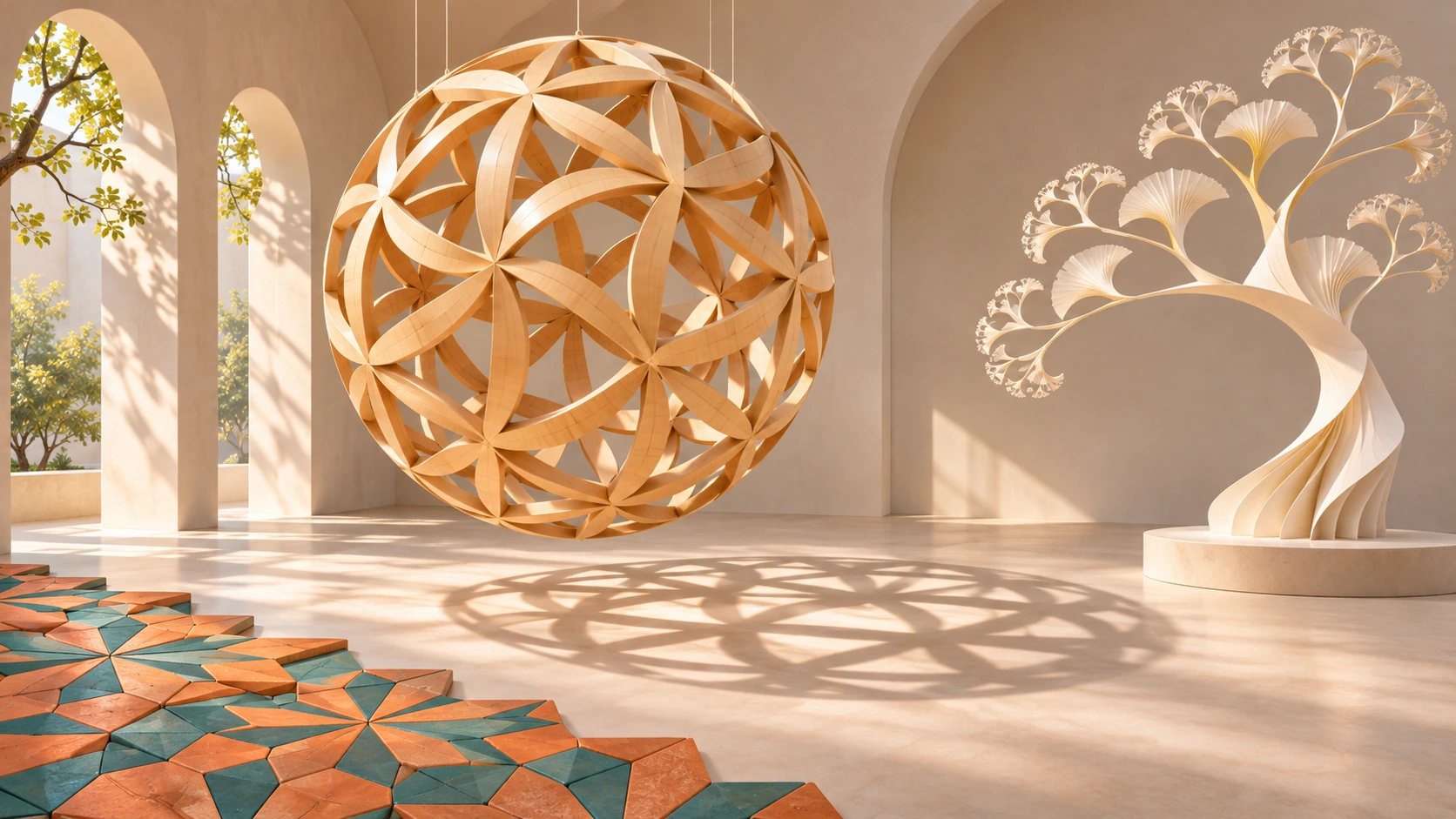
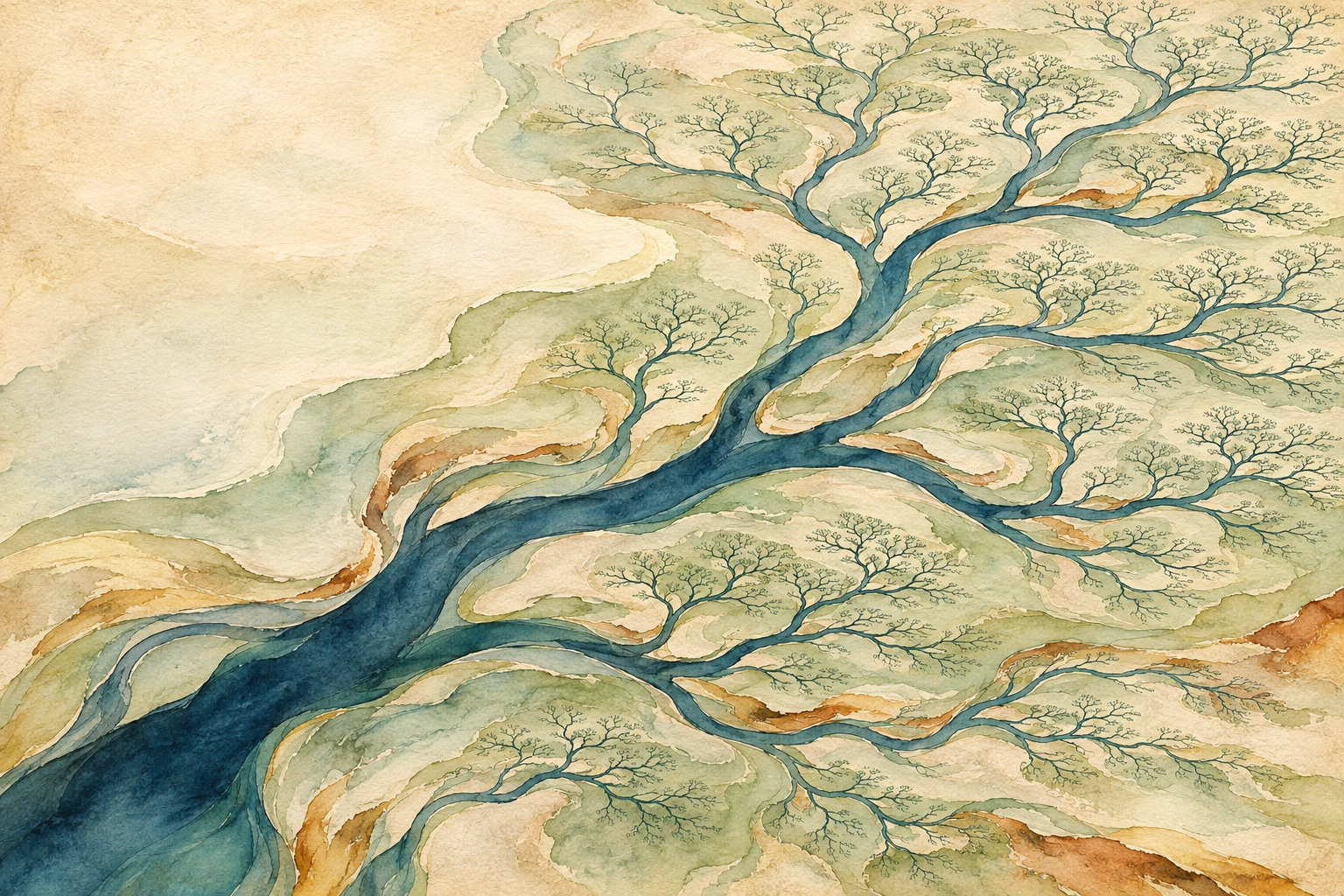
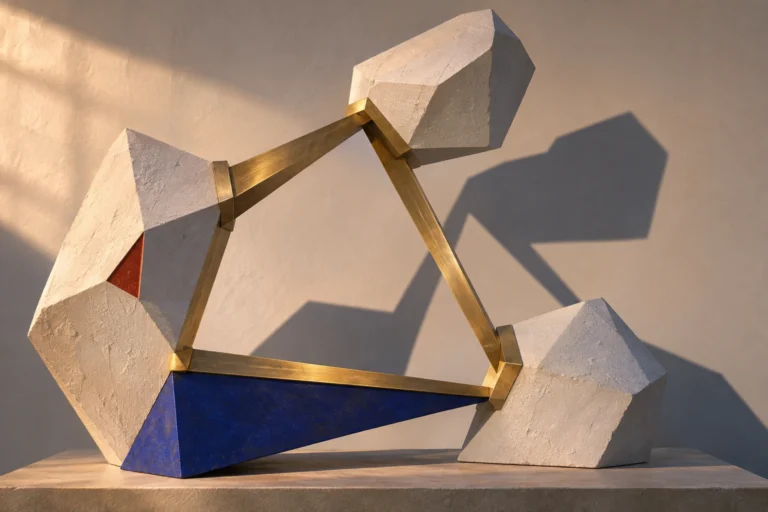
Five original AI-generated interpretations introduce patterned planes, sculptural connections and recursive forms. They illustrate artistic possibilities, not certified mathematical constructions.
Select an image for a closer look. Use the thumbnails, arrow keys or a swipe to compare examples. Zoom in to inspect details, or share the image that inspires you.
Creative toolbox · take this style further
Choose an input and a destination. Search sends your words to the chosen site; Copy & open puts them on your clipboard to paste there.
Create with AI
Turn your chosen input into an image prompt or a new creative direction.
ChatGPT
Copy your input and paste it into a ChatGPT conversation or image request.
Copy & open ChatGPT (new tab)Claude · Anthropic
Develop an image prompt or explore the style in a new Claude conversation.
Copy & open Claude · Anthropic (new tab)Midjourney
Paste your input into the Imagine bar on the Create page.
Copy & open Midjourney (new tab)Adobe Firefly
Copy your input, open Firefly, and paste it into the prompt field.
Copy & open Adobe Firefly (new tab)Leonardo.Ai
Copy your input, open Leonardo, and paste it into the generation field.
Copy & open Leonardo.Ai (new tab)Image search
Find visual references. Short, concrete keywords usually work best.
Lexica
Search AI images and prompts using your selected input.
Search with this input Lexica (new tab)Pexels
Search the photo and video library. Short keywords often work best.
Search with this input Pexels (new tab)Pixabay
Search photos, illustrations and other images.
Search with this input Pixabay (new tab)Unsplash
Search photographs using the style name or your own keywords.
Search with this input Unsplash (new tab)Wikimedia Commons
Search photographs, artworks and historical images. Check each file for its source and reuse terms.
Search with this input Wikimedia Commons (new tab)Art & research
Explore artists, collections and the ideas behind a style.
Wikipedia
Search for background reading. A style may not have its own article.
Search with this input Wikipedia (new tab)WikiArt
Copy your input into WikiArt’s search to explore artists and artworks.
Copy & open WikiArt (new tab)Europeana
Paste your keywords into the search to explore European museum, library and archive collections.
Copy & open Europeana (new tab)Inspiration
Discover portfolios and visual ideas from creative communities.
Instagram hashtags
Search a hashtag made from your input: spaces and punctuation are removed. Instagram may require sign-in.
Search with this input Instagram hashtags (new tab)ArtStation
Paste your input into artwork search for concept art, environments, characters and visual development.
Copy & open ArtStation (new tab)Behance
Paste your input into project search for illustration, design and visual storytelling.
Copy & open Behance (new tab)A closer look
Look for relationships that organize the work: repetition and variation, interlocking units, measured intervals, connected surfaces, nested scales or visible rules. Color and material can vary freely; the mathematical idea may be structural, procedural or an explicitly imaginative reference.
A broad field, with many visual languages
Mathematical Art brings mathematical ideas into artistic form, process or subject matter. A tiling, a woven surface, a drawing made from repeated instructions and a sculpture organized around spatial relationships can all belong to this broad field. It is not one historical movement with a founder, fixed palette or compulsory material. Its useful common question is: what does the mathematical relationship make possible for the artwork?
Sometimes the mathematics is explicit and reproducible. Sometimes it informs a composition without appearing as notation. A third approach imagines mathematical structures freely. These approaches can produce compelling art, but their claims differ: a picture inspired by a knot is not automatically a verified knot diagram. This overview introduces the main routes and connects them to more focused AOI entries.
Historical connections without a single origin story
Geometric ornament offers a long and culturally specific meeting of construction and visual invention. The Metropolitan Museum describes Islamic geometric designs built from circles, squares, stars and polygons across architectural surfaces and objects. Geometry is one part of these traditions, alongside other forms of ornament. Reducing their meanings and craftsmanship to a universal formula would miss much of the art.
Escher in The Palace documents M. C. Escher’s study of patterns at the Alhambra and his engagement with George Pólya’s symmetry systems. His interlocking figures made the relationship between a motif and the surrounding space unusually vivid. This is an important connection, not evidence that mathematical art began with Escher.
The V&A records a different route through electronics and computation: Ben Laposky’s Oscillon 40 used an oscilloscope, while Vera Molnár and Manfred Mohr developed computational drawings with plotters. Molnár also worked with compositional rules before gaining computer access. Today, Bridges brings mathematical connections in visual art, music, architecture and culture into a shared forum. These examples show overlapping practices rather than a tidy succession of styles.
Geometry, symmetry and tiling: what stays the same?
Geometry concerns shapes and their relationships in space. Symmetry asks which transformations leave a structure unchanged: a turn, a reflection or a shift may preserve a design. A tessellation covers a surface without gaps or overlaps; it need not consist of regular polygons. These ideas can organize the whole picture or operate quietly in a border, joint or repeating fabric unit.
For an artist, the practical decisions are scale, interval, orientation and figure–ground balance. A repeated shape can form a calm field; changing its color can reveal a second pattern. Do not confuse visual repetition with a checked symmetry group. If the work claims to be a seamless repeat, test the boundaries. A single mismatched edge can become quite loud after it has been repeated forty times.
Solids, surfaces and topology: what connects to what?
Spatial work can explore polyhedra, curved surfaces, loops, interlocking components and the openings between them. Topological thinking directs attention toward connectedness and continuity rather than exact measurements. A twist or a hole can become the subject instead of a decorative afterthought. In a physical piece, thickness, joinery, balance and the viewer’s route matter as much as the initial diagram.
George Hart’s accounts of his sculpture show how mathematical relationships become material decisions: repeated components, polyhedral structure, carefully arranged crossings and methods of assembly. This route is tactile as well as visual. A model can help someone ask how a form holds together before they know the technical vocabulary. An elegant render, however, does not establish that a proposed object is buildable.
Recursion, fractals and systems: what happens when a rule returns?
Recursion reuses a procedure within its own construction. Repeated scaling can create nested structures and the impression that detail continues beyond what is visible. Fractal imagery often explores such relationships across scales; some fractal systems use more complex forms of recurrence. A finite print or screen shows a finite rendering, not literally infinite detail.
Artists can choose which scales dominate, where an iteration stops, and whether smaller features support or bury the composition. Fractal Art is one branch of the overview, not a synonym for all Mathematical Art. A branching drawing may be fractal-like without being the output of a specified fractal algorithm. If a work claims a particular construction, retain the generating rule and check it; visual resemblance alone cannot supply that evidence.
Algorithms, chance and variation: what is the instruction?
An algorithm is a precise set of steps. An artistic system might repeat a mark, rotate it by a chosen amount, change one parameter or introduce controlled randomness. It can be followed by hand, executed by a plotter or programmed on a computer. Algorithmic Art overlaps strongly with Mathematical Art, while also encompassing rules whose interest is linguistic, social or conceptual.
The artist still makes consequential choices: the rule, its limits, the output selection, the material and the presentation. Compare several results while changing one variable at a time. Record a random seed when reproducibility matters. Chance does not remove authorship, and a complicated procedure does not excuse a weak composition. Sometimes the most expressive result is the one with fewer instructions.
Numbers, networks and motion: what is being represented?
Quantities can be translated into spacing, length, position, color, sound or movement. Connections can become a network of lines and nodes; a sequence can organize a woven rhythm; changing values can drive an animation. This offers routes into data art, kinetic work and audiovisual composition. Here the important artistic choice is the mapping between a relationship and something the viewer can perceive.
If an image presents itself as data-driven, identify the data and explain the mapping. Invented values can serve an artistic exercise, but should not masquerade as measured evidence. A beautiful network does not by itself prove a social or scientific claim. Similarly, a geometric composition can use a proportion deliberately without claiming that one ratio explains all beauty.
How to look, make and use it
Start with one relationship that can be described in an ordinary sentence: every tile shares an edge; each branch repeats at a smaller scale; a line changes direction at regular intervals. Decide what remains constant and what can vary. Make a small study, then test both the structure and the visual hierarchy. Give the eye somewhere to begin and enough quiet space to understand the rule.
For wall art, consider the distance at which small relationships remain readable. For textiles, test repeats and seams. For furniture and architecture, material constraints and professional design checks sit alongside the geometric concept. For education, separate a demonstrably correct construction from a speculative illustration. Mathematical Art can be handmade, monochrome, playful, materially rough or atmospheric; polished neon spirals are only one possible appearance.
Reading the five illustrations on this page
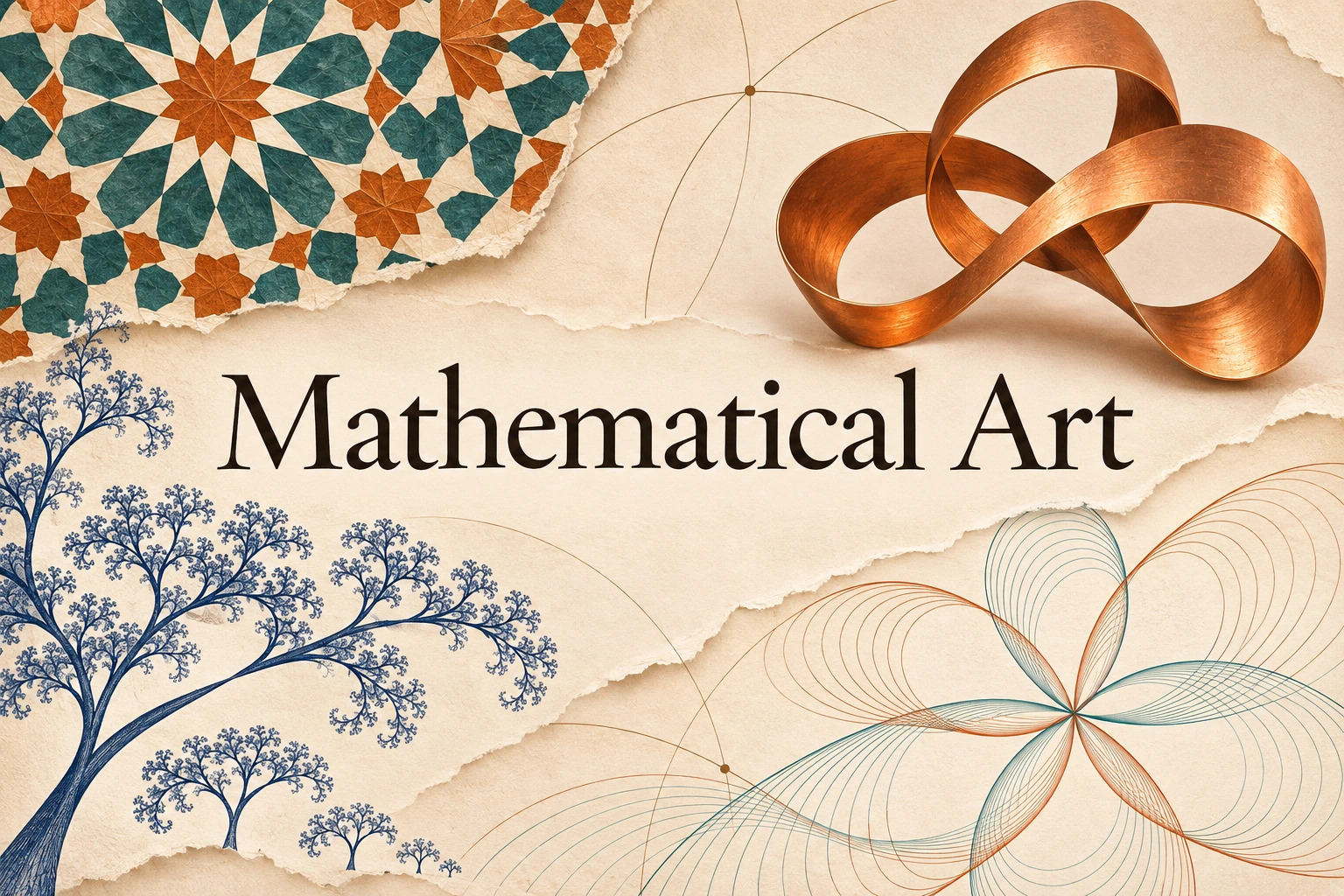
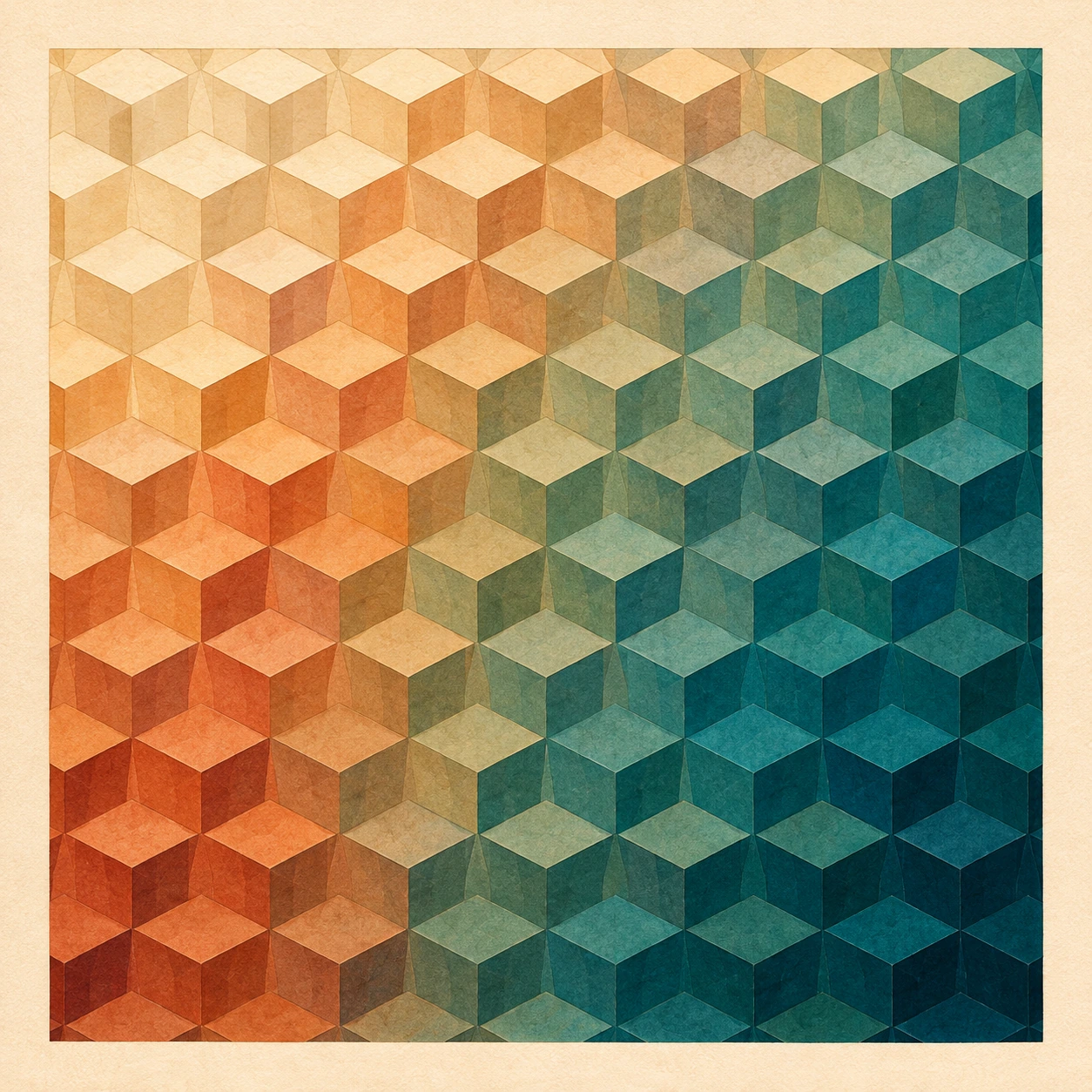
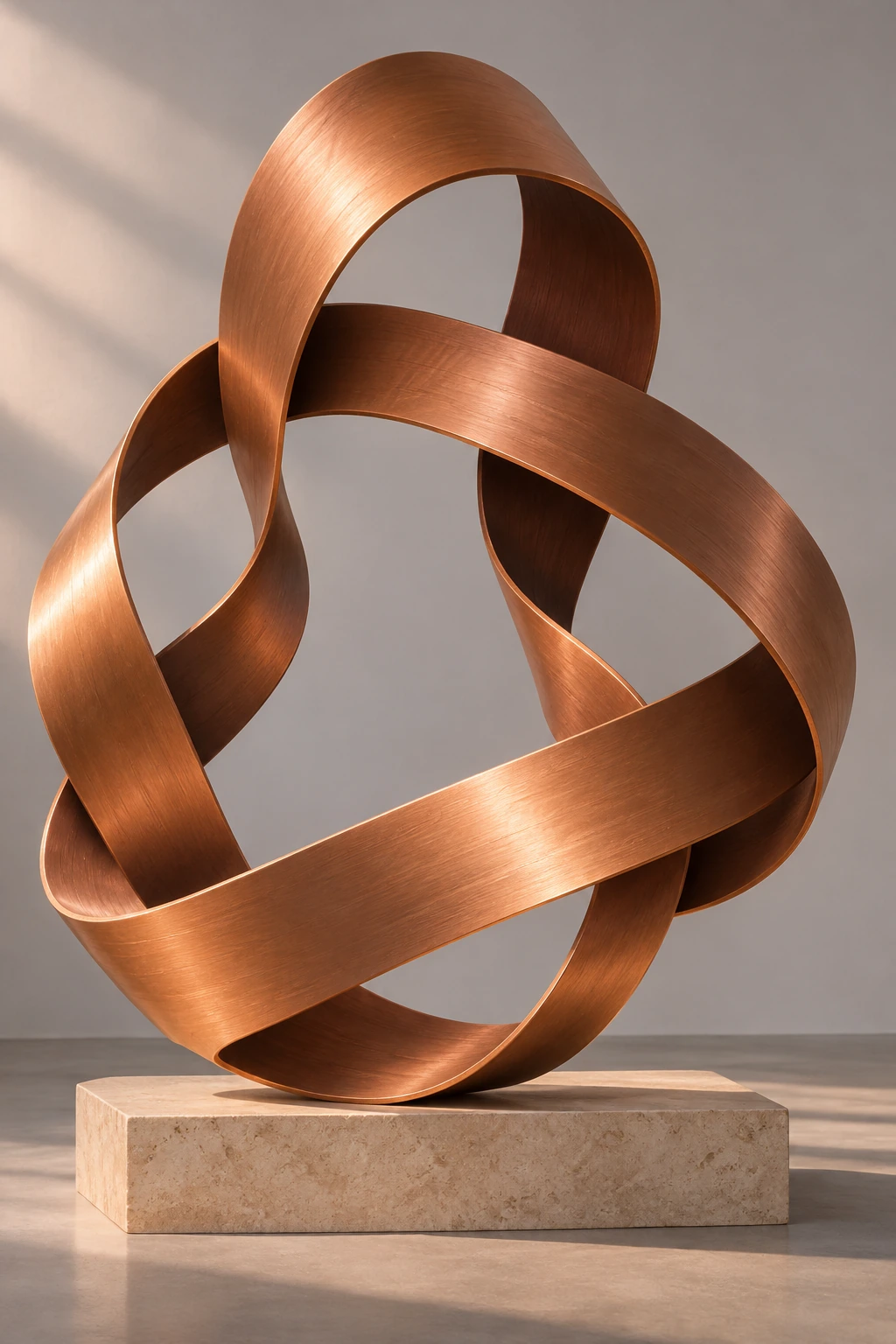
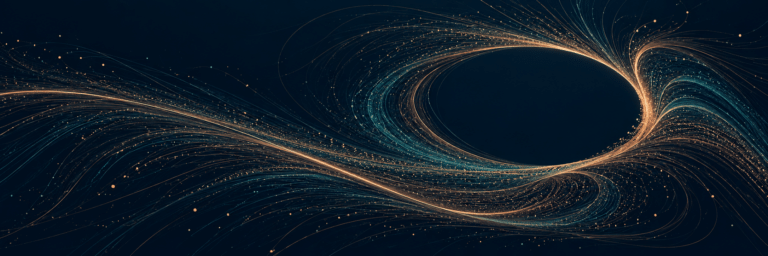
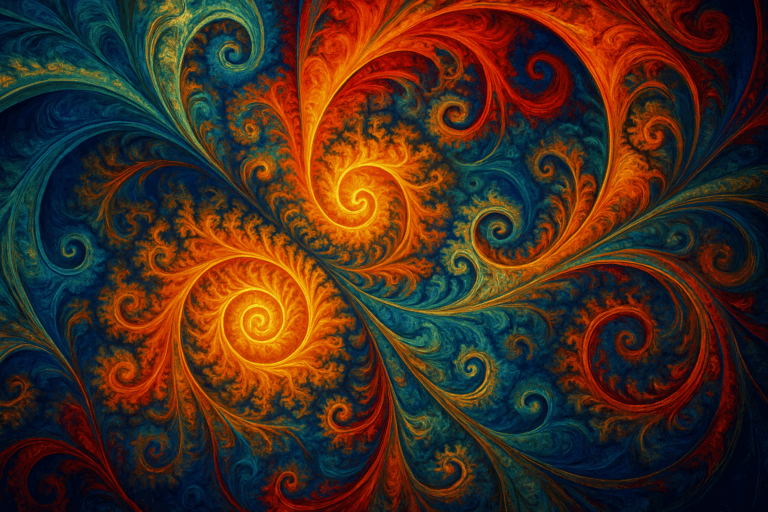
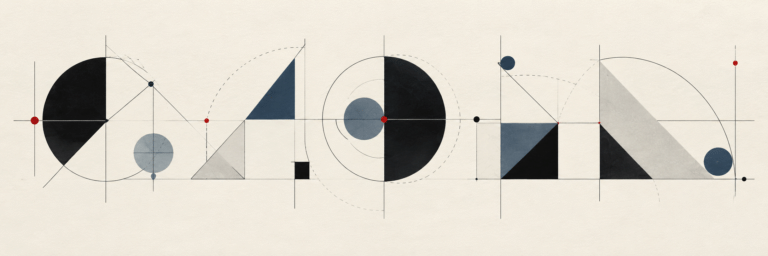
The banner and centrally titled collage introduce several visual routes. Three standalone studies explore a patterned plane, an intertwined sculptural form and a branching landscape organized by repetition across scales. Each is an original AI-generated interpretation made for this overview. They are not reproductions of historical works or photographs of fabricated objects.
These images demonstrate artistic possibilities rather than certify exact mathematical constructions. Where correctness matters, construct or calculate the geometry and verify it independently. Image generation can suggest materials, lighting and composition, but may introduce inconsistent joints, imperfect repeats or misleading crossings. The productive workflow is to use the image as a proposal, then decide which relationships must survive a more rigorous reconstruction.
A small poetic detour
Original words from the AOI studio.
Poetry
A line returns with room to change;
A square lets daylight through its frame.
The near becomes a little strange,
The far repeats a smaller name.
A loop remembers where it goes;
A pattern pauses at the seam.
Between the rule and what it shows,
The hand finds space enough to dream.
The prompt workshop
Original creative exercises. These prompts create new illustrations, not documentary evidence.
A pattern with a clear rule
Create an original mathematical-art illustration of interlocking geometric tiles, warm ivory and terracotta with a few dark teal accents, flat overhead composition, clear repeated units, fine paper texture and generous margins. Explore rhythm and figure–ground balance. No text. Treat the result as an artistic study; verify any claimed seamless tiling separately.
A relationship made sculptural
Create an original sculptural interpretation of mathematical art: a single continuous ribbon-like form loops through an open central space, brushed copper surface, readable over-and-under passages, soft gallery lighting and a restrained pale background. Make negative space as deliberate as the solid. No text. This is a concept rendering, not a validated topology or fabrication plan.
One rule, several scales
Imagine a mathematical-art landscape made from branching forms that echo at successively smaller scales. Begin with one strong branching silhouette, then reduce the detail toward distant layers. Ink-blue shadows, pale mineral green and warm paper, asymmetrical composition, no text. An artistic interpretation of recursion, not a computed fractal or scientific diagram.
Your next inspiration
Discover another art style
Follow a visual thread to the next subject.

A smile from the studio
Jokes
A tessellation, a fractal and a sculptor shared a studio. The tessellation booked every square centimetre. The fractal requested a smaller studio inside the studio, then another inside that. The sculptor made a loop and called it a day. When the landlord asked who would pay for the extra space, they explained that the problem was purely theoretical. The invoice was not.
Sources and further exploration
The Bridges Organization | A meeting place for mathematics, art, music and architecture
The Metropolitan Museum of Art | Geometric Patterns in Islamic Art
Escher in The Palace | Powerful patterns: tessellation and its sources
Victoria and Albert Museum | Digital art, plotters and algorithmic practices
National Museum of Mathematics | A glossary for mathematics and Escher
George W. Hart | Mathematical Awareness via Geometric Sculpture