
Mathematical and generative art approach
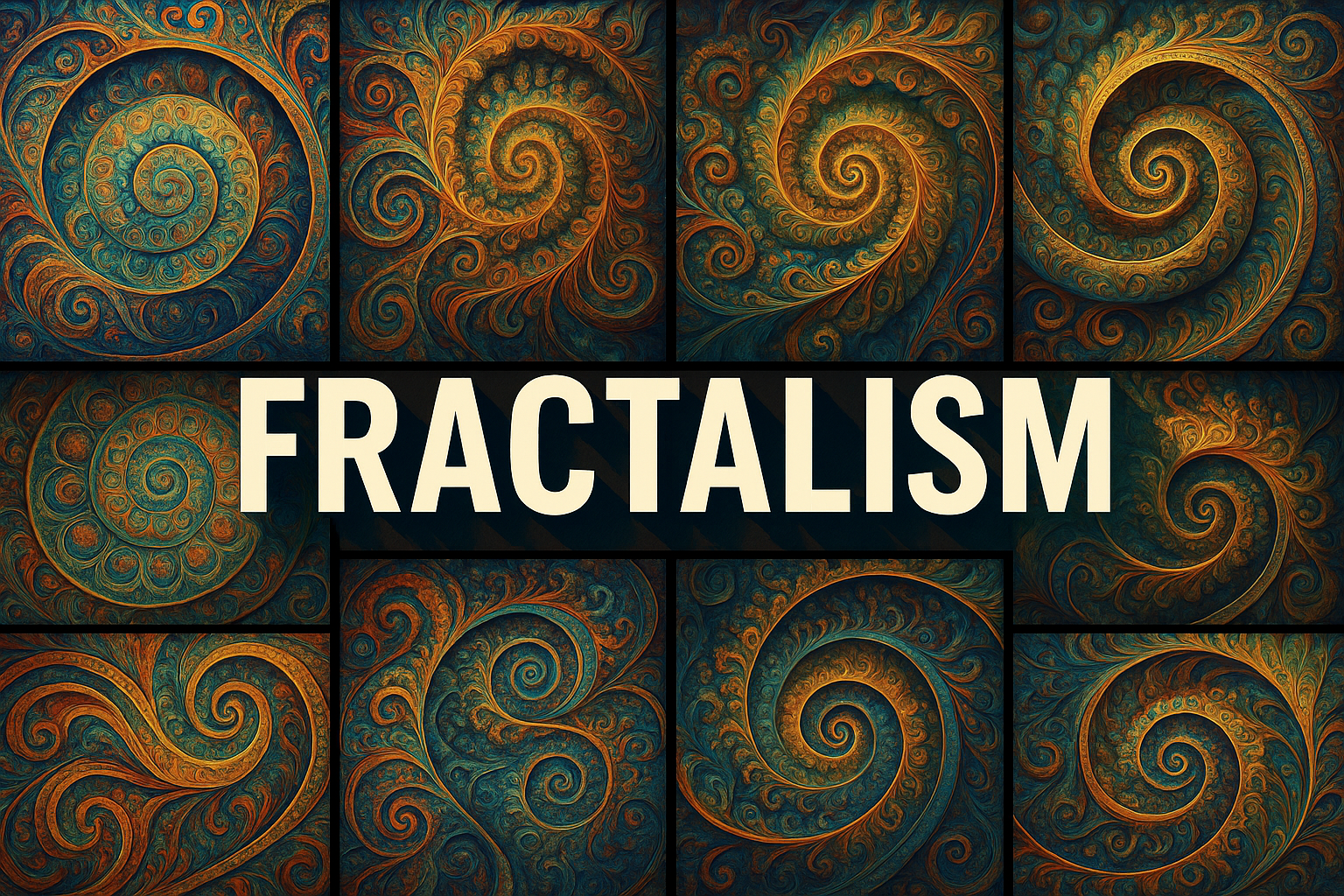
Fractal art uses mathematical structures or visual ideas associated with repeated patterns across scales. The entry’s older label, Fractalism, is used here descriptively rather than as evidence of a single organized historical movement.
A visual introduction
Select an image for a closer look. Use the thumbnails, arrow keys or a swipe to compare examples. Zoom in to inspect details, or share the image that inspires you.
Creative toolbox · take this style further
Choose an input and a destination. Search sends your words to the chosen site; Copy & open puts them on your clipboard to paste there.
Create with AI
Turn your chosen input into an image prompt or a new creative direction.
ChatGPT
Copy your input and paste it into a ChatGPT conversation or image request.
Copy & open ChatGPT (new tab)Claude · Anthropic
Develop an image prompt or explore the style in a new Claude conversation.
Copy & open Claude · Anthropic (new tab)Midjourney
Paste your input into the Imagine bar on the Create page.
Copy & open Midjourney (new tab)Adobe Firefly
Copy your input, open Firefly, and paste it into the prompt field.
Copy & open Adobe Firefly (new tab)Leonardo.Ai
Copy your input, open Leonardo, and paste it into the generation field.
Copy & open Leonardo.Ai (new tab)Image search
Find visual references. Short, concrete keywords usually work best.
Lexica
Search AI images and prompts using your selected input.
Search with this input Lexica (new tab)Pexels
Search the photo and video library. Short keywords often work best.
Search with this input Pexels (new tab)Pixabay
Search photos, illustrations and other images.
Search with this input Pixabay (new tab)Unsplash
Search photographs using the style name or your own keywords.
Search with this input Unsplash (new tab)Wikimedia Commons
Search photographs, artworks and historical images. Check each file for its source and reuse terms.
Search with this input Wikimedia Commons (new tab)Art & research
Explore artists, collections and the ideas behind a style.
Wikipedia
Search for background reading. A style may not have its own article.
Search with this input Wikipedia (new tab)WikiArt
Copy your input into WikiArt’s search to explore artists and artworks.
Copy & open WikiArt (new tab)Europeana
Paste your keywords into the search to explore European museum, library and archive collections.
Copy & open Europeana (new tab)Inspiration
Discover portfolios and visual ideas from creative communities.
Instagram hashtags
Search a hashtag made from your input: spaces and punctuation are removed. Instagram may require sign-in.
Search with this input Instagram hashtags (new tab)ArtStation
Paste your input into artwork search for concept art, environments, characters and visual development.
Copy & open ArtStation (new tab)Behance
Paste your input into project search for illustration, design and visual storytelling.
Copy & open Behance (new tab)A closer look
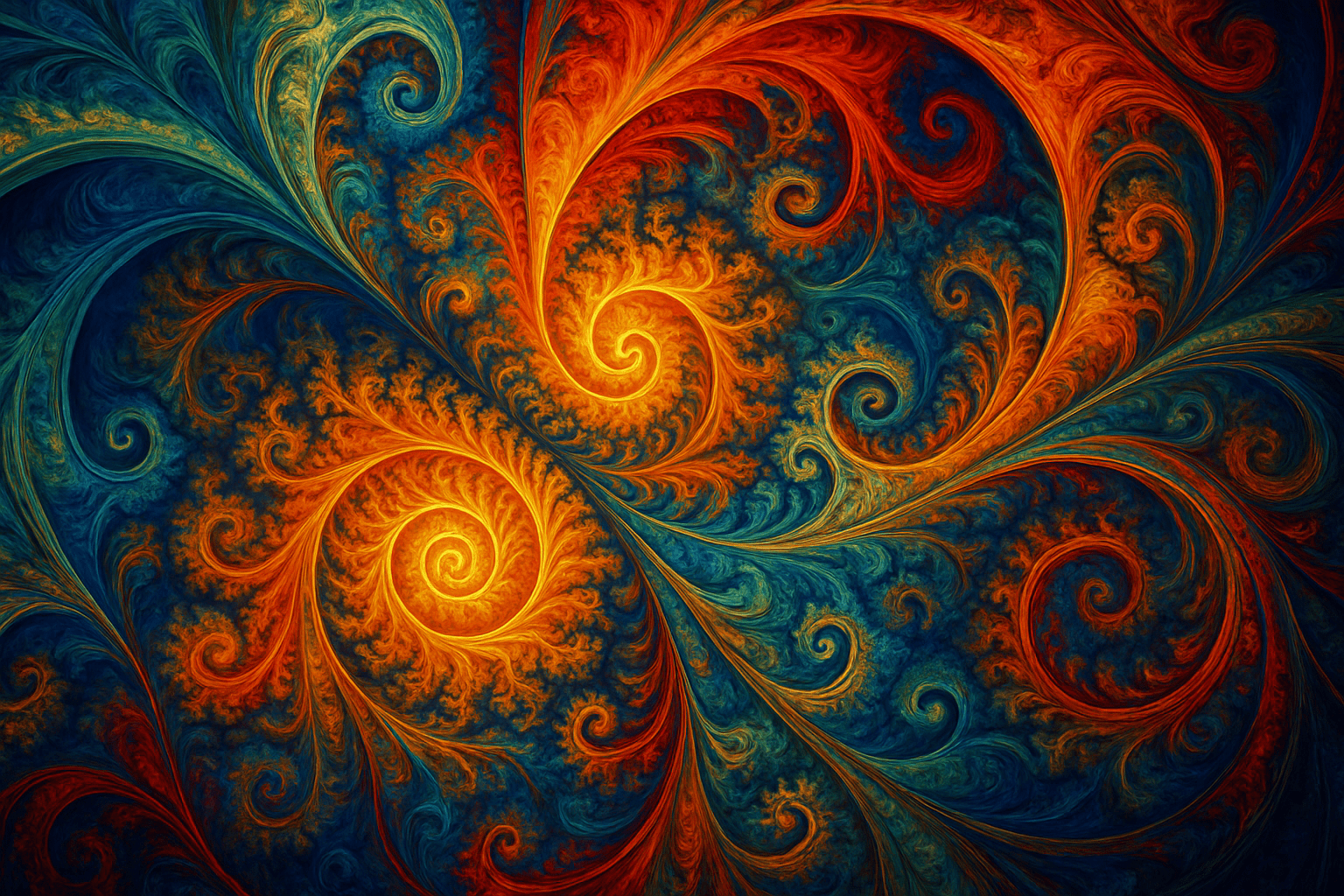
Nested structures, branching and repeated relationships can create depth and rhythm; a deliberate crop and color system make complexity readable.
Distinguish a structure from a resemblance
Wolfram MathWorld describes fractals through scale-related structure and gives examples including the Mandelbrot set and Sierpiński patterns. Exact repetition is not required in every case. Conversely, an intricate image is not automatically a mathematically defined fractal.
Separate calculated fractal imagery from a generated picture that merely resembles branching or recursive ornament. Both can be visually interesting, but only the former can be tied to a specified mathematical procedure and its parameters.
Iteration does not choose the artwork
In a Mandelbrot visualization, repeated calculation and an escape criterion can supply values that are mapped to color. The choice of region, iteration limit and coloring method affects the visible result. A finite image is a limited rendering, not literally an infinitely detailed object.
The artist still chooses a composition. Look for a dominant region, a transition in density or a route through the pattern. A technically intricate render can remain visually unfocused if every area competes equally.
Color should reveal relationships
Use color to distinguish structure rather than simply cycling through the full spectrum. A restrained palette can reveal a progression or isolate a boundary. Check whether neighboring colors retain enough value contrast at the intended output size.
Avoid making very fine detail responsible for the main composition. A small preview should still have an identifiable rhythm. If the image becomes visual noise when reduced, adjust the crop and larger color groupings before increasing calculation detail.
Keep the process reproducible
For calculated work, record the formula or system, parameters, region, rendering settings and color mapping. These details explain how the image was made and allow meaningful variations. They should not be invented after the fact for a generated illustration.
The prompts below describe fractal-inspired visual studies. They are not substitutes for computing or validating a particular mathematical set. Compare an algorithmically produced image with an interpretive one and label their processes accurately; resemblance alone cannot establish mathematical correctness.
The prompt workshop
Original creative exercises. These prompts create new illustrations, not documentary evidence.
Nested rhythm
Original fractal-inspired abstract study with nested branching forms, one dominant region and a restrained three-color palette, clearly an interpretation rather than a verified mathematical plot.
Scale transition
Original recursive-pattern-inspired image moving from broad quiet forms to finer branching detail, readable composition at thumbnail size and no all-over rainbow noise.
A deliberate crop
Original abstract study suggesting repeated spiral relationships across scales, asymmetric crop and controlled contrast, no claim of a specific computed formula.