
Tiling and pattern · Shapes meeting edge to edge
A tessellation covers a surface with tiles that meet without gaps or overlaps. In art, those tiles can be plain geometric units, decorated ceramics or recognizable figures. The pleasure comes from a reliable fit and from the rhythm made by repetition, rotation or reflection.
A visual introduction
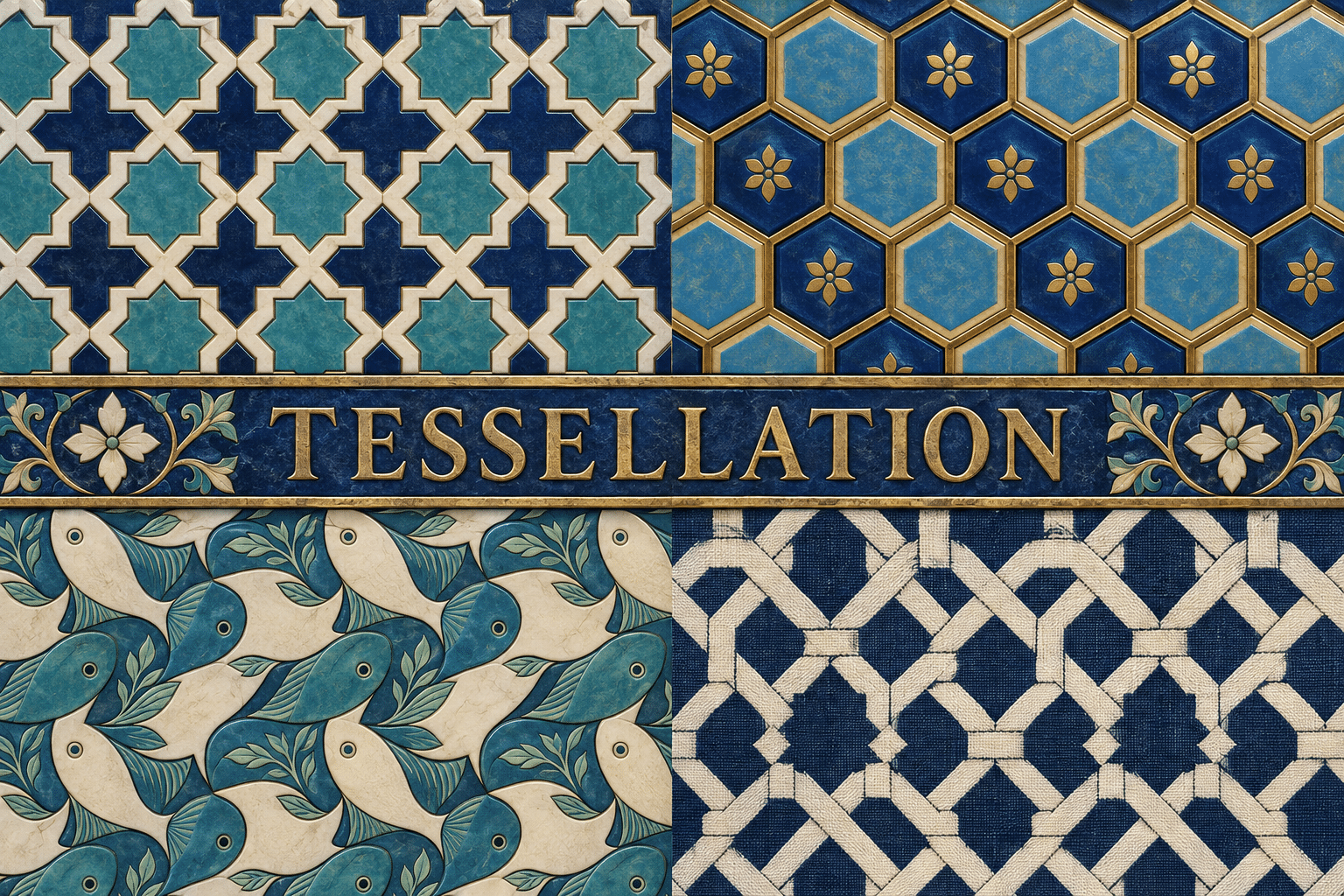
Compare a cross-and-star tile field with four studies of geometric and figurative tiling. These are original visual concepts; verify exact geometry before fabrication.
Select an image for a closer look. Use the thumbnails, arrow keys or a swipe to compare examples. Zoom in to inspect details, or share the image that inspires you.

Creative toolbox · take this style further
Choose an input and a destination. Search sends your words to the chosen site; Copy & open puts them on your clipboard to paste there.
Create with AI
Turn your chosen input into an image prompt or a new creative direction.
ChatGPT
Copy your input and paste it into a ChatGPT conversation or image request.
Copy & open ChatGPT (new tab)Claude · Anthropic
Develop an image prompt or explore the style in a new Claude conversation.
Copy & open Claude · Anthropic (new tab)Midjourney
Paste your input into the Imagine bar on the Create page.
Copy & open Midjourney (new tab)Adobe Firefly
Copy your input, open Firefly, and paste it into the prompt field.
Copy & open Adobe Firefly (new tab)Leonardo.Ai
Copy your input, open Leonardo, and paste it into the generation field.
Copy & open Leonardo.Ai (new tab)Image search
Find visual references. Short, concrete keywords usually work best.
Lexica
Search AI images and prompts using your selected input.
Search with this input Lexica (new tab)Pexels
Search the photo and video library. Short keywords often work best.
Search with this input Pexels (new tab)Pixabay
Search photos, illustrations and other images.
Search with this input Pixabay (new tab)Unsplash
Search photographs using the style name or your own keywords.
Search with this input Unsplash (new tab)Wikimedia Commons
Search photographs, artworks and historical images. Check each file for its source and reuse terms.
Search with this input Wikimedia Commons (new tab)Art & research
Explore artists, collections and the ideas behind a style.
Wikipedia
Search for background reading. A style may not have its own article.
Search with this input Wikipedia (new tab)WikiArt
Copy your input into WikiArt’s search to explore artists and artworks.
Copy & open WikiArt (new tab)Europeana
Paste your keywords into the search to explore European museum, library and archive collections.
Copy & open Europeana (new tab)Inspiration
Discover portfolios and visual ideas from creative communities.
Instagram hashtags
Search a hashtag made from your input: spaces and punctuation are removed. Instagram may require sign-in.
Search with this input Instagram hashtags (new tab)ArtStation
Paste your input into artwork search for concept art, environments, characters and visual development.
Copy & open ArtStation (new tab)Behance
Paste your input into project search for illustration, design and visual storytelling.
Copy & open Behance (new tab)A closer look
Follow one tile boundary across the surface. Check whether edges truly meet, whether a unit repeats, and how color changes the reading of figure and ground. A continuous pattern can be calm, intricate or deliberately surprising.
A pattern with a precise rule
For a flat tessellation, the pieces cover the plane without gaps or overlaps. Squares and hexagons provide straightforward examples. A decorative mark painted inside a square does not change the tile’s boundary, but it can make the repetition look more complex. A photographed wall shows only a finite section; a periodic pattern is one whose arrangement can repeat by translation.
The American Mathematical Society’s introduction to tilings distinguishes periodic and aperiodic arrangements and discusses tilings on other surfaces. Not every intricate pattern is a tessellation, and not every tessellation repeats one small unit. For image work, the useful test is concrete: choose a tile and trace its meeting edges across several neighboring copies.
Place craft and artists in context
The V&A describes a thirteenth-century Iranian panel built from crosses and eight-pointed stars. Its historical design is a specific work with its own materials and context, not a generic recipe to copy without attribution. The original AOI ceramic study on this page explores a different color and spacing arrangement while retaining a legible cross-and-star fit.
Museum Escher in The Palace describes M. C. Escher’s recurring interest in regular division of the plane, often using recognizable birds, fish or insects. Escher is one important practitioner of figurative tiling, not the inventor of tessellation. Claims in the former archive entry that unrelated modern painters were central tessellation artists have been removed.
Make the repeat earn its place
Begin with one unit on paper. Draw the exact tile edge, duplicate it and test four or more neighbors. If a shape is cut from one side and attached to another, preserve the matching edge so the altered unit can still meet its copies. Only then add glaze, texture or an animal suggestion.
Check the pattern at two distances. Up close, every junction should make sense; from across the room, the larger rhythm should survive. A generated image can suggest a convincing tiling, but optical effects and grout can hide small failures. Use a traced vector or physical template when mathematical exactness or fabrication is required.
A small poetic detour
Original words from the AOI studio.
Poetry
A corner meets another side;
The blue returns, the edges guide.
A little shape repeats its part,
Until a wall becomes a chart.
The prompt workshop
Original creative exercises. These prompts create new illustrations, not documentary evidence.
Start here · Cross and star
Original ceramic tessellation study of interlocking cross and eight-point star tiles, four complete repeated units, ultramarine, teal, ivory and muted gold glaze, edges meeting with no gaps or overlaps, no copied historic panel, no lettering.
Change the rule · Hexagonal field
Original precisely repeated hexagonal tile field with a clear unit cell; alternate dark blue and light teal glazes, a small gold floral mark inside some hexagons, coherent edge-to-edge boundaries, oblique daylight, no text or watermark.
Experimental · Figure and ground
Original flat decorative tiling in which simple bird-like silhouettes and their negative spaces alternate across several repeated units. Make every adjacent contour share a boundary and keep the pattern readable at thumbnail size. New shapes, no reproduction of an Escher print, no words.
Your next inspiration
Discover another art style
Follow a visual thread to the next subject.
A smile from the studio
Jokes
The hexagon joined the pattern because it fit in.
The tile artist left no gaps in the schedule.