
Decorative design · Pattern organized for a surface
Ornament organizes visual detail in relation to an object, surface or architectural setting. A border can frame an opening; a repeat can animate cloth; a carved rhythm can make an edge tangible. Ornament is a broad practice with many histories, not a synonym for excess or one universal style.
A visual introduction
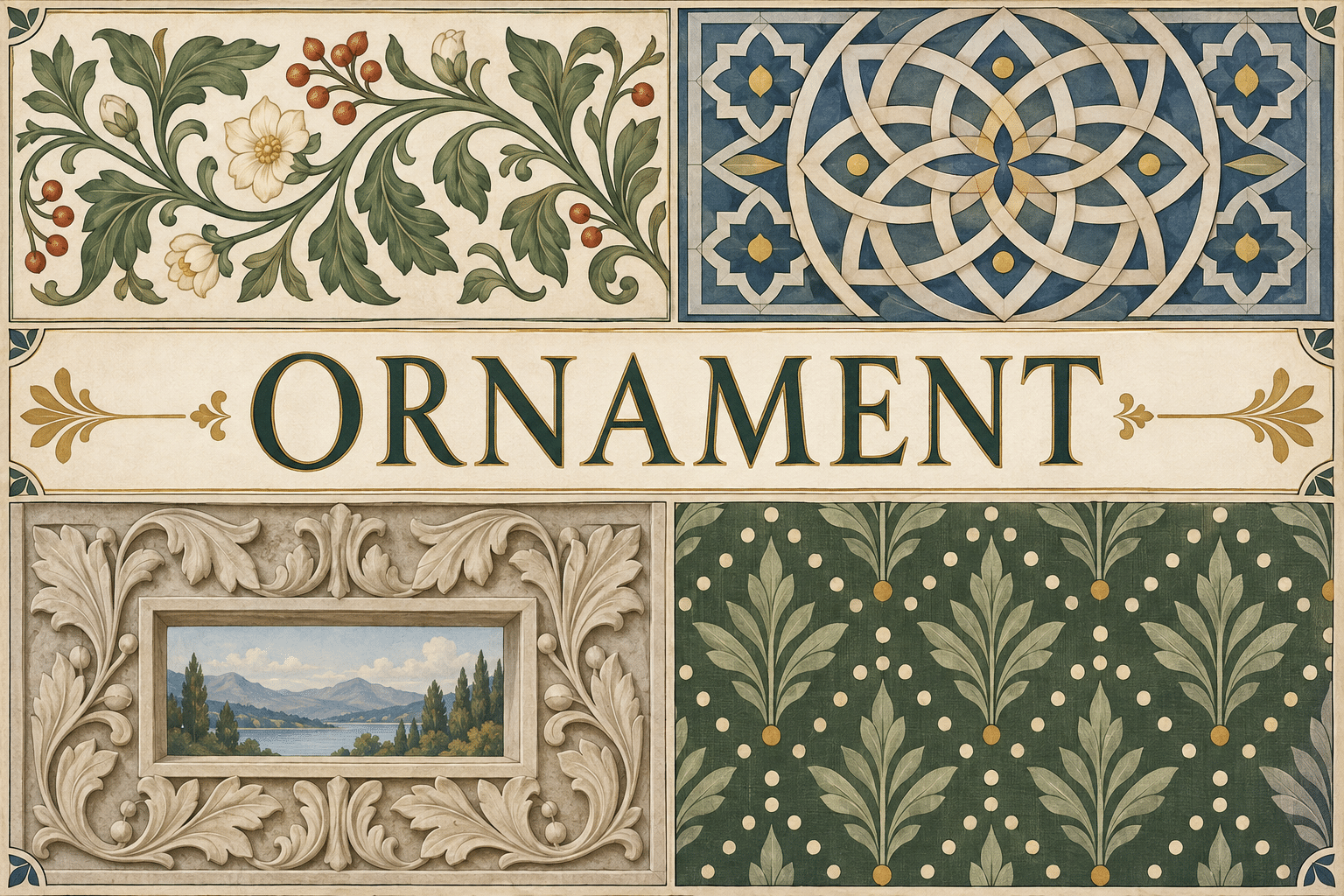
An original illustrative example and a centrally titled four-study collage. These AI-generated images explain visual possibilities; they do not document historical works or certify a physical construction.
Select an image for a closer look. Use the thumbnails, arrow keys or a swipe to compare examples. Zoom in to inspect details, or share the image that inspires you.
Creative toolbox · take this style further
Choose an input and a destination. Search sends your words to the chosen site; Copy & open puts them on your clipboard to paste there.
Create with AI
Turn your chosen input into an image prompt or a new creative direction.
ChatGPT
Copy your input and paste it into a ChatGPT conversation or image request.
Copy & open ChatGPT (new tab)Claude · Anthropic
Develop an image prompt or explore the style in a new Claude conversation.
Copy & open Claude · Anthropic (new tab)Midjourney
Paste your input into the Imagine bar on the Create page.
Copy & open Midjourney (new tab)Adobe Firefly
Copy your input, open Firefly, and paste it into the prompt field.
Copy & open Adobe Firefly (new tab)Leonardo.Ai
Copy your input, open Leonardo, and paste it into the generation field.
Copy & open Leonardo.Ai (new tab)Image search
Find visual references. Short, concrete keywords usually work best.
Lexica
Search AI images and prompts using your selected input.
Search with this input Lexica (new tab)Pexels
Search the photo and video library. Short keywords often work best.
Search with this input Pexels (new tab)Pixabay
Search photos, illustrations and other images.
Search with this input Pixabay (new tab)Unsplash
Search photographs using the style name or your own keywords.
Search with this input Unsplash (new tab)Wikimedia Commons
Search photographs, artworks and historical images. Check each file for its source and reuse terms.
Search with this input Wikimedia Commons (new tab)Art & research
Explore artists, collections and the ideas behind a style.
Wikipedia
Search for background reading. A style may not have its own article.
Search with this input Wikipedia (new tab)WikiArt
Copy your input into WikiArt’s search to explore artists and artworks.
Copy & open WikiArt (new tab)Europeana
Paste your keywords into the search to explore European museum, library and archive collections.
Copy & open Europeana (new tab)Inspiration
Discover portfolios and visual ideas from creative communities.
Instagram hashtags
Search a hashtag made from your input: spaces and punctuation are removed. Instagram may require sign-in.
Search with this input Instagram hashtags (new tab)ArtStation
Paste your input into artwork search for concept art, environments, characters and visual development.
Copy & open ArtStation (new tab)Behance
Paste your input into project search for illustration, design and visual storytelling.
Copy & open Behance (new tab)A closer look
Motif, repetition, interval, symmetry or deliberate asymmetry, border and field. The strongest design gives each element a role and resolves what happens at edges, corners and changes of scale.
A grammar, not a universal recipe
The V&A’s account of Owen Jones and The Grammar of Ornament provides a documented example of the study and publication of decorative systems. Such historical compilations are situated interpretations, not a neutral license to merge every culture’s motifs into a single interchangeable pattern.
Look at the relationship between a motif and its setting. A design made for a narrow architectural band solves a different problem from an all-over textile repeat. The name ornament covers this relationship rather than one required palette or historical period.
Let the repeat do useful work
Choose a small vocabulary of shapes and test how they connect. A branching stem may create direction; alternating leaves may set a pulse; a quiet margin may prevent the pattern from overwhelming its support. Check the spaces between motifs as carefully as the motifs themselves.
Corners often reveal weak design. Decide whether a border turns, mirrors, interrupts or ends. Enlarging a motif without reconsidering spacing can destroy the rhythm even when the individual drawing remains attractive.
Develop a surface-specific study
Design one ornament for a book border, then adapt the same vocabulary to a square textile panel. Keep the family resemblance while changing the scale and edge behavior. Compare a flat-color version before introducing metallic effects or carved depth.
The examples here use original motifs and are not copies of historical plates. A generated image should be checked for broken repeats, accidental tangencies and unresolved corners. When drawing on a named tradition, research that tradition and describe the borrowing precisely.
A small poetic detour
Original words from the AOI studio.
Poetry
One leaf returns, another turns;
The patient border slowly learns.
A quiet gap, a measured start,
And repetition gathers heart.
The prompt workshop
Original creative exercises. These prompts create new illustrations, not documentary evidence.
Start here · A branching border
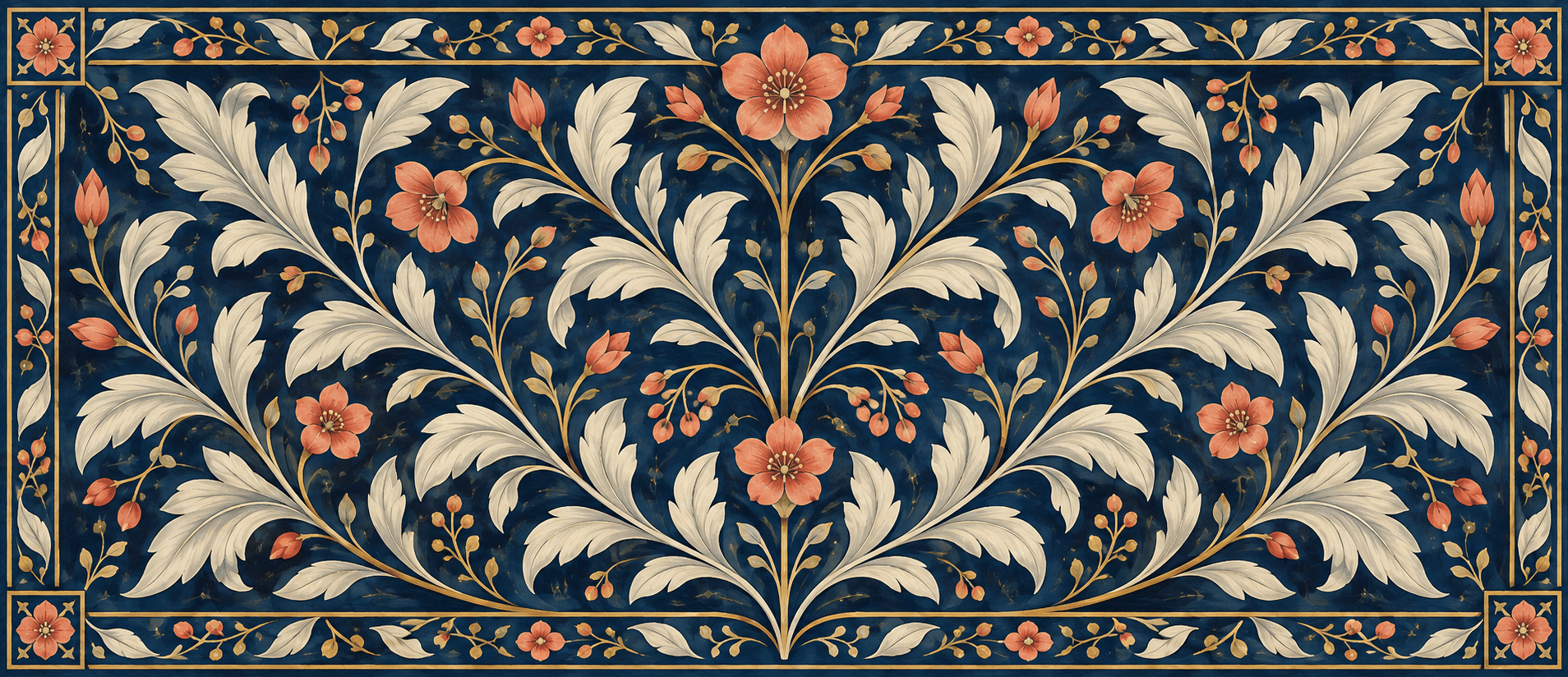
Original botanical ornament for a rectangular panel: ivory stylized leaves and coral blossoms on deep indigo, thin gold-colored stems, resolved corners and a quiet central field. Coherent hand-drawn repeat, no lettering or copied historical plate.
Geometric · Medallion and margin
Original geometric ornament study with a central interlace medallion, two restrained border bands and ample ivory margins, indigo and muted rust palette. Clear connections and consistent line weight, no text.
Material · Carved leaf rhythm
Original decorative relief concept: a rhythmic stylized leaf border carved into pale stone around a plain rectangular opening, shallow shadows and carefully resolved corner transitions. No copied monument or signature.
Your next inspiration
Discover another art style
Follow a visual thread to the next subject.

A smile from the studio
Jokes
The corner asked the pattern to turn over a new leaf.
The repeating motif wanted a day off, but its contract had no end.