
Georgian art · Cultural and historical overview
Explore art of Georgia in the Caucasus: medieval mosaics, Pirosmani’s dark-ground paintings and Georgian modernism, with researched context and clearly labeled AI studies.
A visual introduction
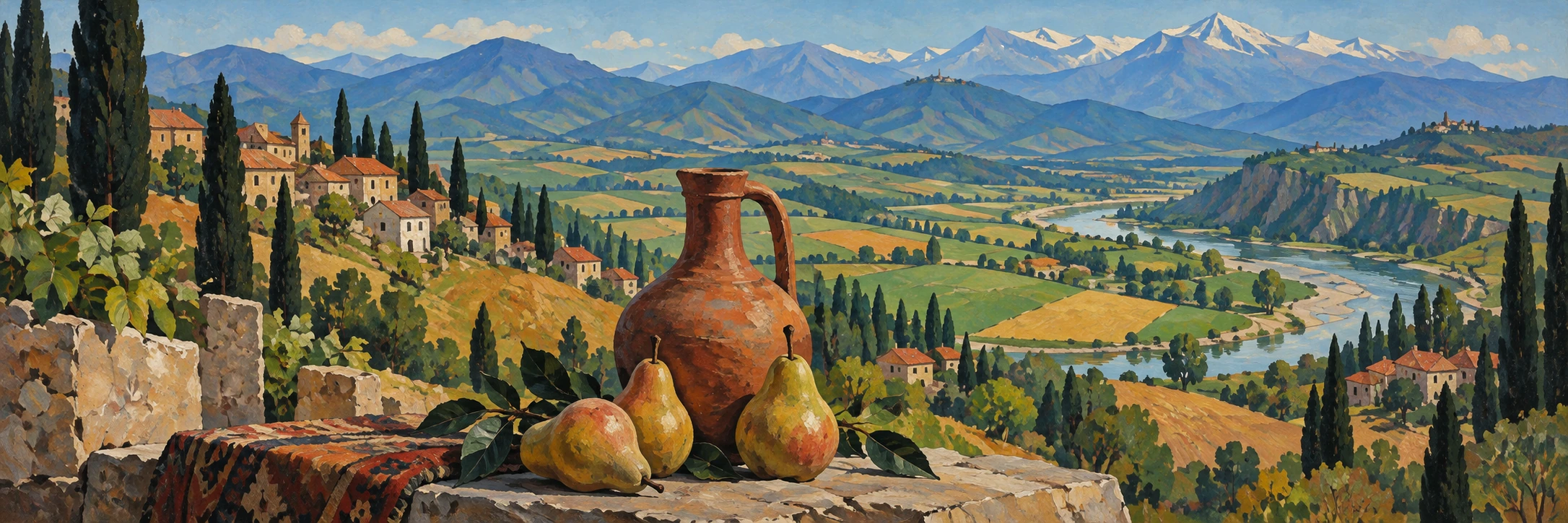
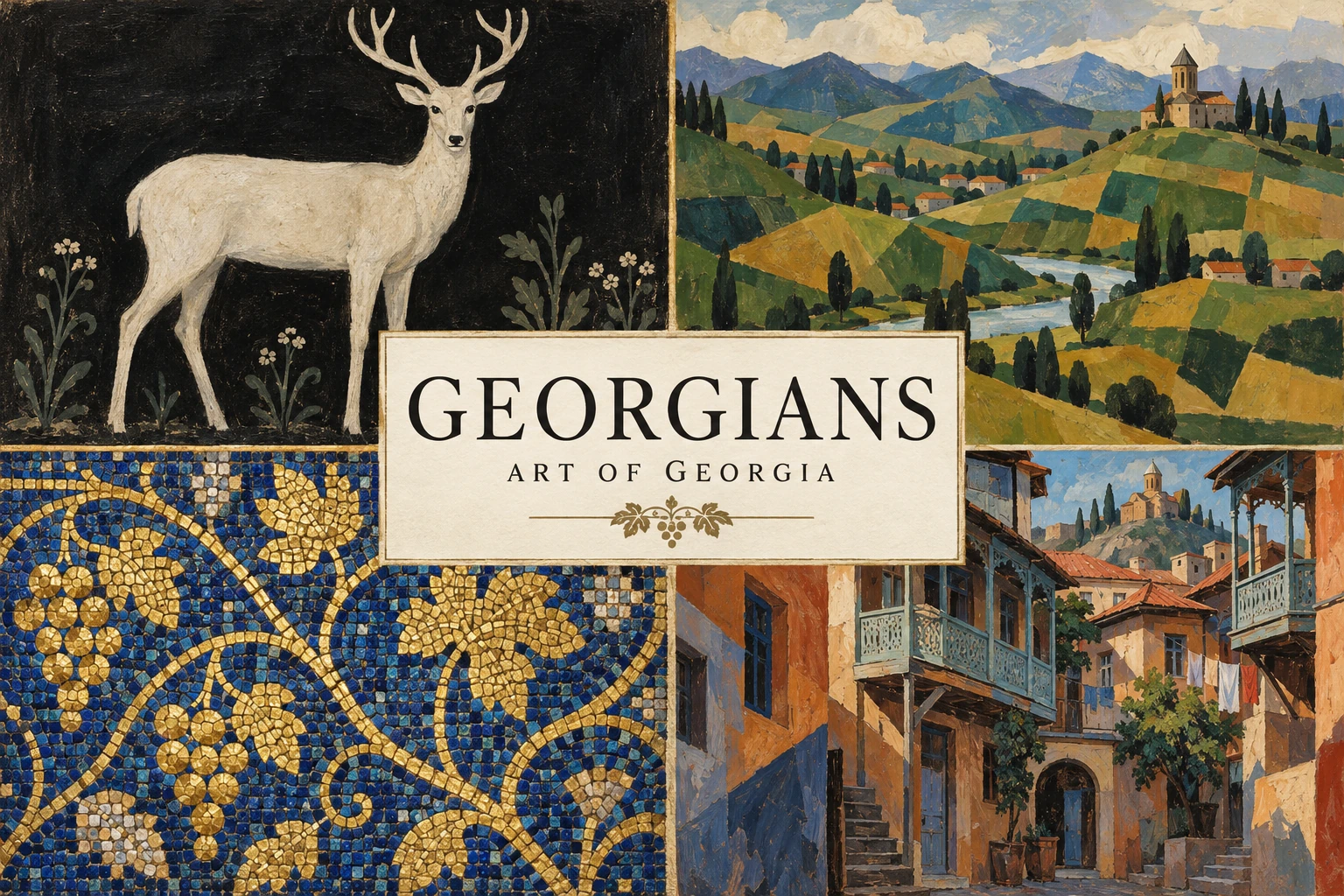
A panoramic header, named collage and three standalone examples. All are AI-generated interpretations; the text explains what to look for and distinguishes them from documented works.
Select an image for a closer look. Use the thumbnails, arrow keys or a swipe to compare examples. Zoom in to inspect details, or share the image that inspires you.
Creative toolbox · take this style further
Choose an input and a destination. Search sends your words to the chosen site; Copy & open puts them on your clipboard to paste there.
Create with AI
Turn your chosen input into an image prompt or a new creative direction.
ChatGPT
Copy your input and paste it into a ChatGPT conversation or image request.
Copy & open ChatGPT (new tab)Claude · Anthropic
Develop an image prompt or explore the style in a new Claude conversation.
Copy & open Claude · Anthropic (new tab)Midjourney
Paste your input into the Imagine bar on the Create page.
Copy & open Midjourney (new tab)Adobe Firefly
Copy your input, open Firefly, and paste it into the prompt field.
Copy & open Adobe Firefly (new tab)Leonardo.Ai
Copy your input, open Leonardo, and paste it into the generation field.
Copy & open Leonardo.Ai (new tab)Image search
Find visual references. Short, concrete keywords usually work best.
Lexica
Search AI images and prompts using your selected input.
Search with this input Lexica (new tab)Pexels
Search the photo and video library. Short keywords often work best.
Search with this input Pexels (new tab)Pixabay
Search photos, illustrations and other images.
Search with this input Pixabay (new tab)Unsplash
Search photographs using the style name or your own keywords.
Search with this input Unsplash (new tab)Wikimedia Commons
Search photographs, artworks and historical images. Check each file for its source and reuse terms.
Search with this input Wikimedia Commons (new tab)Art & research
Explore artists, collections and the ideas behind a style.
Wikipedia
Search for background reading. A style may not have its own article.
Search with this input Wikipedia (new tab)WikiArt
Copy your input into WikiArt’s search to explore artists and artworks.
Copy & open WikiArt (new tab)Europeana
Paste your keywords into the search to explore European museum, library and archive collections.
Copy & open Europeana (new tab)Inspiration
Discover portfolios and visual ideas from creative communities.
Instagram hashtags
Search a hashtag made from your input: spaces and punctuation are removed. Instagram may require sign-in.
Search with this input Instagram hashtags (new tab)ArtStation
Paste your input into artwork search for concept art, environments, characters and visual development.
Copy & open ArtStation (new tab)Behance
Paste your input into project search for illustration, design and visual storytelling.
Copy & open Behance (new tab)A closer look
This is a guide to several traditions, not one national look. Compare the material shimmer of mosaic, the luminous silhouettes of dark-ground painting and the constructed spaces of modernist landscape.
Georgia is the place; “Georgians” is not a single style
Here Georgians means the art and artists of Georgia in the Caucasus, also known as Sakartvelo. It does not refer to Britain’s Georgian period or to the American painter Georgia O’Keeffe. Those unrelated associations appeared in the old entry and have been removed. A national label can help you begin a search, but it cannot tell you how every artist paints, what every object means or how centuries of production should look.
This introduction follows three manageable routes: medieval church art, the paintings of Niko Pirosmani, and twentieth-century modernist approaches to place. They are starting points within a much larger field. The differences are the point. A mosaic wall, a painting on oilcloth and a modernist landscape ask us to look at different materials, kinds of space and relationships between an image and its audience.
Medieval art: an image belongs to a building
Gelati Monastery gives this route a specific anchor. UNESCO records its foundation in 1106, a twelfth-century apse mosaic and mural paintings spanning the twelfth to seventeenth centuries. Its artistic importance lies partly in the relationship between architecture, images and setting. Look at a photograph of a complete interior before isolating a decorative detail. The curve of the apse and the height of a figure affect the image’s encounter with a viewer.
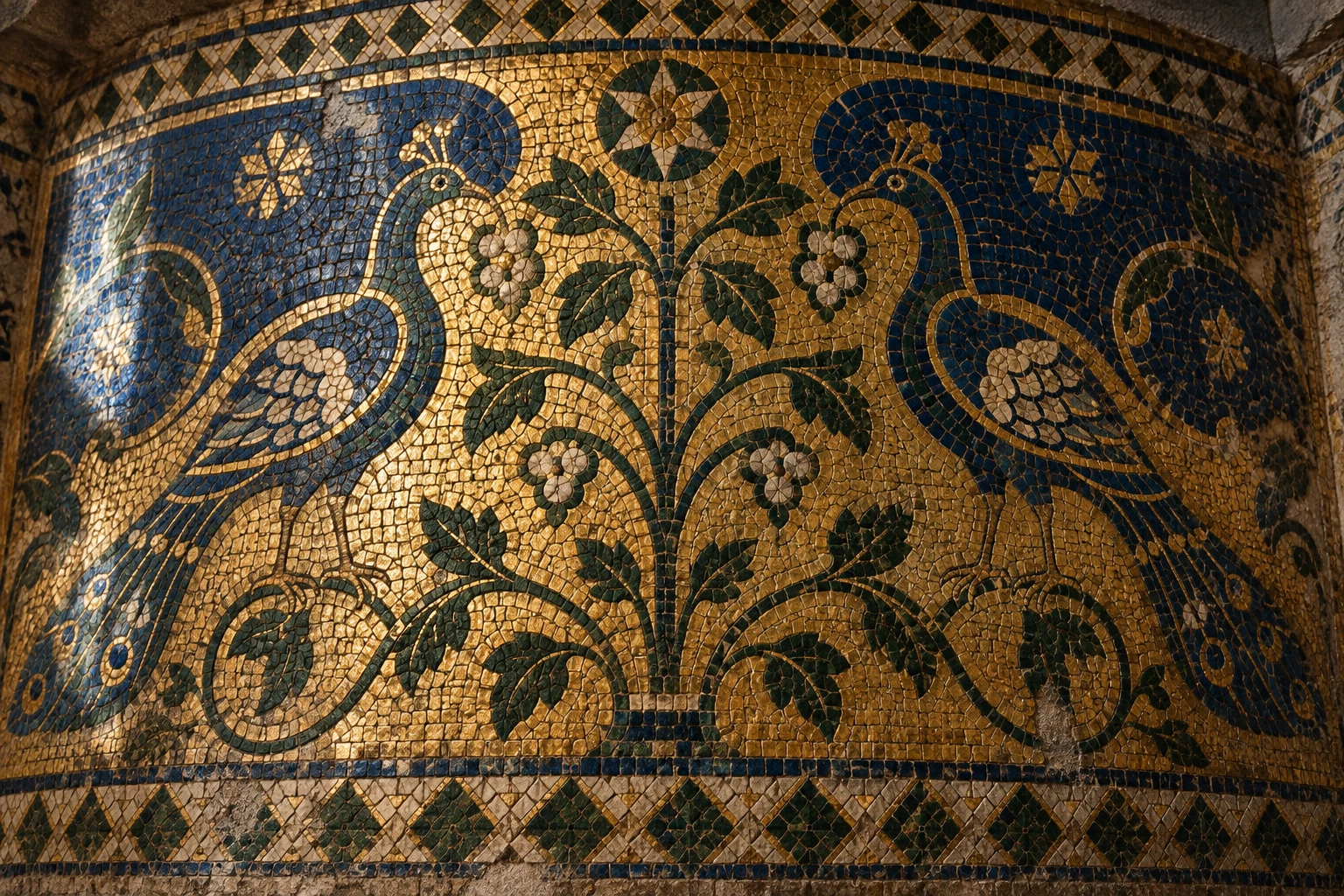
In a mosaic, the small units that build an outline also break up reflected light. A painted imitation of gold and a field of reflective tesserae do not behave identically. Our new bird-and-vine study uses that material distinction as a creative exercise. It is an invented secular design informed by mosaic surfaces, not a reconstruction of Gelati, a sacred icon or a verified traditional Georgian motif. Its visual attraction should lead you toward the documented object, not replace it.
Pirosmani: let the dark ground remain active
Niko Pirosmani, also known as Niko Pirosmanashvili (1862–1918), is a particularly useful artist to study through material and pictorial economy. The Georgian visual-art archive identifies him as self-taught and records works on oilcloth, cardboard and tin. Fondation Beyeler’s exhibition account emphasizes his luminous figures against dark backgrounds. Reducing this to a generic folk-art filter misses the force of that relationship.
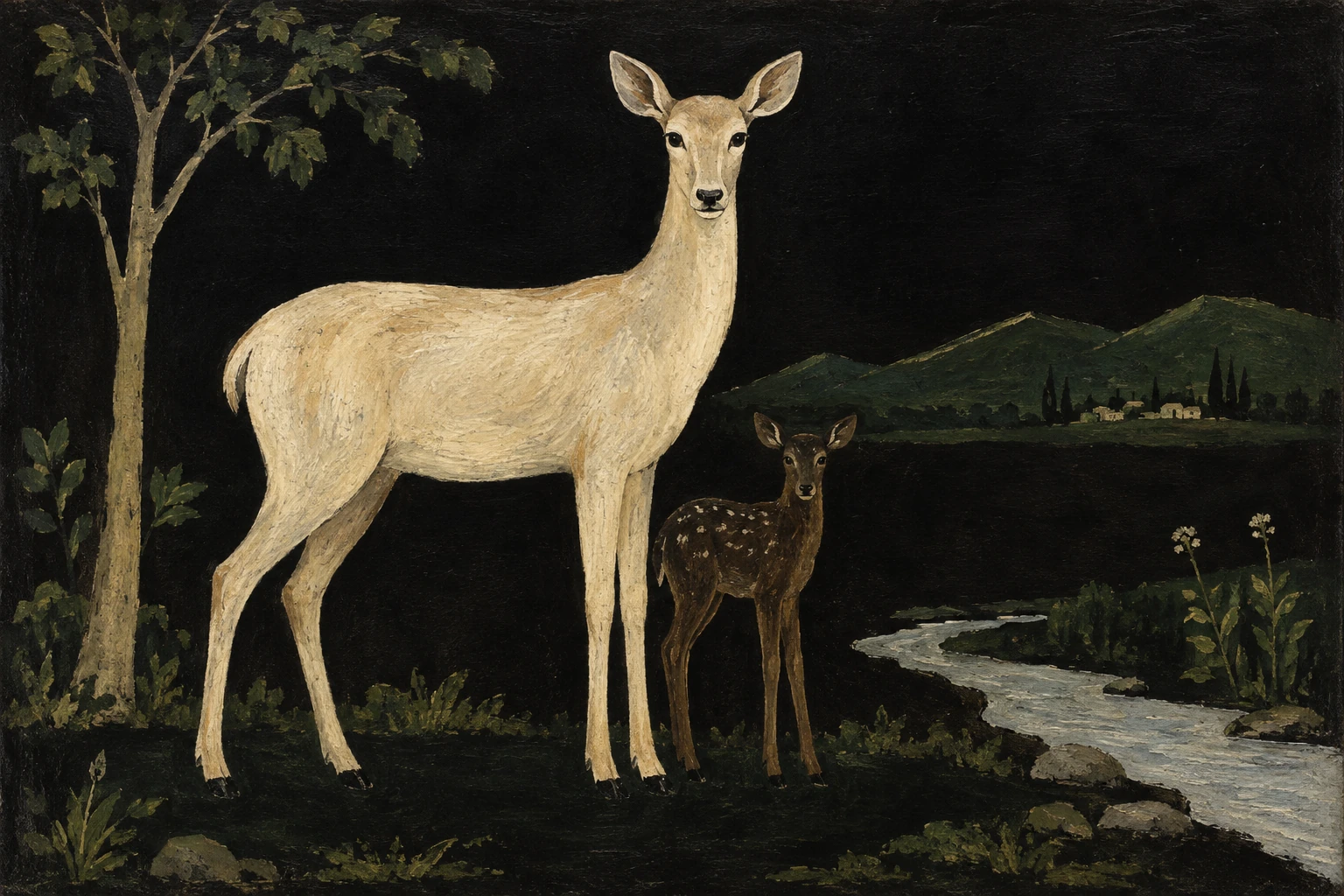
Try looking first at the spaces around a figure. A pale animal gains its presence partly from the darkness left beside it. A few economical strokes can establish an eye, a leg or the edge of a table without describing every hair or reflection. Simplicity here should not be mistaken for a lack of decision. The question is how much descriptive information a picture can withhold while making its subject feel unmistakably present.
Modernism: Georgia participated in an international conversation
David Kakabadze (1889–1952) complicates the idea that Georgian art can be represented by a timeless decorative vocabulary. The Georgian art archive documents his Paris years, 1919–1927, and work in abstraction, collage and constructed forms. It lists Imereti — My Mother and Imeretian Still Life, both dated 1918. His interests in art and scientific invention also resist the convenient division between an intuitive painter and a technical thinker.
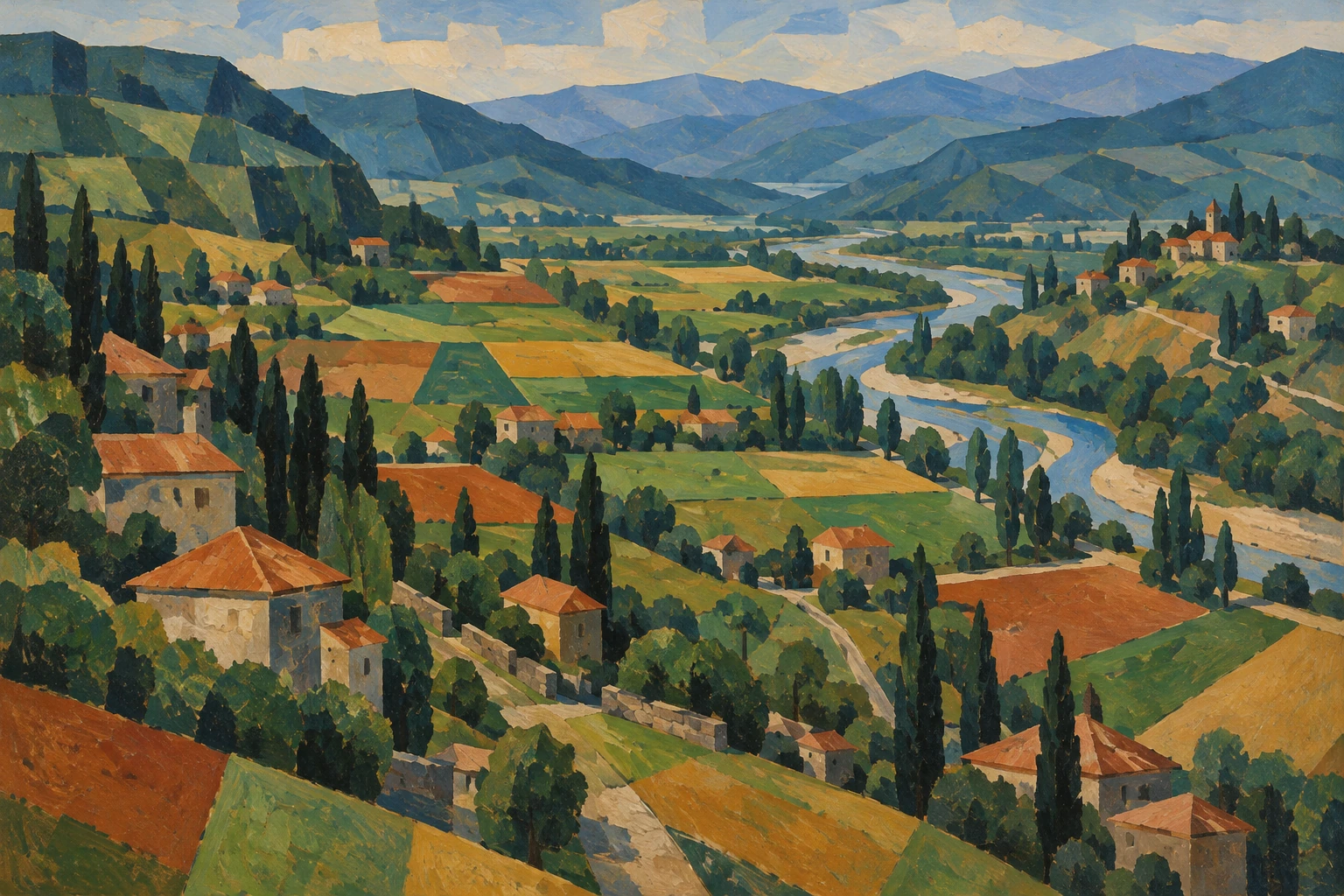
For a visual exercise, compare a hillside understood as a view with a hillside understood as an arrangement of planes. A field may be both a piece of cultivated land and a patch of color supporting the picture’s balance. Our invented landscape explores this second reading. It does not reproduce a Kakabadze painting, identify a real village or provide an accurate map of Imereti. Its broad compositional decisions are more useful than its incidental architecture.
Elene Akhvlediani: a city is more than a skyline
Elene Akhvlediani (1901–1975) worked across painting, graphic art, book illustration and stage-related practice. The Georgian archive documents her urban landscapes and her studies in Paris, and records Old Tbilisi, Maidan (1927). Her career makes a valuable companion to Kakabadze’s: a place can be approached through color and structure while remaining full of streets, buildings and daily life.
When looking at a city painting, follow the small connections. A balcony may bridge two patches of shade; a stair changes the pace at which the eye moves; an open strip of road prevents the roofs from locking into a wall. These observations are questions to bring to the linked works, not a claim that every Georgian street or painting shares the same architecture. The courtyard panel in our collage is deliberately labeled an imagined interpretation.
Reading the new gallery
The named collage replaces the previous British Georgian imagery. Its four panels introduce dark-ground animal painting, landscape, mosaic-like surface and an imagined courtyard. The header expands the landscape route, setting a terracotta jug and pears against ordered fields and distant mountains. The landscape contains generalized architectural forms: read it as a compositional study, never as documentary evidence of a particular Georgian town.
The standalone examples separate the techniques so their differences remain visible. In Deer at the Stream, a pale silhouette interrupts a nearly black field. In Light Between Tesserae, tiny units and angled highlights carry the image. In A Hillside in Planes, broad areas of green and ochre establish depth through overlap and rhythm. None is presented as made by a Georgian artist, as an antique, or as a historically authenticated pattern.
Usability in AI art generation
Avoid treating Georgian as a complete prompt. State Georgia in the Caucasus, identify a period or a specific reference, and describe the medium and compositional behavior. A dark-ground animal study needs different instructions from a mosaic detail or a modernist city painting. A model may otherwise drift toward British Georgian portraits, generic Mediterranean scenery or a collage of vaguely regional ornament.
Check generated buildings, dress, objects and writing against sources if accuracy matters. Do not invent Georgian lettering and describe it as a translation. Do not use a plausible face to define an ethnic appearance. For a historical reconstruction, gather suitable documentary references and obtain informed review; an attractive output alone is insufficient. For an original artwork, retain the distinction between an informed visual experiment and cultural evidence.
A better way to keep exploring
Start with one documented work and ask one material question: how does its ground support the figure, how do its small marks build a large shape, or how does its surface alter the light? Then compare a work from another period. This route gives individual artists and objects room to disagree. It also makes the broad catalog label useful without pretending that a country is an image preset.
Penny’s note: the most interesting discovery was not a single Georgian look. It was the distance between these approaches, and the care needed to cross it. A good visual library preserves that distance. Let a dark background remain dark long enough to see what the painter has chosen to bring forward.
A small poetic detour
Original words from the AOI studio.
Poetry
A dark ground waits.
One pale animal looks back.
The picture holds still.
The prompt workshop
Original creative exercises. These prompts create new illustrations, not documentary evidence.
Study 1
Create a stunning original 3:2 painting inspired by Niko Pirosmani's spare pictorial language in Georgian art: one alert cream-colored deer and a small dark fawn stand beside a slender pale stream on a deep nearly black oilcloth-like ground, a sparse tree to the left, distant low green hills indicated with few economical strokes. Animals monumental and dignified, simplified frontal/side silhouettes, luminous restrained ivory, russet and deep green paint against bare black, visible handmade brush marks, shallow space, quiet intensity, not photorealistic wildlife, not cute cartoon. Invented composition, no copying an existing work, no labels or text.
Original AOI exercise. Compare the generated result with the visual criteria above; the prompt is an intention, not proof of execution.
Study 2
Create an exquisite 3:2 close-view original decorative study informed by medieval Georgian church mosaic craft, NOT a reproduction of a named monument or sacred icon. A pair of stylized birds facing a central branching vine on a gently curved apse-like surface; tiny individually angled gold, lapis, warm ivory and dark green mosaic tesserae with irregular mortar joints catch raking light. The vine and bird silhouettes are clearly legible across a restrained geometric border, a little weathering, tactile hand-laid surface, luminous gold field against profound blue. An invented secular motif study emphasizing material and light, no saints, no pseudo-Georgian writing, no British imagery, no text.
Original AOI exercise. Compare the generated result with the visual criteria above; the prompt is an intention, not proof of execution.
Study 3
Create an exceptional 3:2 original modernist oil painting of an invented Imeretian hillside in Georgia, Caucasus: geometric patchwork green and ochre cultivated fields seen from a high viewpoint, small terracotta-roofed houses, narrow paths, a sinuous river, receding blue hills. Rhythmic planar construction and balanced compressed depth informed by early twentieth-century Georgian landscape modernism, tactile matte paint, precise yet alive brushwork, emerald against muted vermilion, intensely luminous organized color. No impressionist blur, no photorealism, no fantasy palaces, no famous landmark replicas, no lettering.
Original AOI exercise. Compare the generated result with the visual criteria above; the prompt is an intention, not proof of execution.
Your next inspiration
Discover another art style
Follow a visual thread to the next subject.

People & works to explore
References discussed in this article. Consult the sources below for context.
Artists and practitioners
Niko Pirosmani (1862–1918) — painting, including work on dark oilcloth.
David Kakabadze (1889–1952) — Georgian modernism, landscape and abstraction.
Elene Akhvlediani (1901–1975) — landscape, city views and work across media.
Paintings and other works
Gelati Monastery — twelfth-century mosaic and mural cycles of several periods; UNESCO record.
Niko Pirosmani, The Feast of Five Noblemen — oil on oilcloth; Georgian National Museum collection as documented by art.gov.ge.
David Kakabadze, Imereti — My Mother (1918) — Georgian archive record.
Elene Akhvlediani, Old Tbilisi, Maidan (1927) — Georgian archive record.