
Animation craft companion and original paper-theatre study
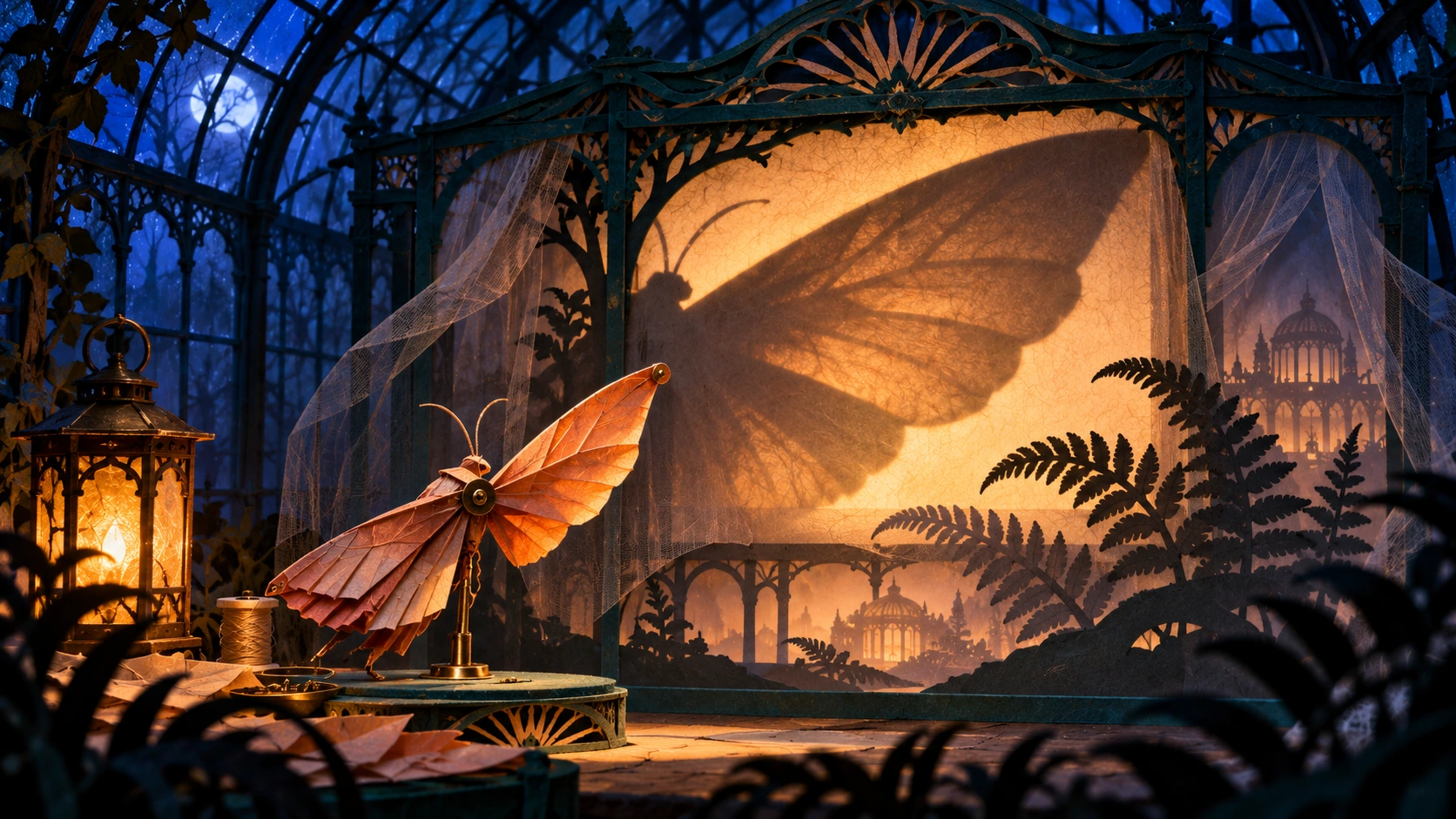
The audience sees a moth enter the glasshouse a moment before the moth gets there. Its shadow has arrived first. In this companion to Disney animation, a troupe of folded-paper lamplighters puts an old staging question to work. How can an entrance begin while the performer is still waiting in the wings?
A visual introduction
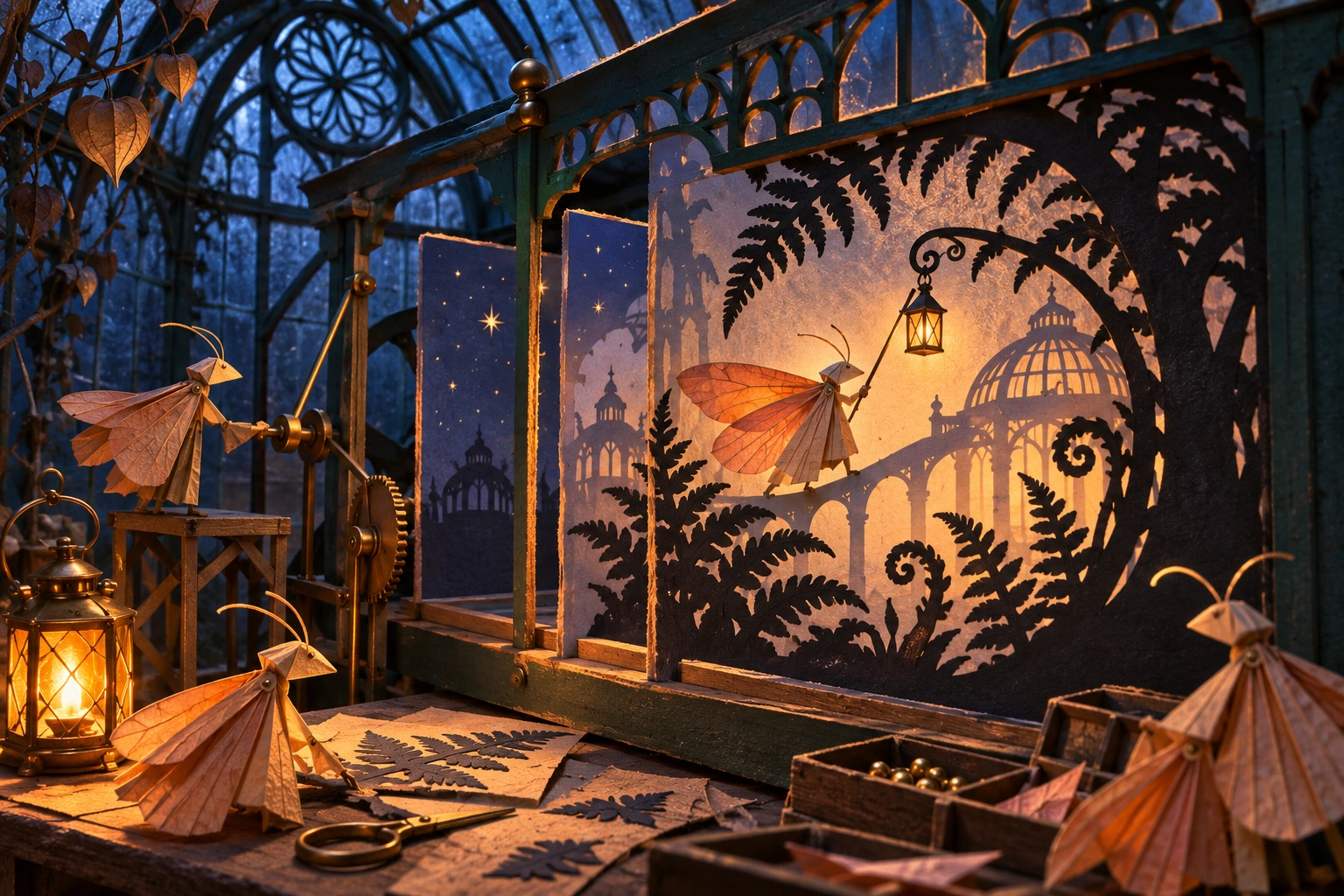
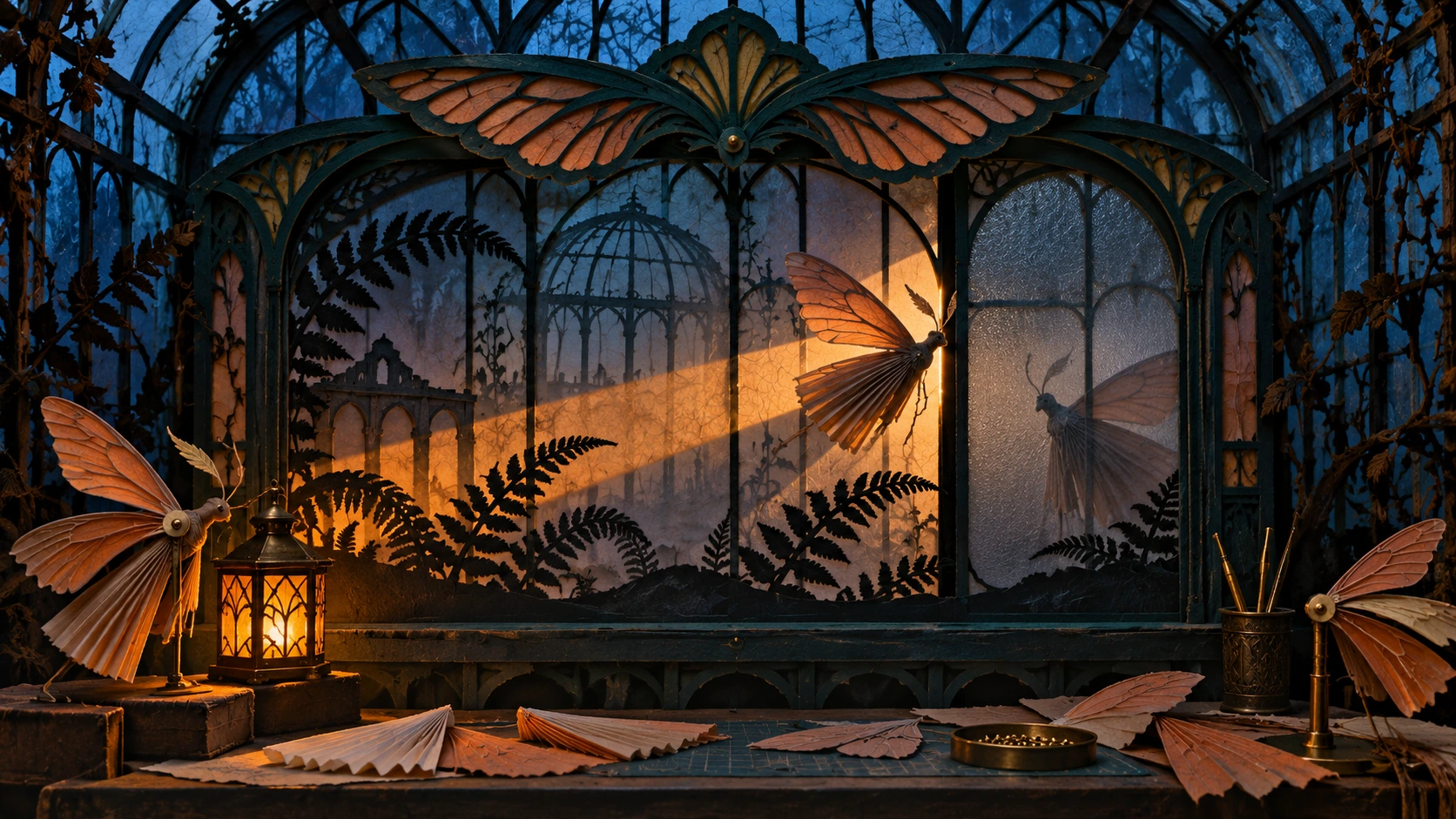
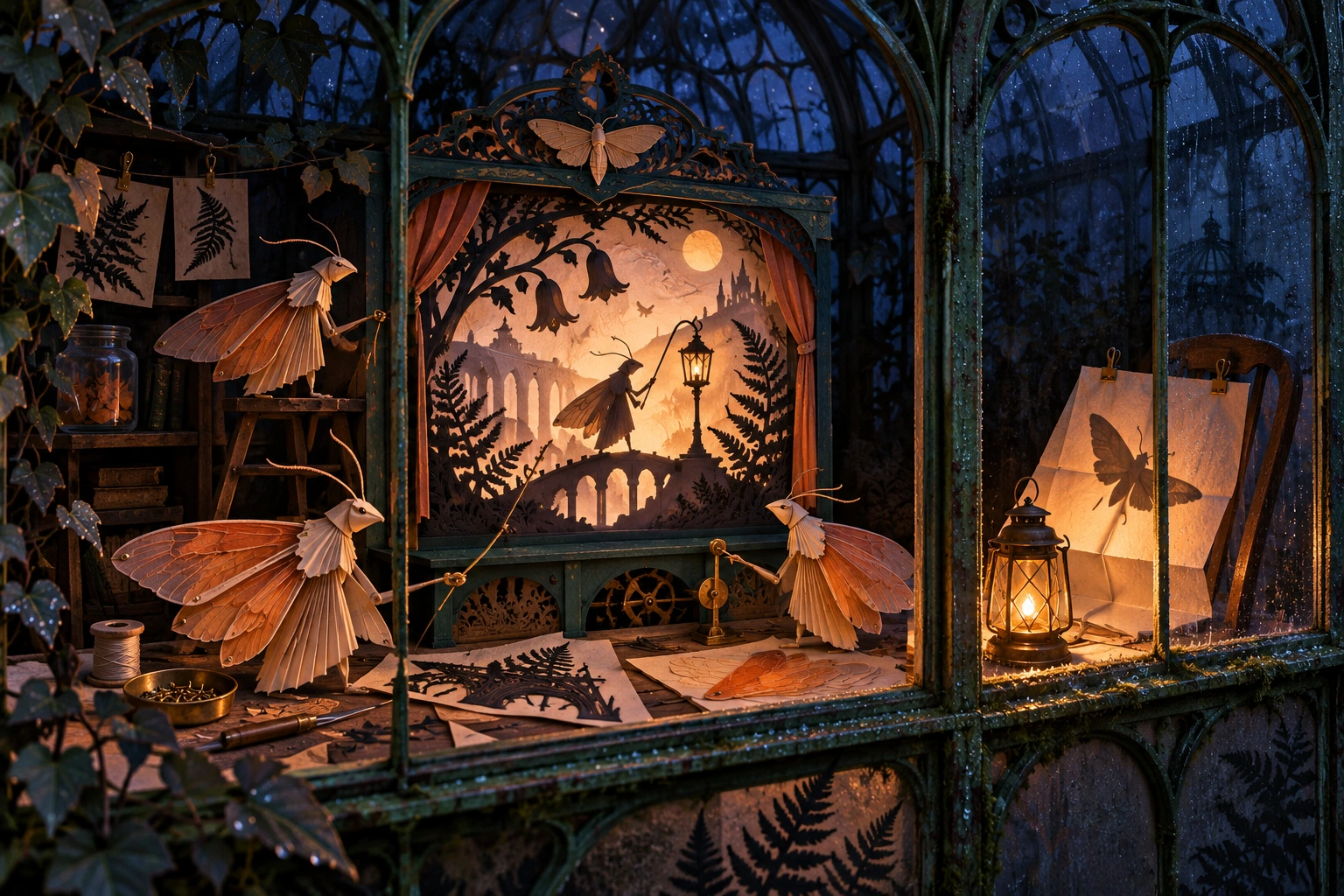
Seven original AI interpretations show invented lamplighters from the auditorium, backstage and outside the glasshouse. The museum’s apparatus diagram and the studio’s layout account supply the historical and technical references.
Select an image for a closer look. Use the thumbnails, arrow keys or a swipe to compare examples. Zoom in to inspect details, or share the image that inspires you.
Creative toolbox · take this style further
Choose an input and a destination. Search sends your words to the chosen site; Copy & open puts them on your clipboard to paste there.
Create with AI
Turn your chosen input into an image prompt or a new creative direction.
ChatGPT
Copy your input and paste it into a ChatGPT conversation or image request.
Copy & open ChatGPT (new tab)Claude · Anthropic
Develop an image prompt or explore the style in a new Claude conversation.
Copy & open Claude · Anthropic (new tab)Midjourney
Paste your input into the Imagine bar on the Create page.
Copy & open Midjourney (new tab)Adobe Firefly
Copy your input, open Firefly, and paste it into the prompt field.
Copy & open Adobe Firefly (new tab)Leonardo.Ai
Copy your input, open Leonardo, and paste it into the generation field.
Copy & open Leonardo.Ai (new tab)Image search
Find visual references. Short, concrete keywords usually work best.
Lexica
Search AI images and prompts using your selected input.
Search with this input Lexica (new tab)Pexels
Search the photo and video library. Short keywords often work best.
Search with this input Pexels (new tab)Pixabay
Search photos, illustrations and other images.
Search with this input Pixabay (new tab)Unsplash
Search photographs using the style name or your own keywords.
Search with this input Unsplash (new tab)Wikimedia Commons
Search photographs, artworks and historical images. Check each file for its source and reuse terms.
Search with this input Wikimedia Commons (new tab)Art & research
Explore artists, collections and the ideas behind a style.
Wikipedia
Search for background reading. A style may not have its own article.
Search with this input Wikipedia (new tab)WikiArt
Copy your input into WikiArt’s search to explore artists and artworks.
Copy & open WikiArt (new tab)Europeana
Paste your keywords into the search to explore European museum, library and archive collections.
Copy & open Europeana (new tab)Inspiration
Discover portfolios and visual ideas from creative communities.
Instagram hashtags
Search a hashtag made from your input: spaces and punctuation are removed. Instagram may require sign-in.
Search with this input Instagram hashtags (new tab)ArtStation
Paste your input into artwork search for concept art, environments, characters and visual development.
Copy & open ArtStation (new tab)Behance
Paste your input into project search for illustration, design and visual storytelling.
Copy & open Behance (new tab)A closer look
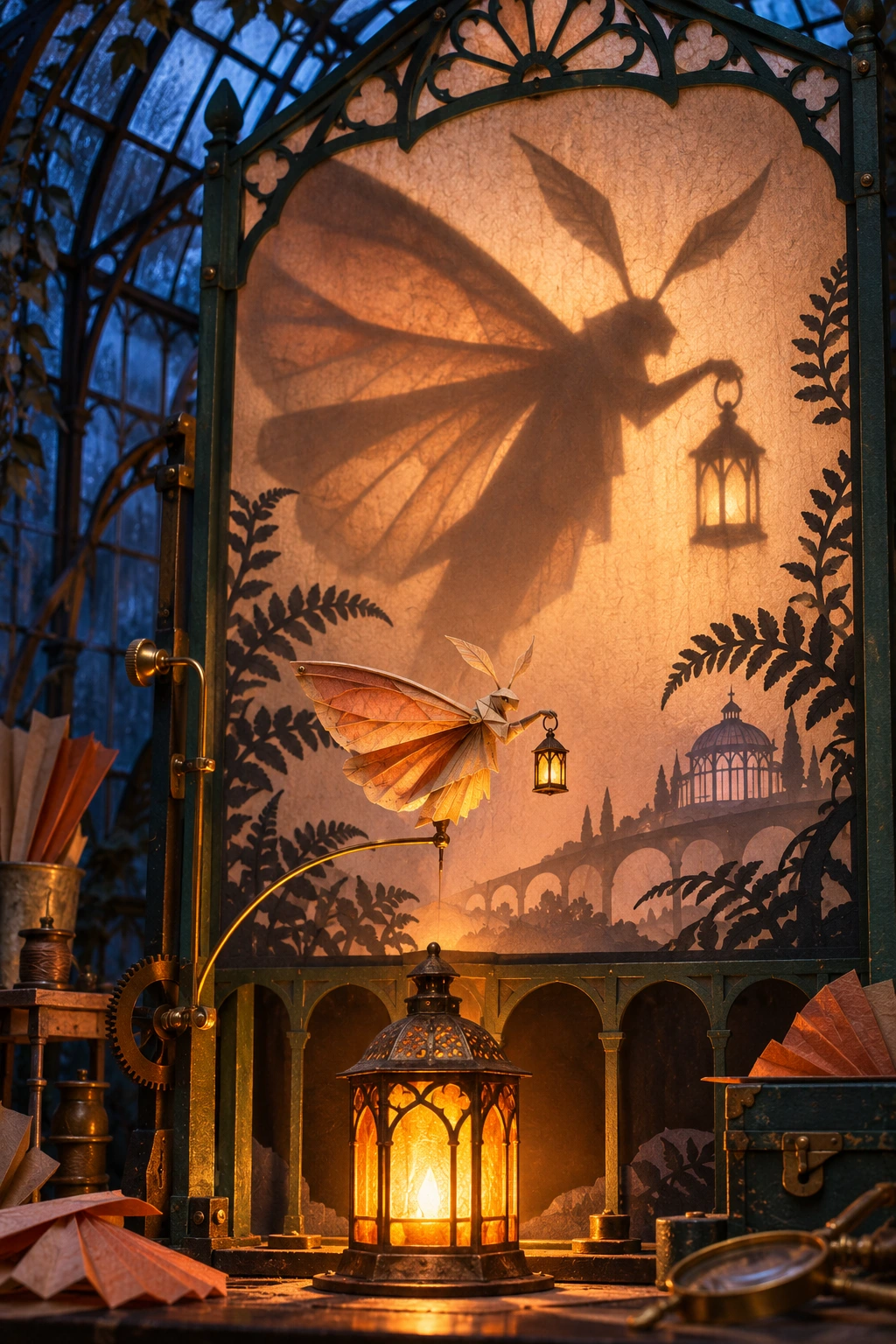
Indigo glass, an amber lamp and persimmon paper give the little theatre its night colours. A fern cutout can obscure the stage. A gap between wing and window bar gives a gesture room to be seen. Pivots, rods and raw card edges become especially interesting from the wrong side of the curtain.
What the old camera let a scene do
The Walt Disney Family Museum documents the studio multiplane camera developed by technician Bill Garity and its experimental use on The Old Mill in 1937. Painted elements on planes at different distances could be moved relative to the camera. A nearby fence and a distant moon could then change their position in the frame at different rates. The museum also describes Ub Iwerks’s earlier horizontal apparatus. Several people and designs belong in this history.
Walt Disney Animation Studios’ account of layout describes a different working context. Layout artists use boards, sets, rough performances and cameras to decide how a shot tells its story. The connection I want for this theatre is a decision both processes make visible. Where shall we put something so the audience sees it at the right instant?
Separate the actor, the scenery and the light
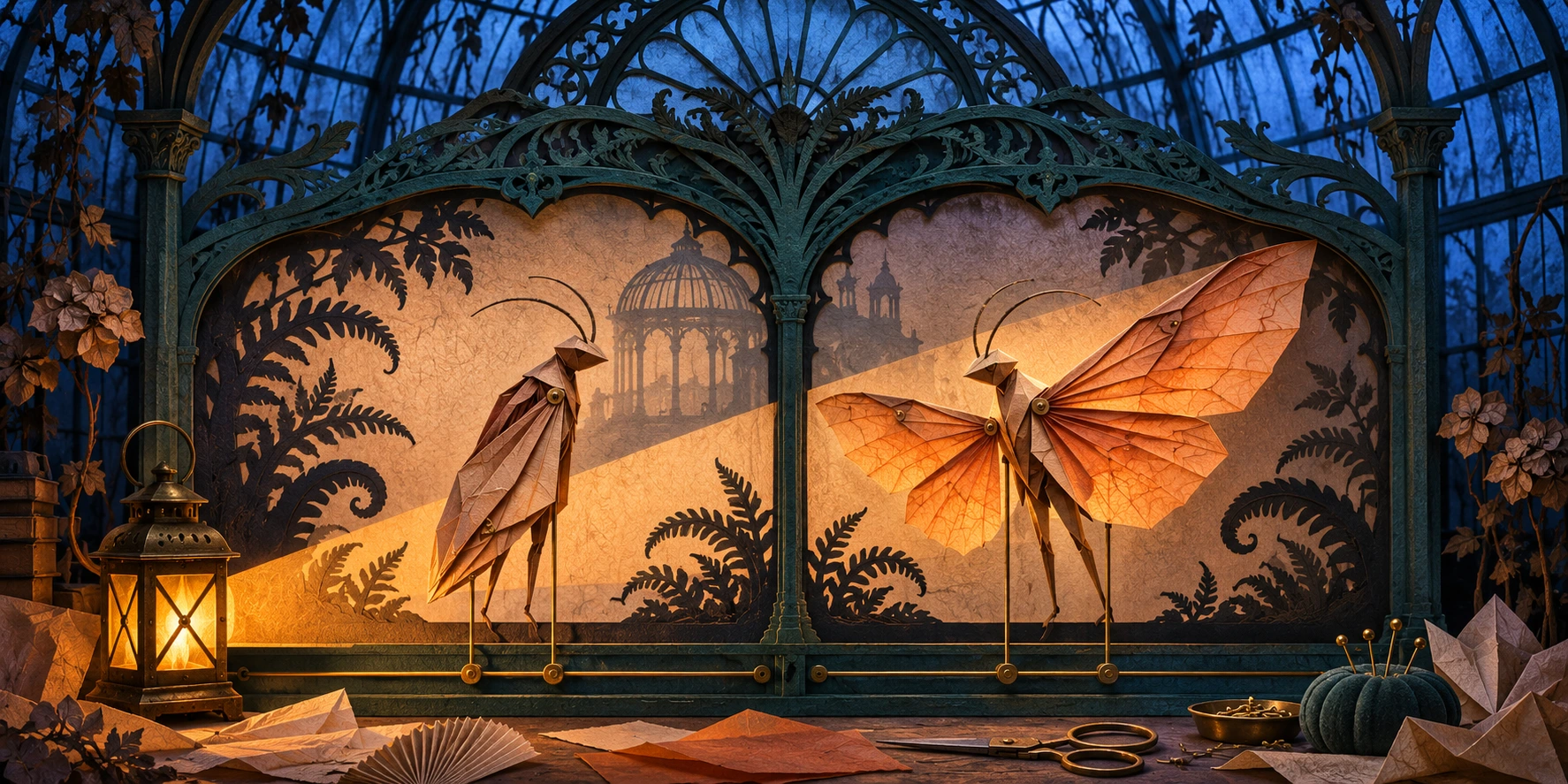
Stand the imaginary audience in front of the screen. Work backwards from the shape it ought to see. A lantern, a folded moth and a receiving sheet occupy three distinct places. Moving a moth towards a small lamp can enlarge its projected shadow. Moving foreground scenery across the audience’s view can hide the moth altogether. Put those operations in different sketches and their effects are easier to recognise.
For the entrance, put a dark fern across the near edge, give the moth the middle ground and leave the lit screen clear. Fold its wing before the cue. Then open it far enough that the outline crosses a pale window while the body remains outside. A single crooked triangle can say something quite ceremonious from that distance.
Turn the cardboard stage around
An audience view sells the illusion. The view from the stage door explains the labour. Let the rods cast incidental shadows, show how thick a sheet of card actually is and give the unused slots in the base a little dust. The people who run miniature theatres tend to know precisely which noises the audience can hear. A similar economy in a drawing feels affectionate.
Try holding the same pose across two arrangements. In the first, a dark window bar and a dark wing just touch. In the second, leave a sliver of amber between them. You may have changed only a few pixels. The second drawing can give the moth a whole extra beat of anticipation. Read the broader Animation guide alongside this study, and the Mickey Mouse article for a distinct example of silhouette and expressive motion.
Three readings from Penny’s desk
Positive review. I like seeing the shadow take a risk before the performer does. One small wing seems brave enough to fill a greenhouse when the light is in the right place.
Negative review. Overlapping silhouettes can read as a single decorative cutout. I would move a whole plane sideways before adding a line of detail to a lost wing.
Neutral review. The audience and backstage views answer different questions about the same object. A set builder may find the raw edge as expressive as the projected shadow.
A small poetic detour
Original words from the AOI studio.
Poetry
The lamp goes on. A paper wing
has found the screen ahead of me.
I leave my little brass pin still
and watch how tall a fold can be.
The prompt workshop
Original creative exercises. These prompts create new illustrations, not documentary evidence.
Send the shadow ahead
Invent a paper moth on a brass pivot in a glasshouse theatre. Keep its body outside the illuminated stage. Arrange one wing shadow already inside the pale square, and leave enough space for the audience to catch the difference.
Walk around the set
Draw the same miniature from behind, showing three sheets slotted into a base. Separate the near black fern, middle actor and far pricked-paper stars. Let raking light catch each raw card edge.
Test the sliver
Make two simple compositions with a folded wing and a narrow greenhouse bar. In one they touch, and in the other a blade of warm light separates them. Keep every other shape fixed and compare the silhouettes at thumbnail size.
A smile from the studio
Jokes
The understudy arrived precisely on time. Unfortunately its shadow had already taken the bow.