
Animation studio companion and original mechanical acting study
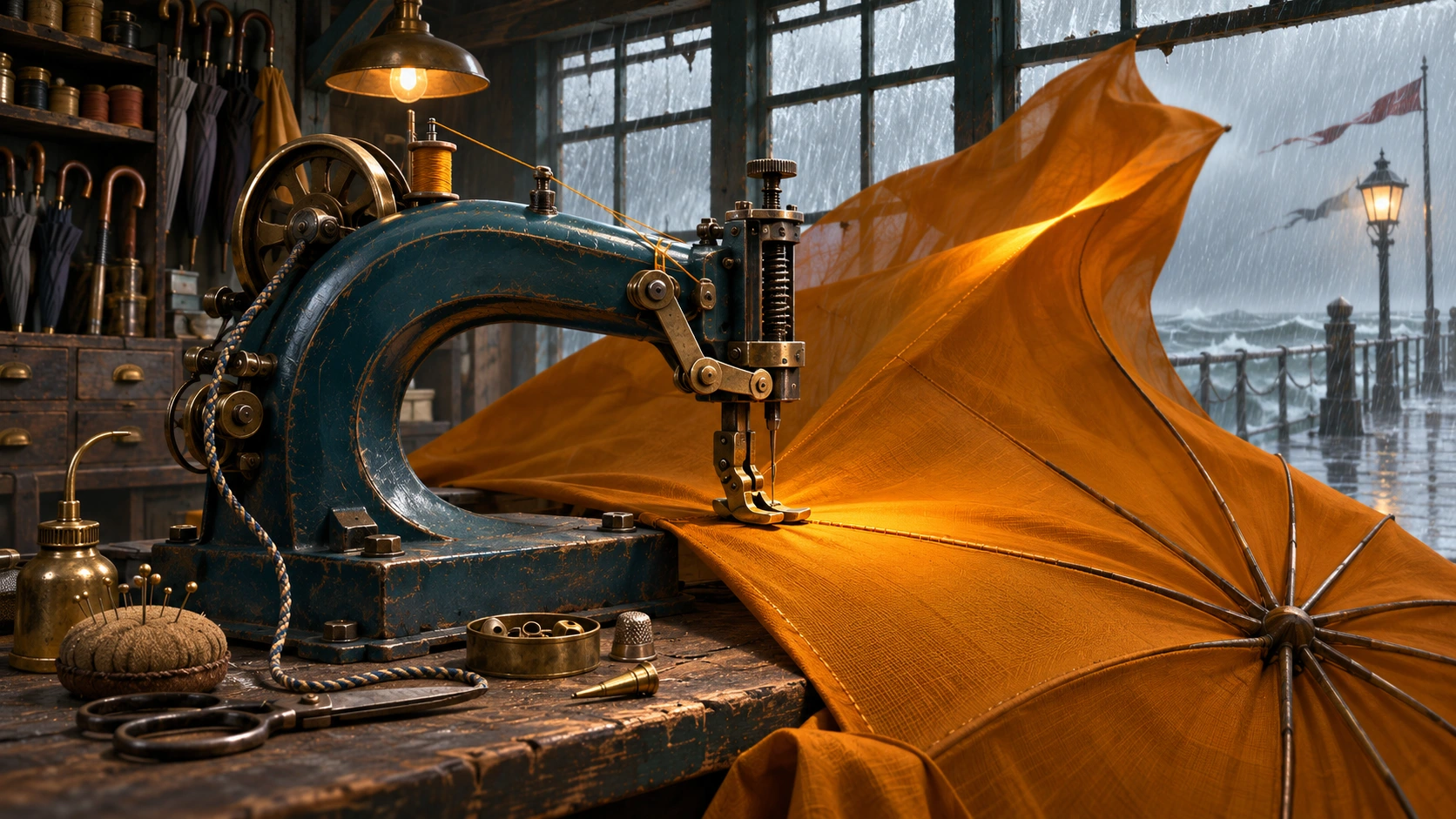
At a repair shop on a windy pier, a stitching machine has one decision left. Its work is finished. Will it let the umbrella go? This companion to Pixar looks for the instant a useful piece of equipment appears to make a choice. A hinge, a scrap of saffron cloth and a millimetre of daylight do the acting.
A visual introduction
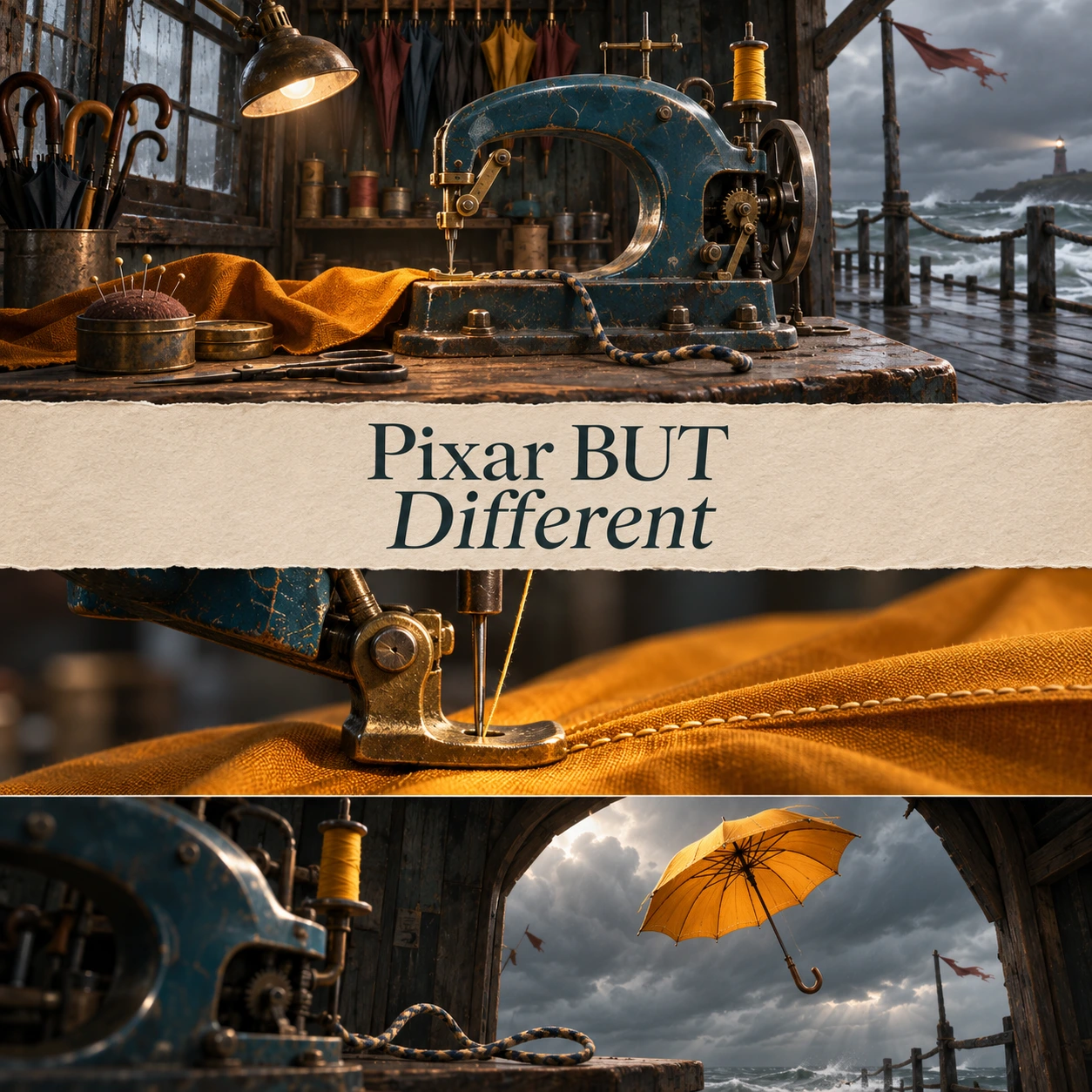
Seven original AI interpretations follow a bench-mounted umbrella stitcher. The gallery changes the distance from the joint, the weight of the cloth and the amount of information left behind.
Select an image for a closer look. Use the thumbnails, arrow keys or a swipe to compare examples. Zoom in to inspect details, or share the image that inspires you.

Creative toolbox · take this style further
Choose an input and a destination. Search sends your words to the chosen site; Copy & open puts them on your clipboard to paste there.
Create with AI
Turn your chosen input into an image prompt or a new creative direction.
ChatGPT
Copy your input and paste it into a ChatGPT conversation or image request.
Copy & open ChatGPT (new tab)Claude · Anthropic
Develop an image prompt or explore the style in a new Claude conversation.
Copy & open Claude · Anthropic (new tab)Midjourney
Paste your input into the Imagine bar on the Create page.
Copy & open Midjourney (new tab)Adobe Firefly
Copy your input, open Firefly, and paste it into the prompt field.
Copy & open Adobe Firefly (new tab)Leonardo.Ai
Copy your input, open Leonardo, and paste it into the generation field.
Copy & open Leonardo.Ai (new tab)Image search
Find visual references. Short, concrete keywords usually work best.
Lexica
Search AI images and prompts using your selected input.
Search with this input Lexica (new tab)Pexels
Search the photo and video library. Short keywords often work best.
Search with this input Pexels (new tab)Pixabay
Search photos, illustrations and other images.
Search with this input Pixabay (new tab)Unsplash
Search photographs using the style name or your own keywords.
Search with this input Unsplash (new tab)Wikimedia Commons
Search photographs, artworks and historical images. Check each file for its source and reuse terms.
Search with this input Wikimedia Commons (new tab)Art & research
Explore artists, collections and the ideas behind a style.
Wikipedia
Search for background reading. A style may not have its own article.
Search with this input Wikipedia (new tab)WikiArt
Copy your input into WikiArt’s search to explore artists and artworks.
Copy & open WikiArt (new tab)Europeana
Paste your keywords into the search to explore European museum, library and archive collections.
Copy & open Europeana (new tab)Inspiration
Discover portfolios and visual ideas from creative communities.
Instagram hashtags
Search a hashtag made from your input: spaces and punctuation are removed. Instagram may require sign-in.
Search with this input Instagram hashtags (new tab)ArtStation
Paste your input into artwork search for concept art, environments, characters and visual development.
Copy & open ArtStation (new tab)Behance
Paste your input into project search for illustration, design and visual storytelling.
Copy & open Behance (new tab)A closer look
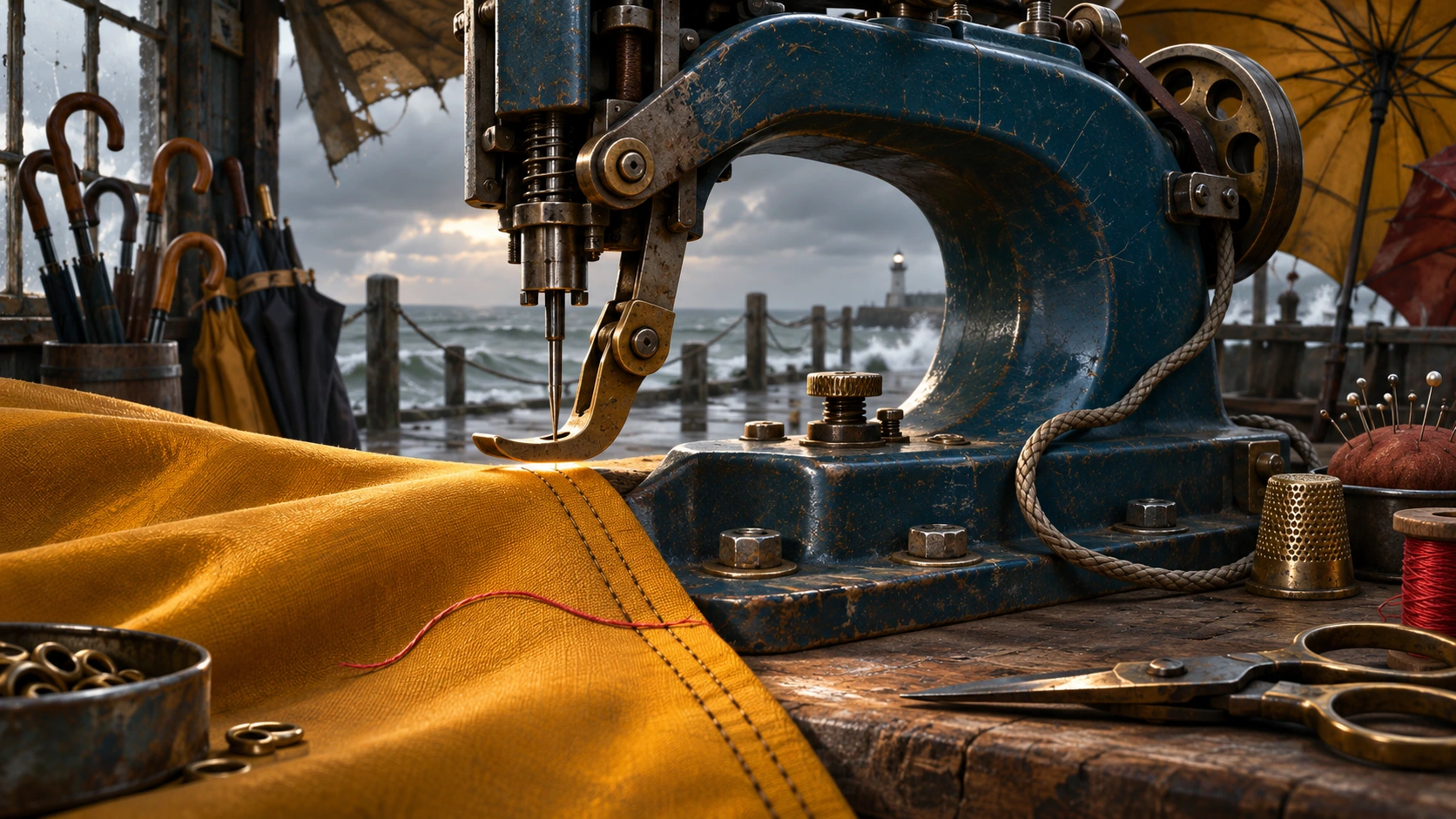
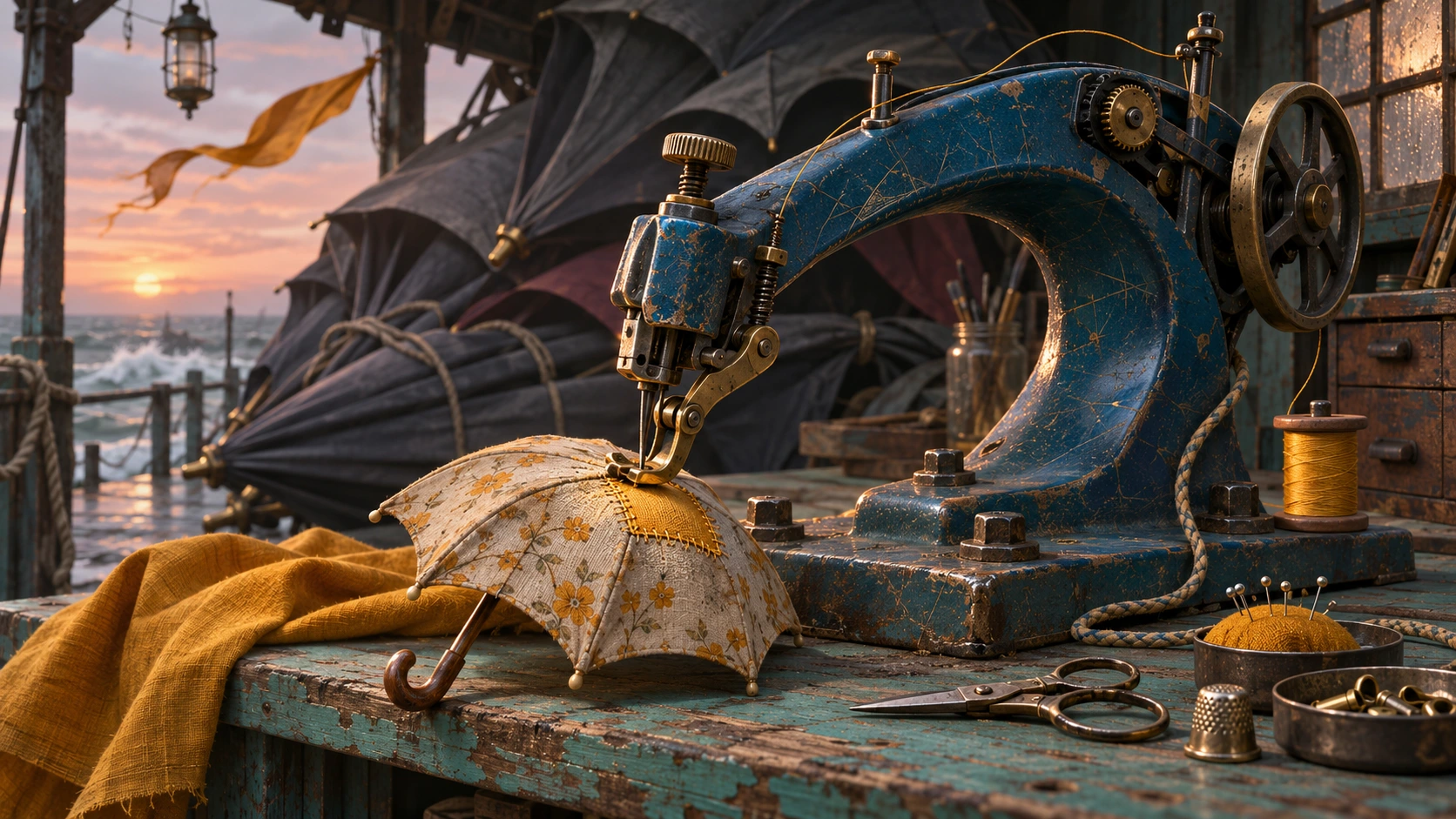
A heavy blue enamel base stays bolted to the bench. Fabric, braided cord and an articulated foot give three different accounts of tension. Small scratches establish what the mechanism is made of. The space between foot and seam tells us what it has just done.
Acting with the parts available
Pixar’s own account of Luxo Jr. gives two lamps and a ball a wonderfully small story problem. In a different film, WALL•E animator Victor Navone describes working out how a character might try to hold a hand during a sunset. Director Andrew Stanton gave the beat room to develop beyond the boards. What connects those accounts is the specificity of the action. Playing, reaching and hesitating ask for different poses.
The broader Pixar article surveys the studio reference. I wanted a narrower test that a reader could repeat with a stapler or a pair of dividers. Our umbrella stitcher has one useful joint and a base too heavy to travel. If the drawing persuades you that it would like to follow the umbrella down the pier, the experiment has earned its keep.
Work out who carries the load
Draw the machine from the side before adding colour. Put a pin through the centre of rotation, follow the arm to the pressing foot and trace the seam out into the fabric. Pull one point on that cloth. Where would a crease sharpen? Which length of cord would go slack? These small dependencies give the viewer something more persuasive than a pair of eyebrows.
In the instant of release, leave a slit of light under the foot. It should remain visible when the image is small. Spread the cloth across the frame early in the sequence, then let it take the eye beyond the window. The new distance between two old shapes can tell the story with very little machinery on show.
Try the scene with the polish turned down
A shiny render can make a worn bolt fascinating and the acting invisible. Squint at the image until the surface detail drops away. If you can still distinguish the planted base, the load and the point of contact, restore just enough scuffed enamel to say how often this machine has done the job before.
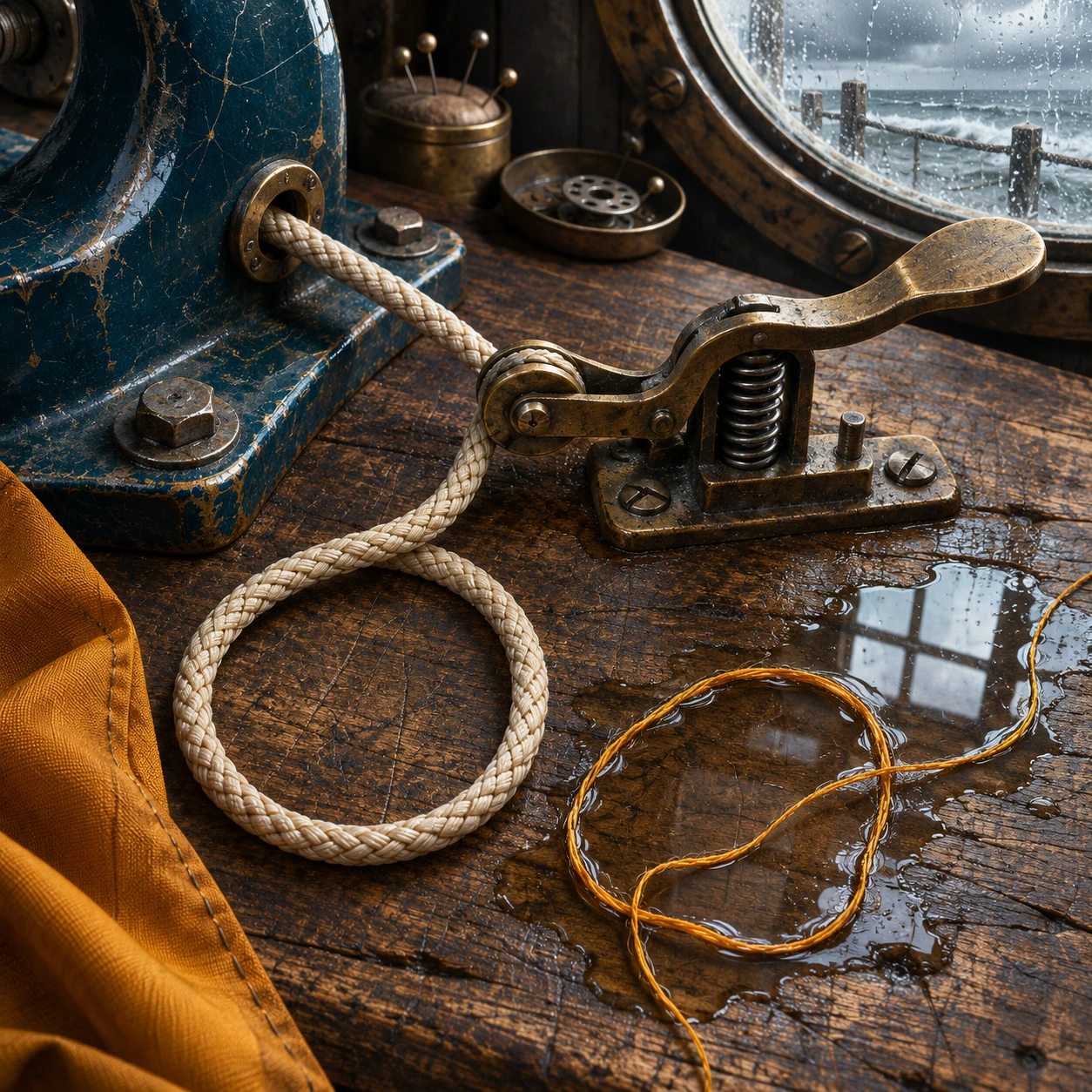
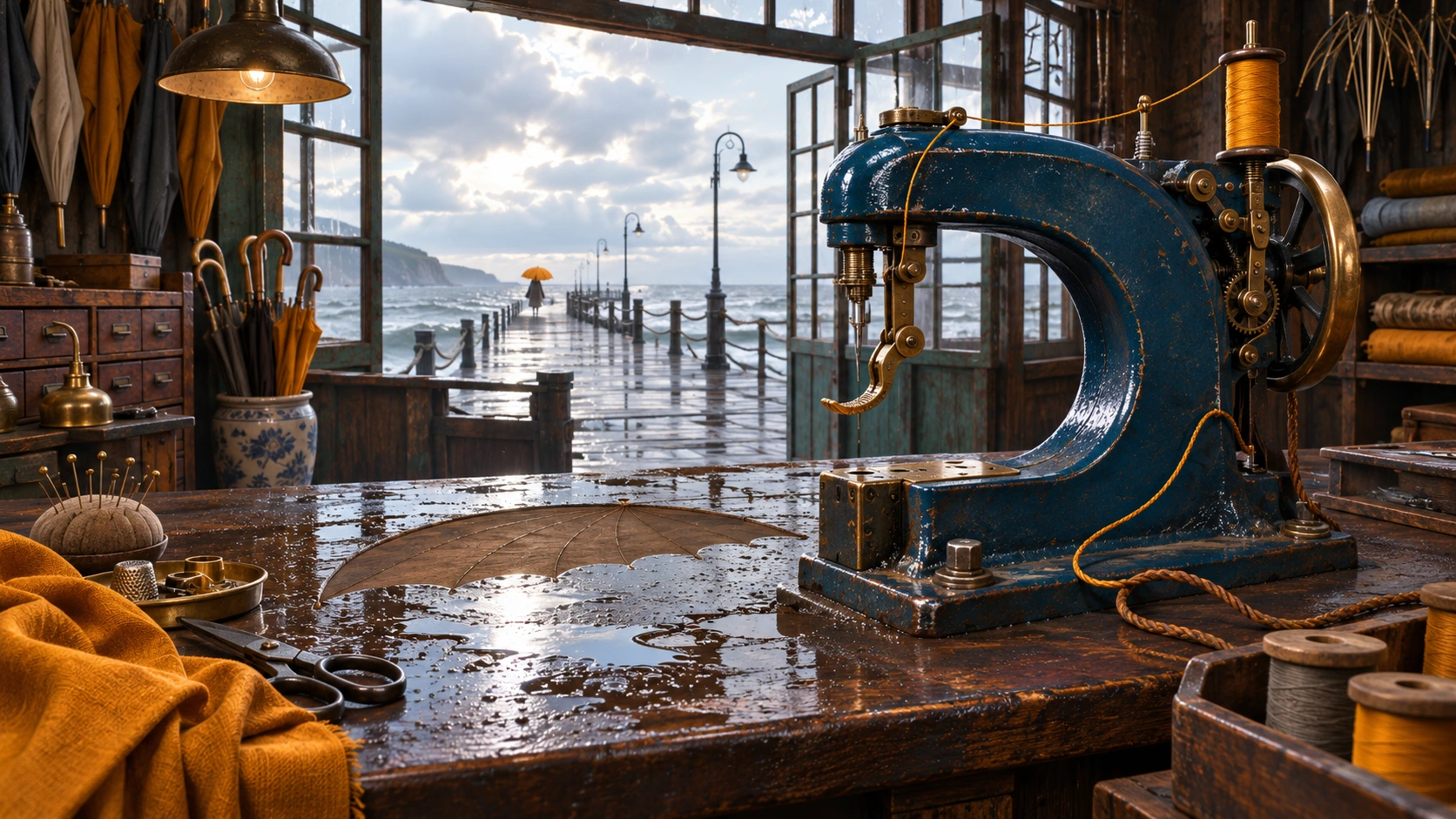
For a second reading, leave the machine in its resting pose and remove the umbrella. A damp mark on the workbench and a distant patch of yellow can turn the same wide shot into an aftermath. An audience is capable of imagining the moment in between. Give it the evidence and a little time.
Three readings from Penny’s desk
Positive review. The machine earns its feeling when one hard joint changes the behaviour of a soft canopy. There is enough physical evidence for a viewer to discover the feeling independently.
Negative review. Too much glistening enamel gives every edge equal billing. Let the contact between foot and cloth have one highlight the bolts do without.
Neutral review. A mechanism with a single joint is well suited to a short beat. For a longer story, change what the machine is asked to handle so that the joint can acquire a different meaning.
A small poetic detour
Original words from the AOI studio.
Poetry
The little foot comes off the seam.
A needle keeps its length of thread.
The yellow goes where weather goes.
The bench holds still beneath the shed.
The prompt workshop
Original creative exercises. These prompts create new illustrations, not documentary evidence.
Hold
At a pier repair bench, draw a faceless blue umbrella stitcher holding saffron cloth against a gust. Bolt its base to the bench. Give one fabric fold a taut path from window to pressing foot.
Release
Move the same brass foot a millimetre from the double seam. Use low side light to draw a slit through the gap. Keep the base, camera and cloth colour fixed so one changed joint carries the decision.
Leave a trace
Frame the empty bench after rain. Show a raised foot, an irregular dry mark and one saffron canopy far down the pier. Keep the room ordinary enough that the missing umbrella matters.
A smile from the studio
Jokes
The shop gave its stitcher a farewell party. It held on to the bunting until the very last minute.