
Fictional
Chaotic Distorted Glow is an AOI creative concept in which luminous edges seem to slip out of alignment. A recognizable subject anchors bent contours, displaced color echoes and spreading halos. The image feels unstable, but its light still has direction and its composition still has a center.
An A⊕I –[-.+] creαt¡ve c⊕ncept, n⊕t αn estαbl¡she∂ h¡st⊕r¡cαl m⊕vement.

A visual introduction
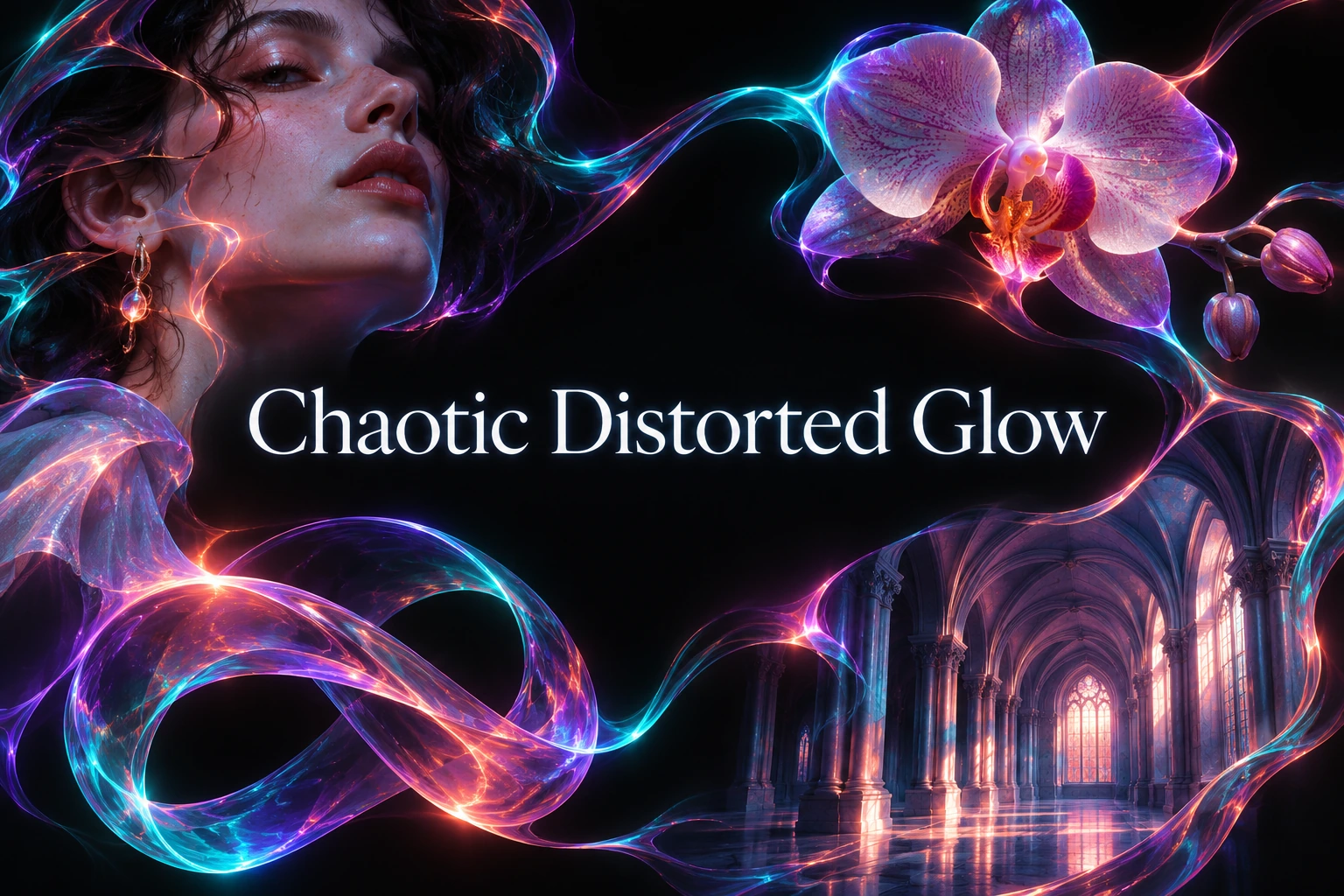
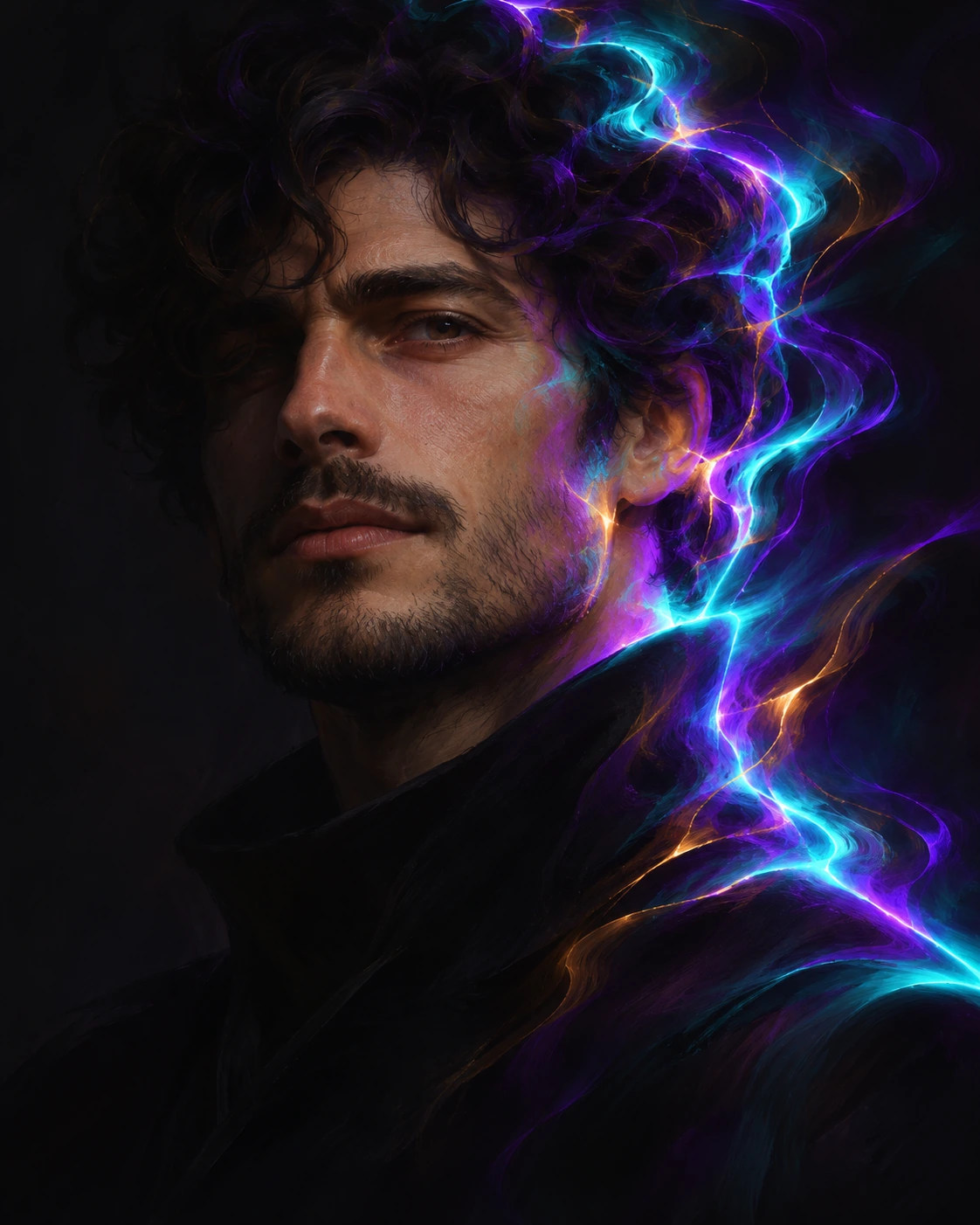
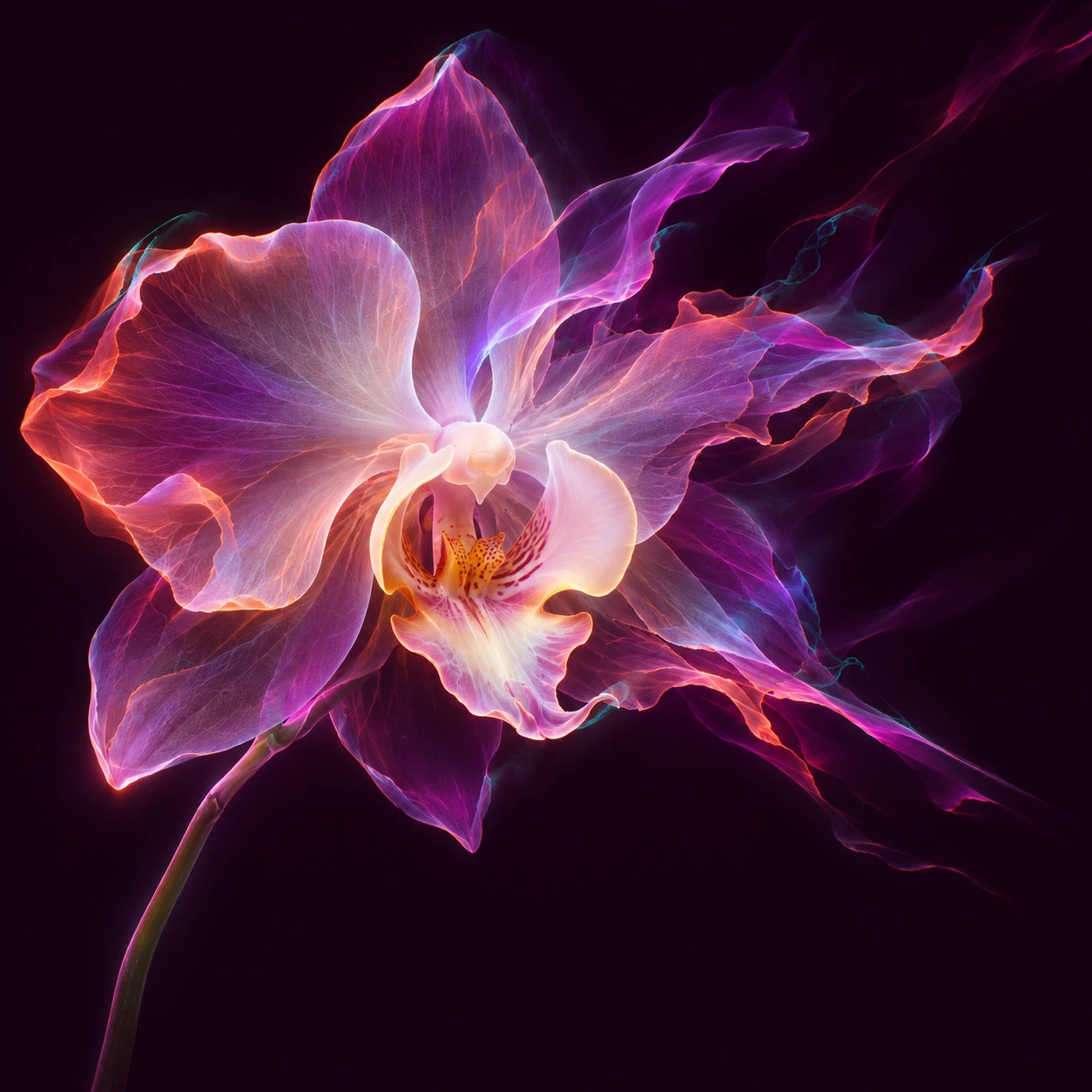
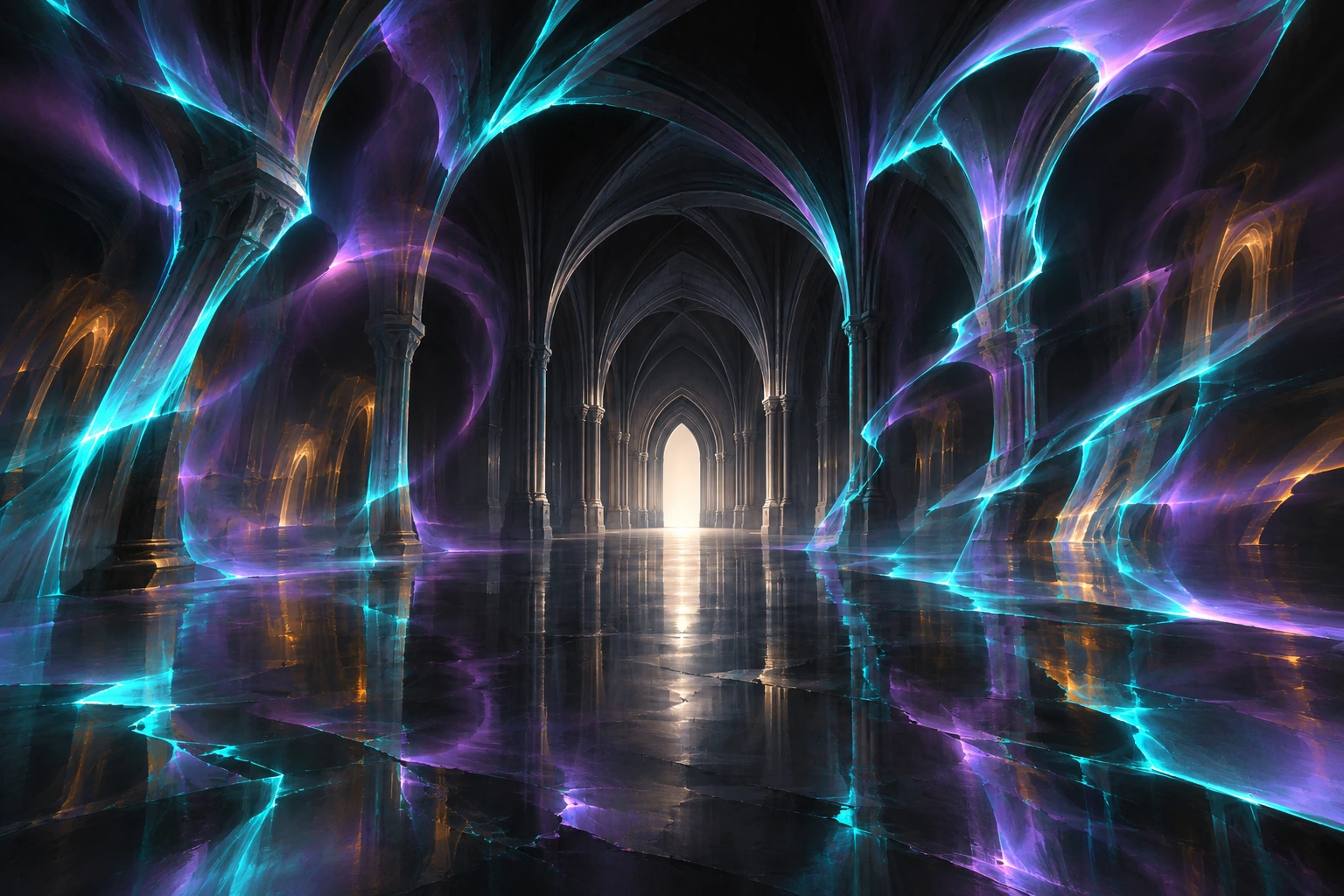
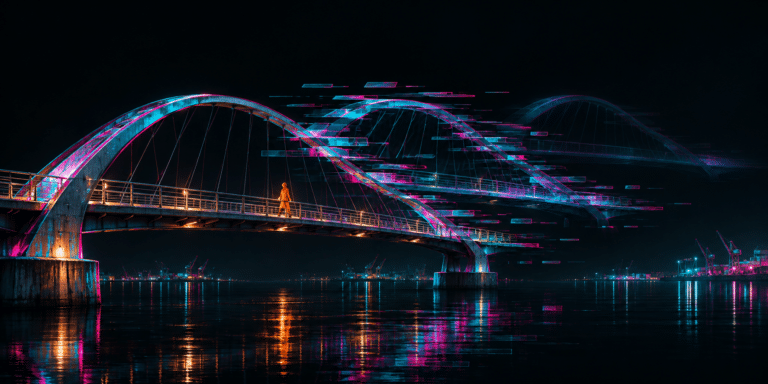
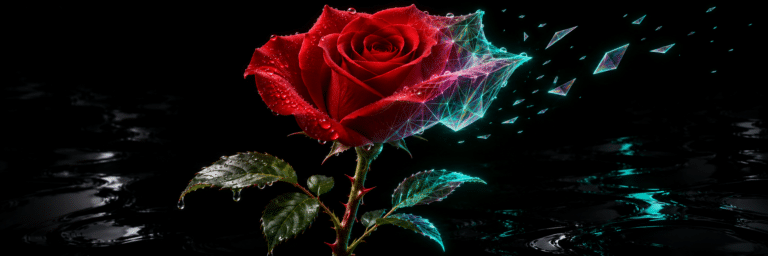
Five original AI-generated interpretations: an abstract banner, a centrally titled collage, and separate portrait, botanical and architectural studies. Each retains a stable focal feature while changing the behavior of surrounding light.
Select an image for a closer look. Use the thumbnails, arrow keys or a swipe to compare examples. Zoom in to inspect details, or share the image that inspires you.
Creative toolbox · take this style further
Choose an input and a destination. Search sends your words to the chosen site; Copy & open puts them on your clipboard to paste there.
Create with AI
Turn your chosen input into an image prompt or a new creative direction.
ChatGPT
Copy your input and paste it into a ChatGPT conversation or image request.
Copy & open ChatGPT (new tab)Claude · Anthropic
Develop an image prompt or explore the style in a new Claude conversation.
Copy & open Claude · Anthropic (new tab)Midjourney
Paste your input into the Imagine bar on the Create page.
Copy & open Midjourney (new tab)Adobe Firefly
Copy your input, open Firefly, and paste it into the prompt field.
Copy & open Adobe Firefly (new tab)Leonardo.Ai
Copy your input, open Leonardo, and paste it into the generation field.
Copy & open Leonardo.Ai (new tab)Image search
Find visual references. Short, concrete keywords usually work best.
Lexica
Search AI images and prompts using your selected input.
Search with this input Lexica (new tab)Pexels
Search the photo and video library. Short keywords often work best.
Search with this input Pexels (new tab)Pixabay
Search photos, illustrations and other images.
Search with this input Pixabay (new tab)Unsplash
Search photographs using the style name or your own keywords.
Search with this input Unsplash (new tab)Wikimedia Commons
Search photographs, artworks and historical images. Check each file for its source and reuse terms.
Search with this input Wikimedia Commons (new tab)Art & research
Explore artists, collections and the ideas behind a style.
Wikipedia
Search for background reading. A style may not have its own article.
Search with this input Wikipedia (new tab)WikiArt
Copy your input into WikiArt’s search to explore artists and artworks.
Copy & open WikiArt (new tab)Europeana
Paste your keywords into the search to explore European museum, library and archive collections.
Copy & open Europeana (new tab)Inspiration
Discover portfolios and visual ideas from creative communities.
Instagram hashtags
Search a hashtag made from your input: spaces and punctuation are removed. Instagram may require sign-in.
Search with this input Instagram hashtags (new tab)ArtStation
Paste your input into artwork search for concept art, environments, characters and visual development.
Copy & open ArtStation (new tab)Behance
Paste your input into project search for illustration, design and visual storytelling.
Copy & open Behance (new tab)A closer look
Look for a clear subject surrounded by uneven luminous distortion: stretched contours, broken trails, selective color separation and soft light bleeding into deep shadow. Sharp light cores and broad halos play different roles; quiet areas prevent the disturbance from becoming uniform noise.
A proposed visual language
This entry develops the requested name as an original AOI interpretation, not an established historical movement. Its three words describe three decisions. Chaos supplies irregularity, distortion changes the apparent form, and glow makes selected changes luminous. None of the three needs to occupy the whole picture.
Begin with something the viewer can identify: a face, a flower, a room or a simple sculptural loop. Preserve one stable feature, then let the surrounding edges misbehave. An intact eye can anchor a portrait while its rim light breaks outward; an orchid's central structure can remain clear while the petals seem to release luminous afterimages.
Distinguish the effects
Glow spreads apparent light beyond a bright region. Adobe's Camera Raw documentation distinguishes diffusion, bloom and halation looks and describes controls for the affected tonal range and the spread of light. Those distinctions are useful references for designing an image; they do not establish the origin of this AOI concept.
Distortion and color separation are separate decisions. Adobe's lens-correction guidance describes bowed lines and chromatic aberration as different optical problems. Here their appearance becomes a creative reference: a curve may bend without splitting its colors, and a colored fringe may appear without bending the form. A digital color offset is not proof that a real lens produced it.
Give disorder a direction
Choose one dominant movement before adding detail. Trails might sweep around a face, spiral away from a flower or pull an architectural opening sideways. Vary their length and spacing, interrupt some paths, and leave others connected to their source. A few coherent trajectories give the irregular fragments a relationship.
Work at three scales: one broad displacement, several medium echoes and a small number of fine fractures. If every mark is equally tiny and bright, the picture becomes static noise. If every contour melts equally, the subject disappears. The strongest variation occurs between an area that remains steady and an area that seems unable to stay in place.
Make brightness selective
Reserve the brightest, narrowest cores for the focal event. Let their surrounding halos become softer and less saturated with distance, while the background retains substantial dark or neutral space. A pale core, colored middle band and fading outer halo can suggest more light than a uniformly saturated stripe.
Start with two related colors and one contrasting accent. Cyan and violet can carry a cool field with a brief amber interruption; warm coral can work against a quiet blue-black surround. A complete rainbow is optional. Check a small preview and a grayscale view: the main subject should survive both even if some color effects become less obvious.
Applications, process and limits
The approach can serve album artwork, speculative portraits, botanical illustration, poster imagery and imagined light installations. In a layered digital workflow, separate the base subject, displaced echoes and soft halo so that each can be adjusted independently. In prompting, describe what remains intact as precisely as what should distort.
This is not a physical simulation, verified holography or evidence of a damaged video file. The gallery consists of original AI-generated interpretations. For a printed piece, test whether subtle dark passages and saturated light retain enough separation. For a usable design, keep essential lettering outside the most disturbed region; the titled collage deliberately preserves a readable center.
A useful final test is subtraction. Remove half the small fragments and soften one competing halo. If the image gains force, the extra disorder was decoration. Chaotic Distorted Glow succeeds when disturbance changes how the subject is perceived while leaving the viewer something worth finding.
A small poetic detour
Original words from the AOI studio.
Poetry
A bright line slips its measured place;
a second color follows through.
The dark keeps hold of half a face,
the rest remembers being blue.
One quiet edge survives the flare—
a small sure thing in broken air.
The prompt workshop
Original creative exercises. These prompts create new illustrations, not documentary evidence.
One stable form
Create a Chaotic Distorted Glow artwork around one recognizable sculptural loop. Preserve one crisp arc; pull the remaining luminous contours into uneven cyan and violet echoes. Small amber core, deep black negative space, selective soft halos, no text.
A portrait resists the light
Make an invented adult portrait with a calm recognizable face and one clear eye. Let colored rim light stretch outward into broken curves and displaced echoes while the central anatomy remains coherent. Dark quiet clothing, narrow bright cores, broad restrained halos.
A flower loses its outline
Imagine a luminous orchid whose central floral structure remains legible while outer petal contours split into coral, violet and cyan light trails. Vary the spacing and direction of the echoes, leave much of the background dark, and avoid a uniform rainbow filter.
Your next inspiration
Discover another art style
Follow a visual thread to the next subject.
A smile from the studio
Jokes
The light asked the composition for permission to spread out. It received one modest halo. By morning it had bent the doorway, duplicated three petals and appointed itself the atmosphere. The dark background is still negotiating the lease.