
AOI original concept · temporal displacement
Holographic Chrono-Glitch is an AOI visual concept in which several apparent moments occupy one image. Stable subjects meet displaced afterimages, floating planar fragments and selective chromatic interference, making time feel briefly misaligned.
An A⊕I –[-.+] creαt¡ve c⊕ncept, n⊕t αn estαbl¡she∂ h¡st⊕r¡cαl m⊕vement.
A visual introduction
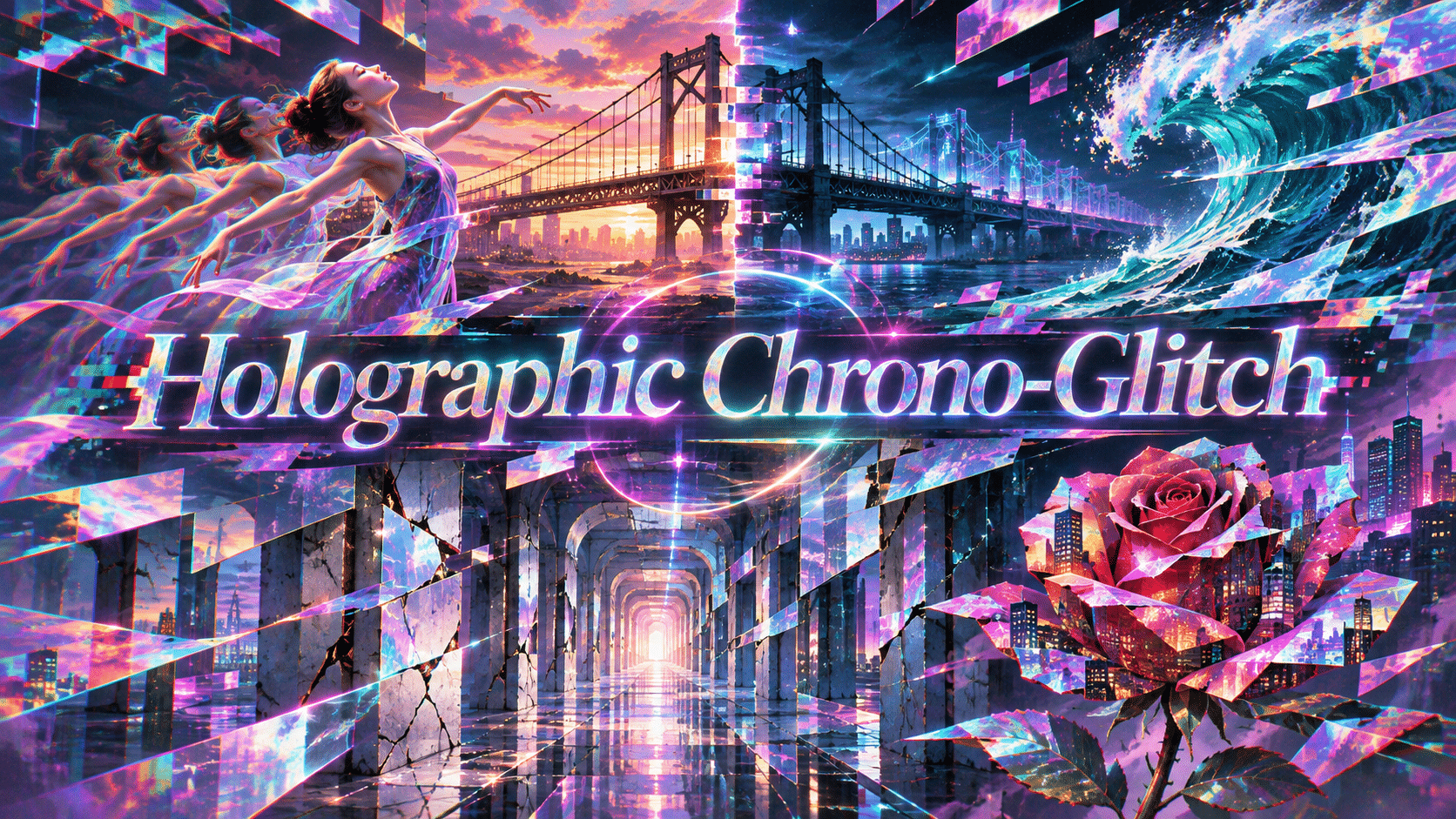
Seven original AI-generated interpretations: a dedicated banner, a centrally titled artistic collage and five standalone studies.
Select an image for a closer look. Use the thumbnails, arrow keys or a swipe to compare examples. Zoom in to inspect details, or share the image that inspires you.

Creative toolbox · take this style further
Choose an input and a destination. Search sends your words to the chosen site; Copy & open puts them on your clipboard to paste there.
Create with AI
Turn your chosen input into an image prompt or a new creative direction.
ChatGPT
Copy your input and paste it into a ChatGPT conversation or image request.
Copy & open ChatGPT (new tab)Claude · Anthropic
Develop an image prompt or explore the style in a new Claude conversation.
Copy & open Claude · Anthropic (new tab)Midjourney
Paste your input into the Imagine bar on the Create page.
Copy & open Midjourney (new tab)Adobe Firefly
Copy your input, open Firefly, and paste it into the prompt field.
Copy & open Adobe Firefly (new tab)Leonardo.Ai
Copy your input, open Leonardo, and paste it into the generation field.
Copy & open Leonardo.Ai (new tab)Image search
Find visual references. Short, concrete keywords usually work best.
Lexica
Search AI images and prompts using your selected input.
Search with this input Lexica (new tab)Pexels
Search the photo and video library. Short keywords often work best.
Search with this input Pexels (new tab)Pixabay
Search photos, illustrations and other images.
Search with this input Pixabay (new tab)Unsplash
Search photographs using the style name or your own keywords.
Search with this input Unsplash (new tab)Wikimedia Commons
Search photographs, artworks and historical images. Check each file for its source and reuse terms.
Search with this input Wikimedia Commons (new tab)Art & research
Explore artists, collections and the ideas behind a style.
Wikipedia
Search for background reading. A style may not have its own article.
Search with this input Wikipedia (new tab)WikiArt
Copy your input into WikiArt’s search to explore artists and artworks.
Copy & open WikiArt (new tab)Europeana
Paste your keywords into the search to explore European museum, library and archive collections.
Copy & open Europeana (new tab)Inspiration
Discover portfolios and visual ideas from creative communities.
Instagram hashtags
Search a hashtag made from your input: spaces and punctuation are removed. Instagram may require sign-in.
Search with this input Instagram hashtags (new tab)ArtStation
Paste your input into artwork search for concept art, environments, characters and visual development.
Copy & open ArtStation (new tab)Behance
Paste your input into project search for illustration, design and visual storytelling.
Copy & open Behance (new tab)A closer look
Establish a clear subject, repeat a limited number of its contours as temporal echoes, and concentrate fragmentation along a meaningful transition. Reserve dark or quiet space so the intact form and its displaced states remain distinguishable.
Make time visible through a stable reference
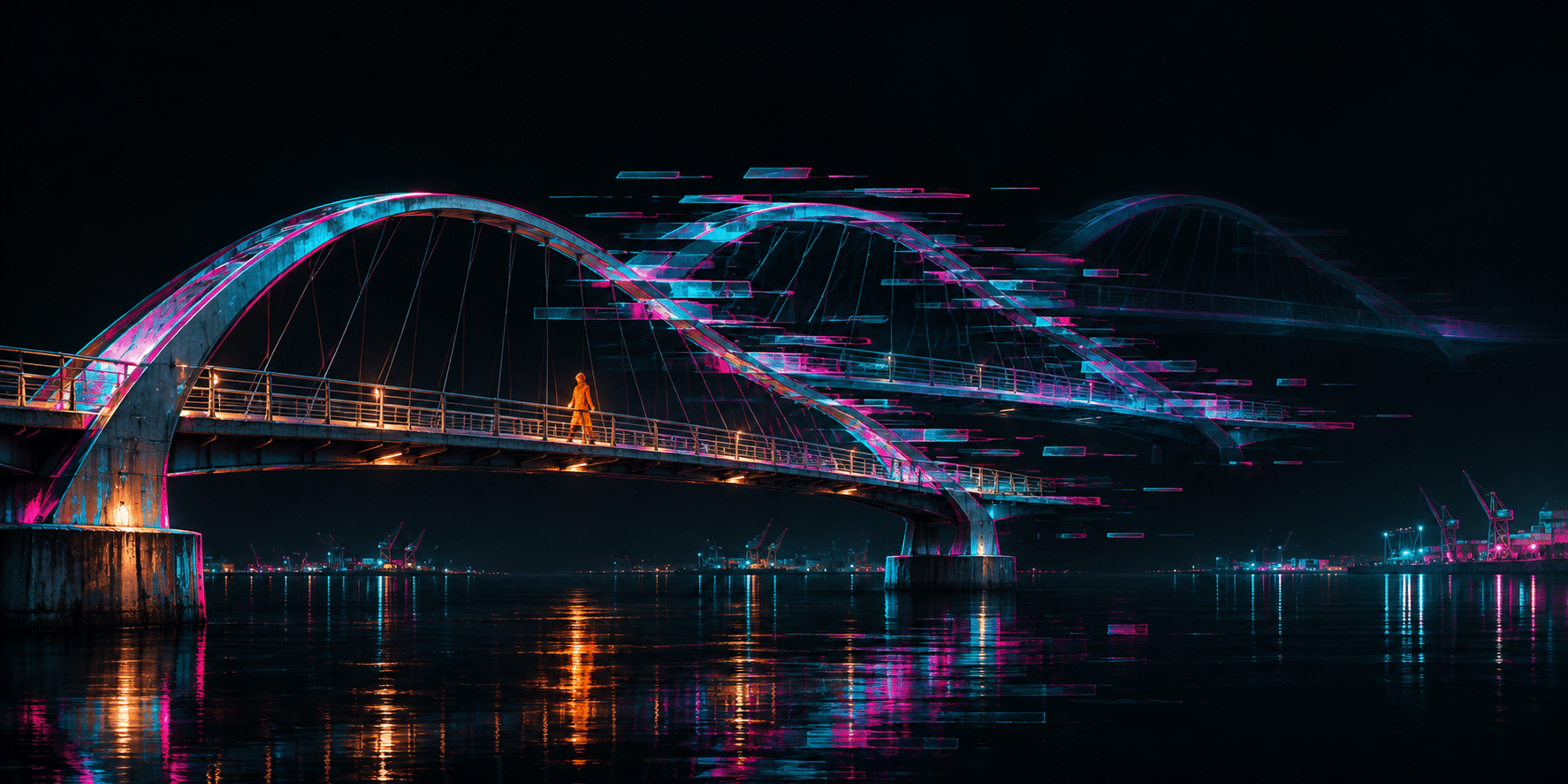
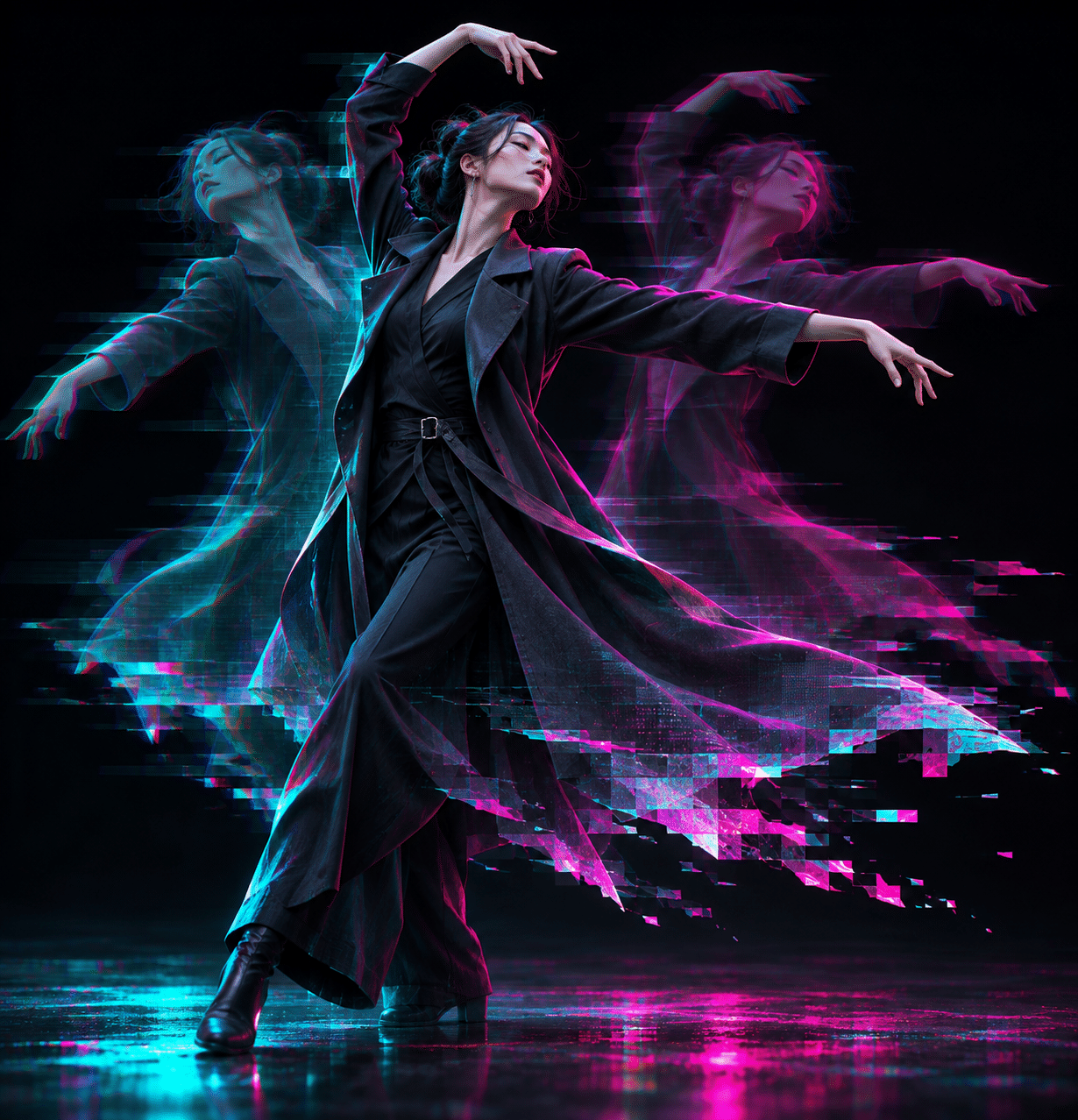
The defining idea is a disagreement between moments. A bridge appears to persist while versions of its arch drift away; a dancer holds one pose while translucent gestures remain beside it. The viewer needs enough continuity to recognize what changed. Without that reference, the result becomes an attractive scatter of fragments.
This is an original AOI concept, not a claim of an established historical movement. The requested vocabulary—holographic chrono-glitch, datamosh aesthetic, floating laser-sliced pixel fragments, chromatic shift interference and cyberpunk artifacting—describes the desired appearance. These static AI-generated illustrations are not physical holograms or evidence of a particular video-processing technique.
Choose an anchor before adding corruption
In the banner, an orange-lit pedestrian and the nearest bridge span provide a dependable point of attention. Cyan and magenta fragments gather around the displaced arches. The dark harbor gives the eye room to separate the main structure from its echoes.
An anchor can be a face, doorway, bowl rim or continuous wave crest. Keep its silhouette, lighting or location more stable than the surrounding elements. Decide which part of the image belongs to the present and which parts suggest before or after; the audience should be able to discover that distinction without a caption.
Give the fragments a direction
The dancer’s coat breaks into small planes that follow the sweep of the fabric. The wave sheds rectangular fragments from its trailing edge. In both cases, disruption develops from the subject’s motion rather than arriving as a uniform overlay.
Vary fragment size and spacing deliberately. Larger slices can retain recognizable pieces of an object; smaller shards can indicate dissipation. A trail that narrows or becomes more transparent creates a different rhythm from an abrupt wall of corruption. Keep some uninterrupted contours between the fragments so the image does not lose all structure.
Use color as an offset, not a flood
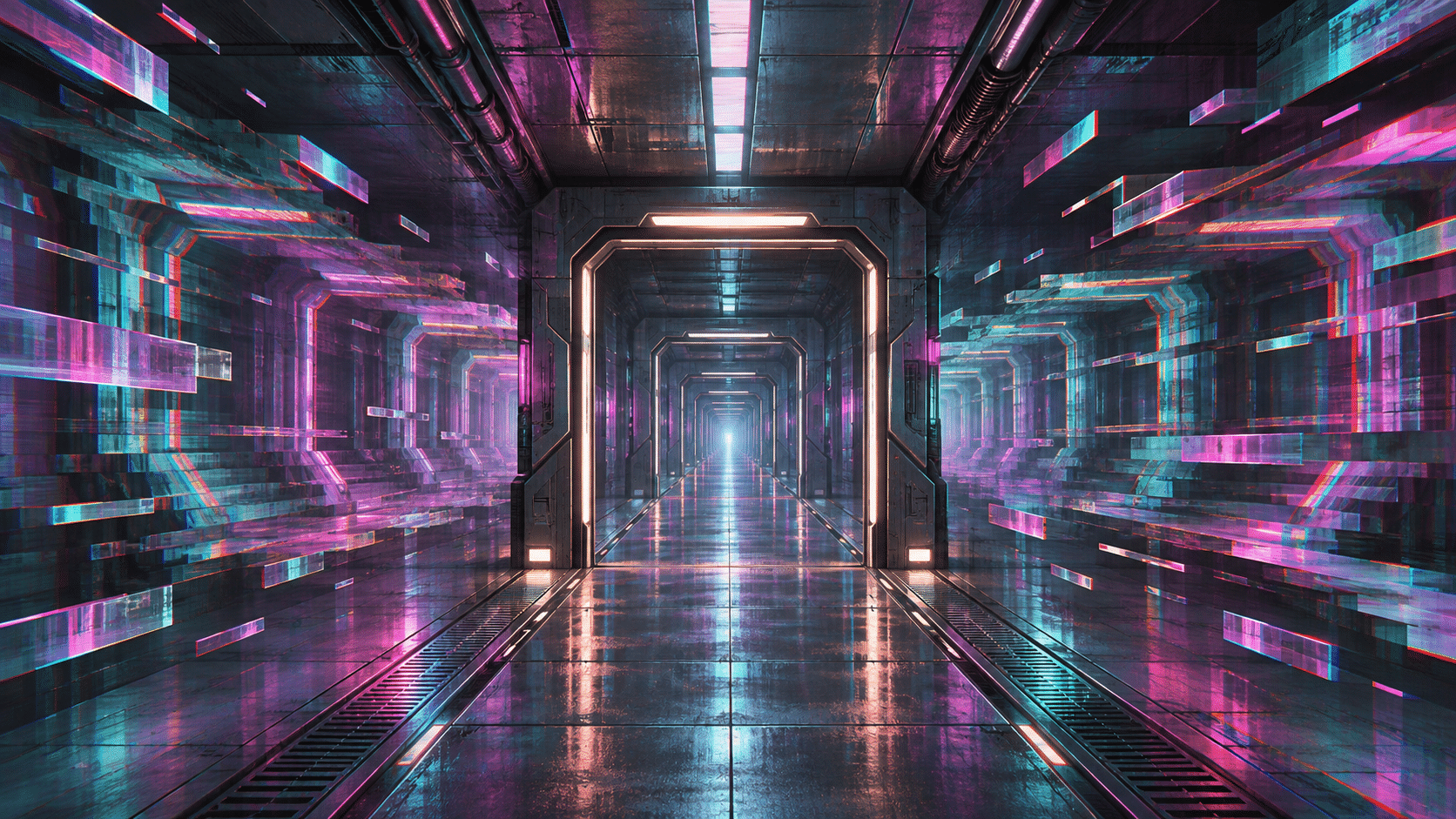
Cyan and magenta shifts are useful for separating adjacent states, but they need not cover every surface. In the corridor study, neutral architectural planes preserve depth while bright edge displacements disturb the side walls. The intact central route remains inviting and slightly unsettling.
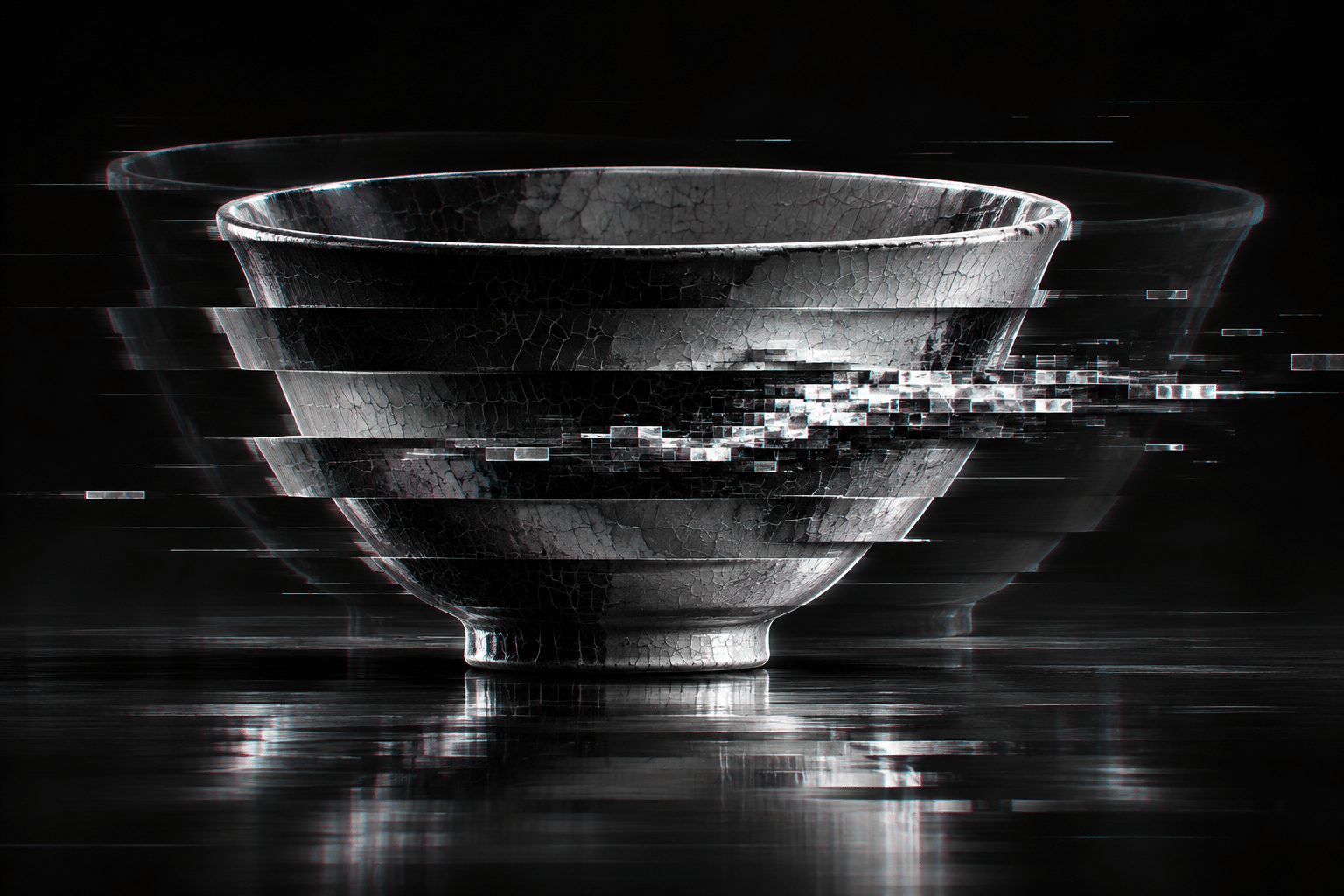
The silver-gray bowl tests the same idea with almost no color. Horizontal displacement, ghost contours and contrast carry the temporal effect. Its faint edge fringes are secondary. This near-monochrome variant suits quieter editorial images or print applications where a full neon palette would overwhelm the subject.
Translate the concept across subjects
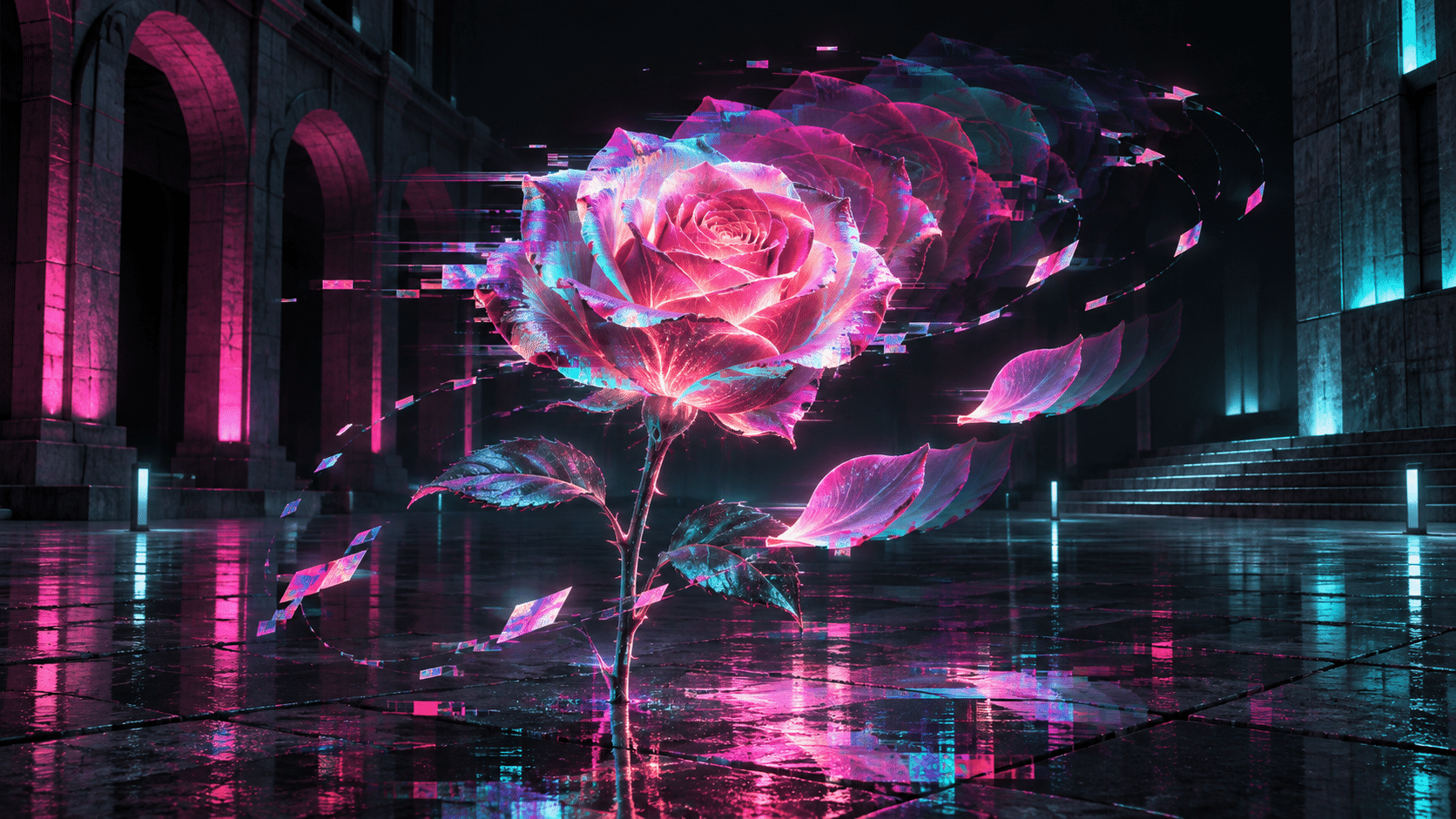
Architecture offers repeated doors, arches and strong perspective lines. Dance offers changes of gesture. Water offers a continuous surface that can become discontinuous at the crest. A rose offers nested petals whose repeated contours can suggest successive stages or positions.
The plaza rose is organized around temporal echoes, rather than a botanical wireframe. That choice distinguishes this concept from a general cyber-nature aesthetic. When adapting it to another subject, identify the feature that communicates change: a turning head, opening flower, receding train or shifting shadow. Do not depend on neon lighting alone.
Review the image for useful tension
This direction works well for speculative album art, stories about memory, editorial illustrations about delay and concept art about unstable perception. The emotional range can extend from exhilaration to unease. Dark space and a few fragile echoes can feel more mysterious than a screen filled with artifacts.
Review the image at thumbnail size first: is there a clear subject and an intelligible disturbance? Then inspect the fragments and repeated anatomy at full size. Reject accidental extra limbs, unreadable focal shapes and indiscriminate noise. If developing an animated version later, the timing and continuity must be designed separately; a static afterimage is only a compositional proposal.
Positive editorial perspective
AOI editorial perspective (AI-authored). A stable subject gives the spectacle a reason to exist. The bridge, dancer and near-monochrome bowl show that temporal displacement can organize very different compositions while retaining a recognizable visual rule.
Negative editorial perspective
AOI editorial perspective (AI-authored). The concept can collapse into familiar neon decoration. Too many equal-strength echoes obscure the subject, and arbitrary pixel fragments may suggest a filter rather than a considered interpretation of time.
Neutral editorial perspective
AOI editorial perspective (AI-authored). Holographic Chrono-Glitch is an AOI-created artistic direction. Its gallery uses static generated imagery to suggest displaced moments; it does not demonstrate physical holography or verified datamoshing.
Pocket-sized facts
A stable visual anchor is the central compositional rule.
Temporal echoes can be expressed through displacement and value, including near-monochrome images.
The gallery consists of original AI-generated interpretations, not physical holograms.
A small poetic detour
Original words from the AOI studio.
Poetry
The bridge remembers one more span.
The coat keeps moving after me.
A wave repeats where it began,
then leaves its pieces on the sea.
The doorway holds a steady light;
the walls arrive a little late.
A silver bowl divides the night
and cannot choose a single state.
The rose lets yesterday unfold
beside the petal opening now.
One quiet shape is ours to hold;
the rest forgets precisely how.
The prompt workshop
Original creative exercises. These prompts create new illustrations, not documentary evidence.
A bridge out of time
Holographic chrono-glitch: one pedestrian bridge across a midnight harbor, its nearest span intact and two displaced temporal echoes dissolving into laser-thin planar pixel fragments. One warm figure anchors the scene; cyan-magenta edge interference, deep negative space, no text.
Keep the figure and nearest bridge span stable.
Gesture and afterimage
An adult dancer in a dark flowing coat, one clear central pose with two translucent temporal echoes. Concentrate floating pixel fragments along the coat hem, selective cyan-magenta edge shifts, quiet black studio, coherent anatomy, no text.
Make the fragments follow the garment’s movement.
A quiet glitch
A silver-gray ceramic bowl against black, a clear original silhouette interrupted by offset horizontal image slices and two faint ghost contours. Localized fine digital fragments, near-monochrome palette, restrained light, no text.
Let displacement and value carry the effect.
A smile from the studio
Jokes
The time-glitched dancer arrived for rehearsal yesterday, today and three seconds from now. The choreographer praised the ensemble, then discovered it was one person. “Excellent,” she said. “You already know the steps.” The dancer pointed at her trailing afterimages. “They know the old version.” The lighting technician asked whether all three needed a spotlight. Accounting immediately classified the echoes as unpaid interns.