
AOI concept · translucent material fantasy
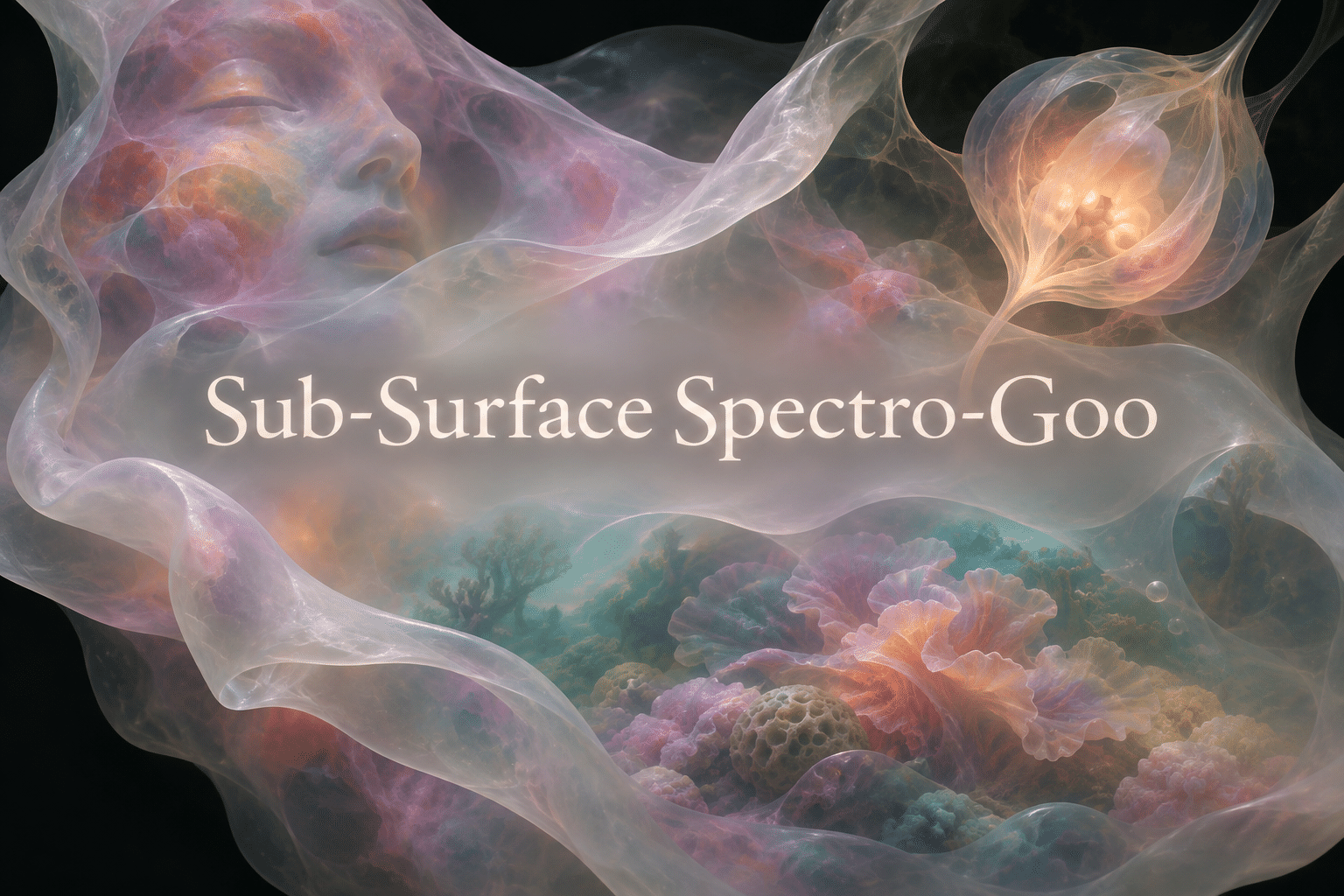
Sub-Surface Spectro-Goo is an AOI material fantasy built around soft membranes and color that seems suspended beneath them. Its defining tension is between a readable outer form and a gently obscured, luminous interior.
An A⊕I –[-.+] creαt¡ve c⊕ncept, n⊕t αn estαbl¡she∂ h¡st⊕r¡cαl m⊕vement.

A visual introduction
Seven original AI-generated interpretations: a dedicated banner, a centrally titled artistic collage and five standalone studies.
Select an image for a closer look. Use the thumbnails, arrow keys or a swipe to compare examples. Zoom in to inspect details, or share the image that inspires you.
Creative toolbox · take this style further
Choose an input and a destination. Search sends your words to the chosen site; Copy & open puts them on your clipboard to paste there.
Create with AI
Turn your chosen input into an image prompt or a new creative direction.
ChatGPT
Copy your input and paste it into a ChatGPT conversation or image request.
Copy & open ChatGPT (new tab)Claude · Anthropic
Develop an image prompt or explore the style in a new Claude conversation.
Copy & open Claude · Anthropic (new tab)Midjourney
Paste your input into the Imagine bar on the Create page.
Copy & open Midjourney (new tab)Adobe Firefly
Copy your input, open Firefly, and paste it into the prompt field.
Copy & open Adobe Firefly (new tab)Leonardo.Ai
Copy your input, open Leonardo, and paste it into the generation field.
Copy & open Leonardo.Ai (new tab)Image search
Find visual references. Short, concrete keywords usually work best.
Lexica
Search AI images and prompts using your selected input.
Search with this input Lexica (new tab)Pexels
Search the photo and video library. Short keywords often work best.
Search with this input Pexels (new tab)Pixabay
Search photos, illustrations and other images.
Search with this input Pixabay (new tab)Unsplash
Search photographs using the style name or your own keywords.
Search with this input Unsplash (new tab)Wikimedia Commons
Search photographs, artworks and historical images. Check each file for its source and reuse terms.
Search with this input Wikimedia Commons (new tab)Art & research
Explore artists, collections and the ideas behind a style.
Wikipedia
Search for background reading. A style may not have its own article.
Search with this input Wikipedia (new tab)WikiArt
Copy your input into WikiArt’s search to explore artists and artworks.
Copy & open WikiArt (new tab)Europeana
Paste your keywords into the search to explore European museum, library and archive collections.
Copy & open Europeana (new tab)Inspiration
Discover portfolios and visual ideas from creative communities.
Instagram hashtags
Search a hashtag made from your input: spaces and punctuation are removed. Instagram may require sign-in.
Search with this input Instagram hashtags (new tab)ArtStation
Paste your input into artwork search for concept art, environments, characters and visual development.
Copy & open ArtStation (new tab)Behance
Paste your input into project search for illustration, design and visual storytelling.
Copy & open Behance (new tab)A closer look
Keep the contour deliberate, soften the inner color and reserve crisp highlights for a few folds. Milky veils, partial concealment and uneven apparent thickness give the image depth; the color should feel embedded rather than painted onto an opaque shell.
A material imagined through its appearance
This name describes a proposed AOI visual language, not a discovered substance, established art movement or laboratory technique. “Spectro” suggests a range of luminous color; it does not mean the image contains measured spectral information. “Goo” supplies the idea of softness, yielding folds and uncertain boundaries.
The gallery uses original AI-generated images to explore those ideas. No physical gel, biological specimen or constructed installation is documented here. The artistic challenge is to create a convincing relationship between a surface and something partly visible underneath it, without relying on a technical label to do the work.
Give the surface and interior different jobs
A clear outer contour tells the viewer where the form ends. Soft internal masses imply that something lies within it. If both are equally sharp, the object can look like a hollow glass display case. If both dissolve completely, the subject may read as smoke. The useful middle ground is a stable silhouette with selective uncertainty inside.
The banner concentrates this contrast in a single sweeping fold. Its bright crest stays precise while amber, cyan and rose regions overlap beneath the pale membrane. The dark ground is essential: it gives the translucent edge somewhere to disappear and makes the luminous interior feel contained.
Color belongs beneath the skin
Treat each internal hue as a volume or current, not as a stripe printed on the surface. Let a pale veil interrupt it. Allow a color to grow dimmer or softer where the imagined material thickens. Repeating the same saturated rainbow across every fold removes the sense of depth.
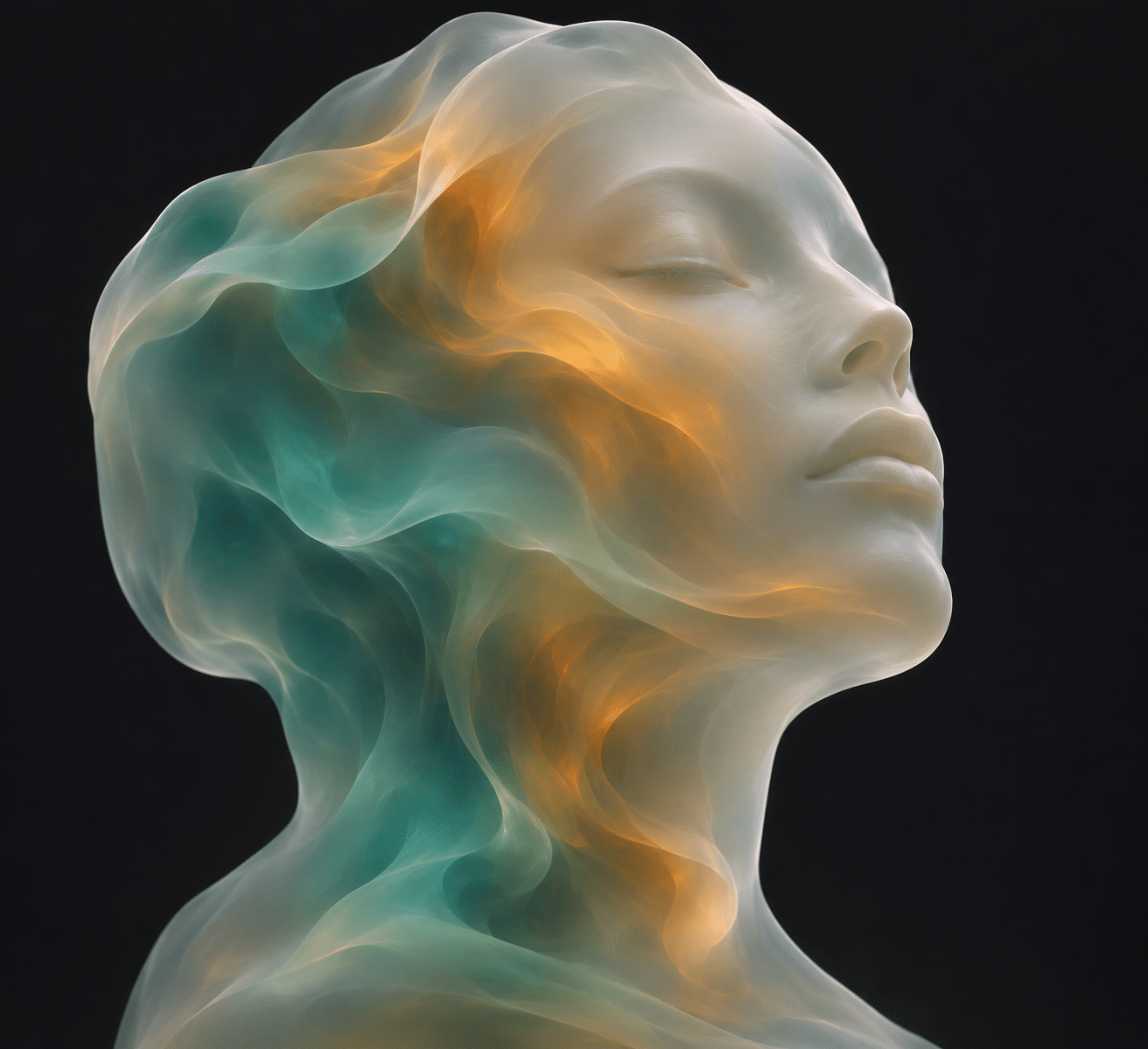
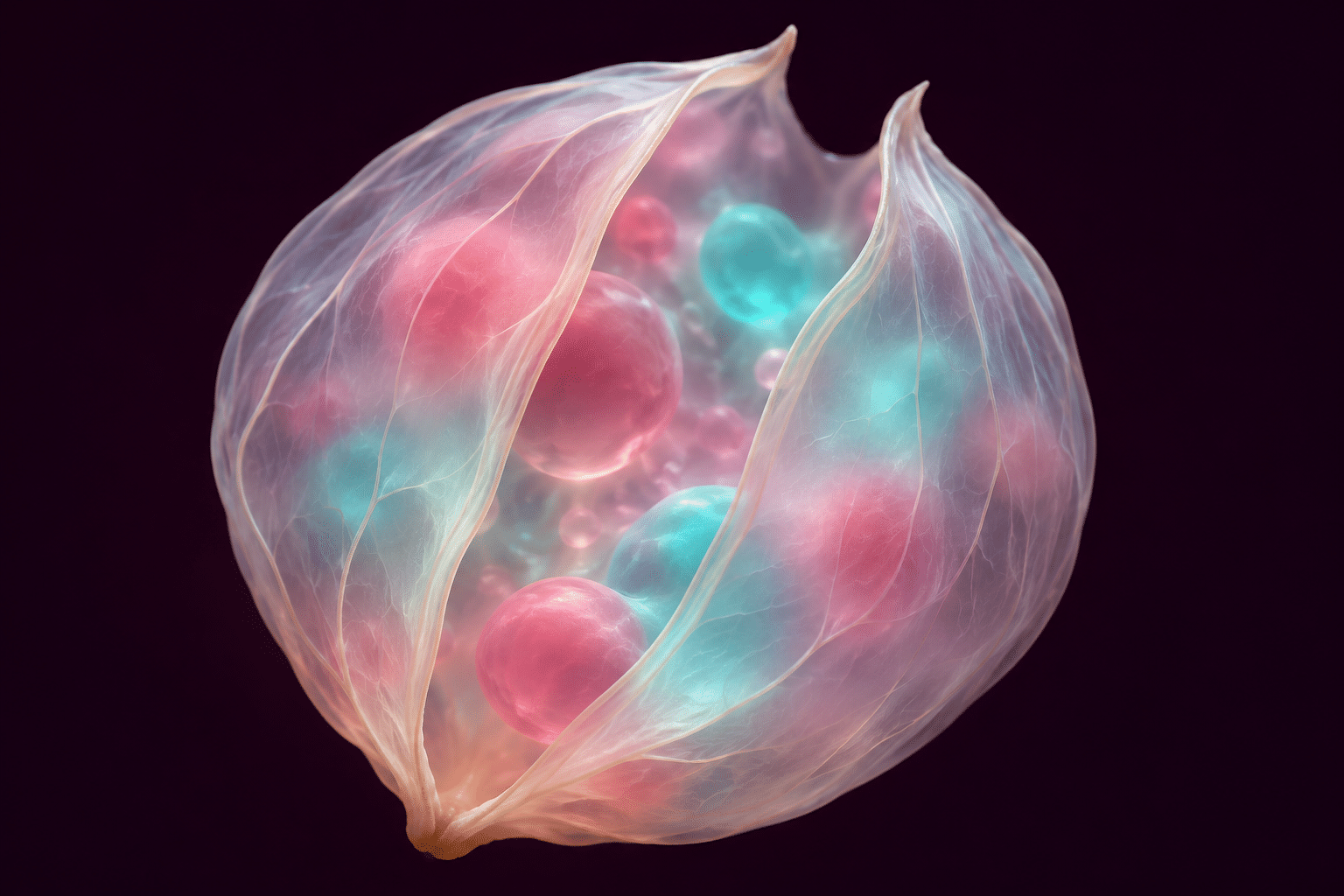
The portrait keeps a serene facial contour while teal and amber flows continue through the head and neck. In the seed-pod study, rose and cyan spheres are partly veiled by the opened shell. One uses flowing bands and the other rounded inclusions, demonstrating two different ways to organize the interior.
Build variation through shape and scale
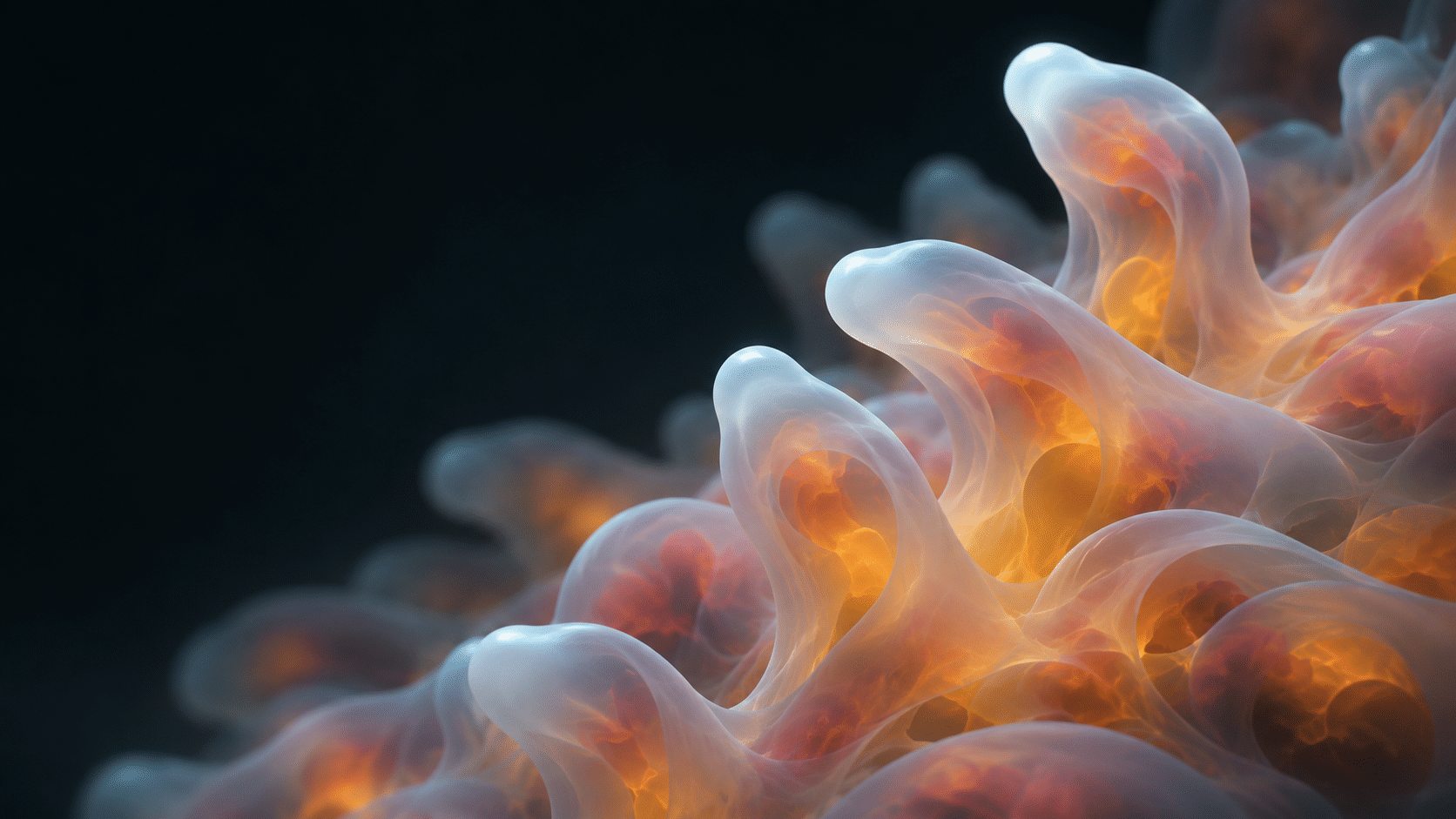
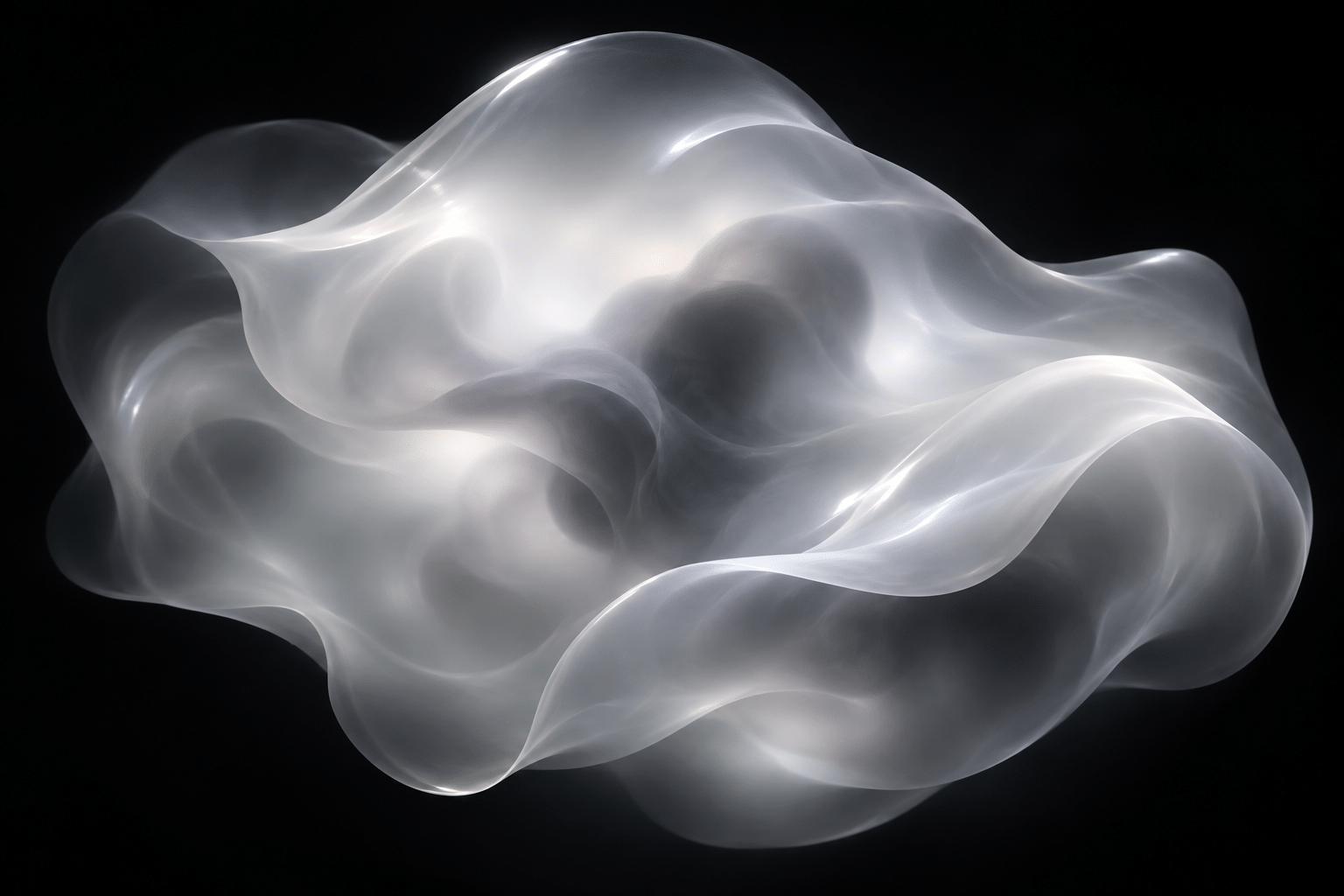
The reef-like cluster repeats pale tubes with warm cores, creating a rhythm of rising forms against a quiet dark field. It is an organic abstraction, not a claim about a species or microscopic discovery. The monochrome membrane removes the colored palette altogether and relies on smoky gray inclusions, white glow and selected glancing highlights.
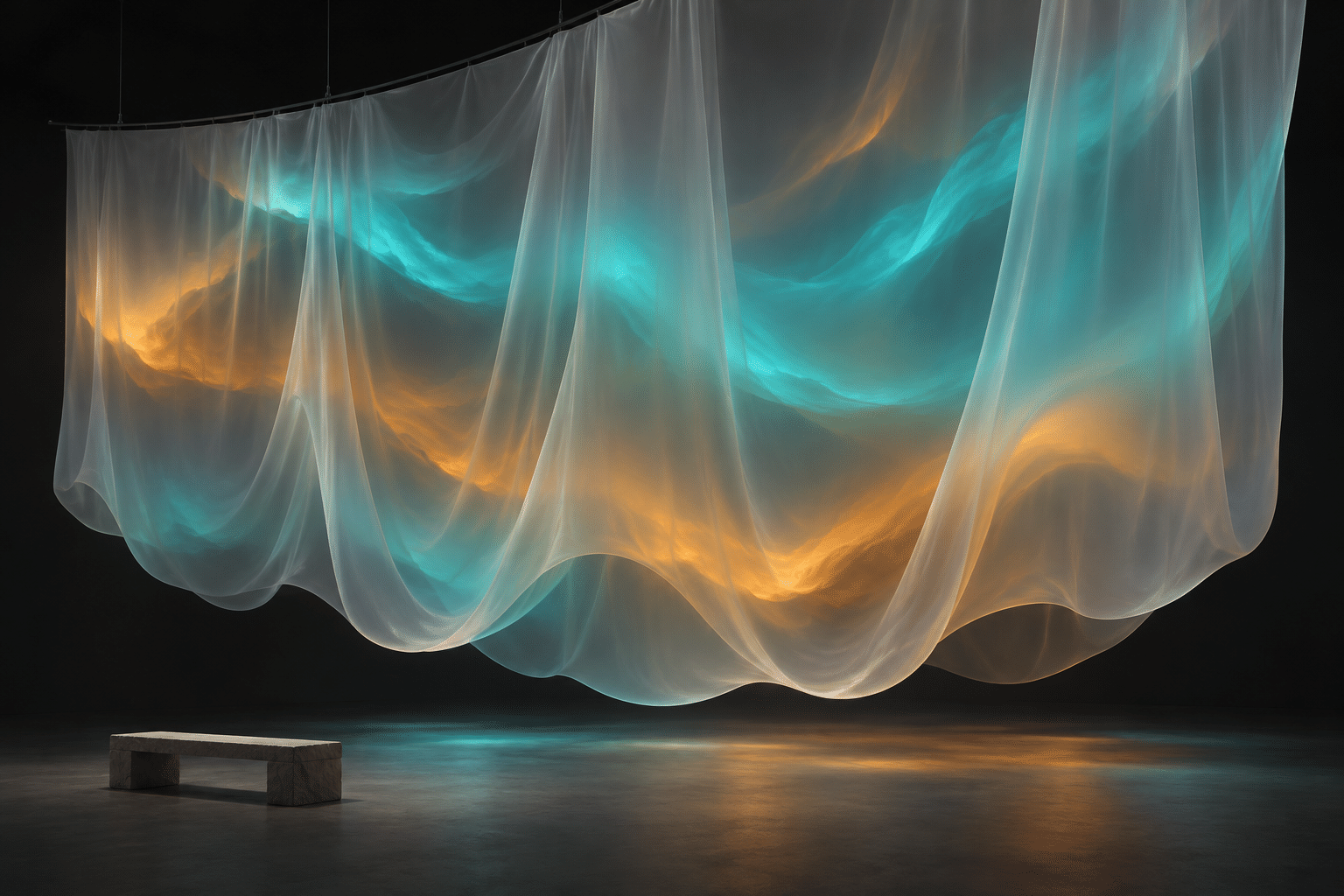
The installation study then changes scale. A small stone bench makes the suspended curtain seem enormous. This is a speculative visualization rather than a fabrication proposal. Its value is compositional: it asks how the same relationship between folded surface and internal light might shape a room-sized experience.
Keep it distinct from neighboring looks
The central quality here is softness with partial concealment. Hard facets, mirror-metal spikes and sharp internal reflections would move the image toward other material fantasies. Similarly, neon outlines alone would describe the boundary without giving the viewer a sense of an interior.
This makes a useful comparison with Iridescent Ferrofluid Hyper-Vitrification: that AOI concept emphasizes the tension of dark fluid-like structures and glass-like arrest. Sub-Surface Spectro-Goo favors a milky veil, yielding curves and diffuse internal color. They can share luminous palettes without becoming interchangeable.
A practical brief and a useful critique
Choose an outer form, an inner organization and one place where the viewer can compare them. A folded membrane with a colored current is enough to begin. Use a dark background, a limited palette and one strong contour. Add secondary detail only after the relationship between outside and inside reads clearly.
The direction suits speculative sculpture, album imagery, conceptual portraits and atmospheric installation studies. Its main failure is anonymous glossy beauty: a luminous blob can be attractive and still have no composition. Give it a gesture, a point of tension or a change of scale. Do not describe the result as evidence of real optical measurements or a working material process.
Positive editorial perspective
AOI editorial perspective (AI-authored). The approach gives color apparent depth and turns partial concealment into an expressive device. The quiet portrait and monumental curtain demonstrate that the same material logic can work at intimate and architectural scales.
Negative editorial perspective
AOI editorial perspective (AI-authored). Milky translucency can conceal weak form as easily as it creates atmosphere. Too much glow produces a generic soft-focus blob. Use a clear contour, a limited internal structure and a deliberately placed sharp edge.
Neutral editorial perspective
AOI editorial perspective (AI-authored). Sub-Surface Spectro-Goo is an AOI speculative art concept. Its images explore perceived softness and embedded light; they do not demonstrate a new material, measured spectrum or fabricated installation.
Pocket-sized facts
An original AOI concept centered on soft translucency and partially concealed color.
The word “Spectro” is an artistic cue, not a measurement claim.
All seven images are generated interpretations, including the imagined installation.
A small poetic detour
Original words from the AOI studio.
Poetry
Beneath the fold, a color waits.
The surface keeps its softened seam.
A little amber hesitates
between a body and a dream.
The blue withdraws behind the white.
A rose lies deeper than the skin.
The contour holds a thread of light
and lets the quiet gather in.
No glass remembers being stone.
No curtain promises to stay.
A pale membrane keeps its own
small weather from the open day.
The prompt workshop
Original creative exercises. These prompts create new illustrations, not documentary evidence.
A fold with an interior
Create one pearl-colored translucent gel fold against dark plum. Soft amber and cyan currents lie visibly beneath the milky surface. Keep one precise bright crease and a clear outer silhouette, broad quiet space, no text.
Separate surface clarity from interior softness.
The imagined seed
Create a luminous imaginary seed pod with an opened milky membrane and suspended rose and cyan globules. Different apparent depths, a clear organic silhouette, diffused internal color, restrained highlights, dark background, no scientific labels.
Use partial concealment to create depth without implying a real specimen.
Monochrome monument
Visualize a monumental folded translucent membrane in a dark gallery with a small stone bench for scale. Pearl white and smoky gray only, soft interior light, a few crisp surface highlights, quiet architectural framing, no lettering.
Translate the idea to a different scale and remove reliance on saturated color.
A smile from the studio
Jokes
The gallery ordered a sculpture with a strong internal life. The artist delivered a translucent fold full of amber and blue. The curator approved the concept but asked for a firmer identity. The sculpture replied, “I’m working on my boundaries.” The bench, which had very reliable boundaries, received none of the reviews.