
AOI creative concept · imagined material transformations
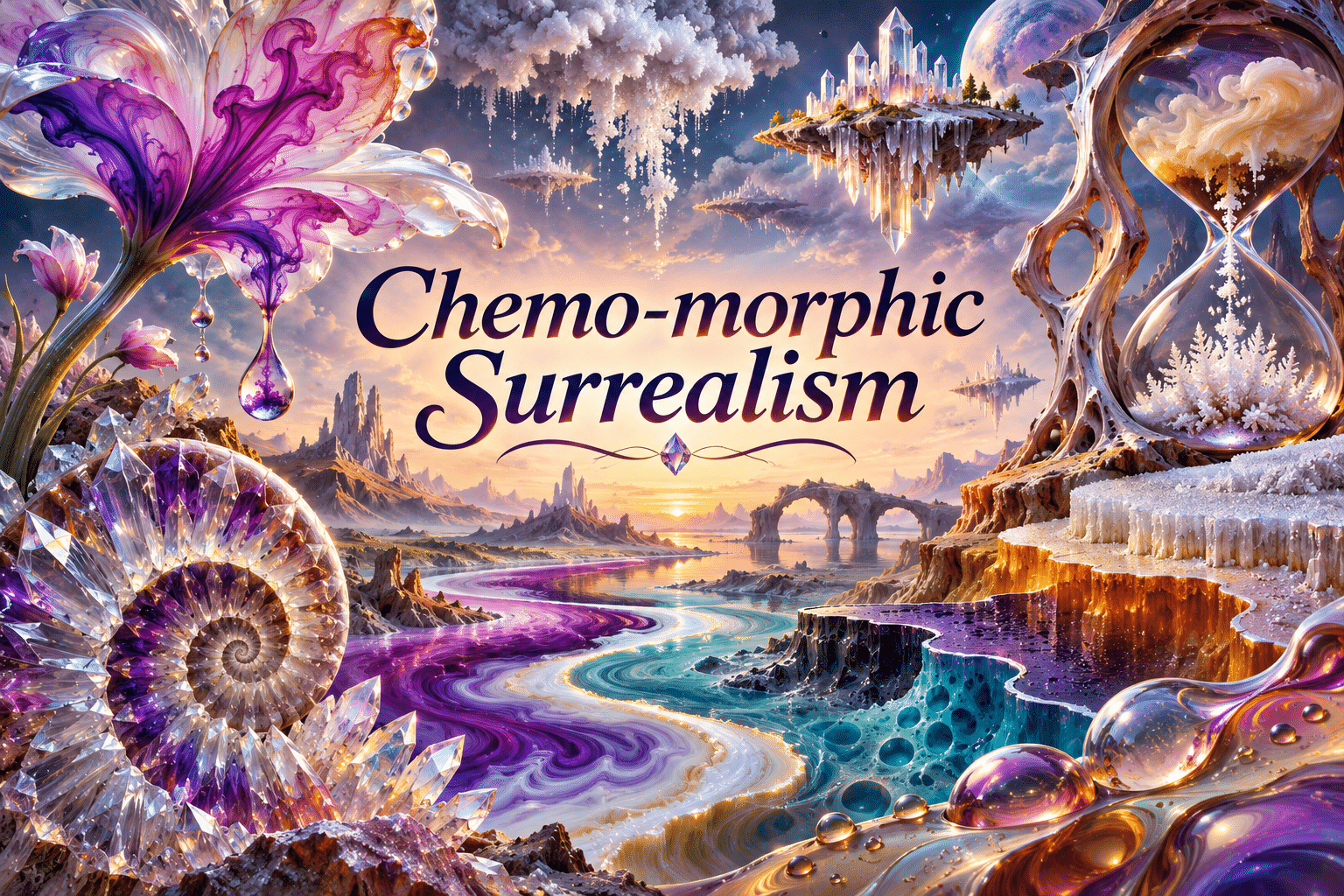
Chemo-morphic Surrealism is an AOI proposal in which matter seems to change its identity before the viewer’s eyes. Flowing surfaces become facets, colored boundaries branch, and recognizable objects survive halfway through impossible transformations.
An A⊕I –[-.+] creαt¡ve c⊕ncept, n⊕t αn estαbl¡she∂ h¡st⊕r¡cαl m⊕vement.
A visual introduction
Seven original AI-generated interpretations: a dedicated banner, a centrally titled artistic collage and five standalone studies.
Select an image for a closer look. Use the thumbnails, arrow keys or a swipe to compare examples. Zoom in to inspect details, or share the image that inspires you.
Creative toolbox · take this style further
Choose an input and a destination. Search sends your words to the chosen site; Copy & open puts them on your clipboard to paste there.
Create with AI
Turn your chosen input into an image prompt or a new creative direction.
ChatGPT
Copy your input and paste it into a ChatGPT conversation or image request.
Copy & open ChatGPT (new tab)Claude · Anthropic
Develop an image prompt or explore the style in a new Claude conversation.
Copy & open Claude · Anthropic (new tab)Midjourney
Paste your input into the Imagine bar on the Create page.
Copy & open Midjourney (new tab)Adobe Firefly
Copy your input, open Firefly, and paste it into the prompt field.
Copy & open Adobe Firefly (new tab)Leonardo.Ai
Copy your input, open Leonardo, and paste it into the generation field.
Copy & open Leonardo.Ai (new tab)Image search
Find visual references. Short, concrete keywords usually work best.
Lexica
Search AI images and prompts using your selected input.
Search with this input Lexica (new tab)Pexels
Search the photo and video library. Short keywords often work best.
Search with this input Pexels (new tab)Pixabay
Search photos, illustrations and other images.
Search with this input Pixabay (new tab)Unsplash
Search photographs using the style name or your own keywords.
Search with this input Unsplash (new tab)Wikimedia Commons
Search photographs, artworks and historical images. Check each file for its source and reuse terms.
Search with this input Wikimedia Commons (new tab)Art & research
Explore artists, collections and the ideas behind a style.
Wikipedia
Search for background reading. A style may not have its own article.
Search with this input Wikipedia (new tab)WikiArt
Copy your input into WikiArt’s search to explore artists and artworks.
Copy & open WikiArt (new tab)Europeana
Paste your keywords into the search to explore European museum, library and archive collections.
Copy & open Europeana (new tab)Inspiration
Discover portfolios and visual ideas from creative communities.
Instagram hashtags
Search a hashtag made from your input: spaces and punctuation are removed. Instagram may require sign-in.
Search with this input Instagram hashtags (new tab)ArtStation
Paste your input into artwork search for concept art, environments, characters and visual development.
Copy & open ArtStation (new tab)Behance
Paste your input into project search for illustration, design and visual storytelling.
Copy & open Behance (new tab)A closer look
Build the composition around a readable transition: a flowing contour becomes angular, a translucent field grows an opaque edge, or one continuous form changes surface and structure. Give the boundary a deliberate direction and keep material differences visible.
A proposed visual language
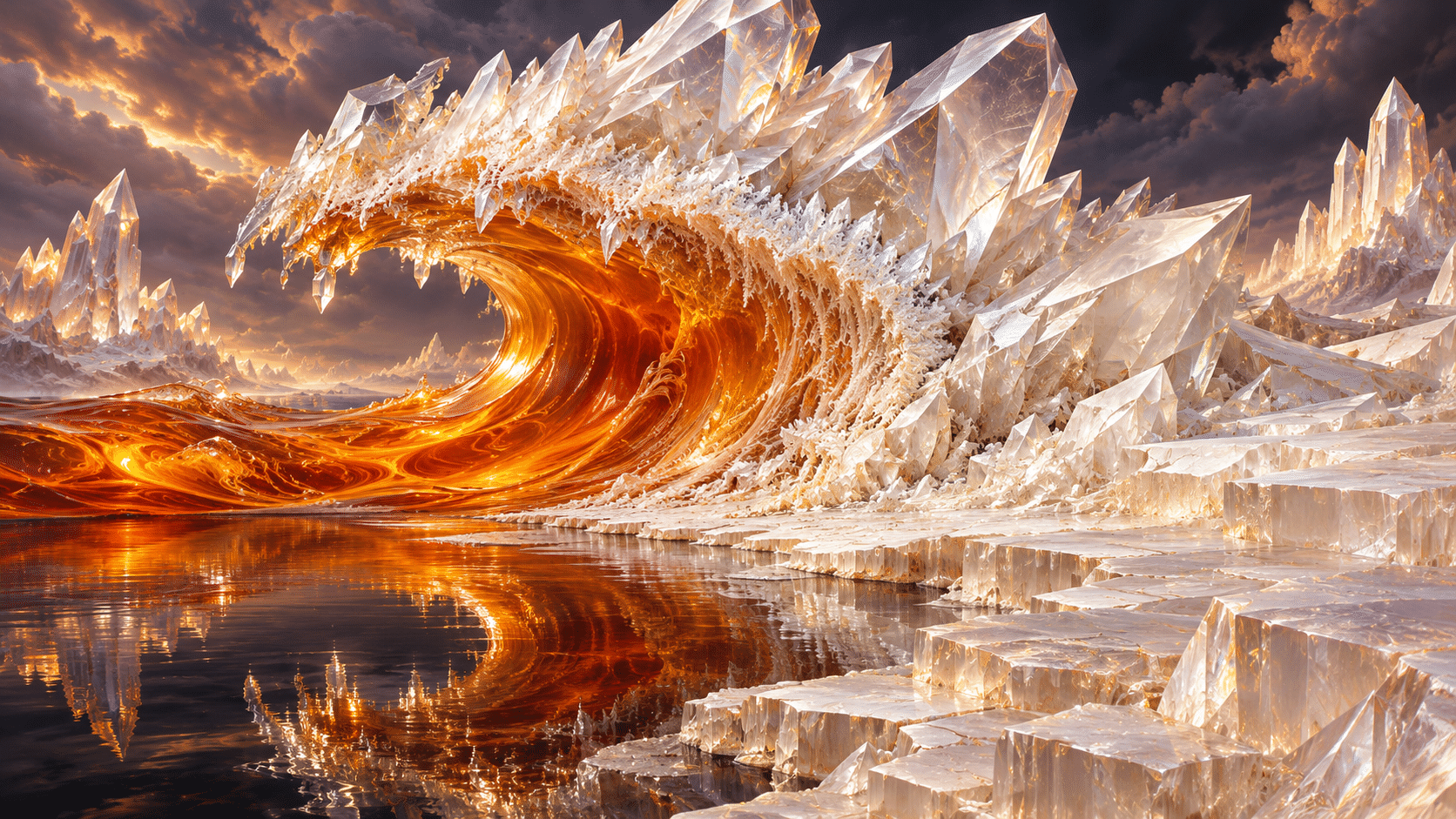
Chemo-morphic Surrealism is introduced here as an AOI artistic interpretation, not a documented historical movement or a scientific classification. The name combines an interest in chemical-looking change with imagined transformations of form. Its central subject is the moment between states: the wave still moving while its crest becomes crystal, or a sheet that begins to behave like a vessel.
The examples borrow appearances associated with diffusion, mineral growth and changing material states. They are invented pictures, not demonstrations of verified reactions. Physical phase changes and chemical reactions are different things; this artistic framework can borrow imagery from either without treating them as scientifically interchangeable. No chemical procedure is implied by the images.
Make the boundary do the work
Choose an initial form, an eventual form and a visible route between them. The route matters most. A smooth amber curve may develop a granular edge, then become a field of angular facets. If the transition happens everywhere with equal intensity, the eye has nowhere to begin. Give it one dominant front and several quieter echoes.
A boundary can cross the picture diagonally, wrap around a portrait or follow the lip of a vessel. It need not be a clean dividing line. A ragged intermediate zone can show droplets, partially formed branches or a change in opacity. The viewer should be able to trace the transformation even when the process is impossible.
Material differences create conviction
Surreal subject matter benefits from precise surface decisions. A liquid suggests continuity through curved highlights and flowing contours. A faceted solid catches light in separated planes. A pale granular deposit scatters the visual rhythm into many small irregular marks. Keep these behaviors distinct rather than coating every object in the same glossy finish.
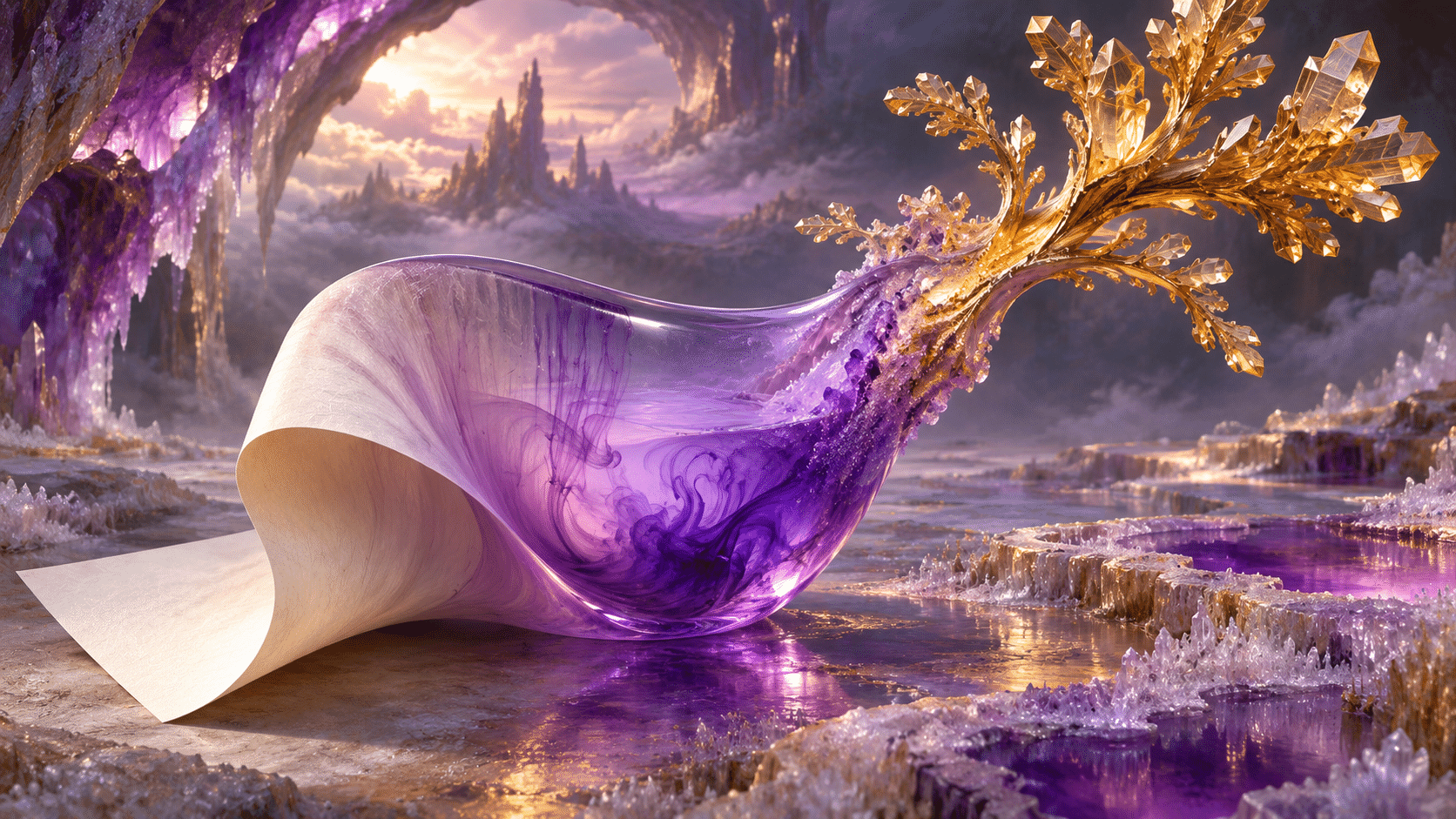
The sheet-to-vessel study uses a continuous silhouette to connect different surfaces. Its ivory end remains broad and quiet, the violet middle becomes translucent, and the gold end branches into facets. The continuity makes the change legible; the surface differences make it worth looking at. In a painted version, these effects could be translated into edge and brushwork instead of photorealistic shine.
Color as a relationship, not a requirement
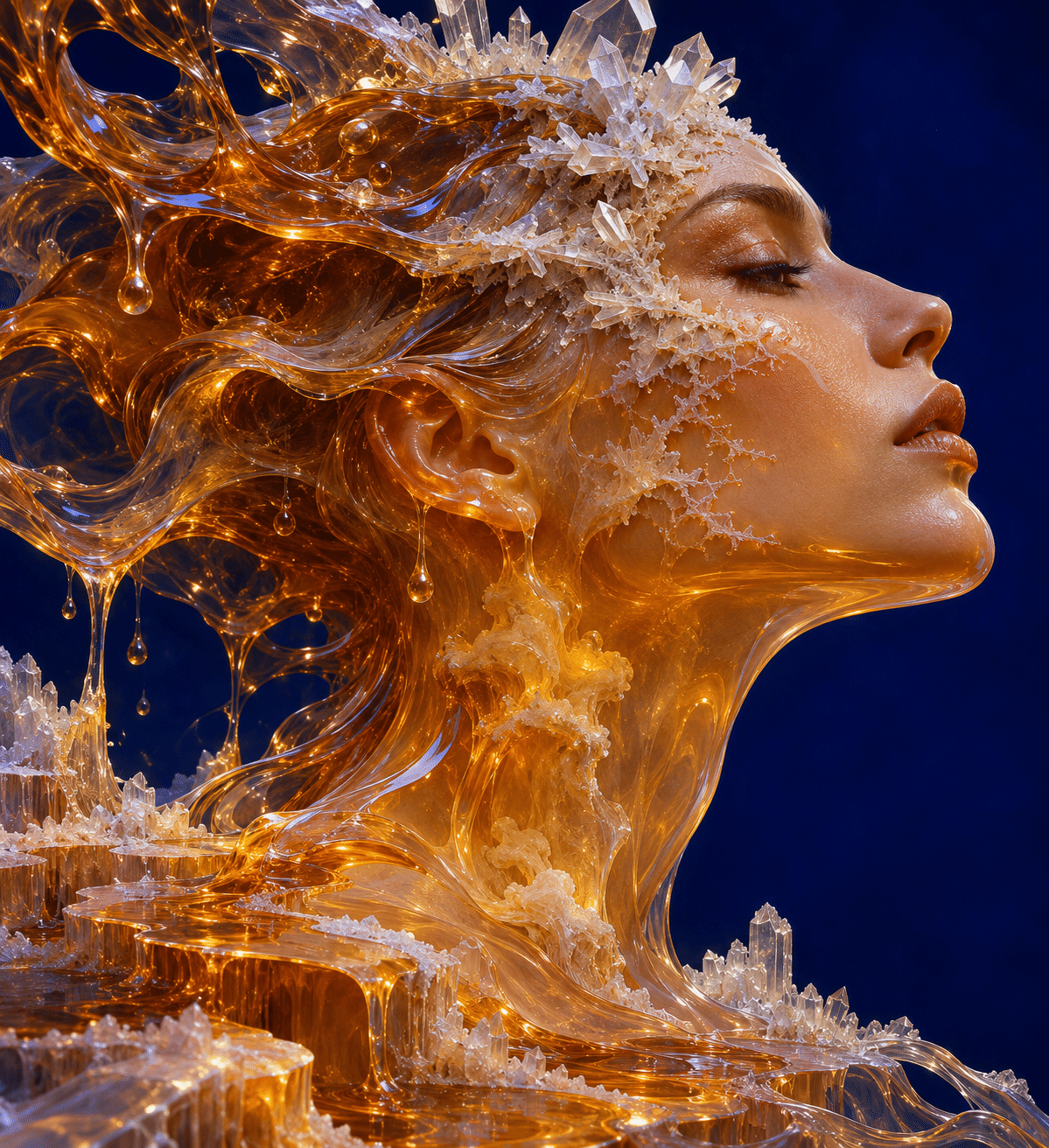
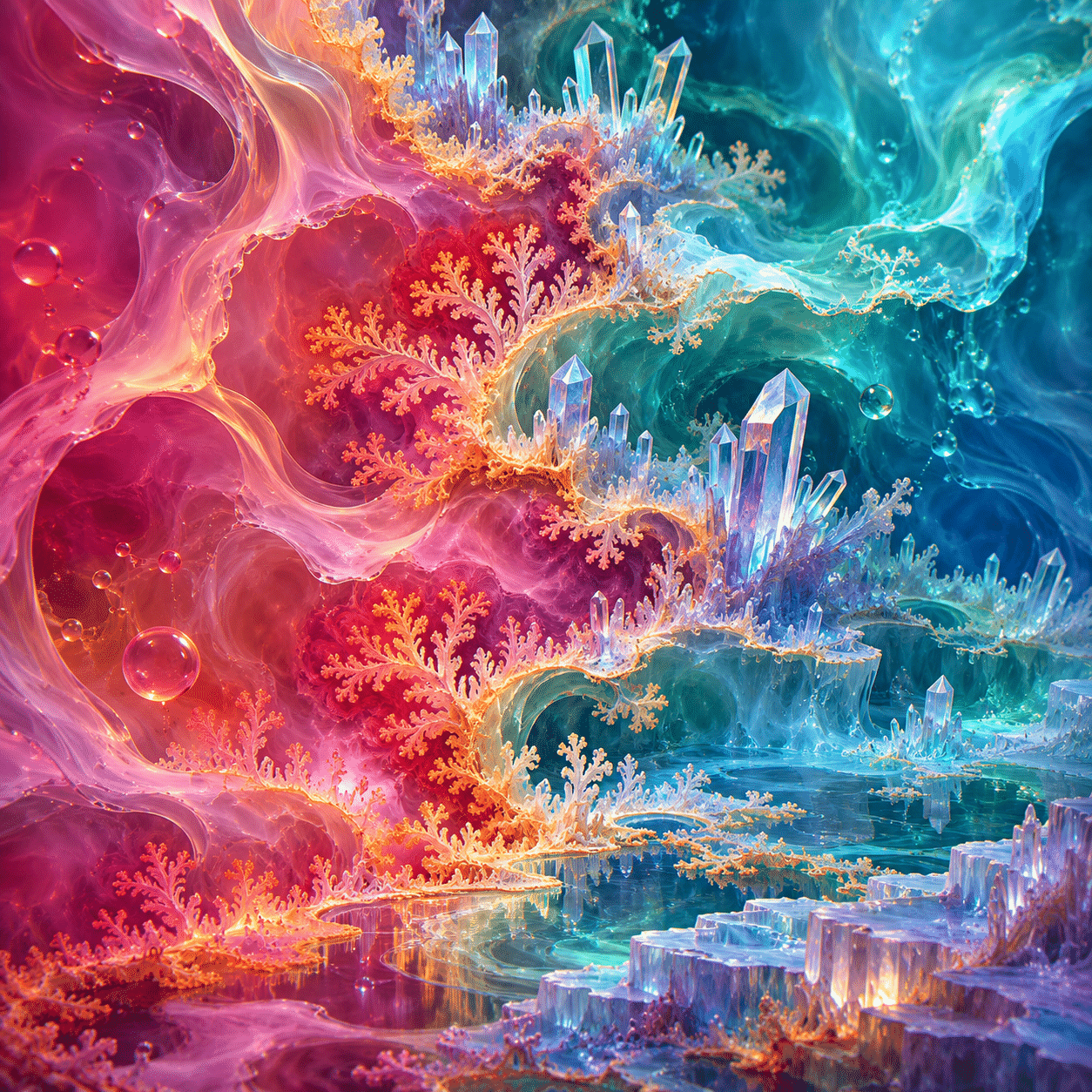
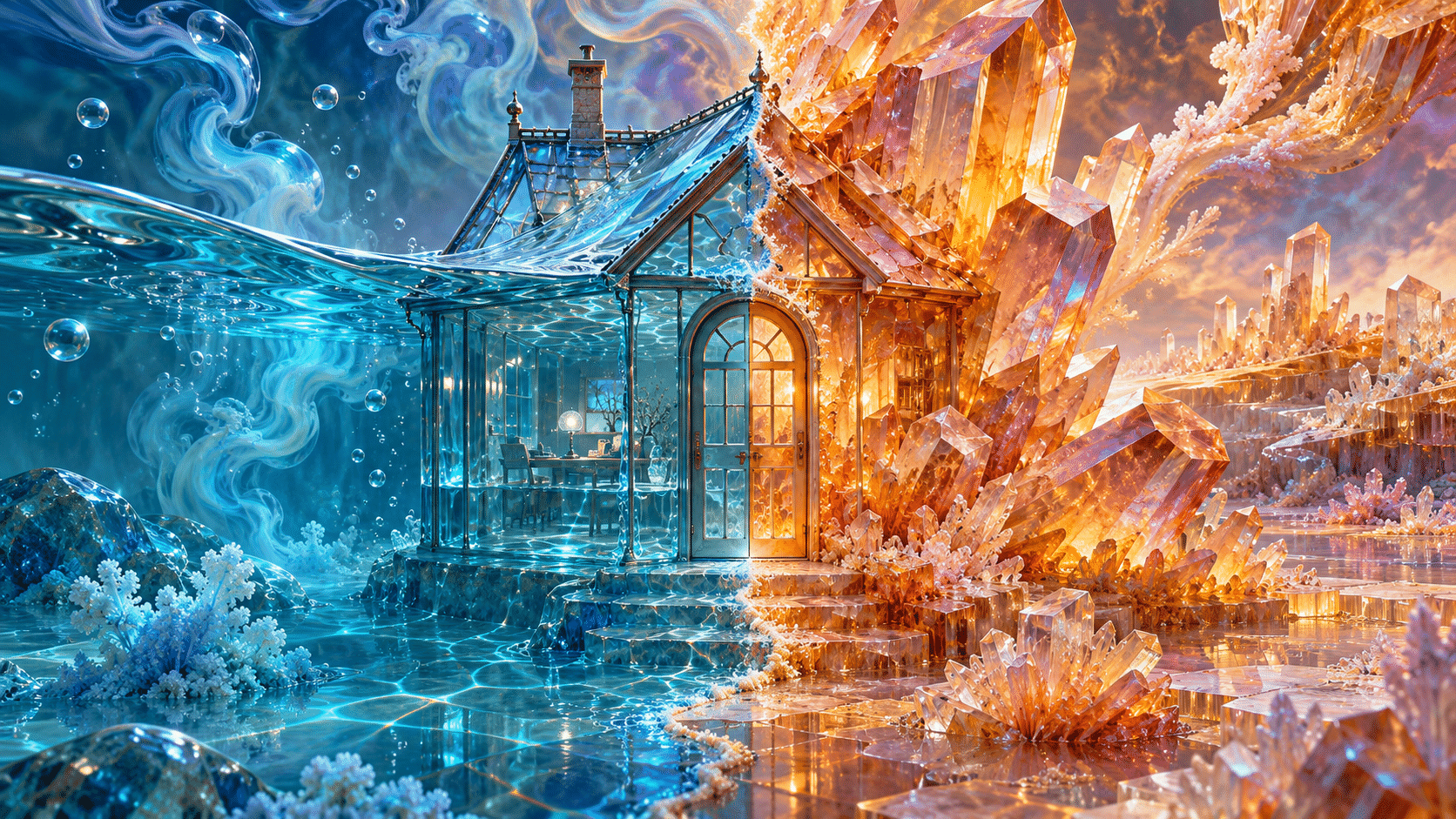
Two contrasting colors can establish the starting conditions quickly. Warm pink meeting turquoise makes the boundary obvious in the garden study. Amber against cobalt separates the portrait from its ground. Reserve the sharpest value contrast for the place where the material changes rather than distributing glitter evenly across the image.
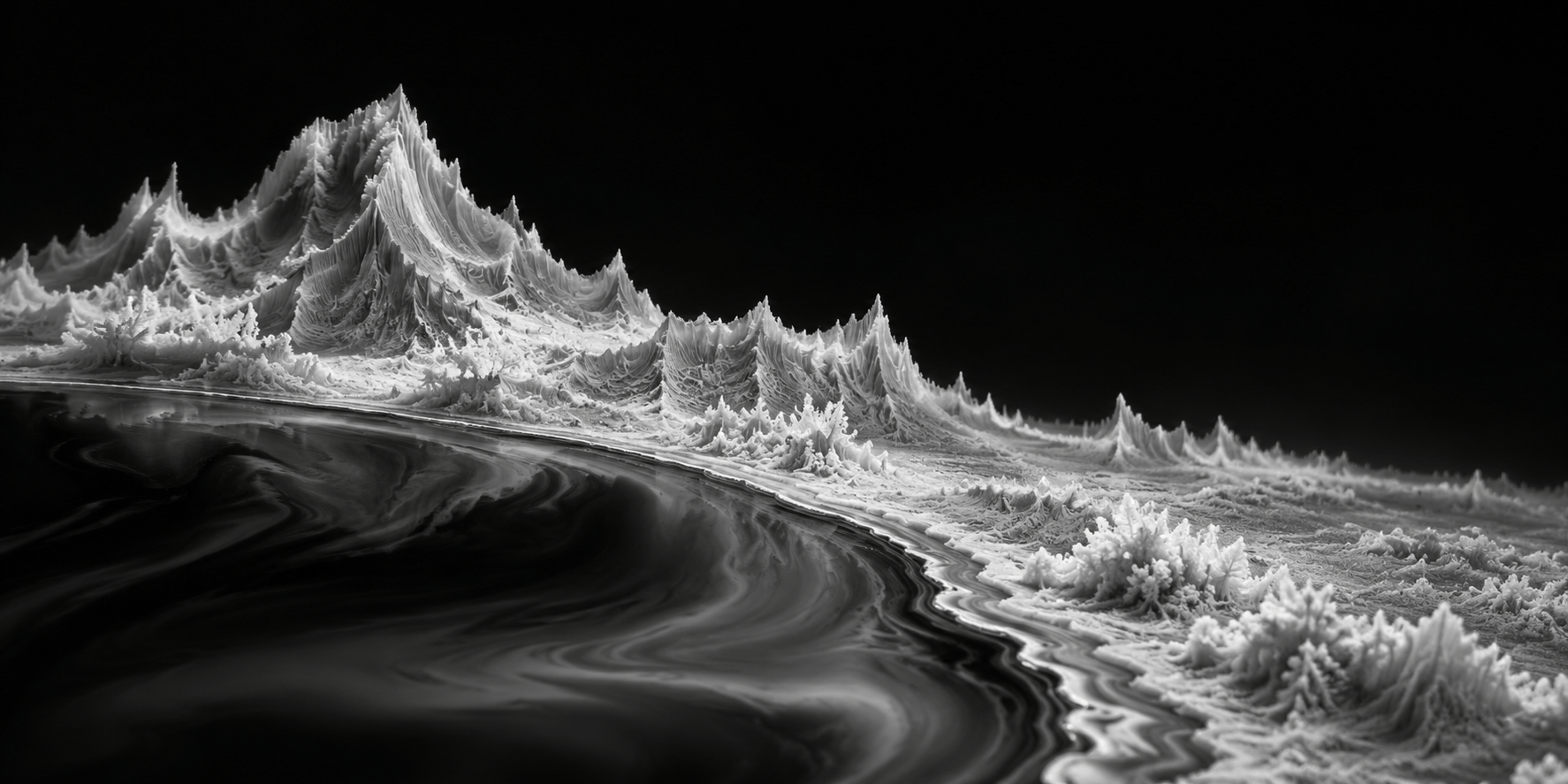
Color is optional. The monochrome droplet study distinguishes dark liquid from pale ridges through texture, scale and negative space. This is a useful test: if removing hue destroys the transformation, the original may have been only a decorative gradient. Try opaque against translucent, rough against smooth, or branching against planar before adding another color.
Subjects that preserve an anchor
A recognizable subject gives the transformation consequences. In the portrait, the expression remains readable while surrounding material changes. In the house study, the doorway lies on the seam between blue flow and warm facets. The building offers a measure of scale and a reason to attend to the boundary.
Abstract images can work just as well when they establish a strong directional pattern. Let one channel, curve or branching front organize the field. A landscape may shift between microscopic and monumental scales, but it should still offer a place for the eye to rest. Scale ambiguity becomes interesting when the composition is clear enough to sustain both readings.
How to develop a stronger study
Start with a small sentence: a wave crystallizes along its crest, or a folded sheet becomes a mineral branch. Sketch the contour and identify the transition zone before specifying elaborate surface detail. In an image prompt, describe the sequence, material contrast, light and focal point. The style name alone cannot supply those decisions.
The approach is useful for speculative illustration, cover art and studies of continuity and change. It weakens when every scene becomes a jewel-encrusted fantasy cavern. Reduce the number of materials, try a quiet background, and give the transformation a compositional purpose. The best test is whether the picture remains compelling once the novelty of its surfaces has passed.
Positive editorial perspective
AOI editorial perspective (AI-authored). The framework gives spectacular surfaces a clear visual task: show continuity through change. A strong transition boundary can unify portraiture, landscape and abstraction while allowing each subject to pose a different compositional problem.
Negative editorial perspective
AOI editorial perspective (AI-authored). Crystal growth and glossy liquid can become interchangeable decoration. Excessive sparkle hides the transition it is meant to emphasize. Limit the materials, simplify the background and test the work in monochrome before adding more effects.
Neutral editorial perspective
AOI editorial perspective (AI-authored). This is an AOI-created interpretive framework for imagined material behavior. Its images are suitable as speculative artworks and visual studies, not scientific diagrams or evidence that the depicted transformations can occur.
Pocket-sized facts
Chemo-morphic Surrealism is presented as an AOI creative concept.
A readable transition between distinct material appearances is its central compositional device.
The generated images are fictional interpretations rather than scientific demonstrations.
A small poetic detour
Original words from the AOI studio.
Poetry
The wave remembered how to stand.
Its curved back learned a crystal edge.
A violet vessel left the sheet
and grew a small, impossible hedge.
Along the seam the colors paused;
no border kept its former name.
The house held open half a door
while both its worlds became the same.
Then all the brilliant colors drained.
A pale ridge met a darkened sea.
The smallest drop became a range,
and change was large enough for me.
The prompt workshop
Original creative exercises. These prompts create new illustrations, not documentary evidence.
One clear transformation
Create an original surreal artwork of a single amber wave whose smooth crest gradually becomes pale angular crystals. Keep a readable intermediate boundary, a dark reflective ground and one dominant curve. No text, diagram labels or signature. Imagined material behavior, not a scientific illustration.
Give the transition a clear location and direction.
A continuous changing form
Create an exceptional standalone original artwork. Vary aspect ratio to fit the stated composition. The folded reaction: still life, a single ivory sheet curls into a translucent purple vessel then into branching gold mineral growth, three stages visibly continuous, no scientific apparatus. Original AOI Chemo-morphic Surrealism: imagined chemical processes become impossible landscapes and objects; crystallization, diffusion, phase boundaries and precipitation inspire transformations. Material-specific surfaces and sharply legible transition zones, a coherent surreal visual argument. Fine-art macro detail and cinematic space, never a scientific diagram or factual chemistry claim. No text, lettering, logo, watermark or signature.
Connect the stages through one silhouette while varying surface behavior.
Remove the color
Create an exceptional standalone original artwork. Vary aspect ratio to fit the stated composition. The quiet residue: black-and-white macro landscape, pale precipitate forms a miniature mountain range along the edge of a receding dark droplet, dramatic empty space and intricate material detail. Original AOI Chemo-morphic Surrealism: imagined chemical processes become impossible landscapes and objects; crystallization, diffusion, phase boundaries and precipitation inspire transformations. Material-specific surfaces and sharply legible transition zones, a coherent surreal visual argument. Fine-art macro detail and cinematic space, never a scientific diagram or factual chemistry claim. No text, lettering, logo, watermark or signature.
Let texture and scale ambiguity carry the transformation.
A smile from the studio
Jokes
The surrealist ordered a vase that would really transform the room. By lunchtime it had become a branching mineral formation, the table was a violet lagoon, and the wallpaper had begun to precipitate. The designer called it a successful material conversation. The cleaner requested a much more specific invoice.