
AOI interpretation · de Chirico and metaphysical painting
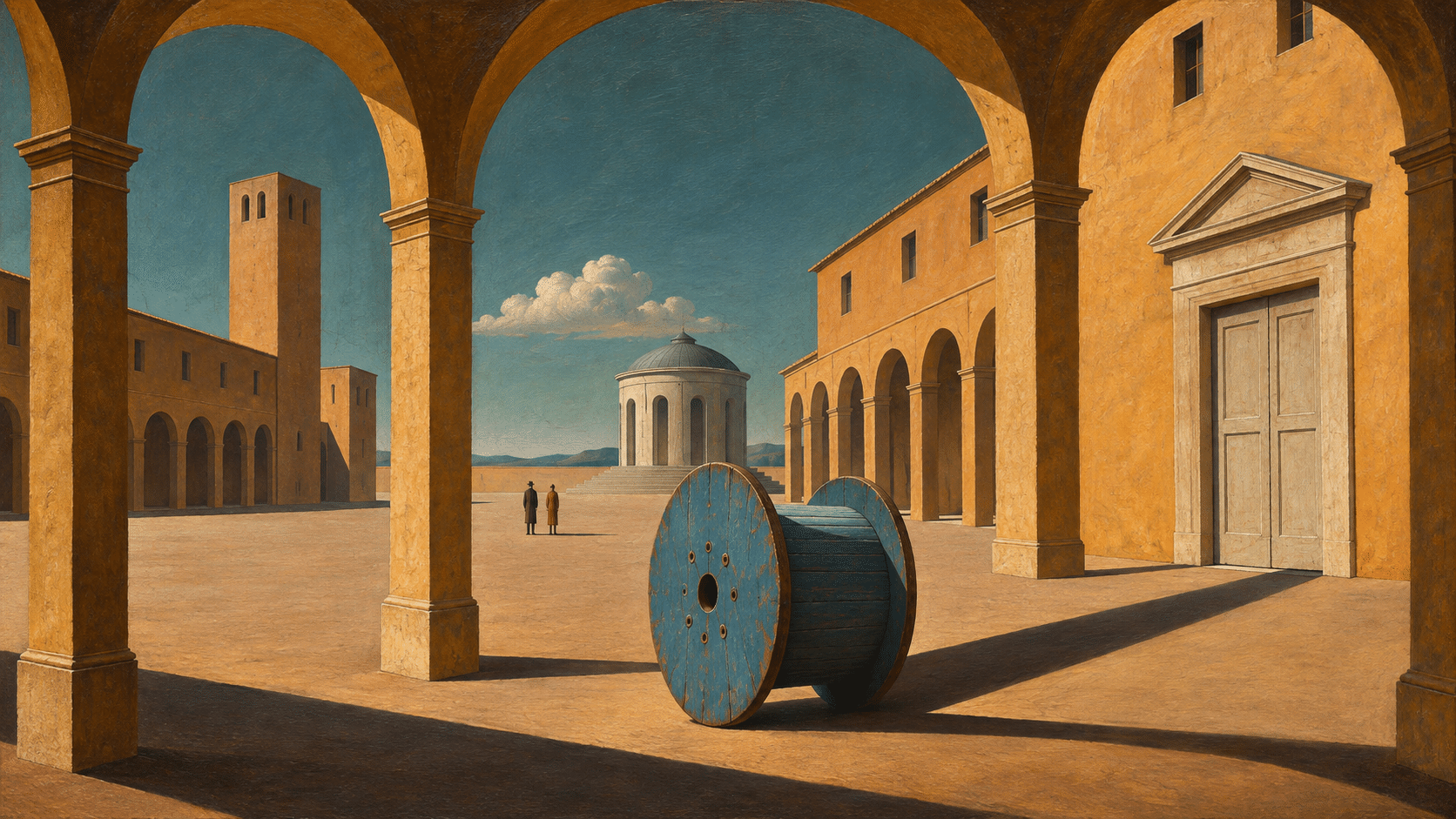
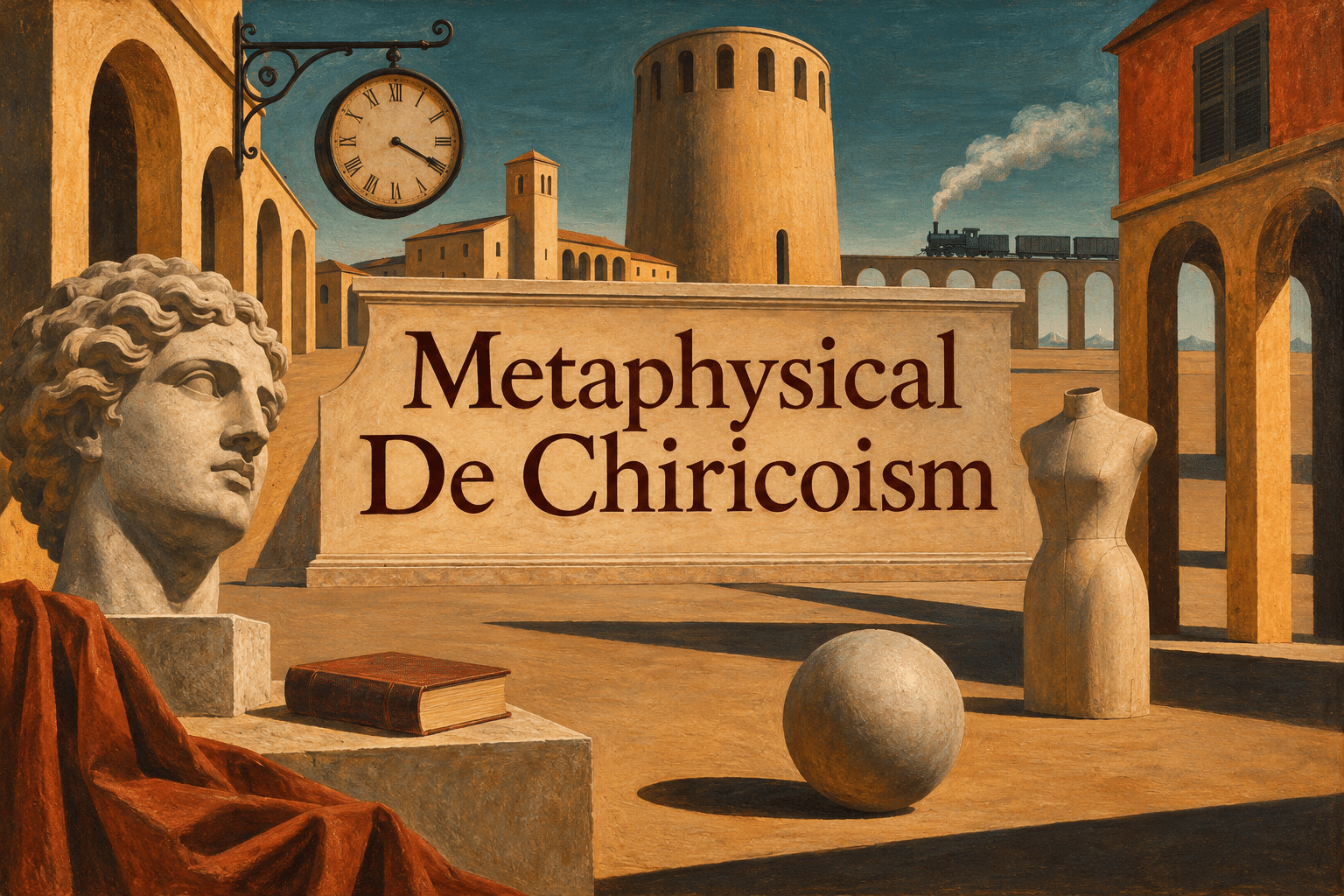
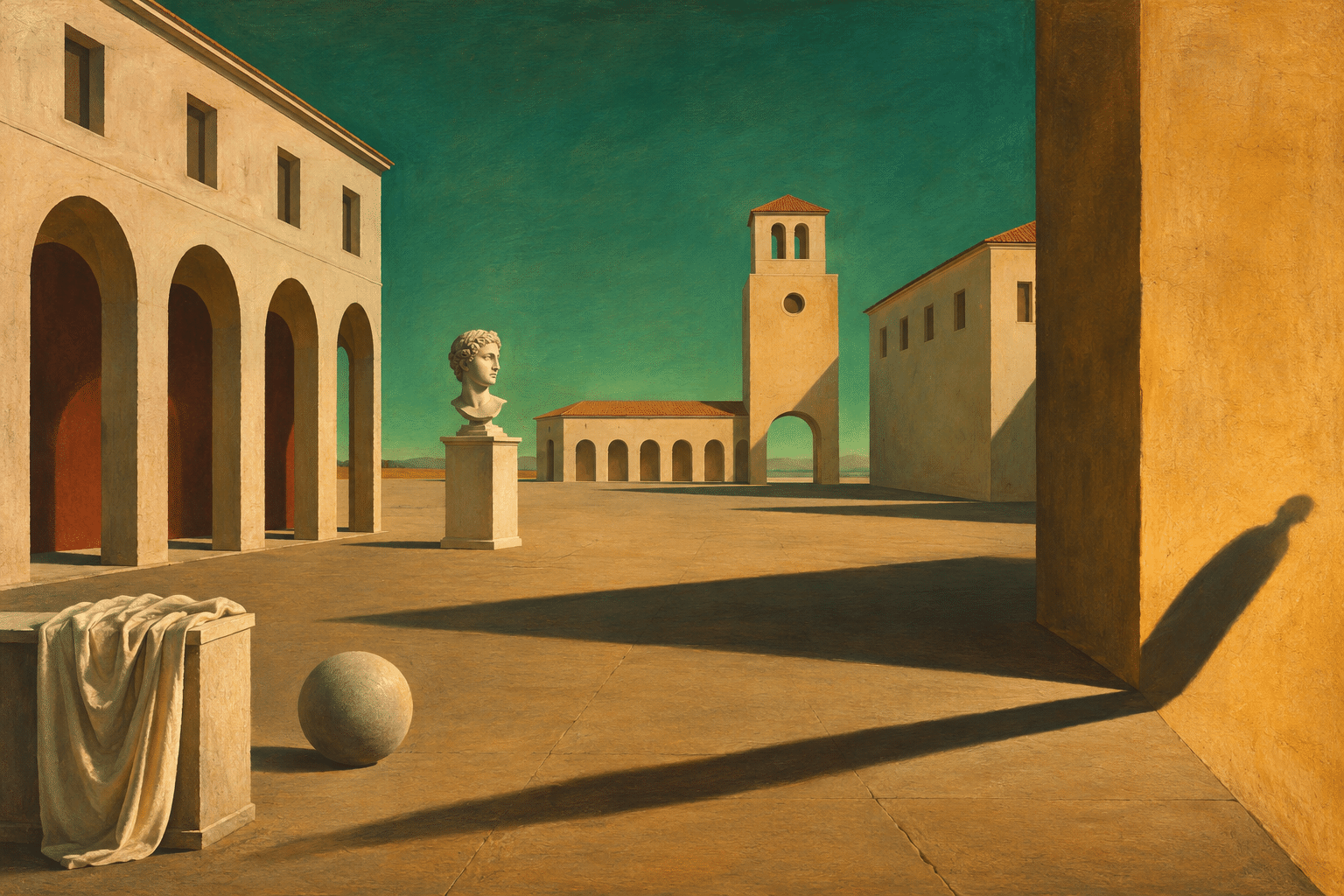
Metaphysical De Chiricoism is AOI’s interpretive label for images that make ordinary objects feel inexplicably displaced. Arcades, long shadows, empty squares and uneasy perspective create a stillness that seems to be waiting for an event.
A visual introduction
Seven original AI-generated interpretations: a dedicated banner, a centrally titled artistic collage and five standalone studies.
Select an image for a closer look. Use the thumbnails, arrow keys or a swipe to compare examples. Zoom in to inspect details, or share the image that inspires you.
Creative toolbox · take this style further
Choose an input and a destination. Search sends your words to the chosen site; Copy & open puts them on your clipboard to paste there.
Create with AI
Turn your chosen input into an image prompt or a new creative direction.
ChatGPT
Copy your input and paste it into a ChatGPT conversation or image request.
Copy & open ChatGPT (new tab)Claude · Anthropic
Develop an image prompt or explore the style in a new Claude conversation.
Copy & open Claude · Anthropic (new tab)Midjourney
Paste your input into the Imagine bar on the Create page.
Copy & open Midjourney (new tab)Adobe Firefly
Copy your input, open Firefly, and paste it into the prompt field.
Copy & open Adobe Firefly (new tab)Leonardo.Ai
Copy your input, open Leonardo, and paste it into the generation field.
Copy & open Leonardo.Ai (new tab)Image search
Find visual references. Short, concrete keywords usually work best.
Lexica
Search AI images and prompts using your selected input.
Search with this input Lexica (new tab)Pexels
Search the photo and video library. Short keywords often work best.
Search with this input Pexels (new tab)Pixabay
Search photos, illustrations and other images.
Search with this input Pixabay (new tab)Unsplash
Search photographs using the style name or your own keywords.
Search with this input Unsplash (new tab)Wikimedia Commons
Search photographs, artworks and historical images. Check each file for its source and reuse terms.
Search with this input Wikimedia Commons (new tab)Art & research
Explore artists, collections and the ideas behind a style.
Wikipedia
Search for background reading. A style may not have its own article.
Search with this input Wikipedia (new tab)WikiArt
Copy your input into WikiArt’s search to explore artists and artworks.
Copy & open WikiArt (new tab)Europeana
Paste your keywords into the search to explore European museum, library and archive collections.
Copy & open Europeana (new tab)Inspiration
Discover portfolios and visual ideas from creative communities.
Instagram hashtags
Search a hashtag made from your input: spaces and punctuation are removed. Instagram may require sign-in.
Search with this input Instagram hashtags (new tab)ArtStation
Paste your input into artwork search for concept art, environments, characters and visual development.
Copy & open ArtStation (new tab)Behance
Paste your input into project search for illustration, design and visual storytelling.
Copy & open Behance (new tab)A closer look
Keep objects recognizable and their relationships uncertain. Let a measured arcade lead toward an implausible distance; give a familiar object an unexpected scale; use long, sharply bounded shadows and spacious pauses.
The name and its historical anchor
Metaphysical De Chiricoism is an AOI workshop label, not the established name of a historical movement. Its reference is Giorgio de Chirico’s metaphysical painting. The artist’s foundation identifies the years 1910–1918 in Florence, Paris and Ferrara as a central metaphysical period; it also documents a much longer, varied career. This entry explores selected spatial ideas rather than claiming that one formula represents everything he painted. [1]
The generated works here are original interpretations, not reproductions, rediscovered paintings or attributed de Chirico originals. An artist-related aesthetic needs this distinction: learning from a visual problem is different from presenting a new picture as a historical artifact.
Recognizable things, uncertain relations
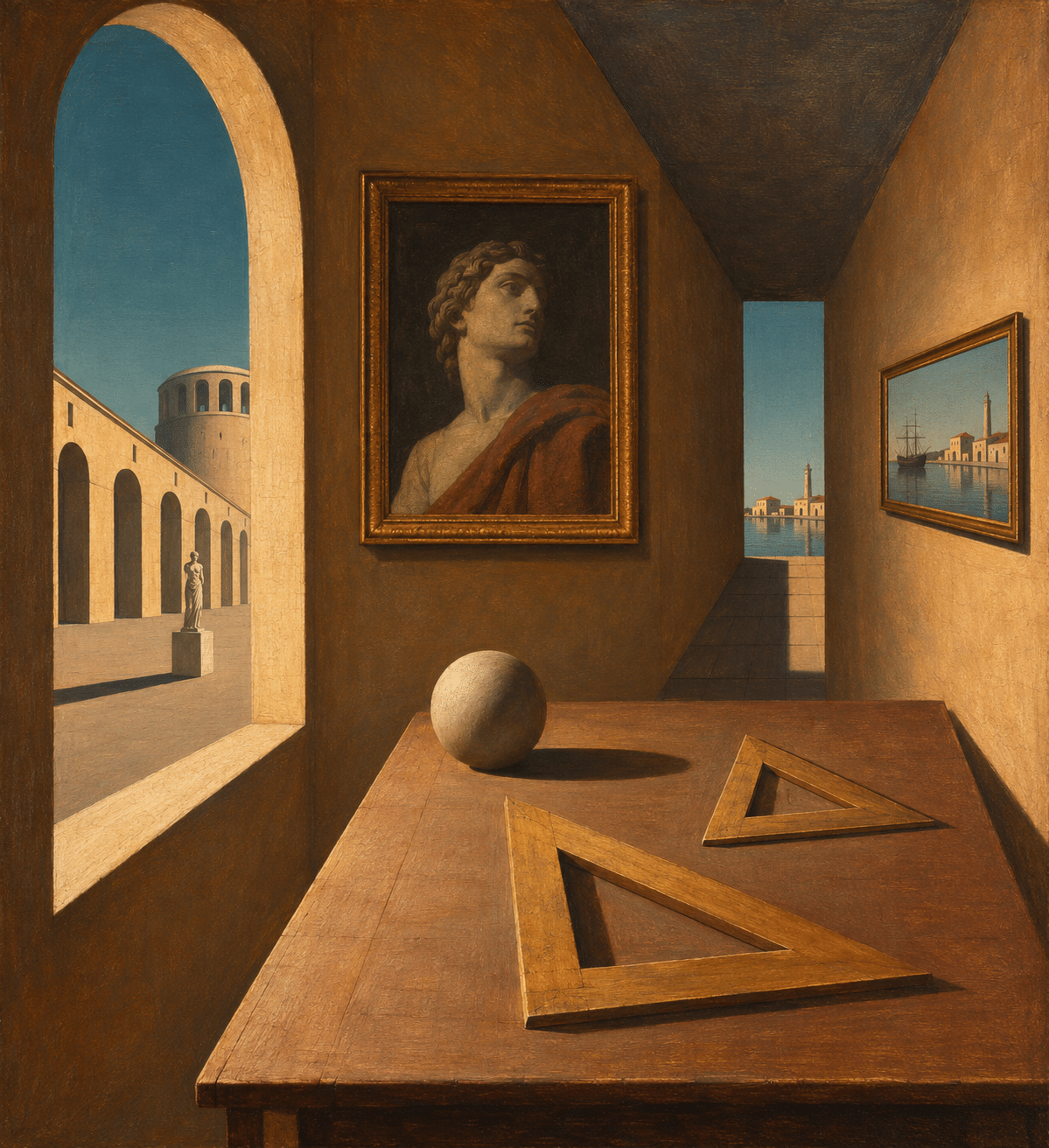
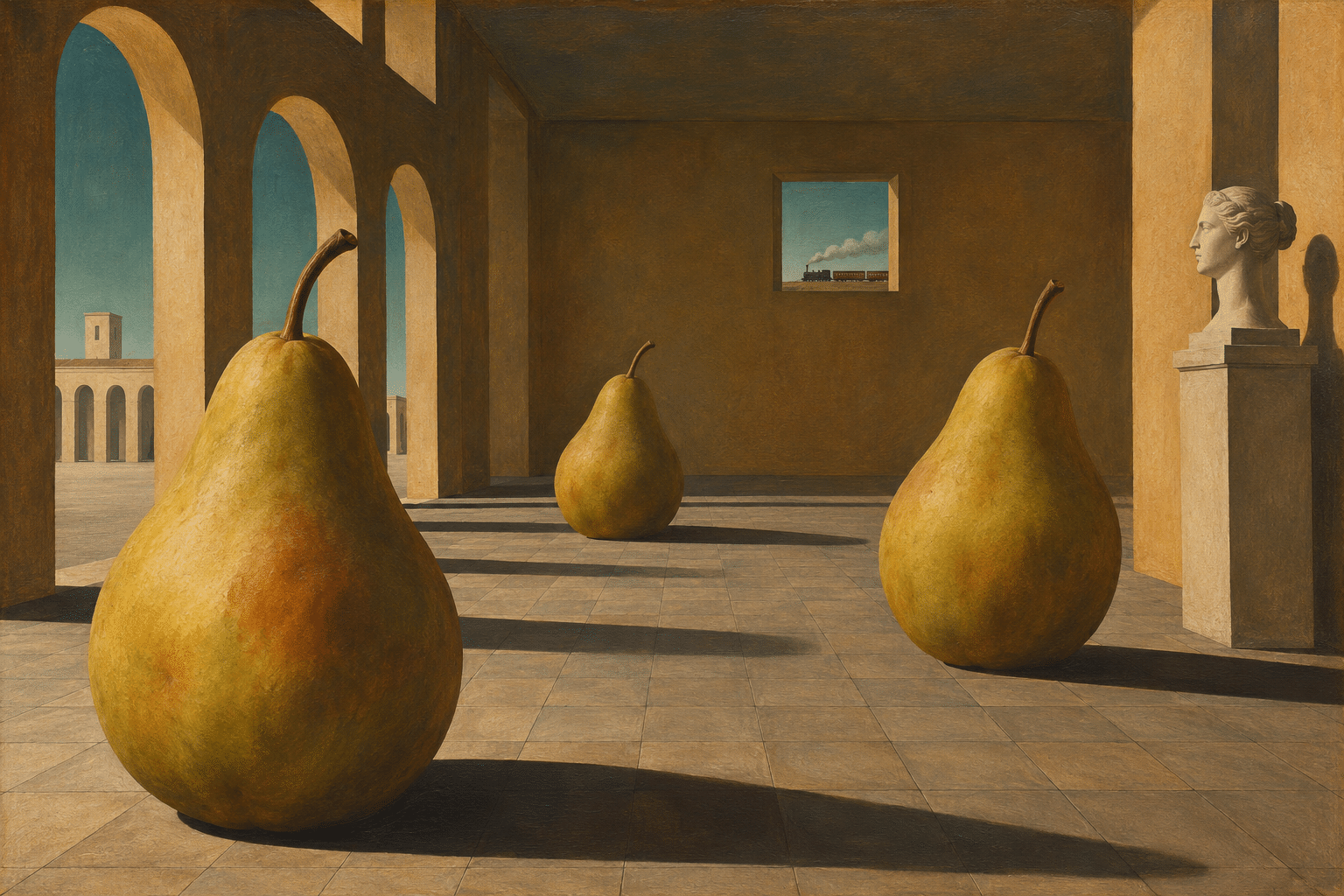
Begin with objects the viewer can name immediately: a chair, pear, sphere, suitcase or drafting triangle. Then change one relationship. A pear may be almost architectural in scale; a room may contain a second view that seems to repeat its own exterior; a shadow may suggest someone who never appears. The familiar object gives the viewer a foothold while its placement unsettles that confidence.
MoMA’s account of Great Metaphysical Interior, painted in Ferrara in 1917, discusses the deliberate spatial distortions associated with de Chirico’s metaphysical work. [2] In this workshop, the practical lesson is to make uncertainty purposeful. A floor can tilt subtly, but an arbitrary tangle of broken buildings usually reads as a drawing error rather than a sustained enigma.
Compose the pause
Use architecture to slow the eye. Repeated arches establish a rhythm, a deep doorway withholds information, and an empty foreground makes a small distant object unusually consequential. Balance a dominant mass against an interval of open space. The interval should feel occupied by expectation even when it contains very little.
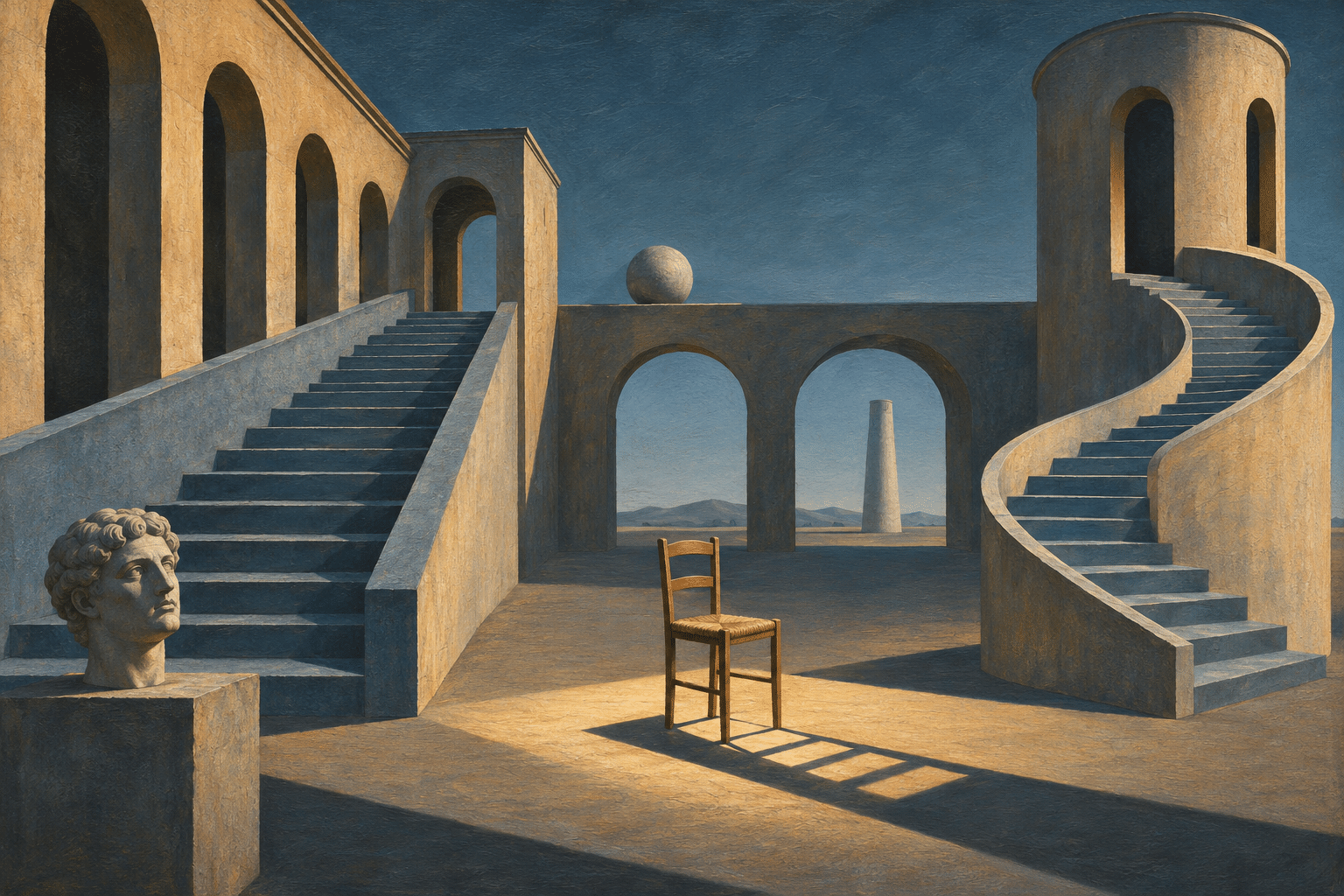
A strong composition does not need every familiar motif at once. Try removing the statue or train after the first study. If the emotional effect vanishes, the design may be relying on recognizable props instead of relationships. The empty chair between two stairs works because the routes direct attention toward waiting, not because a chair is inherently mysterious.
Light that makes time feel strange
Hard-edged shadows can behave like additional architectural forms. Plan their silhouettes alongside the buildings rather than adding them at the end. A single broad shadow can lead the eye across an otherwise quiet square. Let the color temperature of sunlit plaster contrast with the cooler shadow, keeping surface detail subordinate to the large shapes.
Ochre, muted terracotta and blue-green make a useful starting palette, not a compulsory uniform. The blue stair study shifts emphasis toward cool shadows and a small pool of warm light. Softer edges can make the mood more remembered or dreamlike, but too much haze dissolves the sharp spatial tension that gives this interpretation its particular character.
Objects as questions rather than symbols with answers
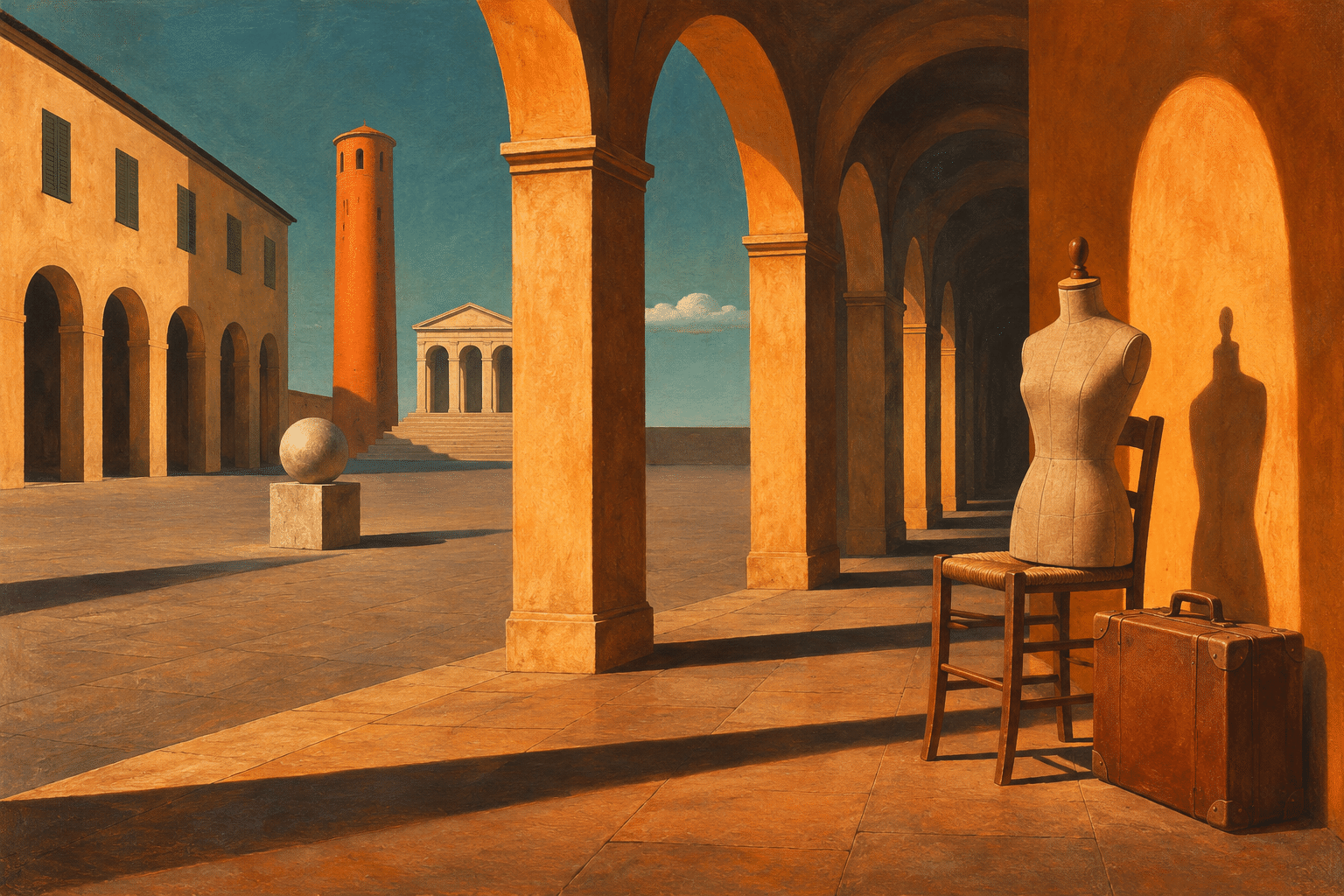
A suitcase may suggest travel, but it need not mean one fixed thing. Beside a motionless tailor’s form, it can create a contradiction between departure and immobility. The oversized pears similarly alter scale without requiring a hidden code. Avoid explaining every object as though the image were a rebus with one correct solution.
For prompts, describe the relationship first and the atmosphere second. Ask for a small room whose framed harbor echoes the view through a doorway, then specify the still light and restrained surface. This is more actionable than asking only for a mysterious masterpiece. Keep the number of anomalies small enough that the viewer can notice them.
Where this approach works—and where it weakens
This visual language suits book illustration, contemplative editorial images and invented environments where anticipation matters more than action. It can also support an austere still life. The five studies move between an interior, a traveler’s absence, a shadow, displaced fruit and architectural waiting to test that range.
The main danger is a catalogue of borrowed motifs: arcade, mannequin, train, repeat. Change the spatial question for each work. Preserve clear silhouettes, vary scale and placement, and let one unresolved relation carry the image. The result should reward looking longer, not merely recognizing its reference.
Positive editorial perspective
AOI editorial perspective (AI-authored). The approach makes absence and ordinary objects carry unusual expressive weight. A measured arcade or oversized pear can turn stillness into an active compositional force, rewarding a viewer who follows the relationships slowly.
Negative editorial perspective
AOI editorial perspective (AI-authored). Repeated arcades, busts and mannequins can become an imitation kit. Too many incompatible perspectives can also look accidental. Remove familiar props and test whether one carefully designed spatial contradiction still sustains the image.
Neutral editorial perspective
AOI editorial perspective (AI-authored). This AOI label describes an artist-related interpretation anchored in metaphysical painting. It is useful for studying suspended time and spatial uncertainty, but neither defines de Chirico’s entire career nor names a newly documented historical movement.
Pocket-sized facts
Metaphysical De Chiricoism is an AOI interpretive label, not a historical movement name.
De Chirico’s foundation locates a central metaphysical period in 1910–1918. [1]
The illustrated studies are newly generated interpretations, not works by de Chirico.
A small poetic detour
Original words from the AOI studio.
Poetry
The square has put its clocks away.
A shadow crosses without feet.
The train is smaller than a pear;
no traveler takes the waiting seat.
A doorway holds another noon.
The ruler doubts its straightest line.
Three arches measure out the air
and leave the last division mine.
I came to ask what happened here.
The empty chair declined to say.
Its patch of sunlight kept my place
until the evening looked away.
The prompt workshop
Original creative exercises. These prompts create new illustrations, not documentary evidence.
One object out of place
Paint a quiet, original metaphysical interior containing three monumental pears on a tiled floor. A tiny distant train is visible through a small window. Restrained ochre and blue-green palette, hard afternoon shadows, spacious pauses, tactile oil surface. No lettering or signature.
Use scale as the main anomaly; keep the fruit recognizable.
The traveler who stayed
Create an exceptional standalone original artwork. Vary aspect ratio to fit the stated composition. The traveler who stayed: faceless tailor mannequin seated beside a closed suitcase under an arcade, crisp orange afternoon light, absence rather than horror. Original metaphysical painting inspired by Giorgio de Chirico's spatial enigmas: precise yet subtly incompatible perspectives, long hard shadows, lucid ochre architecture and cool empty sky, sparse displaced familiar objects, profound arrested time. Not a copy of any existing painting. Painterly oil surface, restrained chiaroscuro, no signature. No text, lettering, logo, watermark or signature.
Use the contradiction between packed luggage and an immobile form.
A cooler kind of waiting
Create an exceptional standalone original artwork. Vary aspect ratio to fit the stated composition. The blue stair: monochrome blue-gray metaphysical scene, two incompatible stairways meet around one sunlit empty chair, lucid forms and suspended expectation. Original metaphysical painting inspired by Giorgio de Chirico's spatial enigmas: precise yet subtly incompatible perspectives, long hard shadows, lucid ochre architecture and cool empty sky, sparse displaced familiar objects, profound arrested time. Not a copy of any existing painting. Painterly oil surface, restrained chiaroscuro, no signature. No text, lettering, logo, watermark or signature.
Let the chair and competing routes hold attention; do not add more symbols.
People & works to explore
References discussed in this article. Consult the sources below for context.
Artists and practitioners
Giorgio de Chirico — historical reference for metaphysical painting; the generated illustrations are not his works. [1]
Paintings and other works
Great Metaphysical Interior (1917), Giorgio de Chirico, MoMA — a source for studying displaced objects and spatial uncertainty. [2]
A smile from the studio
Jokes
The traveler asked the station clerk when the train would arrive. The clerk pointed to a tiny locomotive beyond a gigantic pear. “It is perfectly on time,” he said. “Unfortunately, time is in the next room.” The traveler sat down. His shadow had already joined the queue.