
Artistic practice · lived space and subjective mapping
Psychogeographic art investigates how places shape feeling, attention and movement. A walk, a map, a film or a collage can expose a city quite different from the one organized by shortest routes and official landmarks.
A visual introduction
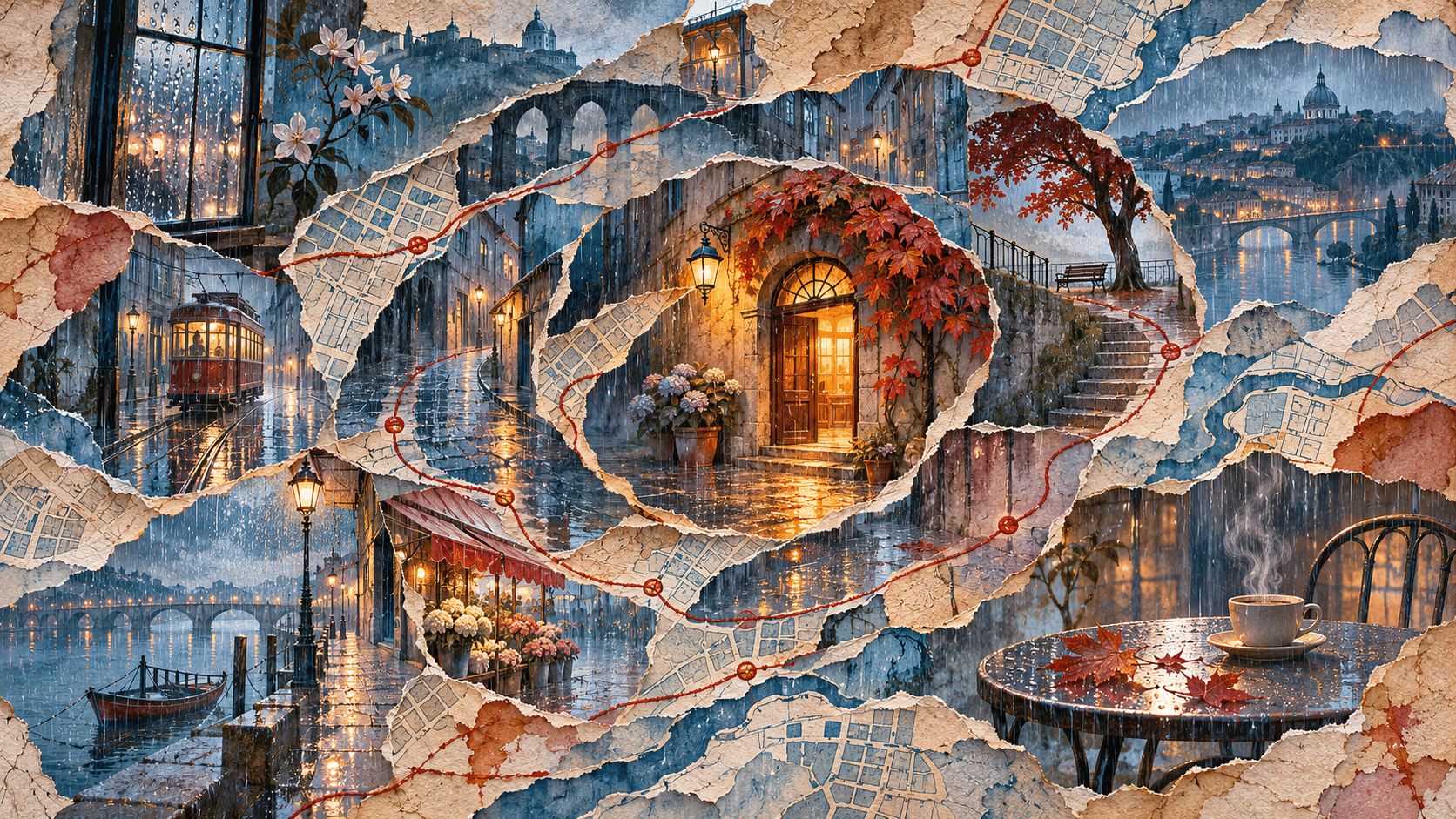
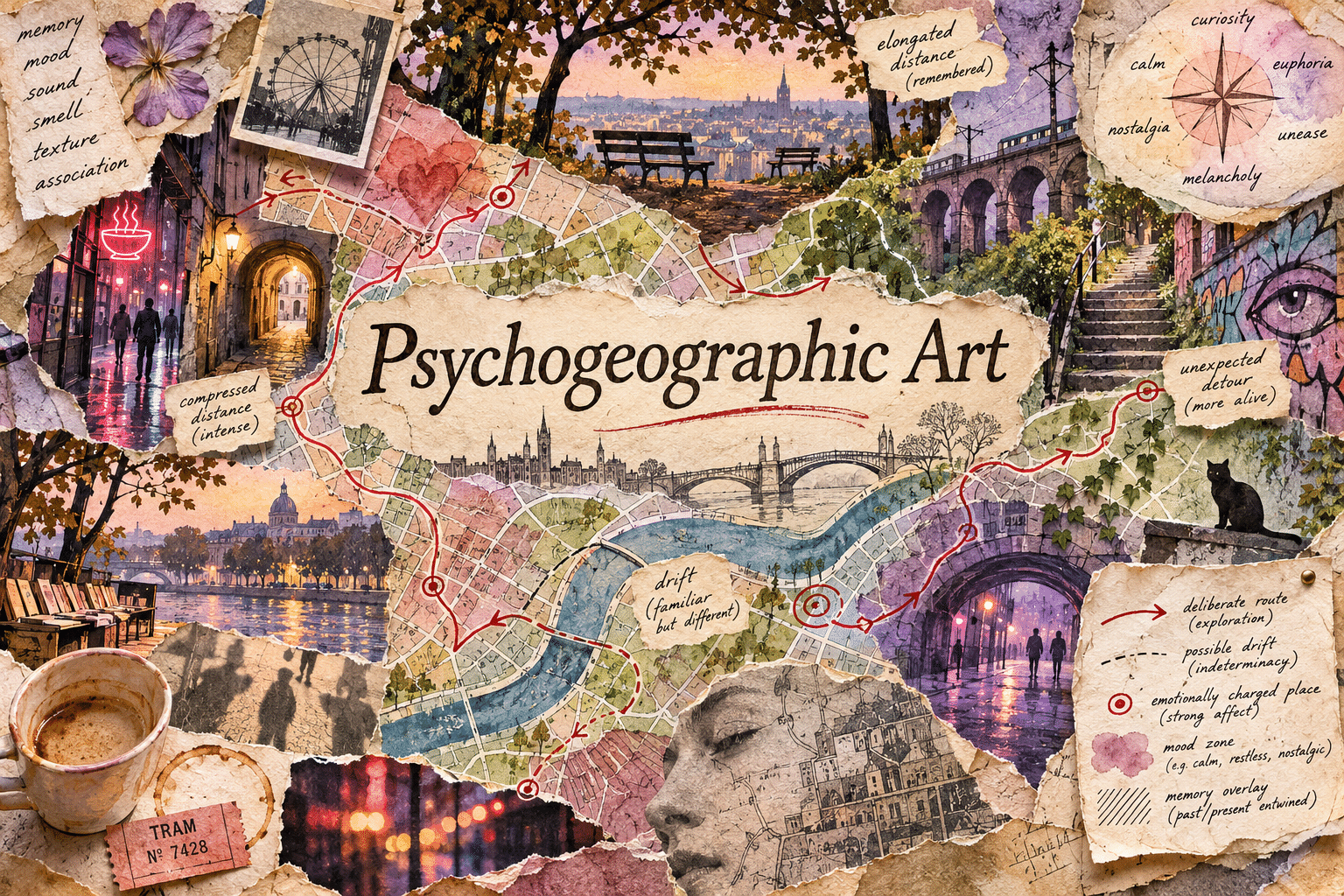
Seven original AI-generated interpretations: a dedicated banner, a centrally titled artistic collage and five standalone studies.
Select an image for a closer look. Use the thumbnails, arrow keys or a swipe to compare examples. Zoom in to inspect details, or share the image that inspires you.
Creative toolbox · take this style further
Choose an input and a destination. Search sends your words to the chosen site; Copy & open puts them on your clipboard to paste there.
Create with AI
Turn your chosen input into an image prompt or a new creative direction.
ChatGPT
Copy your input and paste it into a ChatGPT conversation or image request.
Copy & open ChatGPT (new tab)Claude · Anthropic
Develop an image prompt or explore the style in a new Claude conversation.
Copy & open Claude · Anthropic (new tab)Midjourney
Paste your input into the Imagine bar on the Create page.
Copy & open Midjourney (new tab)Adobe Firefly
Copy your input, open Firefly, and paste it into the prompt field.
Copy & open Adobe Firefly (new tab)Leonardo.Ai
Copy your input, open Leonardo, and paste it into the generation field.
Copy & open Leonardo.Ai (new tab)Image search
Find visual references. Short, concrete keywords usually work best.
Lexica
Search AI images and prompts using your selected input.
Search with this input Lexica (new tab)Pexels
Search the photo and video library. Short keywords often work best.
Search with this input Pexels (new tab)Pixabay
Search photos, illustrations and other images.
Search with this input Pixabay (new tab)Unsplash
Search photographs using the style name or your own keywords.
Search with this input Unsplash (new tab)Wikimedia Commons
Search photographs, artworks and historical images. Check each file for its source and reuse terms.
Search with this input Wikimedia Commons (new tab)Art & research
Explore artists, collections and the ideas behind a style.
Wikipedia
Search for background reading. A style may not have its own article.
Search with this input Wikipedia (new tab)WikiArt
Copy your input into WikiArt’s search to explore artists and artworks.
Copy & open WikiArt (new tab)Europeana
Paste your keywords into the search to explore European museum, library and archive collections.
Copy & open Europeana (new tab)Inspiration
Discover portfolios and visual ideas from creative communities.
Instagram hashtags
Search a hashtag made from your input: spaces and punctuation are removed. Instagram may require sign-in.
Search with this input Instagram hashtags (new tab)ArtStation
Paste your input into artwork search for concept art, environments, characters and visual development.
Copy & open ArtStation (new tab)Behance
Paste your input into project search for illustration, design and visual storytelling.
Copy & open Behance (new tab)A closer look
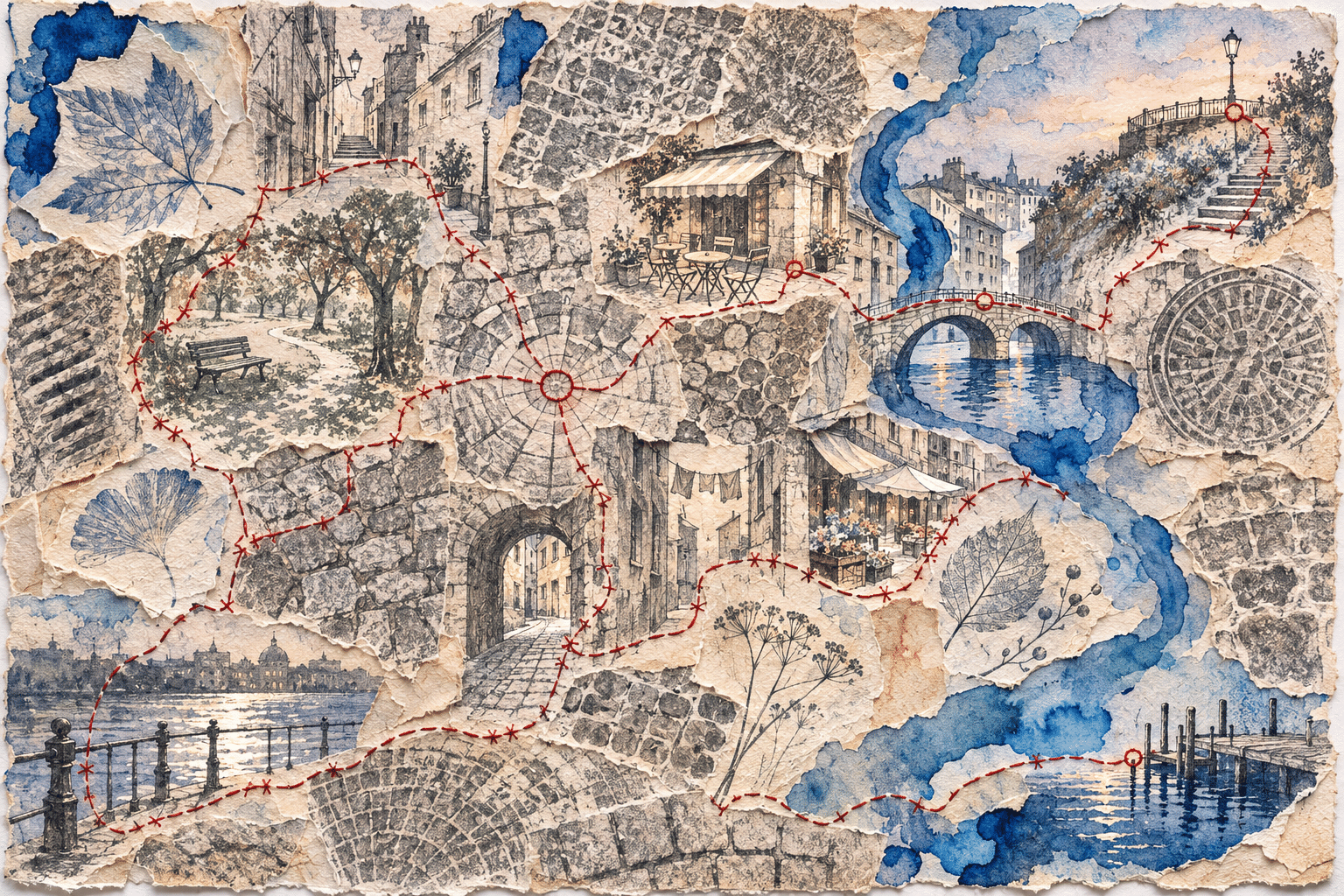
Translate an experience of space into relationships: compressed and stretched distances, interrupted routes, dense or quiet marks, remembered fragments and conspicuous gaps. A red line or torn map is useful only when it reveals a reason for moving.
A method before a look
Psychogeography concerns the emotional and behavioral effects of geographical environments. The University of Colorado's Environmental Futures essay connects the term with Guy Debord in 1955, the urban wanderer and playful departures from functional navigation. It also considers walking through memory and environmental justice. Read it as a situated reflection rather than a universal account of how everyone experiences a city. [1]
An artwork can therefore be psychogeographic without resembling a map. A sequence of photographs, recorded sounds, a written itinerary or an arrangement of collected impressions can investigate the same question: what does this place make possible, attractive, exhausting or difficult? Conversely, a decorative street-map collage may tell us little about lived space.
The map is an argument
FRAC Centre's collection identifies Guy Debord's The Naked City with 1957 and the psychogeographic dérive. Its fragmented urban mapping is a useful historical reference for breaking the apparent neutrality of a conventional plan. The new images on this page are independent imagined studies, not reconstructions of Debord's work. [2]
In a practical exercise, retain enough of a route for the viewer to understand a choice, then alter the scale according to experience. A noisy crossing might occupy half a sheet while a long familiar street becomes a short fold. Explain what the distortion records. Distance could mean time, anxiety, curiosity or memory; mixing those measures without saying so makes the image less informative.
Collect with a question
Choose a simple observation rule before a walk: changes in sound, invitations to sit, the first visible tree after each junction, or places where an intended route becomes impossible. Record location and time separately from your interpretation. A quiet alley at noon may feel different after dark; a remembered impression is not a permanent property of the place.
Make a small set of field notes, sketches or permitted photographs. Then select rather than accumulate. An evocative rubbing, one interrupted route and a short account of why you turned can say more than a sheet crowded with unrelated tickets. The generated examples here simulate such materials; no real fieldwork or collected physical objects are claimed.
Access changes the journey
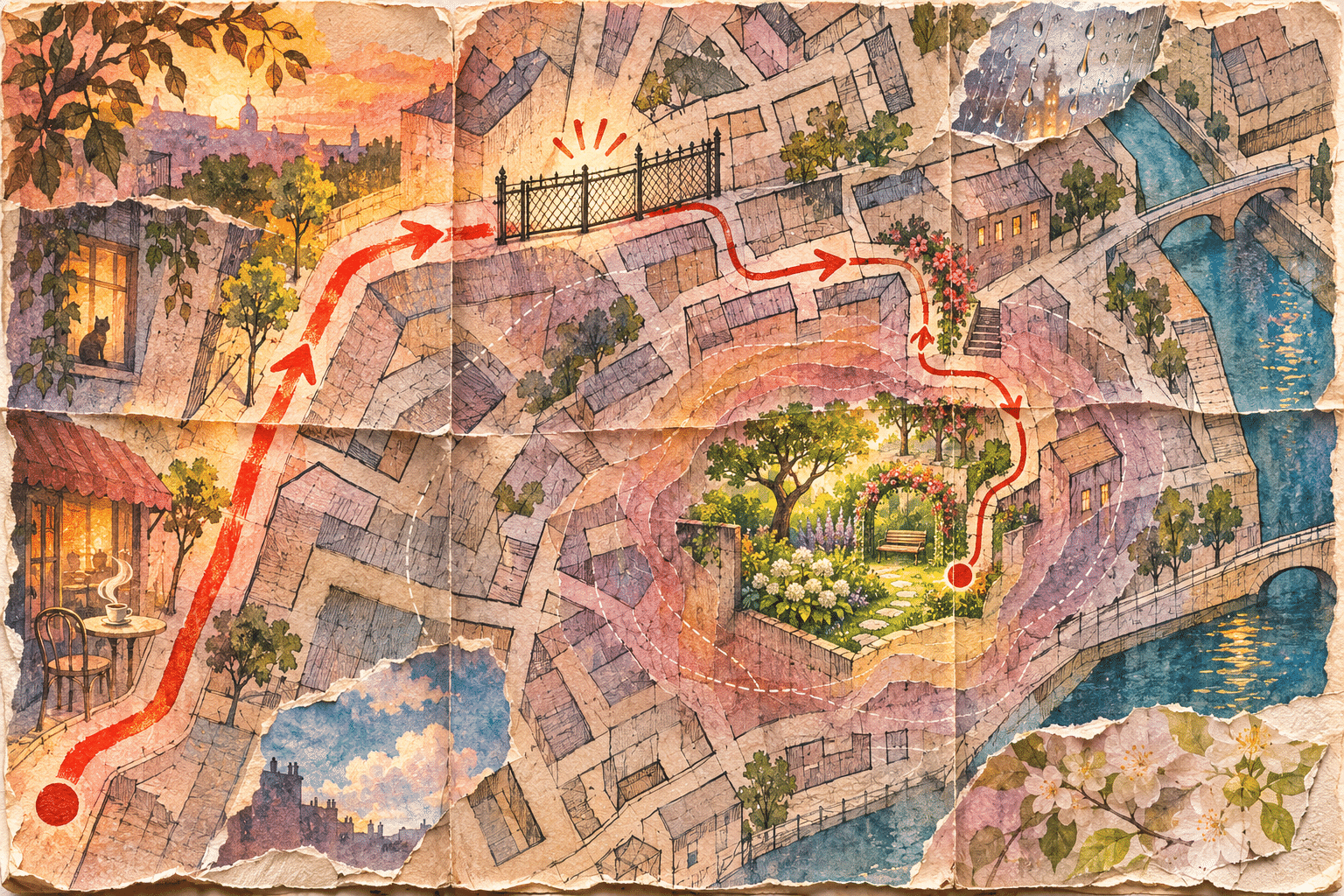
A route is never equally available to everyone. Stairs, fences, fatigue, unfamiliarity and the availability of transport shape what exploration means. Treat these as part of the artistic inquiry. The barrier study on this page asks how a blocked shortcut reorganizes attention; it does not claim that every forced detour is a pleasant discovery.
For a collaborative project, invite different accounts of the same place and preserve disagreement. Do not convert one person's feeling into a label imposed on a whole neighborhood. A map can show uncertainty through gaps, overlapping routes or competing scales. That can be more honest than a perfectly polished diagram.
Make the visual decisions legible
Use mark density to distinguish an overwhelming square from a quieter passage. Let a recurring color identify a remembered route, then interrupt it where memory fails or access changes. Repeated architecture can provide orientation while torn edges declare the assembled nature of the account.
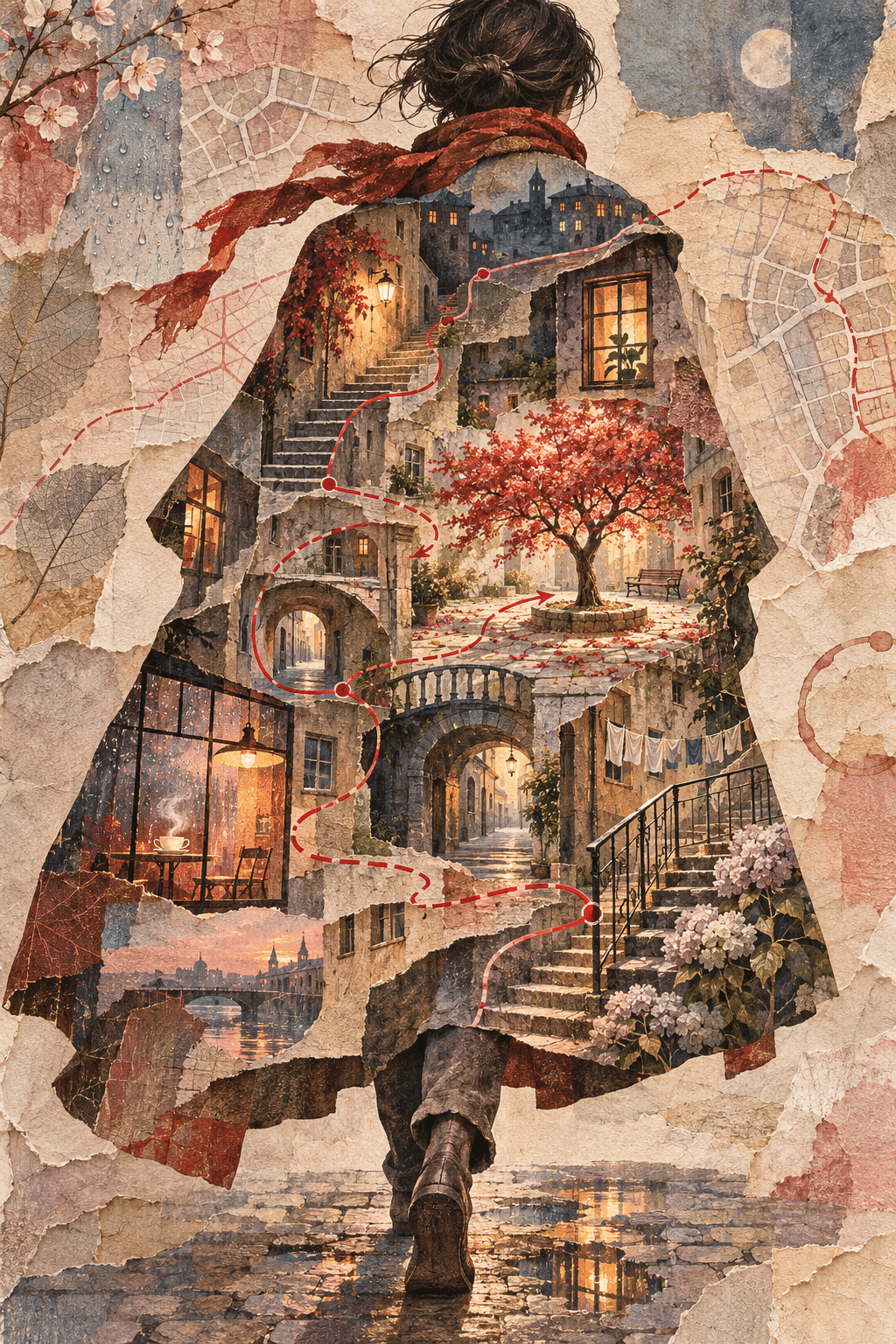
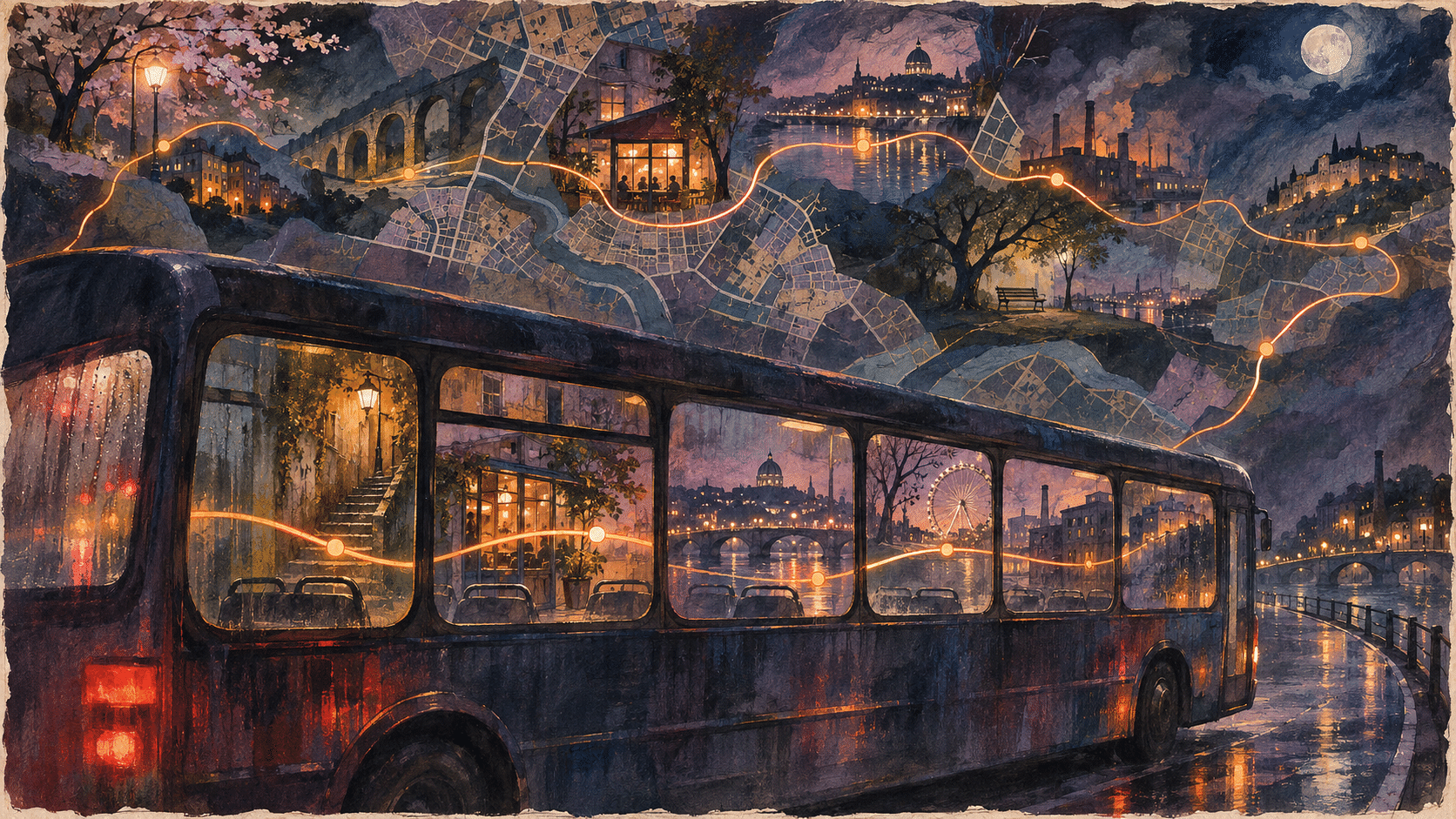
The coat portrait turns places into something carried by a walker. The night bus relocates separate views into neighboring windows. Neither is a literal city record. Their usefulness lies in making continuity of experience visible while keeping the constructed image distinguishable from navigational information.
Where the practice helps and fails
Psychogeographic approaches can support artist books, spatial essays, local-history projects and critical conversations about the built environment. Their strength is attention to what routine navigation leaves out. A useful project includes a question and an accountable observation process, even when its final form is poetic.
The approach weakens when wandering becomes a romantic pose or a familiar collage aesthetic replaces investigation. Try making two versions of one journey: an ordinary route and an experiential account. Compare what each reveals, what it hides and whose perspective is absent. Let that comparison guide the next walk.
Positive editorial perspective
AOI editorial perspective (AI-authored). Subjective mapping makes overlooked thresholds, pauses and detours visible. Its most useful images connect formal choices to a specific experience instead of merely decorating a city plan.
Negative editorial perspective
AOI editorial perspective (AI-authored). Picturesque fragments and nostalgic paper can turn inquiry into a travel mood board. Avoid making one walk stand for an entire neighborhood; show access limits, uncertainty and the question behind the route.
Neutral editorial perspective
AOI editorial perspective (AI-authored). Psychogeographic art is a flexible practice rather than one fixed visual style. These generated examples demonstrate possible image structures; they are imagined interpretations, not field evidence.
Pocket-sized facts
Psychogeography investigates lived responses to environments rather than supplying neutral navigation. [1]
Guy Debord's The Naked City is dated 1957 in the FRAC Centre collection. [2]
These illustrations depict imagined journeys and materials; they do not document actual walks.
A small poetic detour
Original words from the AOI studio.
Poetry
The shortest road forgets the fountain,
the wall that warms before the sun,
the bench where all the city's hurry
sits down and leaves a sentence undone.
I fold the square until its noise
can fit beside a single tree.
The map insists the streets are measured;
the journey keeps revising me.
Here is the gate I could not enter.
Here is the turning I recall.
A city fits inside a pocket,
but never quite inside it all.
The prompt workshop
Original creative exercises. These prompts create new illustrations, not documentary evidence.
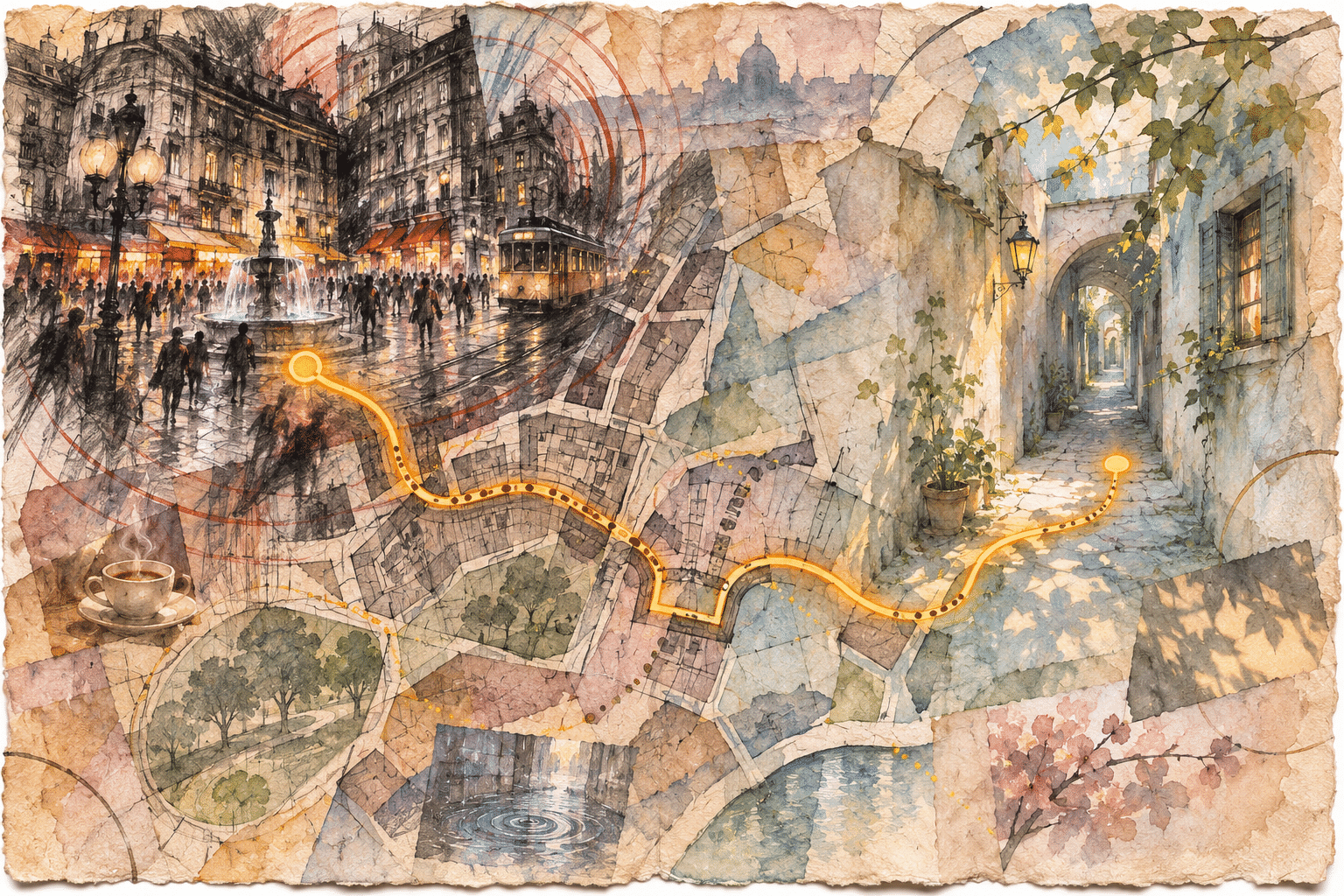
One change in atmosphere
Create an original subjective map connecting a crowded square and a quiet alley. Contrast dense charcoal with pale watercolor, retain one legible amber route and show where the atmosphere changes. No street names. An imagined artistic account, not a navigational map.
Define the experience represented by each change in mark density.
Places carried by a walker
Create an exceptional standalone original artwork. Vary aspect ratio to fit the stated composition. The long way home: vertical collage, one pedestrian's coat silhouette filled with stairways, distant windows and a small courtyard, red route repeatedly detours toward a tree. Psychogeographic art as an original subjective urban atlas: fragmented but legible places, emotionally weighted distances, deliberate route marks, tactile paper and ink, memory and sensory experience altering the map. Thoughtful spatial relationships rather than random surreal collage. Not a documentary map. No text, lettering, logo, watermark or signature.
Keep the silhouette legible while altering the scale of remembered places.
A route with an interruption
Create an exceptional standalone original artwork. Vary aspect ratio to fit the stated composition. An inaccessible shortcut: a fence interrupts a bold route on a folded paper city; route turns around to reveal an overlooked garden, precise barriers and subjective distance. Psychogeographic art as an original subjective urban atlas: fragmented but legible places, emotionally weighted distances, deliberate route marks, tactile paper and ink, memory and sensory experience altering the map. Thoughtful spatial relationships rather than random surreal collage. Not a documentary map. No text, lettering, logo, watermark or signature.
Show the barrier as a real constraint; let the detour change the composition.
People & works to explore
References discussed in this article. Consult the sources below for context.
Artists and practitioners
Guy Debord
Paintings and other works
Guy Debord — The Naked City (1957)
A smile from the studio
Jokes
My navigation app announced that I had added forty minutes to the journey. I explained that the alley had excellent echoes and the tree deserved a second visit. It recalculated in silence. We are now collaborating on a route described as “emotionally efficient.”