
AOI technical hybrid · mask and relief interpretation
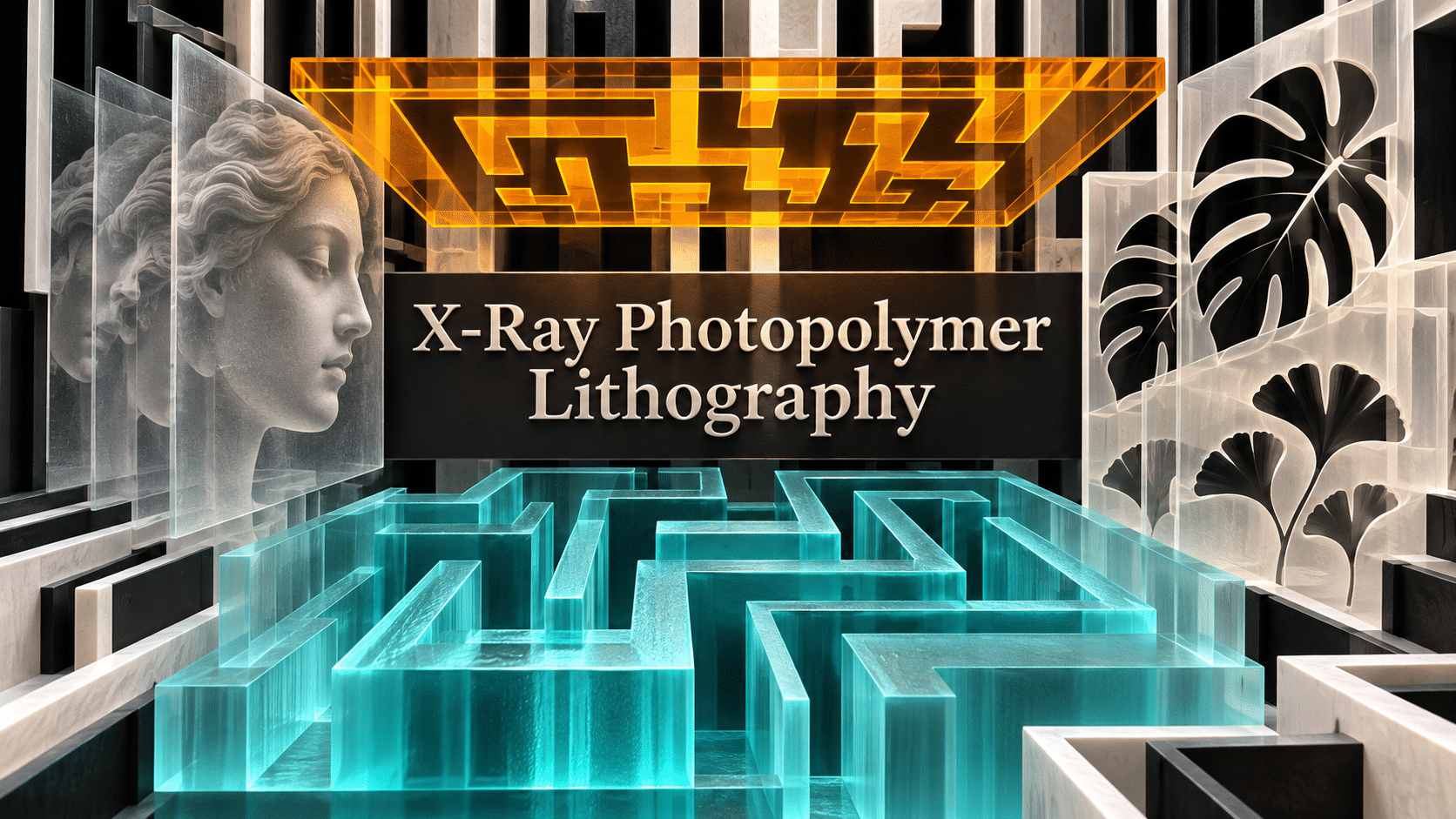
X-Ray Photopolymer Lithography is presented here as an AOI artistic hybrid: masks, sharply bounded relief, deep channels and translucent layers become a sculptural visual language. The images are creative interpretations, not demonstrations of a fabrication process.
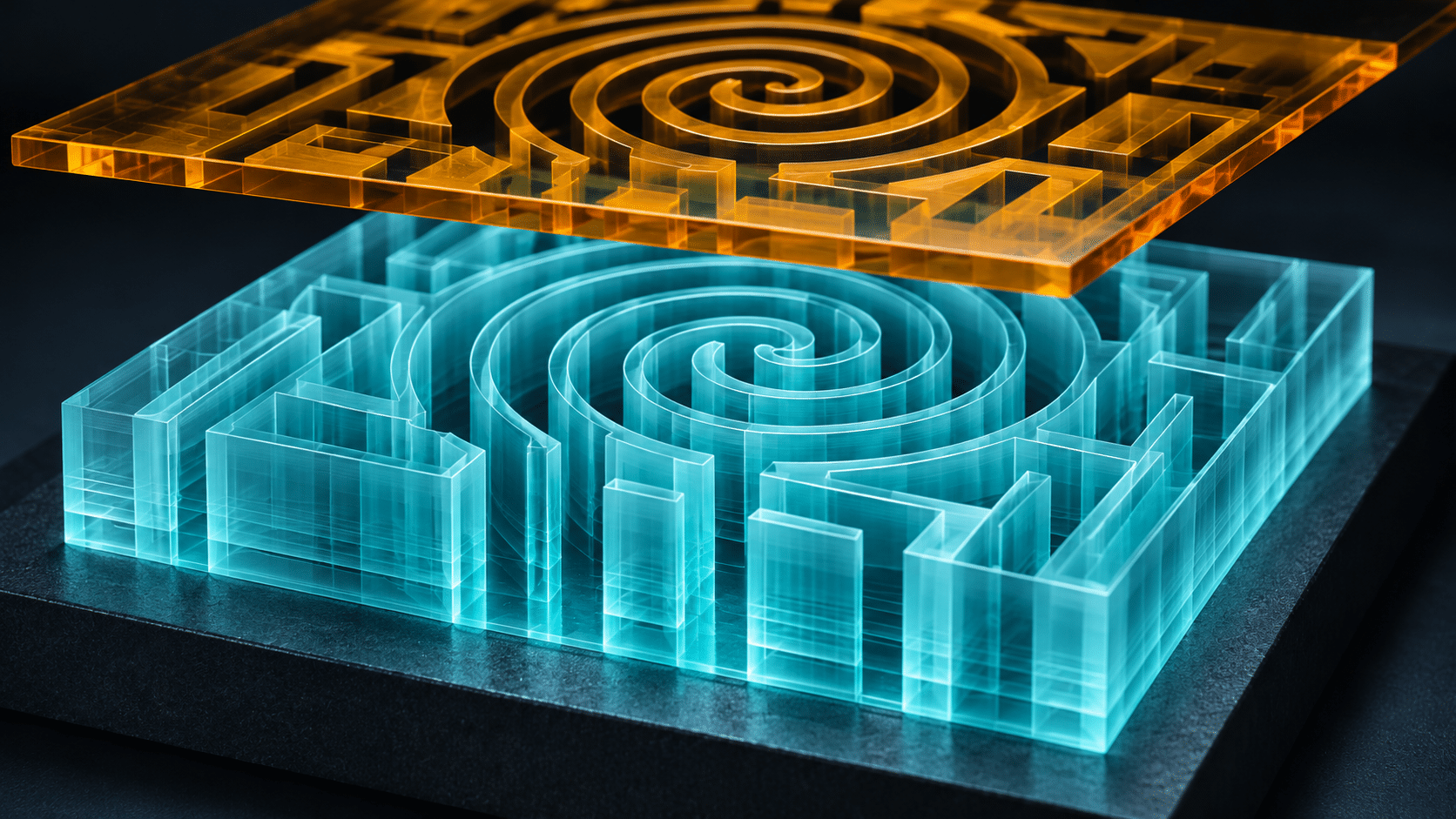
A visual introduction
Seven original AI-generated interpretations: a dedicated banner, a centrally titled artistic collage and five standalone studies.
Select an image for a closer look. Use the thumbnails, arrow keys or a swipe to compare examples. Zoom in to inspect details, or share the image that inspires you.

Creative toolbox · take this style further
Choose an input and a destination. Search sends your words to the chosen site; Copy & open puts them on your clipboard to paste there.
Create with AI
Turn your chosen input into an image prompt or a new creative direction.
ChatGPT
Copy your input and paste it into a ChatGPT conversation or image request.
Copy & open ChatGPT (new tab)Claude · Anthropic
Develop an image prompt or explore the style in a new Claude conversation.
Copy & open Claude · Anthropic (new tab)Midjourney
Paste your input into the Imagine bar on the Create page.
Copy & open Midjourney (new tab)Adobe Firefly
Copy your input, open Firefly, and paste it into the prompt field.
Copy & open Adobe Firefly (new tab)Leonardo.Ai
Copy your input, open Leonardo, and paste it into the generation field.
Copy & open Leonardo.Ai (new tab)Image search
Find visual references. Short, concrete keywords usually work best.
Lexica
Search AI images and prompts using your selected input.
Search with this input Lexica (new tab)Pexels
Search the photo and video library. Short keywords often work best.
Search with this input Pexels (new tab)Pixabay
Search photos, illustrations and other images.
Search with this input Pixabay (new tab)Unsplash
Search photographs using the style name or your own keywords.
Search with this input Unsplash (new tab)Wikimedia Commons
Search photographs, artworks and historical images. Check each file for its source and reuse terms.
Search with this input Wikimedia Commons (new tab)Art & research
Explore artists, collections and the ideas behind a style.
Wikipedia
Search for background reading. A style may not have its own article.
Search with this input Wikipedia (new tab)WikiArt
Copy your input into WikiArt’s search to explore artists and artworks.
Copy & open WikiArt (new tab)Europeana
Paste your keywords into the search to explore European museum, library and archive collections.
Copy & open Europeana (new tab)Inspiration
Discover portfolios and visual ideas from creative communities.
Instagram hashtags
Search a hashtag made from your input: spaces and punctuation are removed. Instagram may require sign-in.
Search with this input Instagram hashtags (new tab)ArtStation
Paste your input into artwork search for concept art, environments, characters and visual development.
Copy & open ArtStation (new tab)Behance
Paste your input into project search for illustration, design and visual storytelling.
Copy & open Behance (new tab)A closer look
Organize the composition around the relationship between a patterned plane and a deeper relief. Keep wall thickness, channels and layer alignment readable. Use translucency selectively so that the voids remain as important as the material.
Separate the artistic title from the technical reference
Deep X-ray lithography is a real fabrication technique. KIT’s account of the LIGA process describes patterned exposure of PMMA, development that removes irradiated regions, and subsequent electroforming or replication. [1] This is a useful factual reference for masks, precise boundaries and tall microstructures.
The full requested title is used here for an AOI artistic interpretation. It should not be read as a standard art movement or a recipe for curing ordinary photopolymer resin with X-rays. The gallery’s cyan, amber and violet materials are imagined aesthetic choices. No image was produced by exposing a physical sample to X-rays.
Turn a pattern into spatial depth
A mask is visually economical: it establishes regions that are present or absent. A relief gives those regions depth. In the banner, an amber patterned plane hovers over a cyan spiral structure. The repeated motif connects the two objects while the gap between them makes their difference visible.
For an artwork, start with a pattern that can be recognized from above. Then decide which edges rise, which remain flat and which become channels. An oblique viewpoint can reveal both the plan and the wall height. Too many overlapping transparent surfaces will make even a simple pattern unreadable.
Let negative space describe the subject
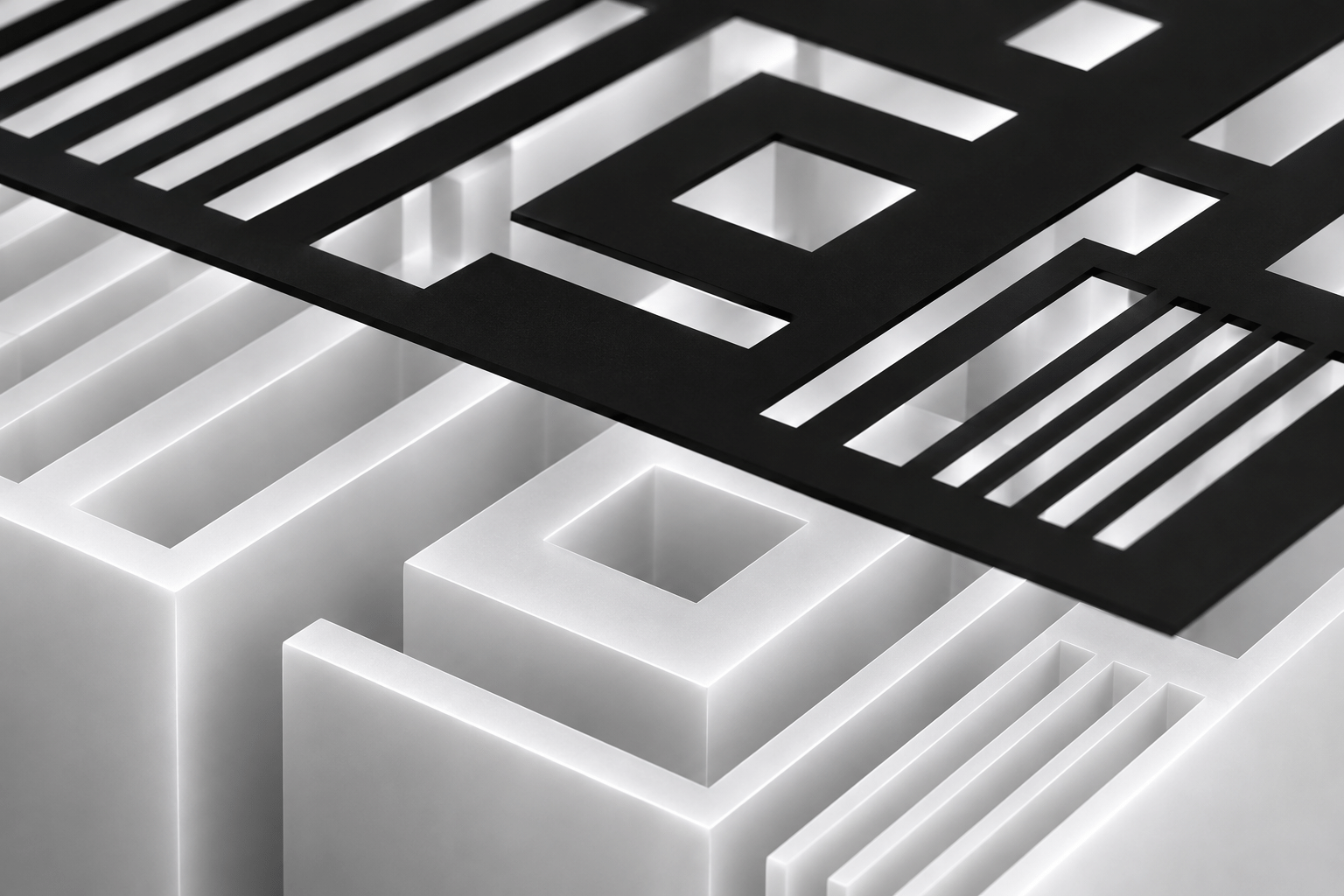
The amber leaf study uses branching dark channels to describe a botanical structure. Its strongest feature is not a painted vein but the apparent absence of material. The monochrome mask study makes the same point with rectilinear openings and white walls.
This gives the concept a practical compositional rule: design the empty shape as carefully as the solid one. A narrow channel can direct the eye; a broad opening can provide rest. Preserve a few continuous paths through the relief so that the viewer can understand how the pattern is organized.
Translate the rule across different subjects
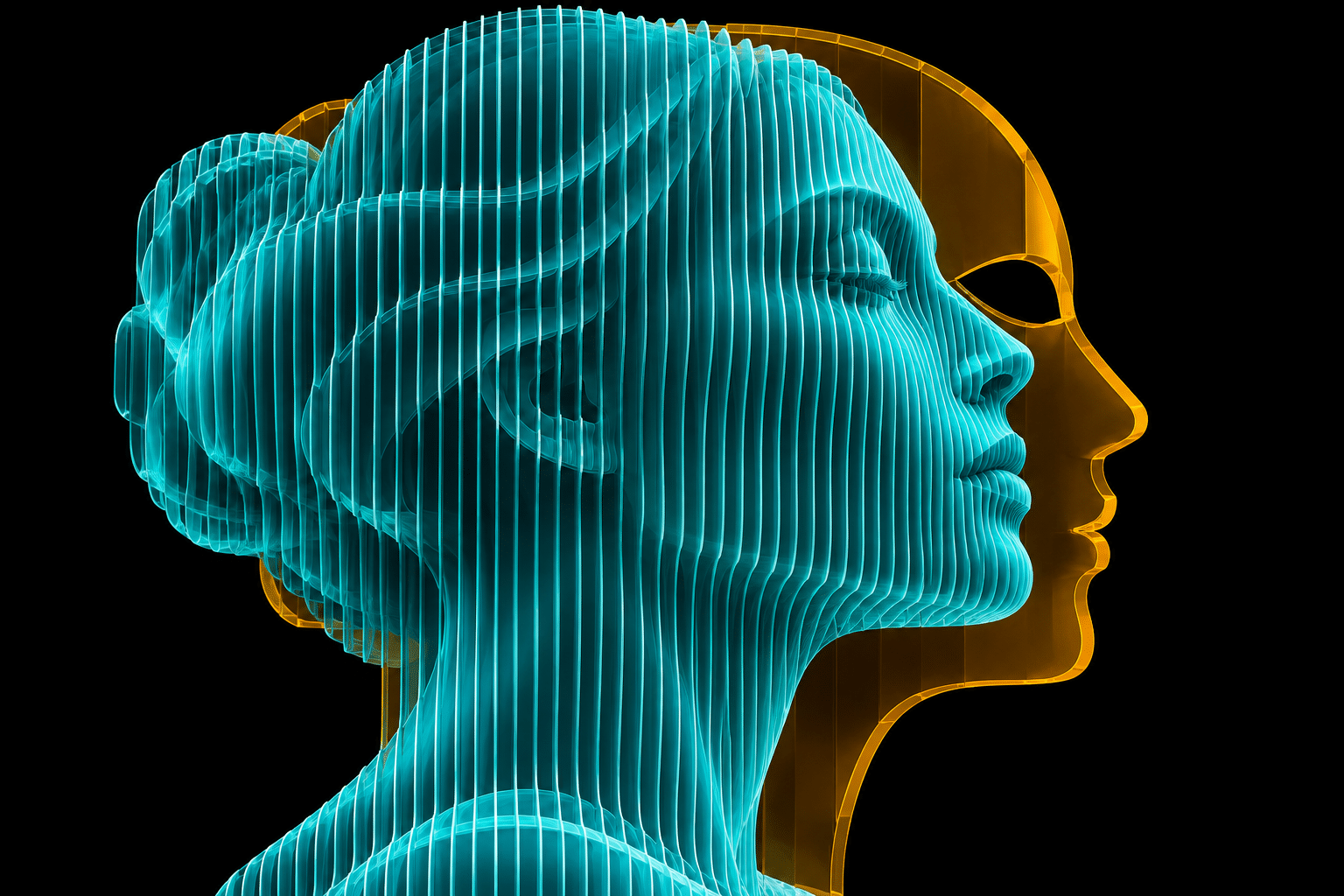
The portrait resolves a recognizable profile from closely spaced cyan fins. An offset amber face-shaped plate introduces a second reading of the same contour. This is a layered sculpture fantasy, not a medical scan or a model of internal anatomy.
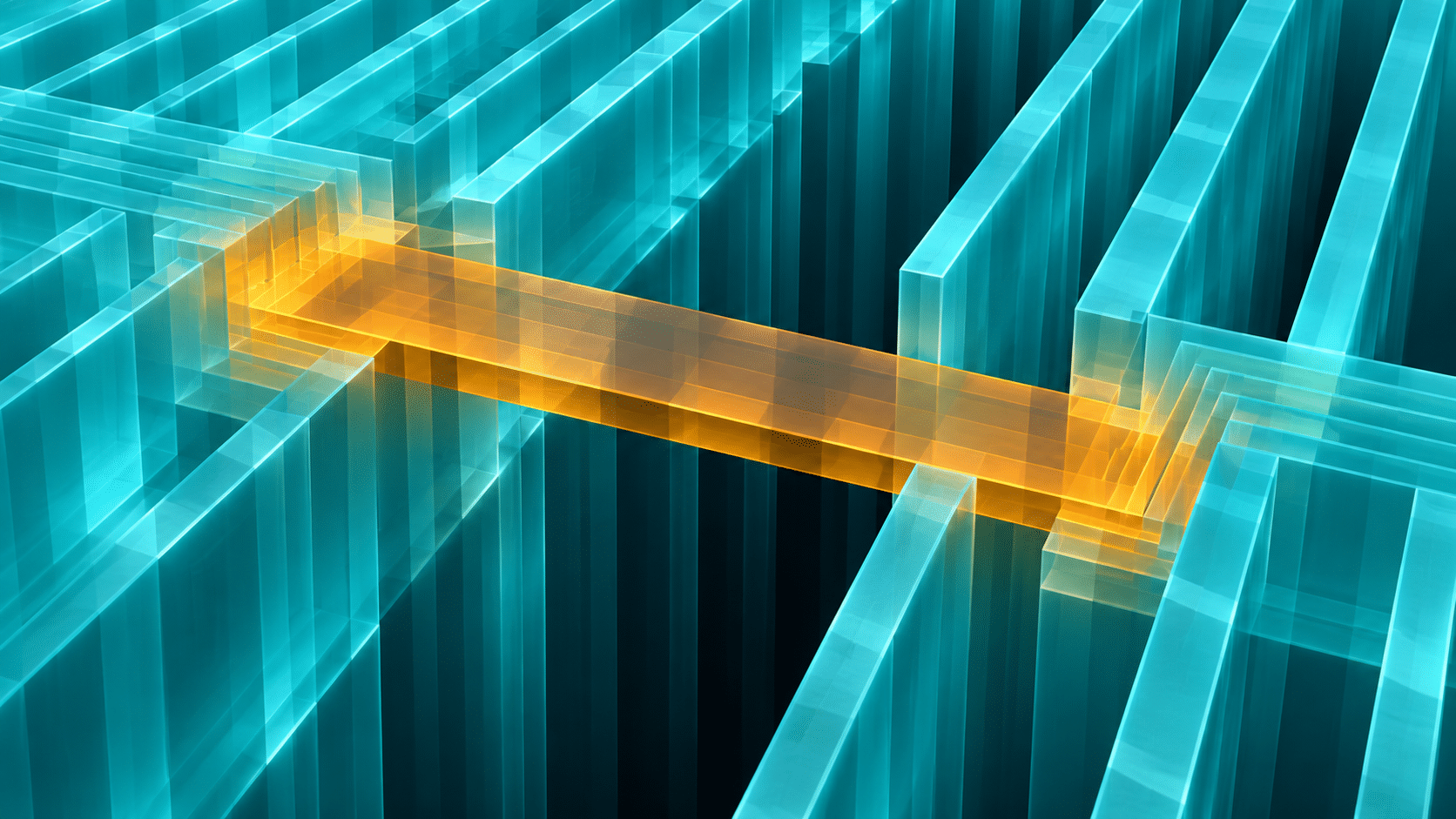
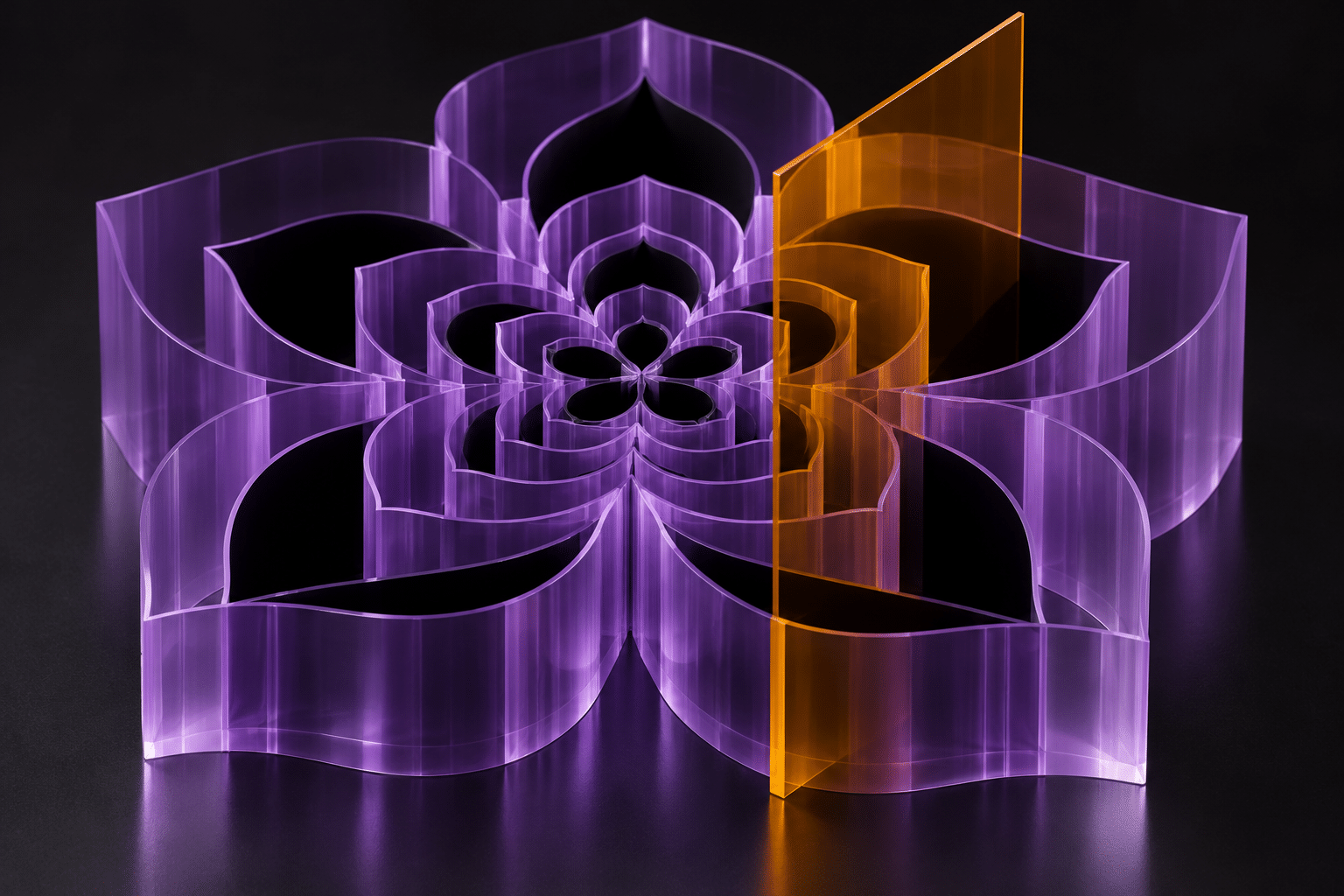
The architectural study enlarges parallel relief walls into a courtyard-like space. One amber crossing interrupts the repetition. The abstract flower uses nested violet walls and petal-shaped voids, with a single upright amber plane disturbing its symmetry. Each image changes the subject while retaining the logic of sharp walls and meaningful gaps.
Use light to reveal, not disguise
Crisp highlights can help define a thin wall, but an outline around every edge soon becomes visual noise. Let some surfaces remain darker. The translucent color should explain overlap or thickness rather than simply make the object glow.
The monochrome example is an especially useful test. Without cyan and amber to separate components, the image depends on depth, overlap and tonal contrast. If a composition only works with highly saturated color, its structure may need simplifying. Strong negative shapes should remain readable at thumbnail size.
Keep the technical metaphor honest
This direction suits speculative sculpture, technology-themed editorial illustration, architectural concepts and studies of presence versus absence. It can make fabrication-inspired geometry accessible as an artistic subject. It is less useful when viewers need accurate process instructions, tolerances or a verifiable scientific image.
A successful brief names the mask pattern, relief depth, material contrast and viewpoint. A weak brief merely piles together technical words and accepts any glowing structure. Review the result for continuity of walls, consistency of layer spacing and clarity of the intended subject. Use the primary technical source for process understanding, and the gallery for creative exploration.
Positive editorial perspective
AOI editorial perspective (AI-authored). The mask-and-relief relationship supplies a strong visual rule. Deep voids, upright walls and selective translucency give the portrait, leaf and architectural study a shared structure without making them identical.
Negative editorial perspective
AOI editorial perspective (AI-authored). Technical vocabulary can lend false authority to an attractive rendering. The concept fails when luminous edges hide incoherent geometry or when an imagined material is presented as a verified fabrication result.
Neutral editorial perspective
AOI editorial perspective (AI-authored). This AOI hybrid draws visual inspiration from masks and microfabrication structures. Its generated artworks are compositional studies; they are not X-ray images, manufacturing diagrams or validated material experiments.
Pocket-sized facts
KIT documents deep X-ray lithography as part of the LIGA fabrication process. [1]
The gallery is an AOI artistic interpretation, not a record of X-ray exposure or resin curing.
Mask, relief and negative space provide the repeatable compositional rules.
A small poetic detour
Original words from the AOI studio.
Poetry
A pattern waits above the wall.
Its missing pieces hold the light.
The narrow channels do not call;
they let the eye pass out of sight.
A leaf is drawn by what is gone.
A face arrives in measured planes.
The amber bridge keeps moving on
across the dark between the lanes.
A flower grows from empty space.
The solid edge is only half.
We find a shape, then leave a place
for light to finish what we craft.
The prompt workshop
Original creative exercises. These prompts create new illustrations, not documentary evidence.
Mask above relief
Create an artistic visualization of a translucent cyan spiral relief on graphite, with an amber patterned plane suspended above it. Deep narrow channels, upright walls, oblique view, restrained highlights. No labels, scales or visible beams.
Keep a clear visual relationship between the plane and relief.
A leaf made of absence
Create a tall amber leaf-shaped relief whose branching veins are dark negative channels. Precise upright walls, one directional studio light, graphite ground, macro composition, no lettering or scientific scale.
Design the voids as carefully as the material.
Achromatic layers
Create a monochrome sculpture study with a flat black cutout mask suspended above pearl-white relief walls. Square openings and parallel channels, diagonal composition, clear layer separation, no text.
Test whether depth and negative space remain readable without saturated color.
A smile from the studio
Jokes
The mask and the relief applied for a joint exhibition. The mask submitted a perfectly flat statement. The relief insisted the work had depth. The curator asked which one had done the real work. They pointed at the empty channels. The channels declined to comment, but their absence was widely discussed.