
AOI original concept · unoccupied thresholds
Liminal Void Neon Noir pictures a place built for passage just when nobody is passing through. A small artificial light makes a threshold visible; beyond it, a stretch of water, concrete, darkness or snow withholds the destination.
An A⊕I –[-.+] creαt¡ve c⊕ncept, n⊕t αn estαbl¡she∂ h¡st⊕r¡cαl m⊕vement.
A visual introduction
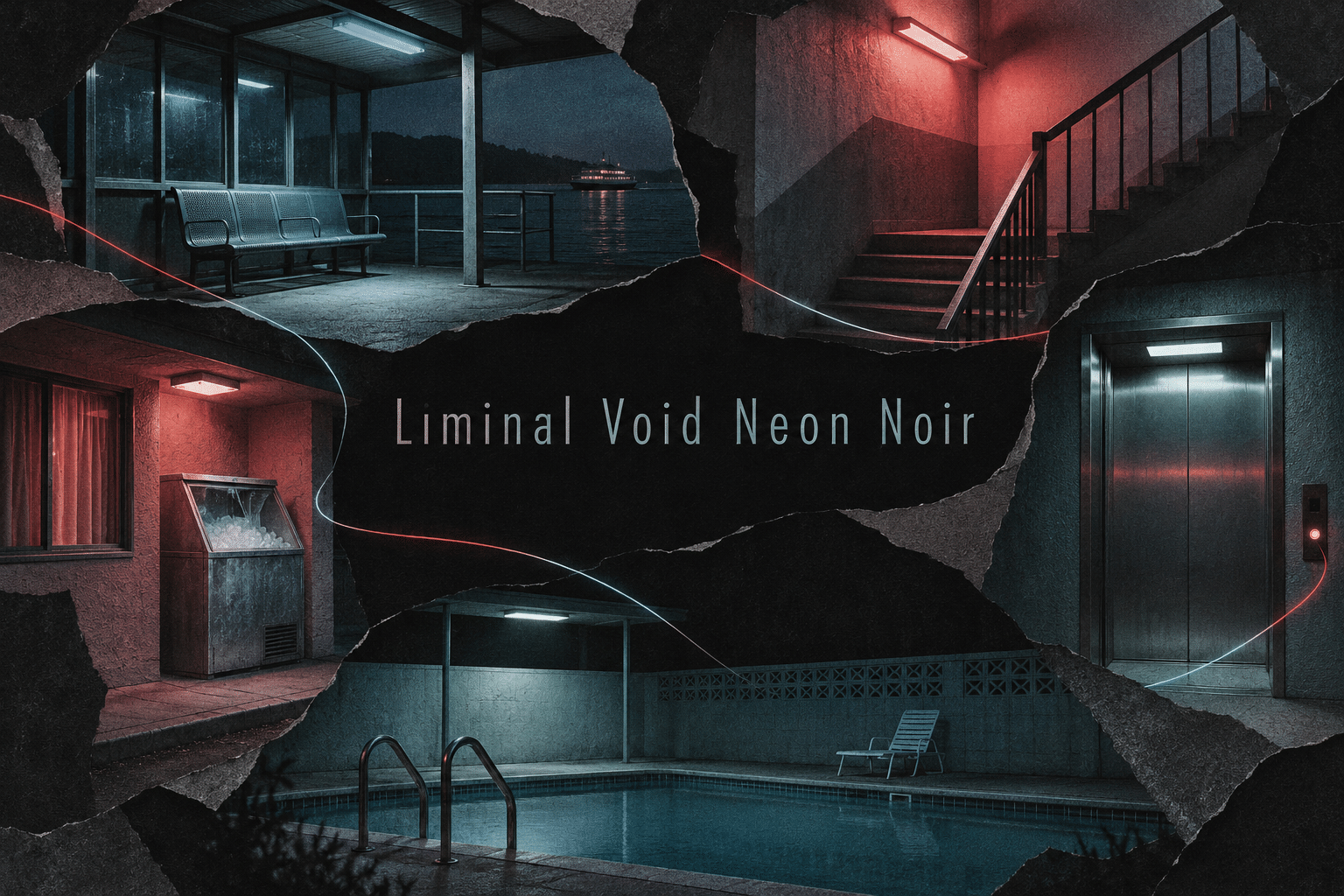
Seven original AI-generated interpretations: a dedicated banner, a centrally titled artistic collage and five standalone studies.
Select an image for a closer look. Use the thumbnails, arrow keys or a swipe to compare examples. Zoom in to inspect details, or share the image that inspires you.
Creative toolbox · take this style further
Choose an input and a destination. Search sends your words to the chosen site; Copy & open puts them on your clipboard to paste there.
Create with AI
Turn your chosen input into an image prompt or a new creative direction.
ChatGPT
Copy your input and paste it into a ChatGPT conversation or image request.
Copy & open ChatGPT (new tab)Claude · Anthropic
Develop an image prompt or explore the style in a new Claude conversation.
Copy & open Claude · Anthropic (new tab)Midjourney
Paste your input into the Imagine bar on the Create page.
Copy & open Midjourney (new tab)Adobe Firefly
Copy your input, open Firefly, and paste it into the prompt field.
Copy & open Adobe Firefly (new tab)Leonardo.Ai
Copy your input, open Leonardo, and paste it into the generation field.
Copy & open Leonardo.Ai (new tab)Image search
Find visual references. Short, concrete keywords usually work best.
Lexica
Search AI images and prompts using your selected input.
Search with this input Lexica (new tab)Pexels
Search the photo and video library. Short keywords often work best.
Search with this input Pexels (new tab)Pixabay
Search photos, illustrations and other images.
Search with this input Pixabay (new tab)Unsplash
Search photographs using the style name or your own keywords.
Search with this input Unsplash (new tab)Wikimedia Commons
Search photographs, artworks and historical images. Check each file for its source and reuse terms.
Search with this input Wikimedia Commons (new tab)Art & research
Explore artists, collections and the ideas behind a style.
Wikipedia
Search for background reading. A style may not have its own article.
Search with this input Wikipedia (new tab)WikiArt
Copy your input into WikiArt’s search to explore artists and artworks.
Copy & open WikiArt (new tab)Europeana
Paste your keywords into the search to explore European museum, library and archive collections.
Copy & open Europeana (new tab)Inspiration
Discover portfolios and visual ideas from creative communities.
Instagram hashtags
Search a hashtag made from your input: spaces and punctuation are removed. Instagram may require sign-in.
Search with this input Instagram hashtags (new tab)ArtStation
Paste your input into artwork search for concept art, environments, characters and visual development.
Copy & open ArtStation (new tab)Behance
Paste your input into project search for illustration, design and visual storytelling.
Copy & open Behance (new tab)A closer look
Choose an ordinary place with a clear purpose, remove the traffic, and leave one sign of use. Give one light source a precise job: pick out a railing, reveal a doorframe or stop at a waterline. Save the largest shape for the space the viewer cannot enter.
A waiting place after the wait
A shelter, platform or lift is built around an expectation: somebody will arrive, board or leave. Look at the same place when it is empty and the architecture still makes that promise. Liminal Void Neon Noir is AOI’s name for the interval in which the promise remains and the traveler is absent. Its noir mood can be tender as easily as threatening.
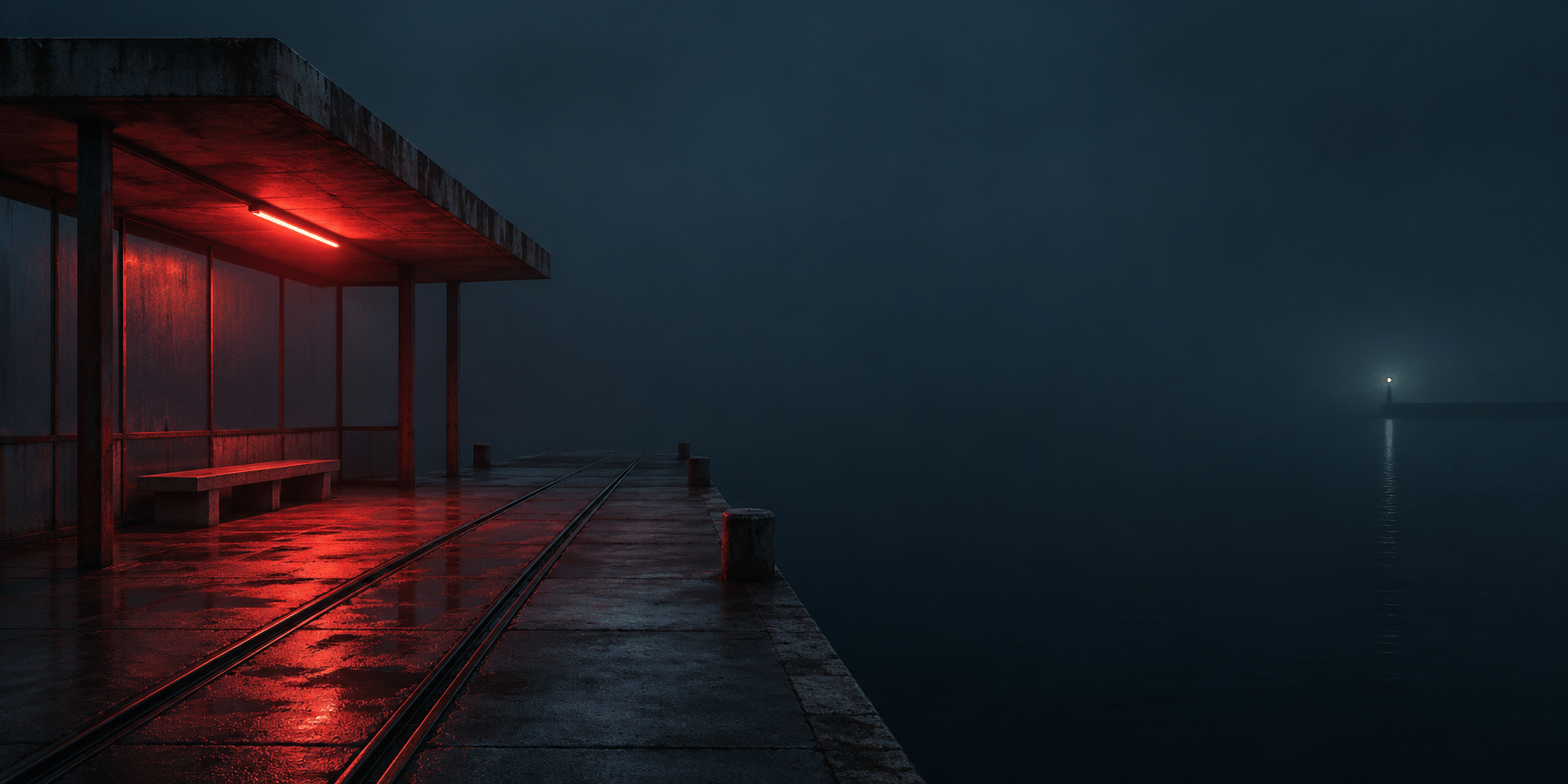
The harbor banner gives us a route toward the water and very little information about what happens next. The lit shelter tells us where a person might stand. The open harbor tells us less. An image becomes more interesting when the viewer can distinguish what has been withheld from what simply got lost in a dark exposure.
Give darkness an edge
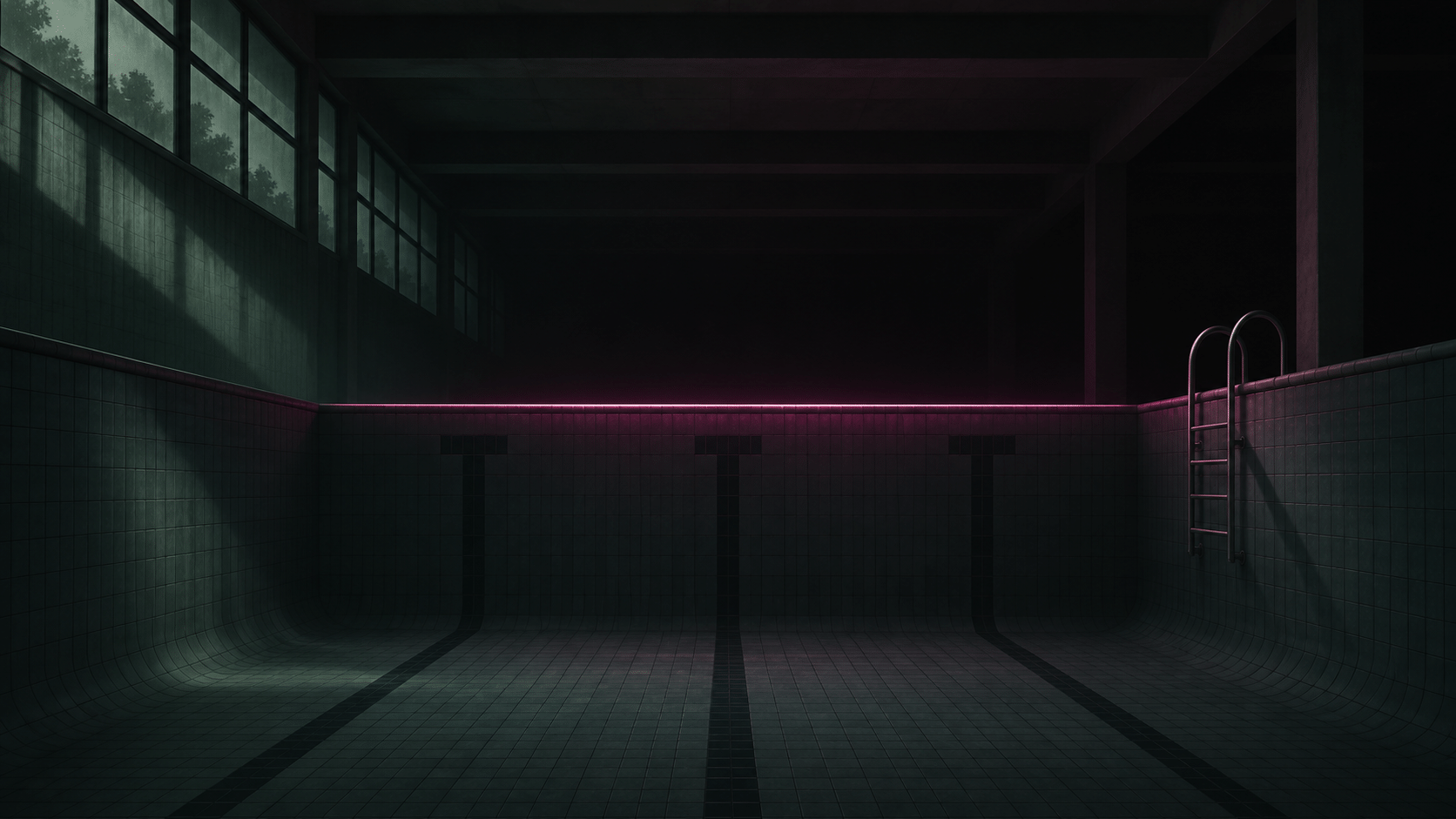
A void becomes visible through its boundary. At a pier, that edge is the line beyond which the paving stops. On a staircase, it is the bend in the flight. In a drained pool, the tiled coping lets the viewer estimate the depth of an empty volume. Draw that boundary before deciding how dark to make the rest.
Keep two or three near-dark values available. A wall can be barely lighter than a doorway; the floor can carry a reflection just bright enough to establish its plane. Crush all three to identical black and the viewer loses the space. A thumbnail test is useful: one large shape should still read as absent space, rather than as a missing half of the image.
Ask the light to perform one task
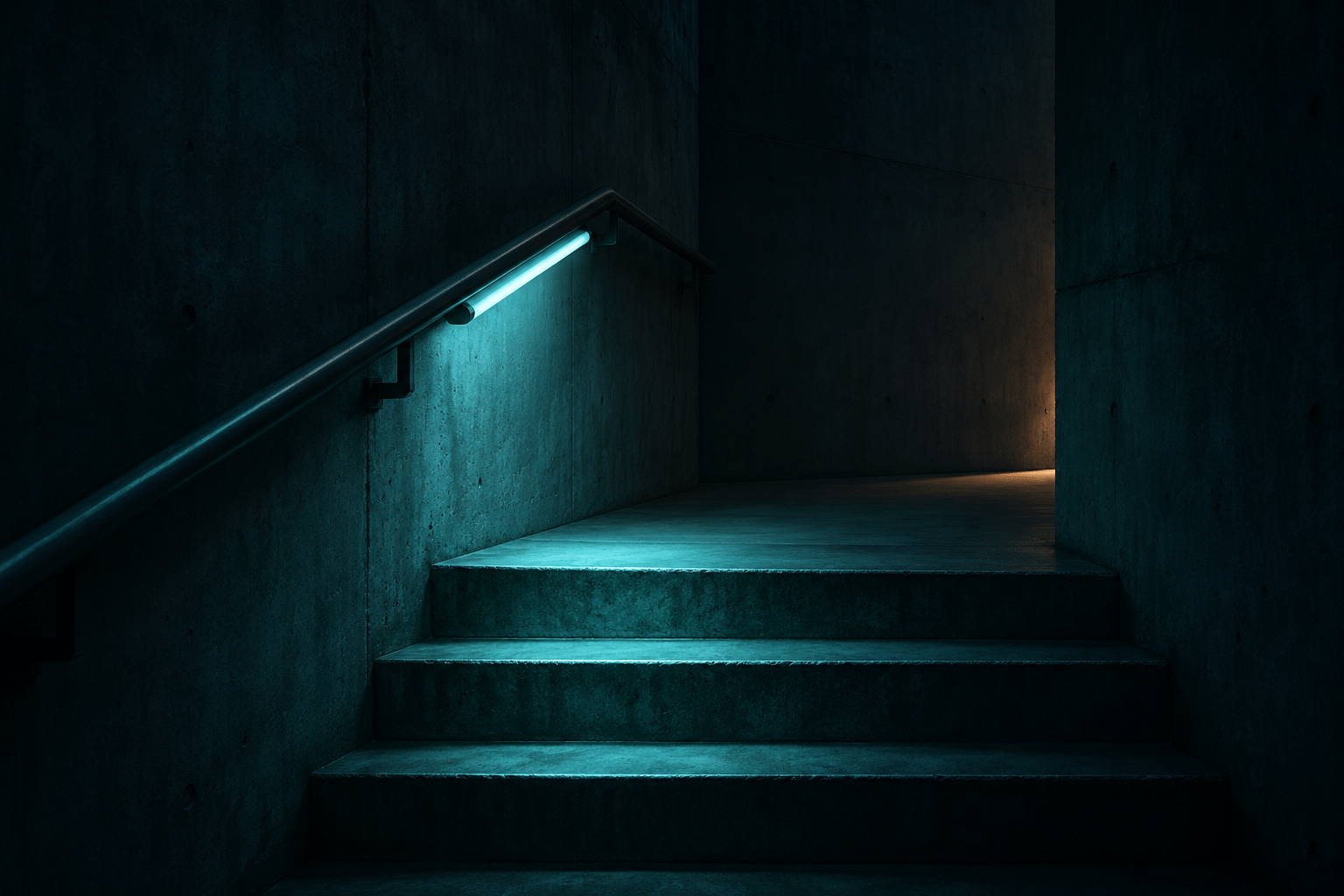
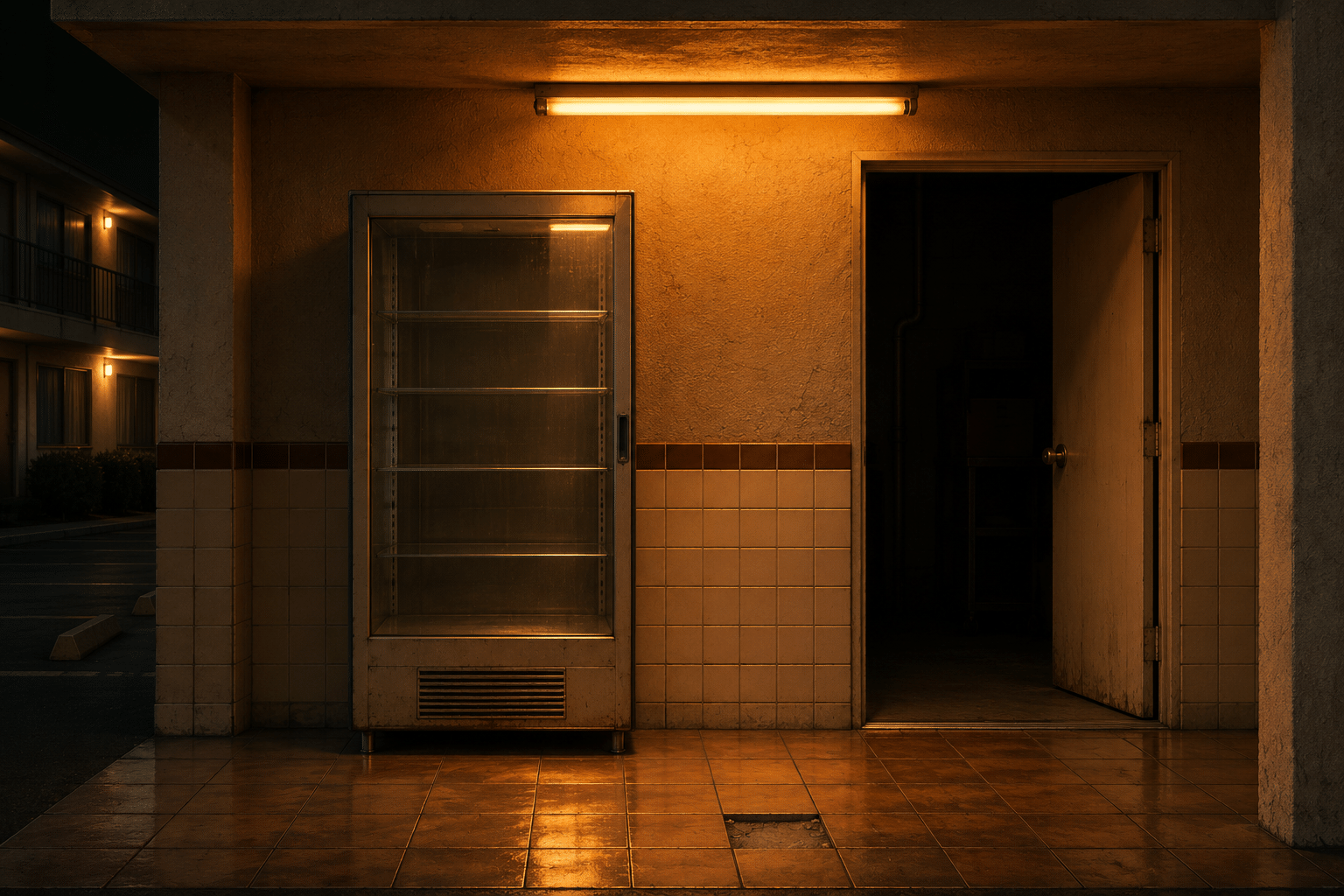
The stair landing uses a handrail to lead the gaze toward a blind turn. The motel alcove has a different problem: its cabinet is visible, but the adjoining doorway does not explain where it leads. A useful light source answers one spatial question while leaving the other open.
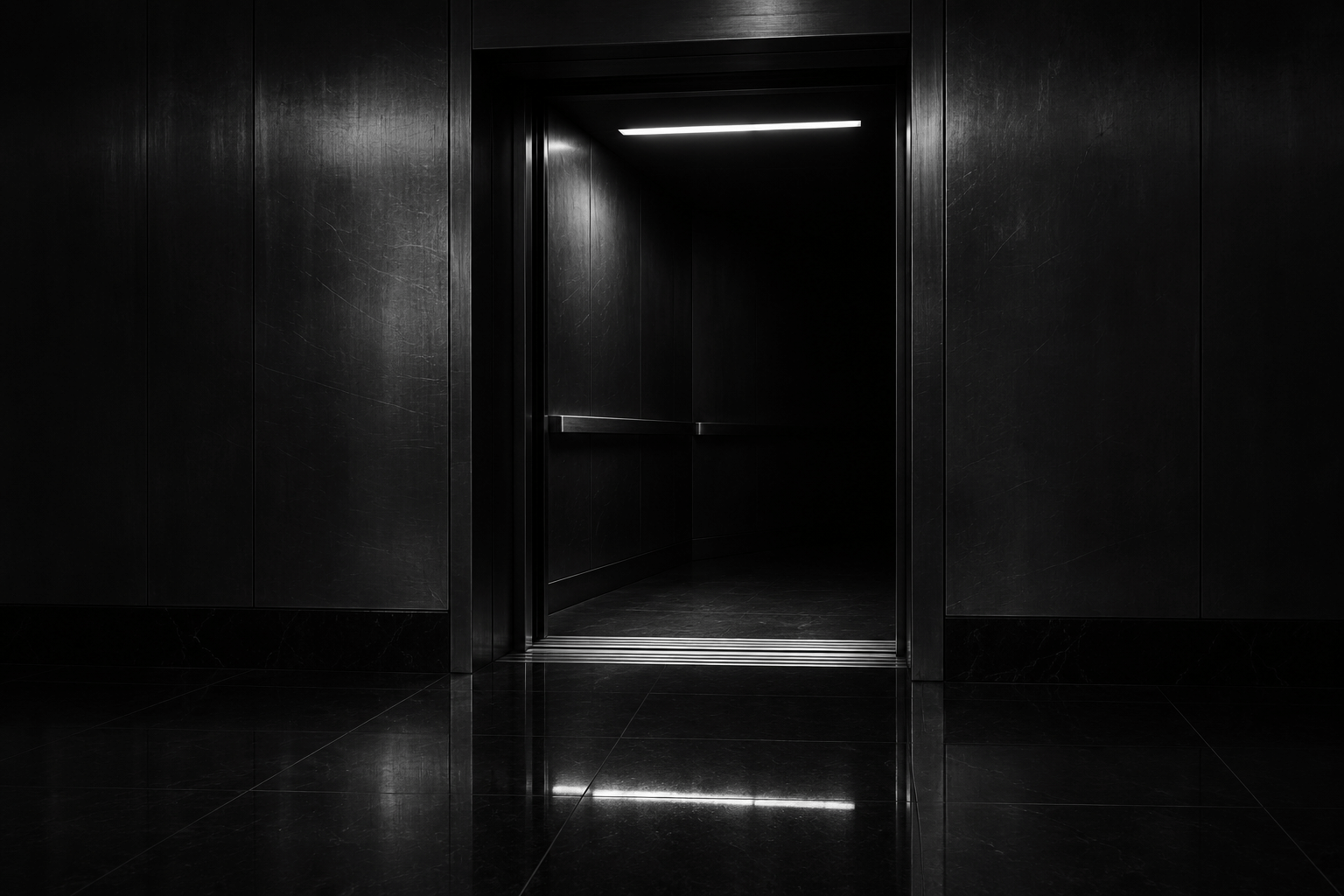
Saturated light is powerful in small quantities. Let the visible fixture, the surface it strikes and the limited reach of its reflection agree. A colored outline around every object has no reason to stop anywhere. White light works too: a single luminous seam in an elevator can be enough to separate brushed metal from a black floor.
Leave evidence of use
A place feels deserted when there is something to desert. A pool ladder is particularly economical evidence: it still offers a route into water that is no longer there. A worn floor, a waiting bench or a polished threshold can perform a similar task. A crowd of props competes with the absence you set out to describe.
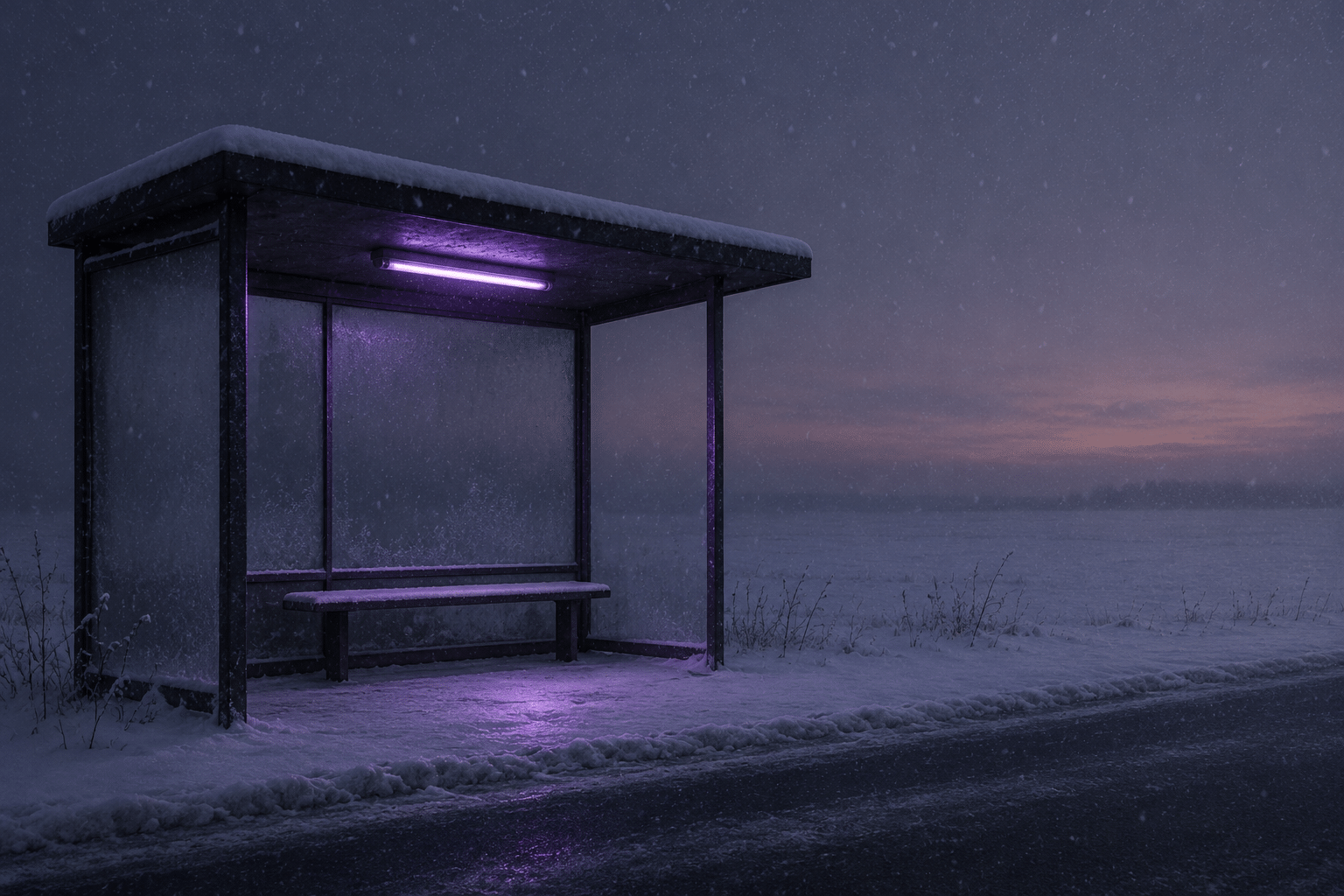
For a quieter variant, reverse the tonal balance. A small shelter in a pale snowy field can feel as isolated as an elevator in a black lobby. The key is the distance between the scale of a human use and the expanse surrounding it. No figure needs to appear for that relationship to be felt.
Use suspense without writing the ending
This direction works for a book jacket about waiting, an establishing image for a game or a photographic sequence about the hours between shifts. Make a series by moving the viewer from outside to inside, or by changing the function of the threshold. Repeating an empty corridor seven times is a weaker experiment than asking what it feels like to wait, descend, cross or enter.
Distinguish the concept from a busy cyberpunk street scene by testing what happens when most lights and signs are removed. If the image loses its subject, the spectacle was doing all the work. Leave enough geometry to orient the viewer and enough uncertainty to let them imagine the next sound. These are original generated scenes, not records of abandoned real locations.
Positive editorial perspective
AOI editorial perspective (AI-authored). A modest fixture can describe a whole room when its reflection, shadow and stopping point agree. The empty pool and the winter shelter show how absence can survive dramatic changes of scale and brightness.
Negative editorial perspective
AOI editorial perspective (AI-authored). Underexposure and a purple tube do not make a threshold. When details disappear indiscriminately, the viewer has nowhere to stand. Recover one usable route and one sign of prior use; remove props that tell the story too explicitly.
Neutral editorial perspective
AOI editorial perspective (AI-authored). Liminal Void Neon Noir is a proposed AOI direction for imagined transitional spaces. It favors architectural cues, selective light and absence; the locations in the gallery are fictional.
Pocket-sized facts
The subject is a place built for passage, shown without its expected traffic.
The light should reveal a boundary or route and leave some space unresolved.
The void can be pale as well as dark; scale and absence matter more than black pixels.
A small poetic detour
Original words from the AOI studio.
Poetry
Two rails go down to where the stone
has given all it has to say.
The harbor keeps the rest alone.
A red tube burns the hours away.
Three steps are blue. The fourth one turns.
The lift holds open like a page.
Across the pool a thin line burns
above the ladder’s empty cage.
Out past the shelter, snow is white.
No engine troubles all that room.
A strip of violet keeps the light
for someone who may still come through.
The prompt workshop
Original creative exercises. These prompts create new illustrations, not documentary evidence.
After the last ferry
A concrete ferry pier at midnight, a red tube beneath an empty waiting shelter, tracks ending at dark water, muted horizon and a narrow reflected line. No boat, text or people.
Let the pavement edge describe the void.
A route around a corner
Unoccupied stair landing, cyan light along three steps and a handrail, the upper flight disappearing around a blind turn. Charcoal and blue-gray values, one warm trace beyond the frame.
Keep the direction of travel readable.
A pale void
A roadside shelter in fine snow, one faint violet light and a broad unbroken pale field. Low horizon, small footprint of human architecture, no signage or pedestrians.
Test whether emptiness survives without a black background.
A smile from the studio
Jokes
The night manager received a complaint that the waiting room felt too empty. He added a second chair. Both chairs then appeared to be waiting for somebody, which made the room feel twice as empty. He removed the first chair and went home before the architect could propose an empty-chair expansion.