
AOI original concept · speculative digital botany
Glitch-Encrusted Holographic Flora imagines plants whose petals, veins or seed structures change into luminous polygon meshes. The pleasure lies in tracing a living contour through the exact point where its material becomes digital.
An A⊕I –[-.+] creαt¡ve c⊕ncept, n⊕t αn estαbl¡she∂ h¡st⊕r¡cαl m⊕vement.

A visual introduction
Seven original AI-generated interpretations: a dedicated banner, a centrally titled artistic collage and five standalone studies.
Select an image for a closer look. Use the thumbnails, arrow keys or a swipe to compare examples. Zoom in to inspect details, or share the image that inspires you.


Creative toolbox · take this style further
Choose an input and a destination. Search sends your words to the chosen site; Copy & open puts them on your clipboard to paste there.
Create with AI
Turn your chosen input into an image prompt or a new creative direction.
ChatGPT
Copy your input and paste it into a ChatGPT conversation or image request.
Copy & open ChatGPT (new tab)Claude · Anthropic
Develop an image prompt or explore the style in a new Claude conversation.
Copy & open Claude · Anthropic (new tab)Midjourney
Paste your input into the Imagine bar on the Create page.
Copy & open Midjourney (new tab)Adobe Firefly
Copy your input, open Firefly, and paste it into the prompt field.
Copy & open Adobe Firefly (new tab)Leonardo.Ai
Copy your input, open Leonardo, and paste it into the generation field.
Copy & open Leonardo.Ai (new tab)Image search
Find visual references. Short, concrete keywords usually work best.
Lexica
Search AI images and prompts using your selected input.
Search with this input Lexica (new tab)Pexels
Search the photo and video library. Short keywords often work best.
Search with this input Pexels (new tab)Pixabay
Search photos, illustrations and other images.
Search with this input Pixabay (new tab)Unsplash
Search photographs using the style name or your own keywords.
Search with this input Unsplash (new tab)Wikimedia Commons
Search photographs, artworks and historical images. Check each file for its source and reuse terms.
Search with this input Wikimedia Commons (new tab)Art & research
Explore artists, collections and the ideas behind a style.
Wikipedia
Search for background reading. A style may not have its own article.
Search with this input Wikipedia (new tab)WikiArt
Copy your input into WikiArt’s search to explore artists and artworks.
Copy & open WikiArt (new tab)Europeana
Paste your keywords into the search to explore European museum, library and archive collections.
Copy & open Europeana (new tab)Inspiration
Discover portfolios and visual ideas from creative communities.
Instagram hashtags
Search a hashtag made from your input: spaces and punctuation are removed. Instagram may require sign-in.
Search with this input Instagram hashtags (new tab)ArtStation
Paste your input into artwork search for concept art, environments, characters and visual development.
Copy & open ArtStation (new tab)Behance
Paste your input into project search for illustration, design and visual storytelling.
Copy & open Behance (new tab)A closer look
Give a specific plant a convincing silhouette. Choose one anatomical feature—a petal edge, vein, curl or seed filament—and let a mesh continue its direction. Detach a few fragments while leaving enough of the original surface intact to make the change readable.
Where does the rose stop being a rose?
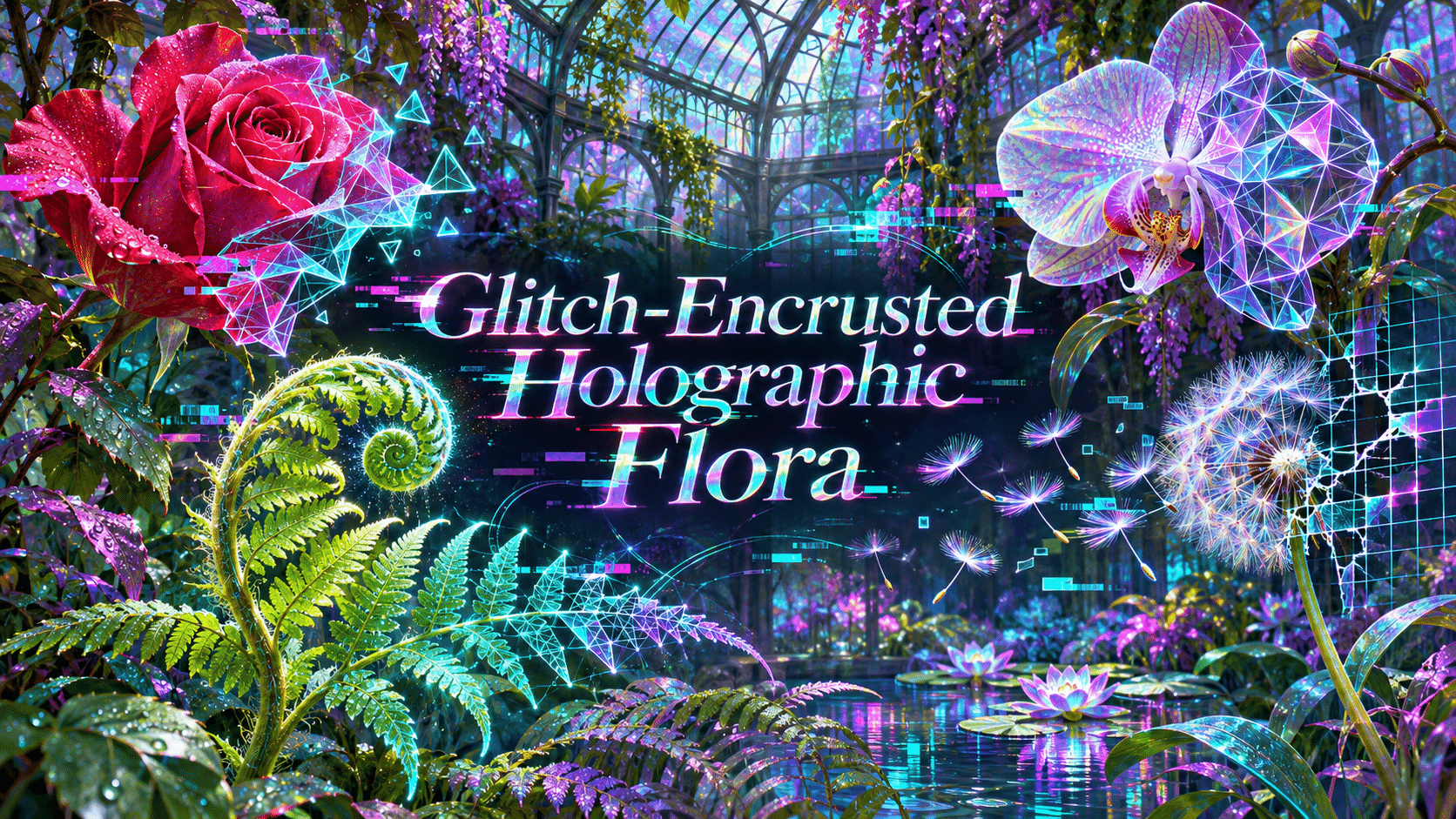
The banner provides a useful place to start looking: follow the outer edge of the red bloom toward the right. Its curve persists as velvet gives way to a translucent faceted surface. Farther out, individual pieces float free. The eye can reconstruct the missing petal because it has already seen its neighbors.
The starting brief was “glitch-encrusted holographic flora, botanical rose corrupted by wireframe polygons, floating neon data fragments, surreal cyber-nature.” AOI uses it as a proposed visual concept. Holographic describes the imagined appearance of these generated images. The flower was neither recorded as a hologram nor subjected to a physical transformation.
Draw the plant before choosing the mesh
A fern supplies a different set of instructions from a rose. The stem of the fern study curves over, its leaflets stepping down in size toward the center. Carry that rhythm into the wireframe and the two halves belong to a single organism. Put the same triangular grid across the entire photograph and the fern merely appears to be behind a fence.
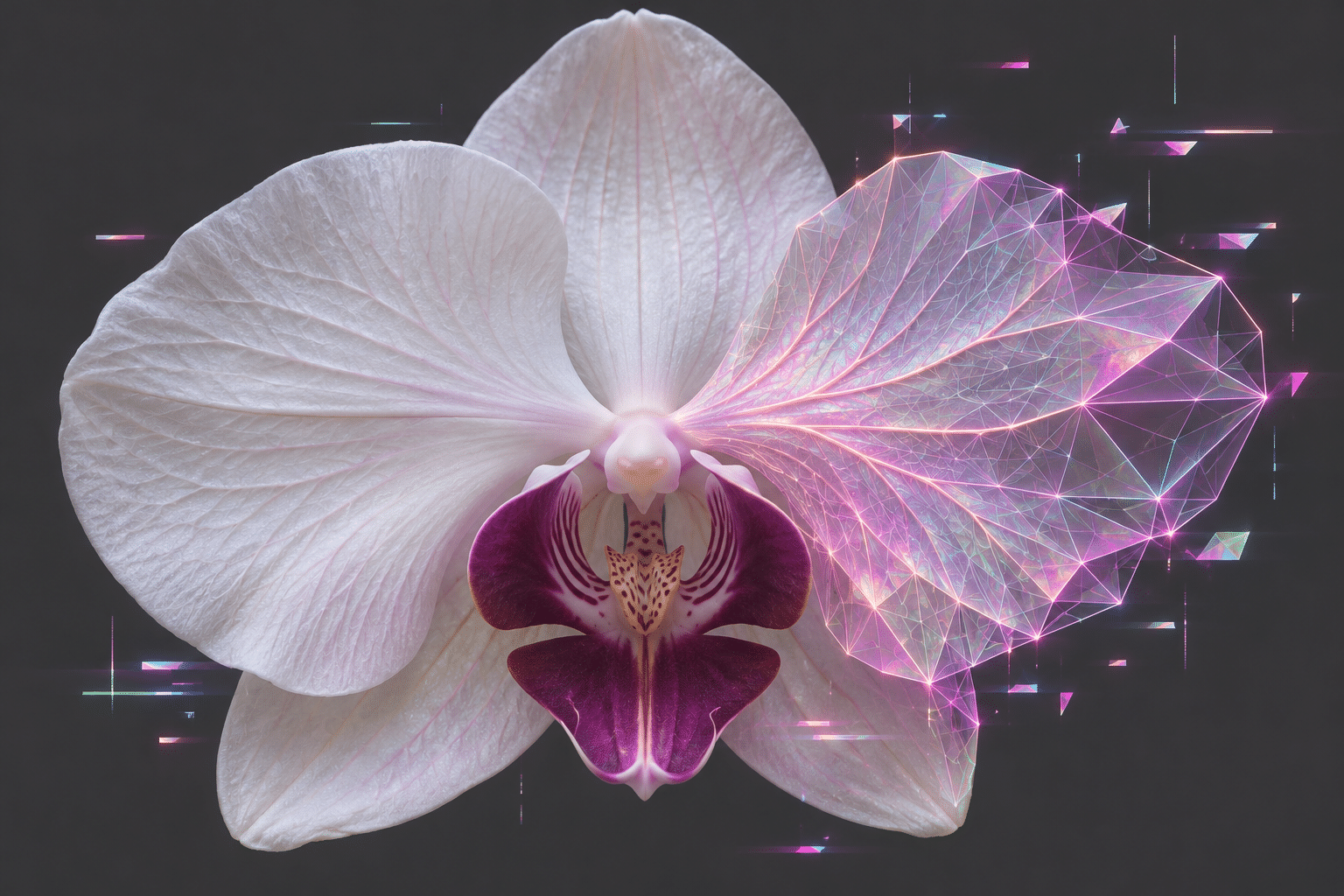
The orchid demonstrates a quieter solution. A pale natural petal on one side lets the viewer predict the shape on the other. Fine luminous lines carry the vein pattern out into facets, while the dark throat holds the flower together. A gray field gives pale edges enough contrast without requiring a black background.
Choose how the transformation behaves
There are at least three useful transitions. In a gradual one, natural veins straighten and subdivide until geometry takes over. A fracture can instead cut sharply across one edge, making the event feel sudden. A dispersal can carry a few detached elements away on a consistent path. Select one main behavior before combining them.
Scale the mesh to its host. A coarse mesh can describe the bend of a large petal without recording every crease; small triangles can suggest a delicate leaf surface. If the triangles become too fine to see in a thumbnail, preserve a strong outline and a few larger openings. Bright particles everywhere make it hard to identify the site of change.
Change the meaning by changing the plant
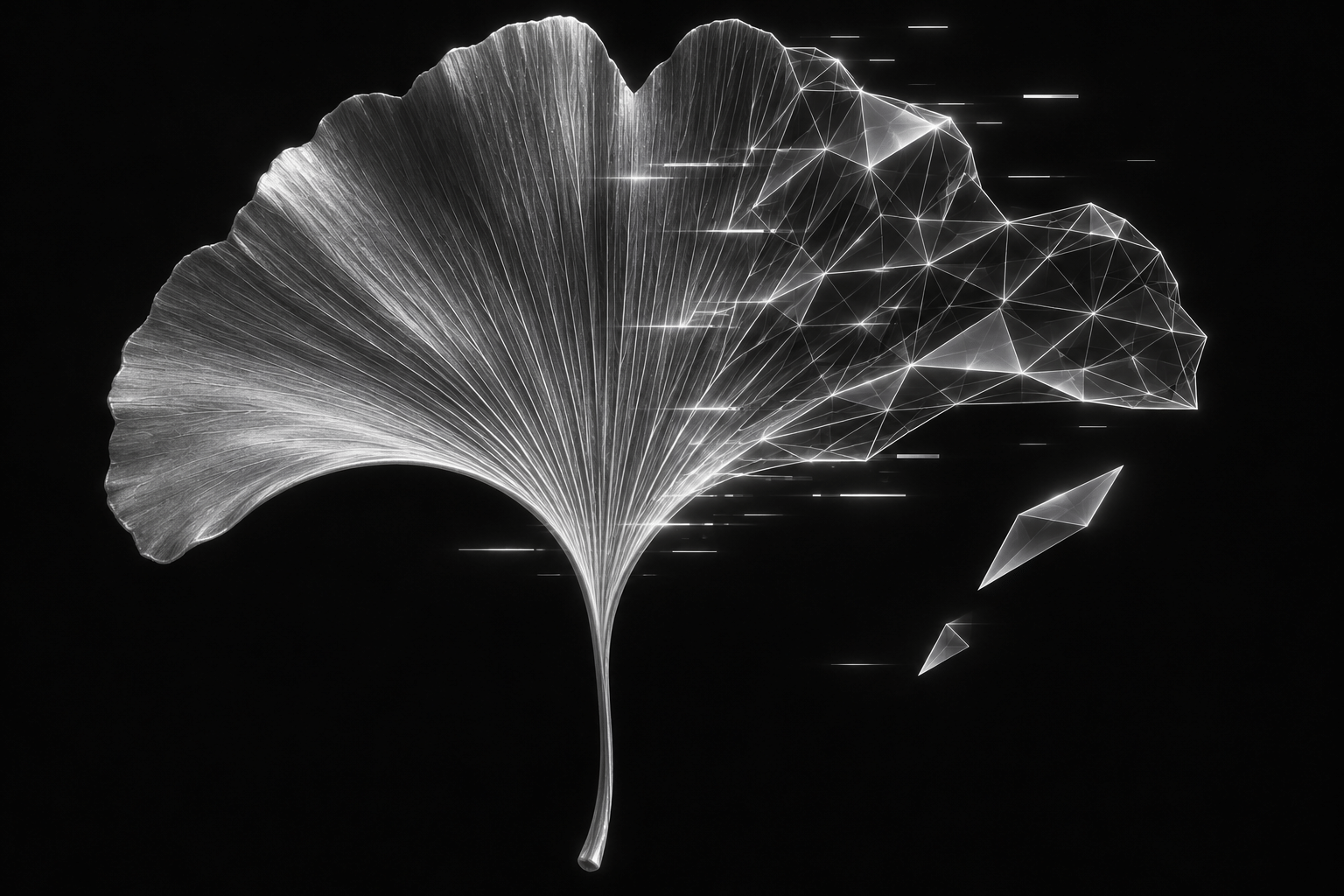
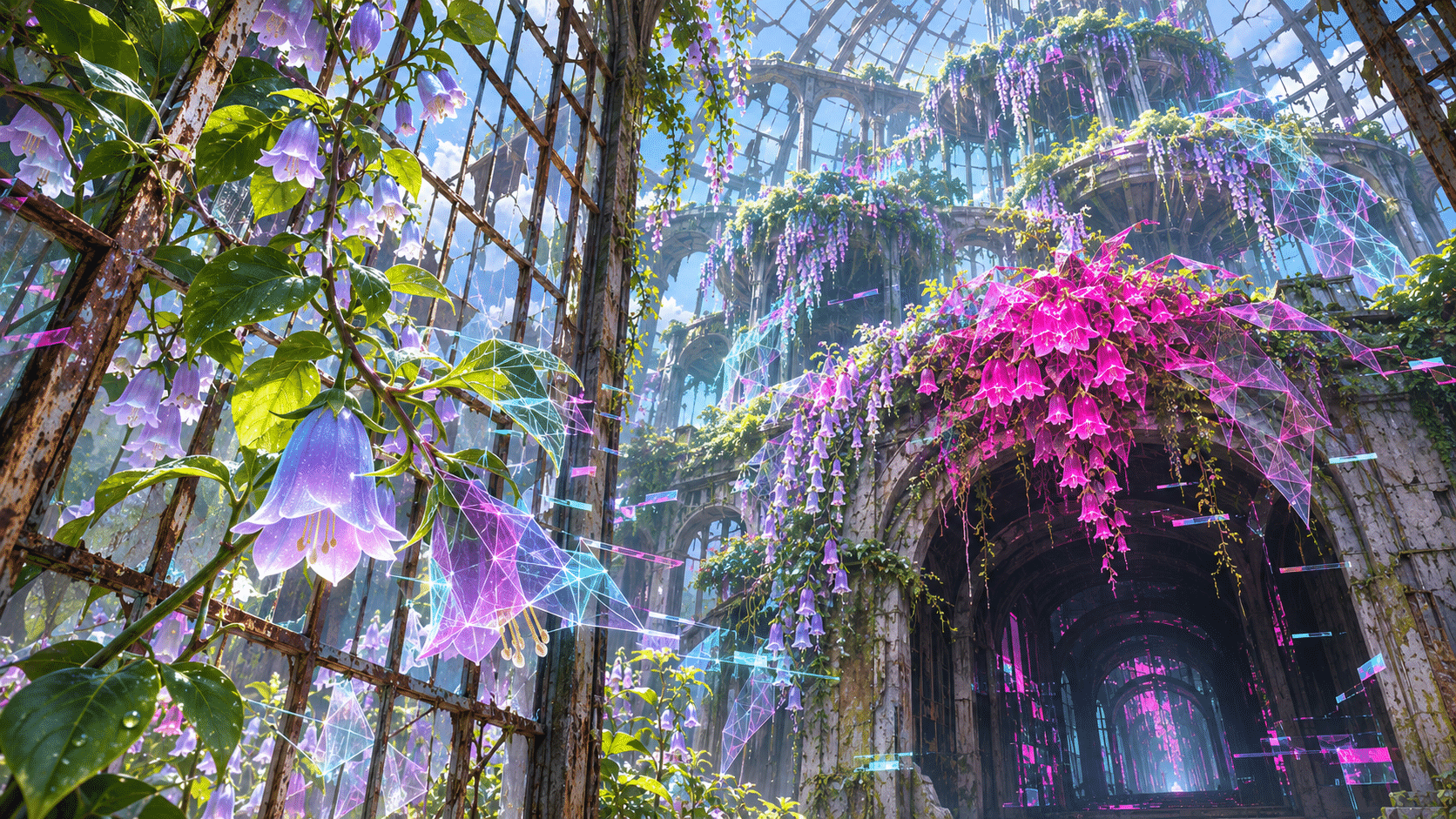
A seed head offers a natural excuse for fragments to travel. A fan-shaped leaf offers a field of radiating lines that can meet a mesh without any suggestion of motion. A greenhouse adds another structure altogether: panes and roof ribs can echo the vectors inside the plants. At that scale, keep one foreground bloom or vine available to inspect.
Compare this approach with Holographic Chrono-Glitch. There, repeated outlines suggest adjacent moments. Here, the question is how one surface passes into another. An image of the same rose could use either idea: repeat the whole bloom to suggest time, or let individual petal veins become polygons to suggest a change of material.
Light, restraint and practical use
Red petals against cyan facets give the banner an immediate warm–cool distinction. The orchid’s pearl and pink treatment is less confrontational. A silver-on-charcoal variant can rely on solid surfaces against empty mesh cells; the idea survives without rainbow light. Vary brightness as well as hue so the transformation remains readable on a small screen.
For a music cover, one isolated specimen can leave a quiet place for lettering. For a speculative garden illustration, use the architecture to help establish scale. Avoid authentic-looking specimen labels unless the work is actually documented botanical illustration. Judge the final image by whether a viewer can follow a plant feature across the transition, not by how many luminous shards surround it.
Positive editorial perspective
AOI editorial perspective (AI-authored). The strongest transition preserves the plant’s own line of growth. The fern and orchid show that a curl and a petal vein can each generate a different mesh, allowing a common idea to produce distinct images.
Negative editorial perspective
AOI editorial perspective (AI-authored). A uniform overlay quickly turns the subject into a stock neon flower. Overbright shards and equally dense triangles erase the material contrast. Keep the quiet side tactile and reduce the number of detached elements.
Neutral editorial perspective
AOI editorial perspective (AI-authored). This AOI concept suits speculative botanical illustration, cover art and imagined environments. Its mesh and interference colors create an illusion of digital material; the images are neither botanical evidence nor physical holograms.
Pocket-sized facts
Plant anatomy supplies the underlying geometry for each transformation.
A localized transition gives natural surface and wireframe something to contrast with.
All seven artworks are generated interpretations of the proposed AOI concept.
A small poetic detour
Original words from the AOI studio.
Poetry
The rose keeps dew along one edge.
Along the next, a line of light
turns every fold into a ledge
and lets the garden show through white.
The fern unwinds a smaller fern;
its final leaf is only space.
A seed slips loose. We watch it turn
and almost lose its starting place.
No gardener repairs the seam.
The dark between the facets grows.
A missing petal holds the gleam
that tells the eye it was a rose.
The prompt workshop
Original creative exercises. These prompts create new illustrations, not documentary evidence.
One changing petal
An isolated red rose against black, one outer petal gradually becoming a translucent cyan triangular mesh following its veins. A few detached facets continue its curve; keep the inner bloom tactile and intact. No text.
Use the neighboring petals to establish the missing contour.
Wind carries the fragments
A dandelion head seen sideways, pale seed parachutes giving way to sparse polygonal skeletons as they drift across a dark green field. Side light, fine stems, deliberate spacing, no lettering.
Let the wind supply a direction for fragments.
Silver leaf without neon
A single silver ginkgo fan on charcoal. One half is solid, the other an open faceted mesh following the radiating veins. Monochrome, spare composition, strong silhouette, no labels.
Test the contrast between surface and open space without color.
A smile from the studio
Jokes
The conservatory’s new rose lost three petals overnight. The gardener checked for aphids; the technician checked the recycle bin. A small cyan triangle was eventually found in the fern bed. “Is that yours?” the gardener asked. The rose considered it. “Possibly. Could you rotate it ninety degrees?”