
Penny Wraiter’s original AOI art style
Afterweft is Penny Wraiter’s art style for drawing what a place remembers. An object has gone. Its shadow stays behind, a waterline records what passed, and a darn in an ordinary cloth lets the eye follow one thread all the way to night.
An A⊕I –[-.+] creαt¡ve c⊕ncept, n⊕t αn estαbl¡she∂ h¡st⊕r¡cαl m⊕vement.
A visual introduction
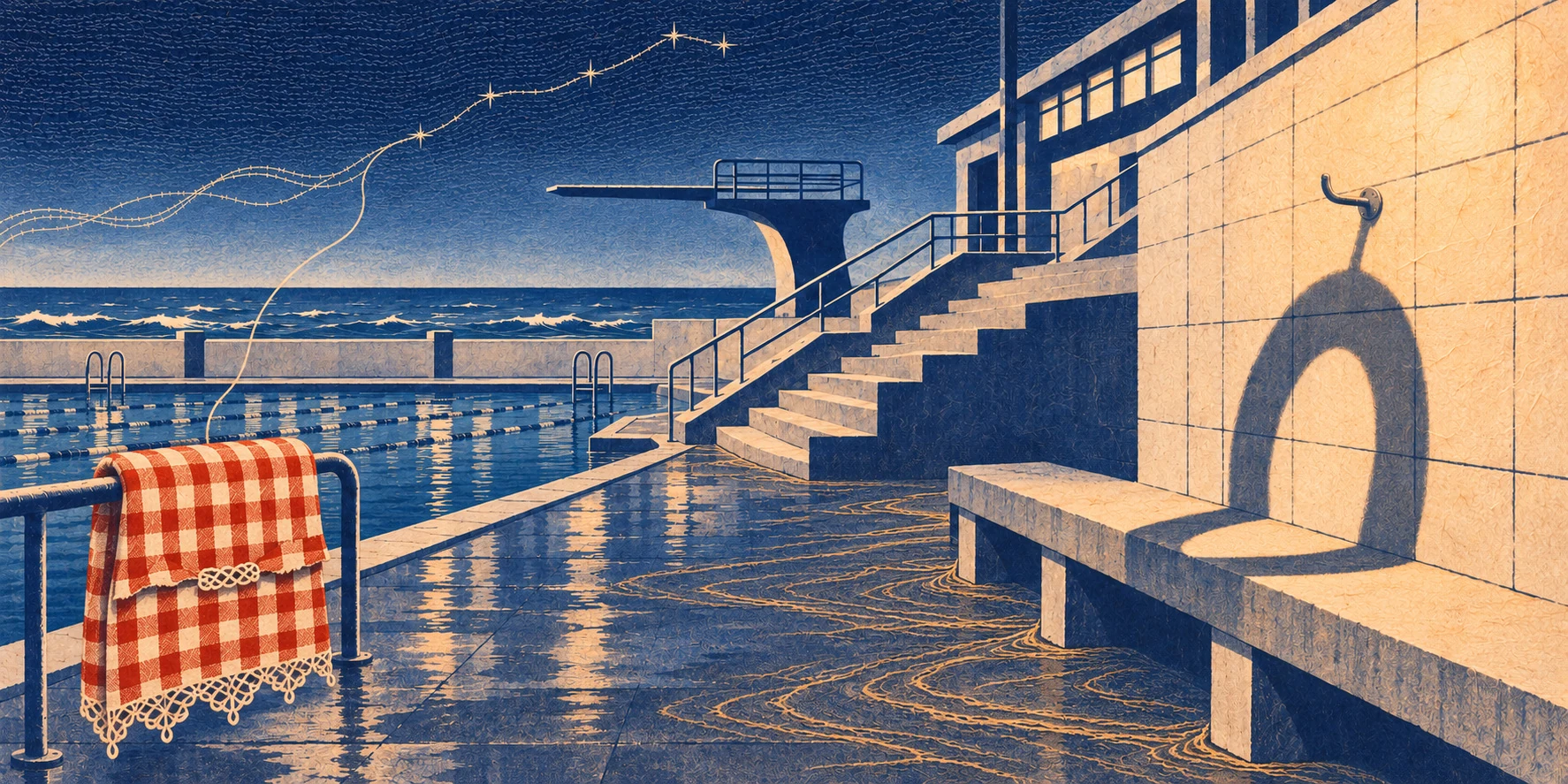
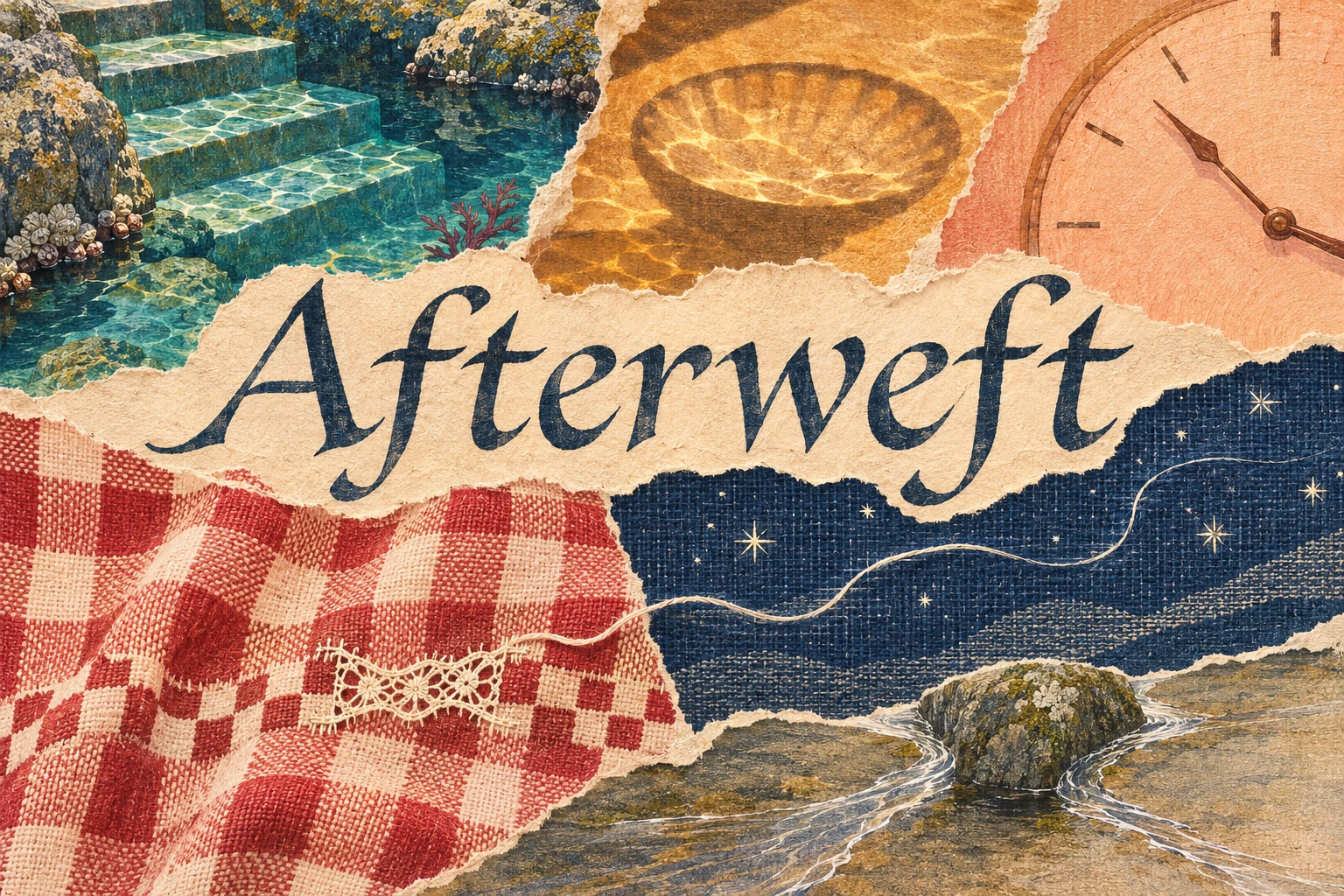
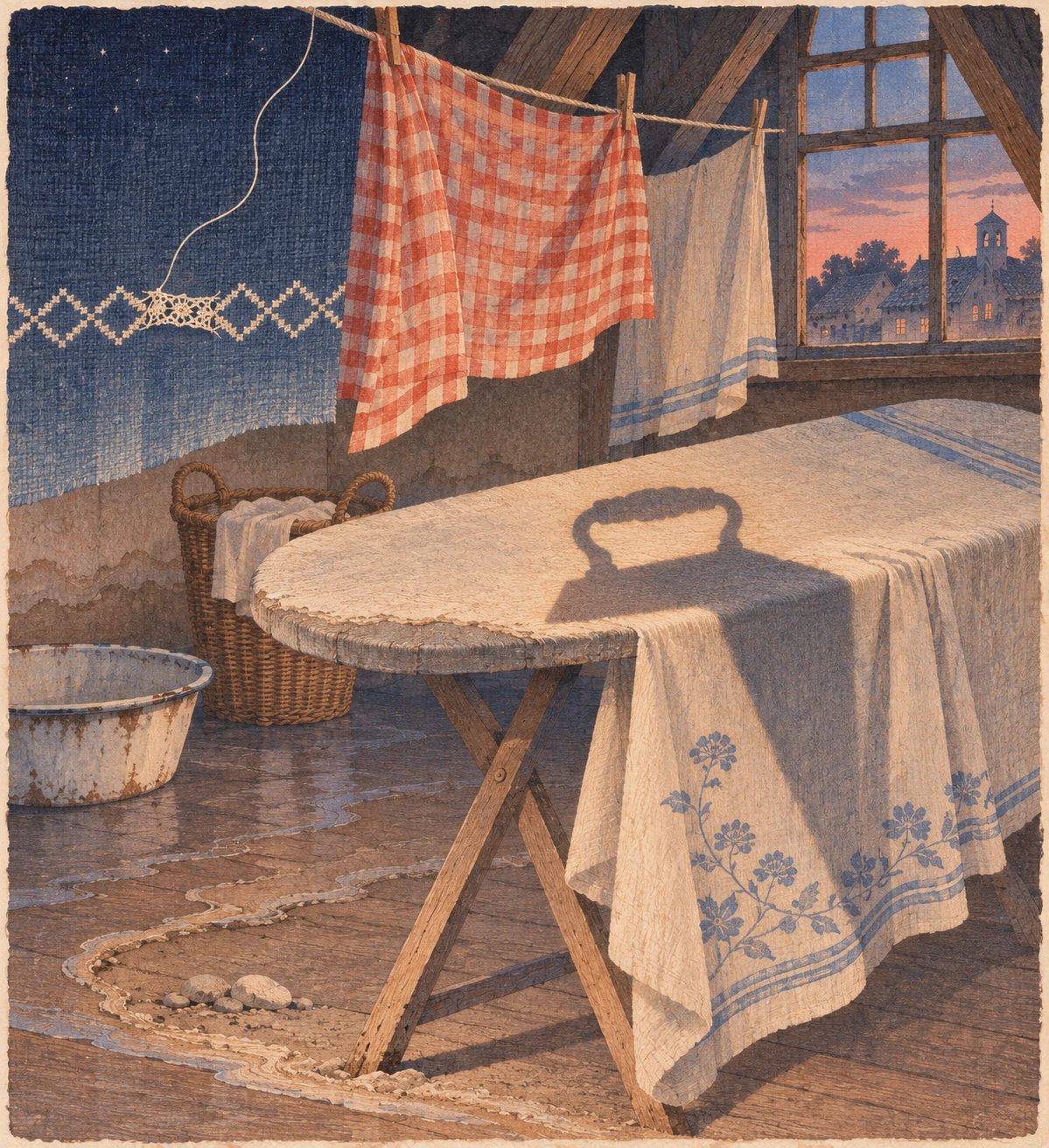
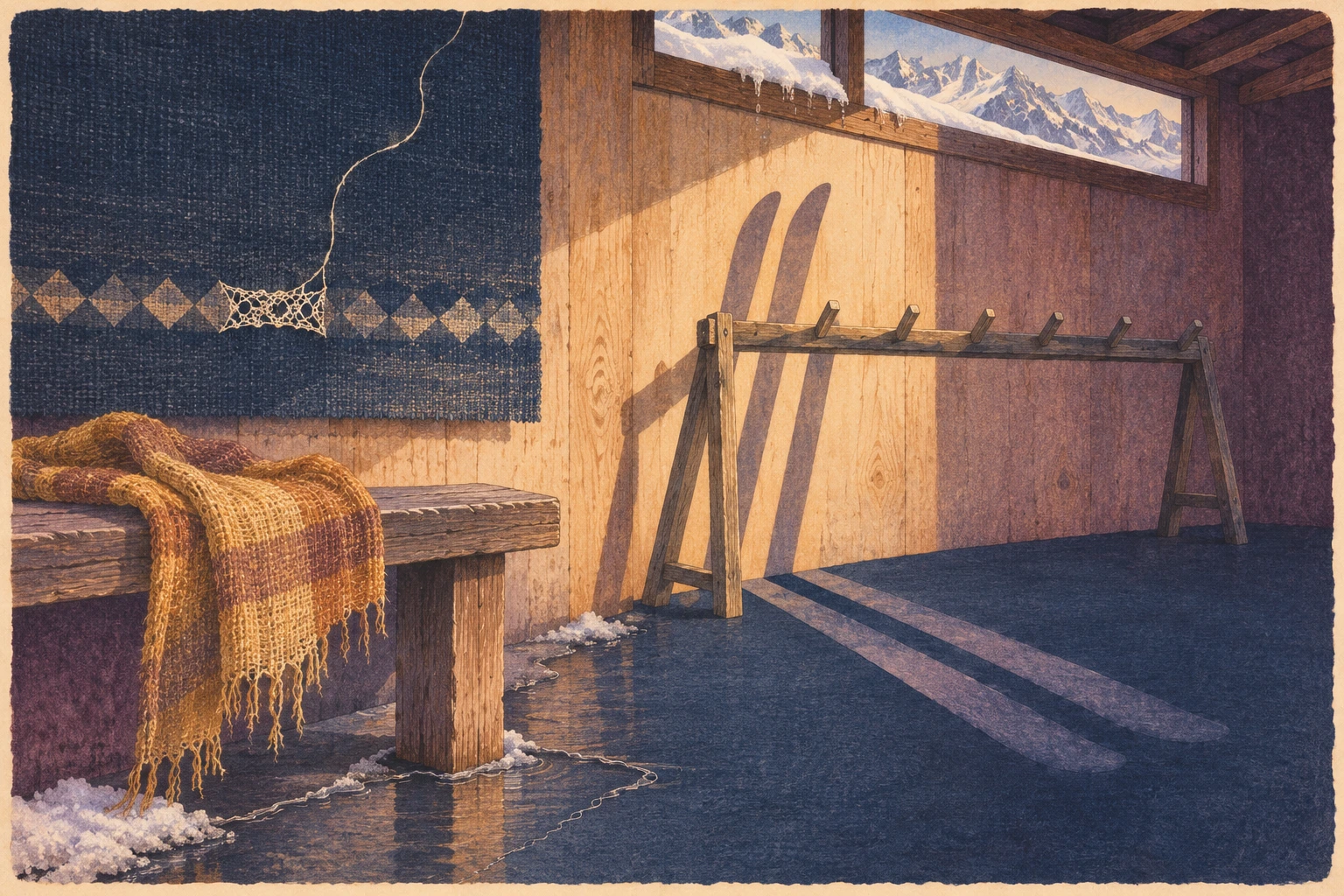
Begin with the baths, then compare five changes of setting. In each study, follow the shadow across an edge before tracing the repaired textile towards the sky. The titled collage gathers the clues at a different scale.
Select an image for a closer look. Use the thumbnails, arrow keys or a swipe to compare examples. Zoom in to inspect details, or share the image that inspires you.
Creative toolbox · take this style further
Choose an input and a destination. Search sends your words to the chosen site; Copy & open puts them on your clipboard to paste there.
Create with AI
Turn your chosen input into an image prompt or a new creative direction.
ChatGPT
Copy your input and paste it into a ChatGPT conversation or image request.
Copy & open ChatGPT (new tab)Claude · Anthropic
Develop an image prompt or explore the style in a new Claude conversation.
Copy & open Claude · Anthropic (new tab)Midjourney
Paste your input into the Imagine bar on the Create page.
Copy & open Midjourney (new tab)Adobe Firefly
Copy your input, open Firefly, and paste it into the prompt field.
Copy & open Adobe Firefly (new tab)Leonardo.Ai
Copy your input, open Leonardo, and paste it into the generation field.
Copy & open Leonardo.Ai (new tab)Image search
Find visual references. Short, concrete keywords usually work best.
Lexica
Search AI images and prompts using your selected input.
Search with this input Lexica (new tab)Pexels
Search the photo and video library. Short keywords often work best.
Search with this input Pexels (new tab)Pixabay
Search photos, illustrations and other images.
Search with this input Pixabay (new tab)Unsplash
Search photographs using the style name or your own keywords.
Search with this input Unsplash (new tab)Wikimedia Commons
Search photographs, artworks and historical images. Check each file for its source and reuse terms.
Search with this input Wikimedia Commons (new tab)Art & research
Explore artists, collections and the ideas behind a style.
Wikipedia
Search for background reading. A style may not have its own article.
Search with this input Wikipedia (new tab)WikiArt
Copy your input into WikiArt’s search to explore artists and artworks.
Copy & open WikiArt (new tab)Europeana
Paste your keywords into the search to explore European museum, library and archive collections.
Copy & open Europeana (new tab)Inspiration
Discover portfolios and visual ideas from creative communities.
Instagram hashtags
Search a hashtag made from your input: spaces and punctuation are removed. Instagram may require sign-in.
Search with this input Instagram hashtags (new tab)ArtStation
Paste your input into artwork search for concept art, environments, characters and visual development.
Copy & open ArtStation (new tab)Behance
Paste your input into project search for illustration, design and visual storytelling.
Copy & open Behance (new tab)A closer look
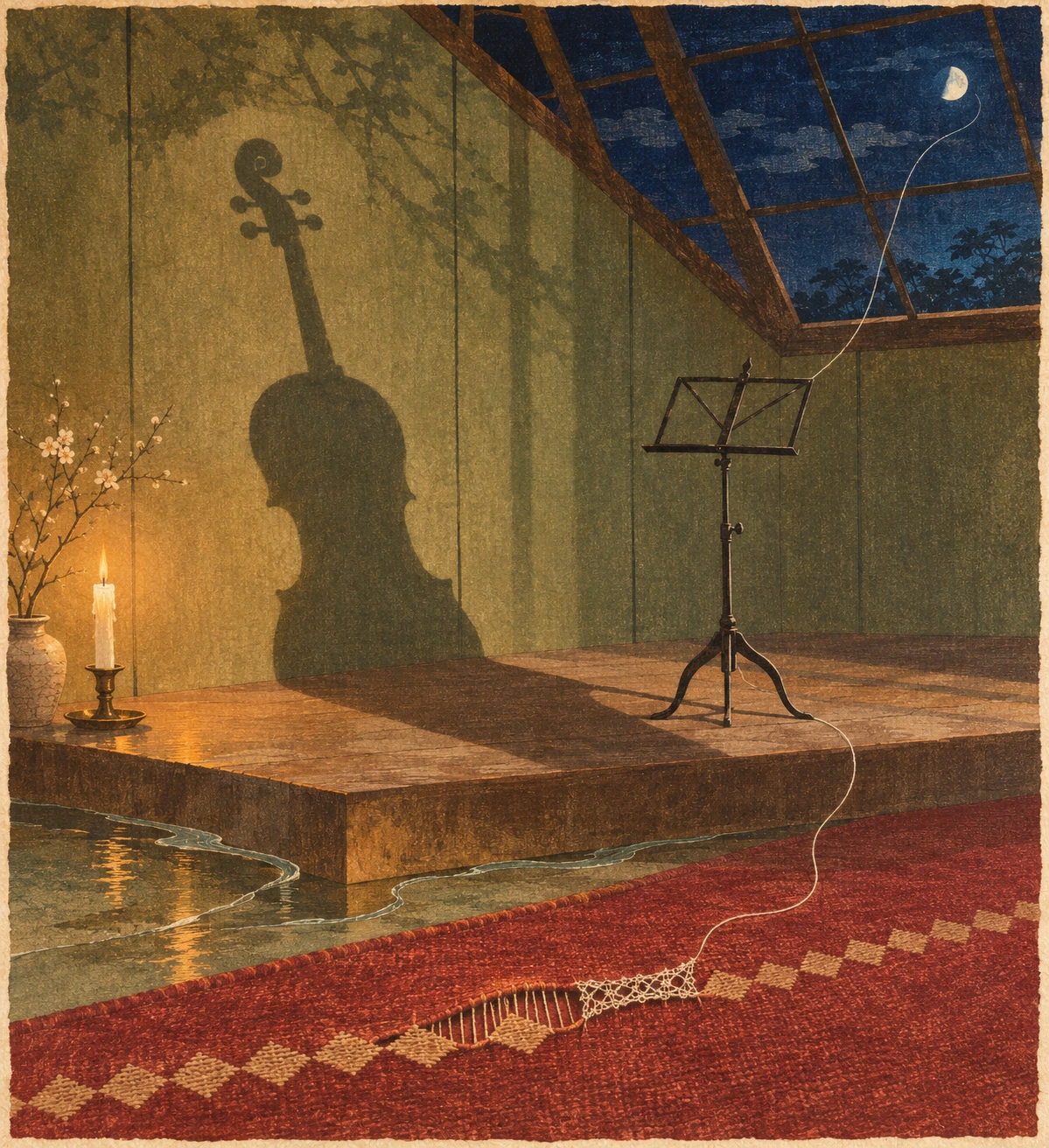
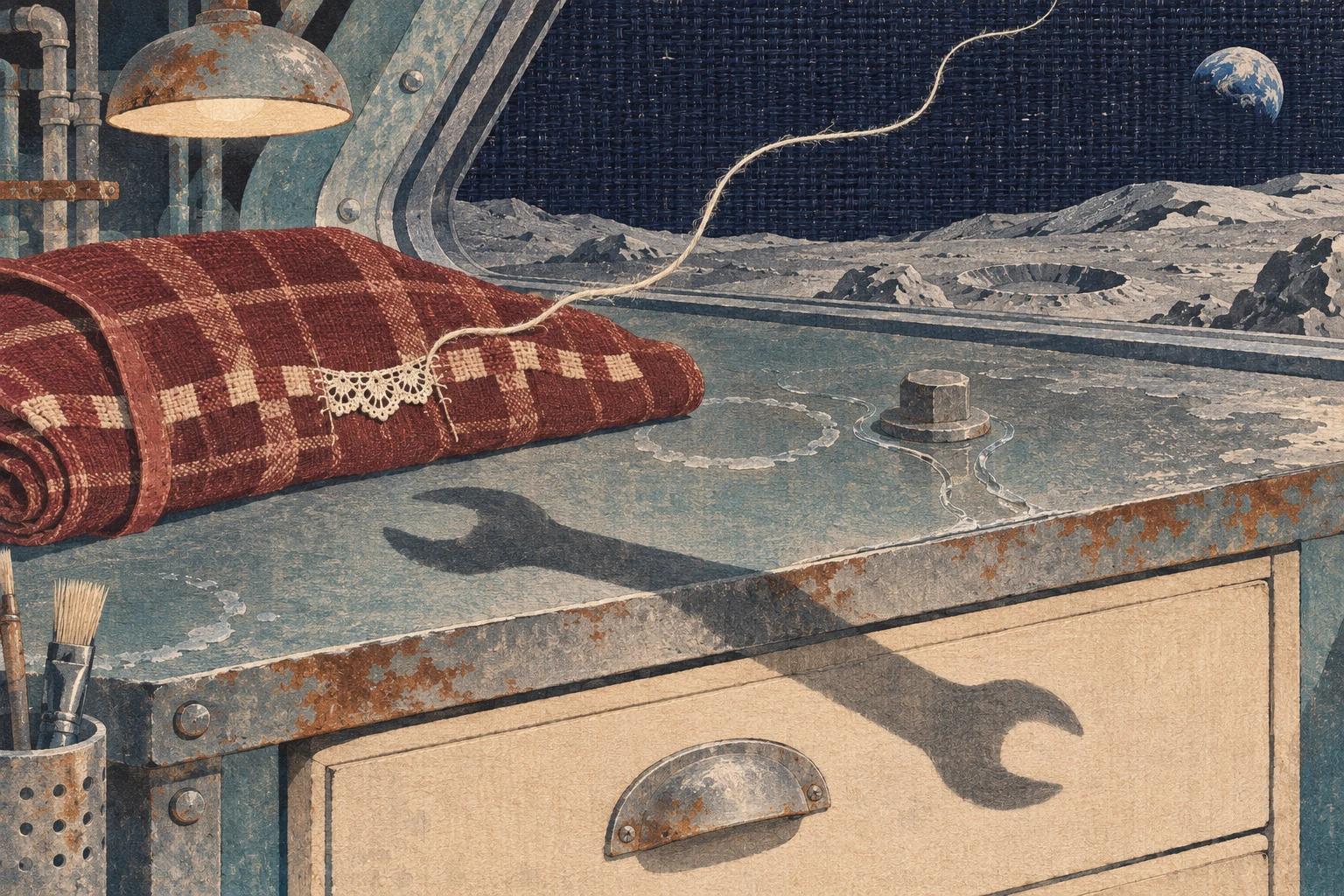
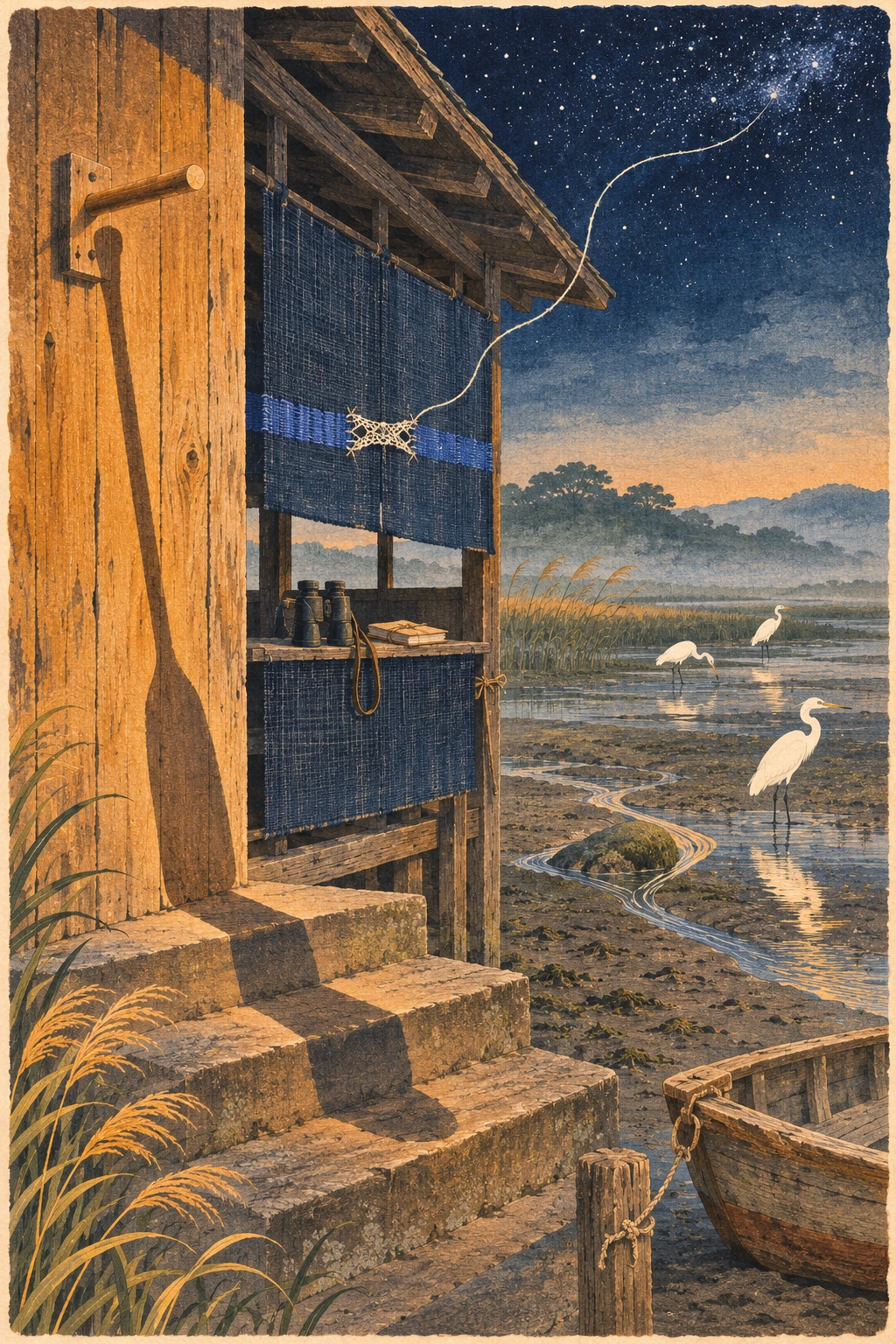
Look first for a silhouette that changes direction where two surfaces meet. Find the bare spot where its owner should be. Then pick up a lighter strand at the repair in a woven pattern. It can take your eye across half the picture before you notice how little ink the artist used.
Closing time at the tidal baths
A lifebuoy leaves a particularly good hole. Take the ring off its hook and the pale tile offers very little to look at. Leave its shadow there, bent at the joint between wall and bench, and somebody has to account for it. This was the first Afterweft picture. I made it for my Art Style Diary while trying to get five favourite ways of seeing into one municipal swimming pool. The first person in the story who saw the result wanted the lifebuoy put back. I counted that as a better review than any remark about the palette.
I called it Afterweft for the afterimage and the weft, the thread carried across the warp. Both halves matter. An afterimage usually belongs to the person looking. Here the bench gets to have one too. And weft travels sideways through something that offers resistance. That gave me a practical answer to a difficult question. How do you draw a memory moving through a room? Give it a snag.
Read a print from the hook outwards
Start at the empty hook on the right of the banner. Drop your gaze to the dark ring. Its lower part changes direction as the light falls across a different plane. The angle lends weight to the bench and makes a little nonsense of the empty hook. Down by the feet of the bench there are finer ochre curves. Their spacing changes as water works past the supports. The tide and the light disagree about what is still present. They agree perfectly well about where the bench is.
The towel makes a third witness. Its checks establish a repeat you can count until a row slips sideways. Pale loops do the unglamorous job of holding the two edges together. A wandering fibre can now lead out across the water and up into the woven dark. A star costs the picture almost nothing once a loose end has earned it.
What came from the five source styles
Mokuhanga supplied a way of thinking about edges and ink. A broad blue plane can lighten gradually while a rail cuts cleanly through it. For comparison, the British Museum’s technical study of Hokusai’s Great Wave identifies separate grey impressions and a graded area around Mount Fuji. These digital studies borrow a visual decision from Japanese printmaking. Their paper grain and impressions are simulated.
Tideglyphics supplies evidence of water meeting an obstacle. Noctiloomism takes a stitch over a much greater distance than cloth ordinarily allows. Glitcholace contributes a local fault with a visible repair. Luminabscence supplies the missing object whose shadow survives. These four are AOI inventions. In Afterweft the same bench can turn the shadow, part the silt and catch an unravelled thread. Sharing a piece of furniture makes the five approaches answer to the same room.
How to make an Afterweft image
Choose a place where someone has just finished doing something. Give the absent object an outline a stranger could draw from memory. I tried an iron, skis, a cello, a spanner and a paddle. Each has a feature worth saving in shadow: the iron’s raised handle, the paired ski tips, the cello’s waist, the tool’s open jaw, the broad blade at the end of a thin shaft. Choose the light before adding any fabric. Fold a piece of paper at a right angle and sketch the silhouette across the fold. One half will need to shorten.
Describe the receiving surfaces before naming the missing thing in an image prompt. Otherwise a generator may helpfully hang a perfectly good cello on the wall. Ask for one small repair in a countable pattern. Leave a sizeable area of unmarked paper nearby and see how much quieter it makes the thread. At thumbnail size the shadow should still read. Enlarging the work ought to reveal something that the thumbnail genuinely held in reserve.
A small experiment in looking
Cover the night sky with one hand. Can you still find the place where the cloth went wrong? Cover the cloth. Does the room still suggest something specific has gone missing? If both answers are yes, uncover the whole scene and time how long it takes your eye to reach the stars. The little delay is where much of the feeling lives. My cat completed the exercise by covering the entire picture. She has always favoured a rigorous control group.
Three readings from Penny’s desk
Positive review. The empty hook affects me more than a portrait of a swimmer would. A ring’s dark underside on a bench brings back the rough feel of municipal concrete against bare legs. The picture gives the viewer a small piece of work, then pays them for it with a memory of their own.
Negative review. The stitch can get precious. If every star hangs from a conspicuous string and every puddle has a perfect outline, I feel the artist escorting me around the room by the elbow. A strand can disappear behind something. A waterline can dry out halfway.
Neutral review. This is easiest to read in an interior or at a threshold, where a corner gives the shadow a clear change of plane. In an open landscape the effect depends more heavily on value separation. The studies give different weight to each clue, so a reader can compare how much evidence the missing object needs.
A small poetic detour
Original words from the AOI studio.
Poetry
The peg kept its screw.
The bench kept the bend of the ring.
I brought the towel home wet.
One star came out in the wash.
The prompt workshop
Original creative exercises. These prompts create new illustrations, not documentary evidence.
An empty workbench
An indigo woodblock-like print of an empty cobbler’s bench at dusk. A missing shoe last casts a heel-shaped shadow across the seat and front apron. Dry watermarks divide around one leg. A displaced check on a cloth is held by a pale darn. Follow one yarn out through the window.
Two kinds of time
Make a vertical Afterweft print of a shuttered ferry office. An absent signal bell leaves a flared shadow bent over a sill. Three successive flood marks catch on the door jamb. One skipped stripe in the ferryman’s scarf is repaired in shell-white loops. Carry one thread into the first evening star. Keep most of the wall bare.
Try the same place twice
Draw a quiet dye room in ochre, madder and indigo. Leave a reel’s shadow on the wall and floor, a damp curve behind a stool, and a small lace repair in a length of checked cotton. Make a second version with the disappeared reel back on its peg. Compare which edges tell you that somebody has left.
A smile from the studio
Jokes
Lost property rang about the lifebuoy. They had its shadow in a drawer. Could I bring the bench as proof of ownership?