
Japanese printmaking technique
A patch of unprinted paper can be rain, a white feather or the brightest part of a river. Mokuhanga, Japanese woodblock printing, gives the paper that much work. This guide follows a design through blocks, moisture, registration and hand pressure.
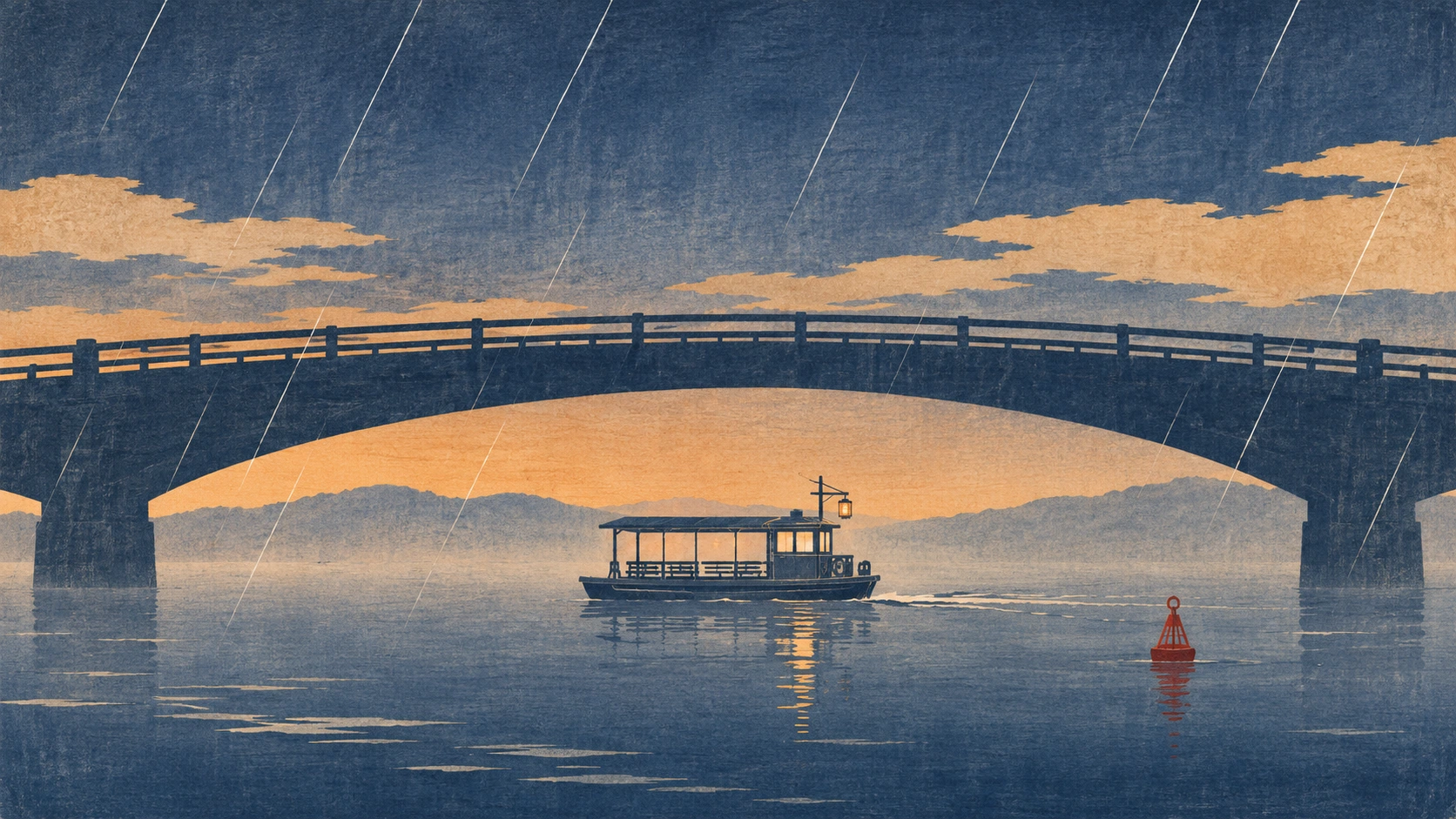
A visual introduction
These are original digital interpretations of print decisions. The annotated museum and workshop sources document historical impressions and physical production.
Select an image for a closer look. Use the thumbnails, arrow keys or a swipe to compare examples. Zoom in to inspect details, or share the image that inspires you.
Creative toolbox · take this style further
Choose an input and a destination. Search sends your words to the chosen site; Copy & open puts them on your clipboard to paste there.
Create with AI
Turn your chosen input into an image prompt or a new creative direction.
ChatGPT
Copy your input and paste it into a ChatGPT conversation or image request.
Copy & open ChatGPT (new tab)Claude · Anthropic
Develop an image prompt or explore the style in a new Claude conversation.
Copy & open Claude · Anthropic (new tab)Midjourney
Paste your input into the Imagine bar on the Create page.
Copy & open Midjourney (new tab)Adobe Firefly
Copy your input, open Firefly, and paste it into the prompt field.
Copy & open Adobe Firefly (new tab)Leonardo.Ai
Copy your input, open Leonardo, and paste it into the generation field.
Copy & open Leonardo.Ai (new tab)Image search
Find visual references. Short, concrete keywords usually work best.
Lexica
Search AI images and prompts using your selected input.
Search with this input Lexica (new tab)Pexels
Search the photo and video library. Short keywords often work best.
Search with this input Pexels (new tab)Pixabay
Search photos, illustrations and other images.
Search with this input Pixabay (new tab)Unsplash
Search photographs using the style name or your own keywords.
Search with this input Unsplash (new tab)Wikimedia Commons
Search photographs, artworks and historical images. Check each file for its source and reuse terms.
Search with this input Wikimedia Commons (new tab)Art & research
Explore artists, collections and the ideas behind a style.
Wikipedia
Search for background reading. A style may not have its own article.
Search with this input Wikipedia (new tab)WikiArt
Copy your input into WikiArt’s search to explore artists and artworks.
Copy & open WikiArt (new tab)Europeana
Paste your keywords into the search to explore European museum, library and archive collections.
Copy & open Europeana (new tab)Inspiration
Discover portfolios and visual ideas from creative communities.
Instagram hashtags
Search a hashtag made from your input: spaces and punctuation are removed. Instagram may require sign-in.
Search with this input Instagram hashtags (new tab)ArtStation
Paste your input into artwork search for concept art, environments, characters and visual development.
Copy & open ArtStation (new tab)Behance
Paste your input into project search for illustration, design and visual storytelling.
Copy & open Behance (new tab)A closer look
A few carved color shapes meet on a pale paper reserve. A brush can carry a pale-to-dark gradation across one block, while a crisp incised gap keeps neighboring forms distinct. The image is constructed in successive impressions.
The journey from block to sheet
The Tokyo Metropolitan Government’s account of Edo woodblock printing traces work shared by designer, carver and printer. The British Museum also describes the publisher who commissioned designs and coordinated their production. The roles help explain how a printer’s decision could change the light in an impression even when the carved image stayed constant.
Mokuhanga names a woodblock practice. Ukiyo-e names a much broader body of images, including works made by other means. Today an individual printmaker may take all the jobs at one bench. This companion follows the material sequence, which can serve a railway platform or a kitchen vegetable as readily as an Edo-period subject.
Registration is part of drawing
In a multicolor design, decide which portions of the damp sheet each carved surface will touch. The printer brushes waterborne pigment onto the relief, often with a little rice paste. Registration guides called kento help the sheet settle in the same position for successive impressions. Rubbing the back with a baren transfers the color. An uncarved printable surface, an overlap and a carved-away gap each leave a different sort of edge.
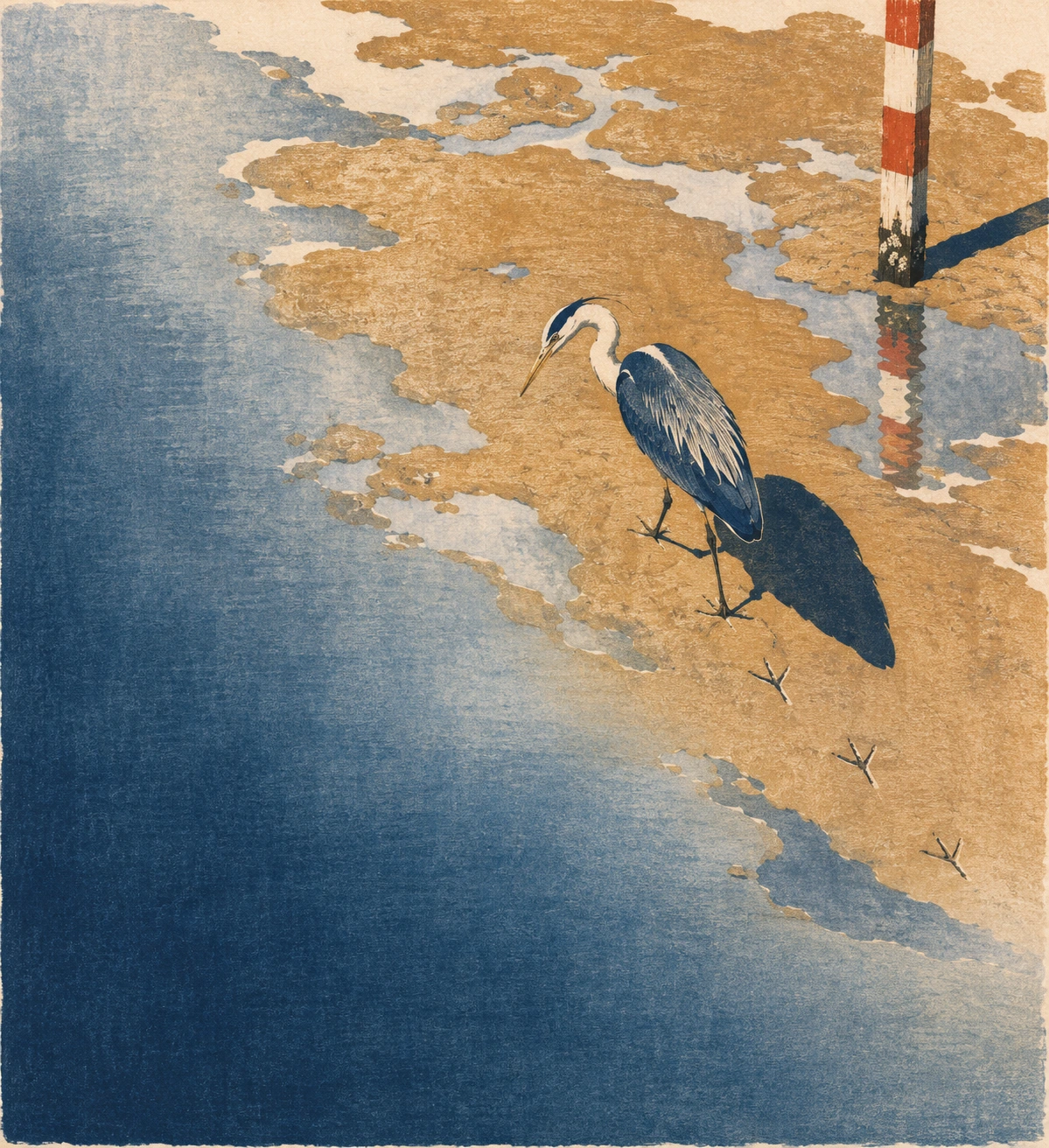
Bokashi is a gradation created by working pigment and moisture across the block. Draw its intended boundary. Across water, a single graded blue can describe distance. Across every object in every direction, the same smoothing begins to read as a screen effect. Conservator Capucine Korenberg’s examination of impressions of Hokusai’s Great Wave shows how much can be learned by comparing actual prints.
Plan a scene as a sequence of decisions
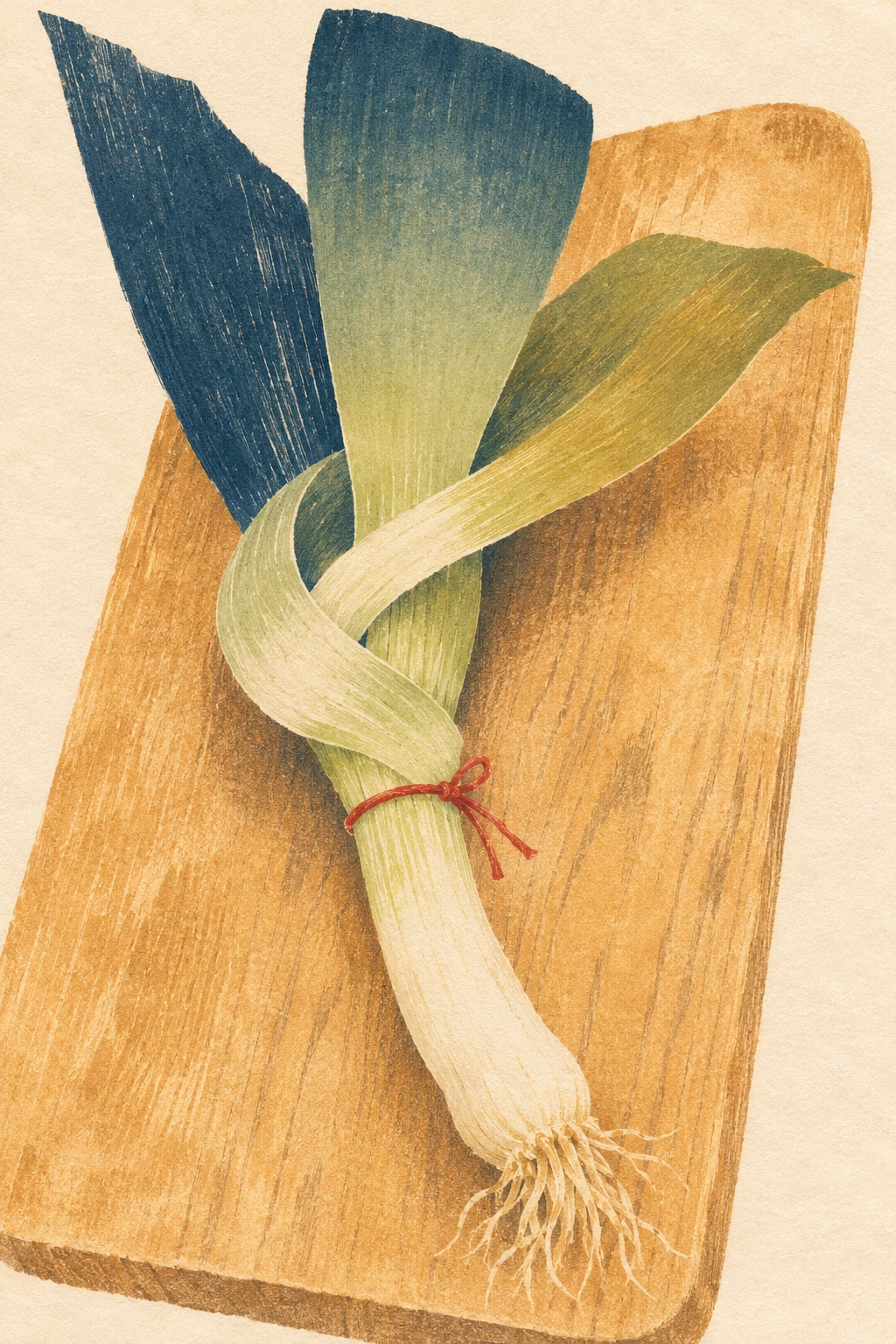
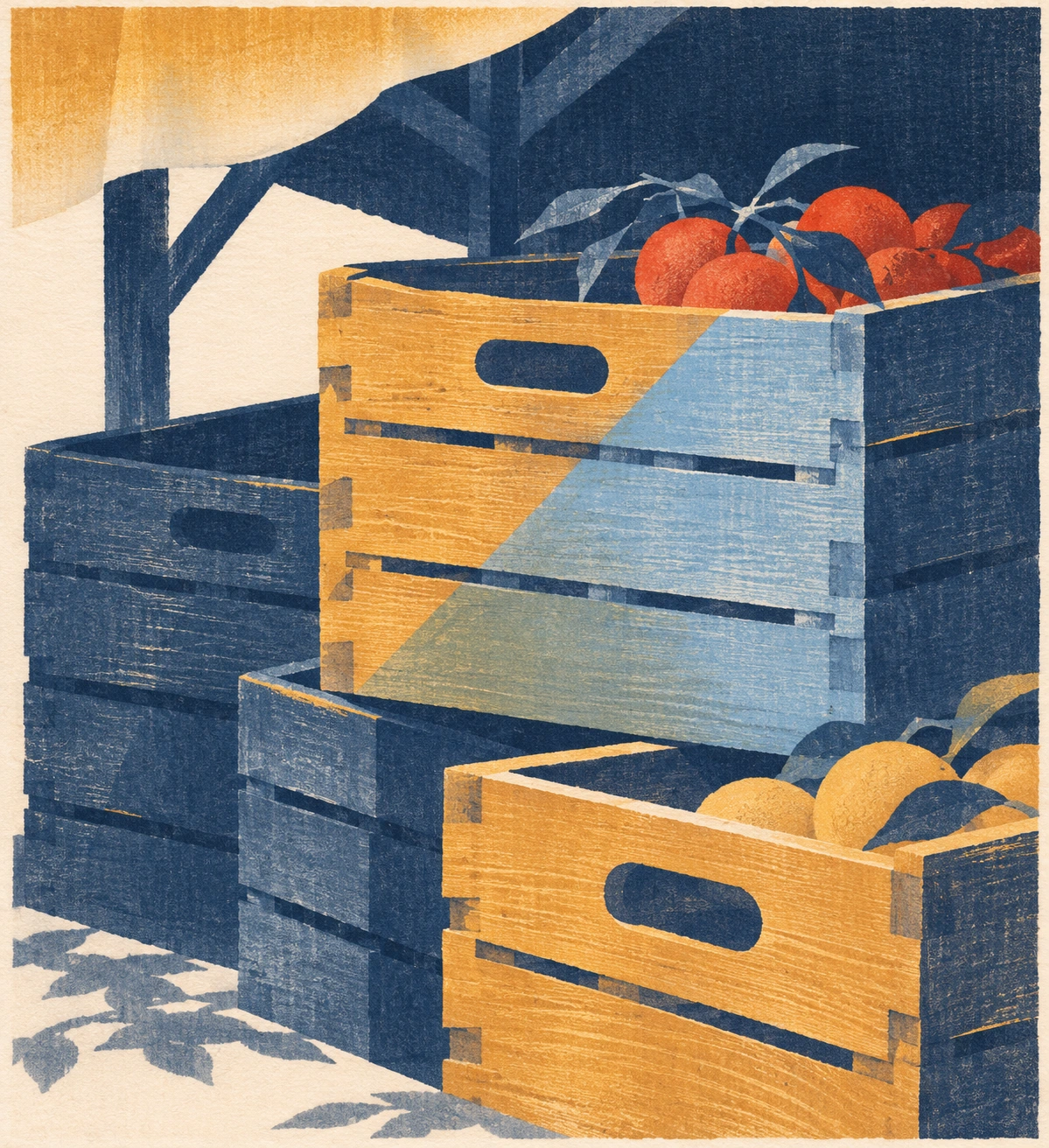
For the market crates, try a pale rectangular impression, a darker surrounding block and a simple band of shade. A third tone can emerge where two transparent layers overlap. In the leek study, a narrow gap of bare paper helps turn a leaf without asking for another color. Work out which cut would keep that gap open.
These digital interpretations offer exercises in looking. For a physical edition, paper moisture, block preparation, brushing and pressure each require trials with the actual materials. A photograph of an impression or a generative imitation cannot tell your hands how much paste this particular block needs.
Three readings from Penny’s desk
Positive review. The economy is exacting in the best sense. A narrow reserve can separate two leaves, turn the light and save an entire block’s worth of explanation.
Negative review. Uniform digital grain is an easy costume. If the image cannot be divided into plausible color impressions, a convincing patch of paper texture will do very little to rescue it.
Neutral review. This guide is useful for planning separations and studying edges. Physical printmaking develops an additional vocabulary of paste, moisture, pressure and repetition that the screen can only suggest.
A small poetic detour
Original words from the AOI studio.
Poetry
The bridge is cut from quiet wood.
The river waits inside a brush.
The paper settles in its corner.
One pale bank comes up for air.
The prompt workshop
Original creative exercises. These prompts create new illustrations, not documentary evidence.
Work with three blocks
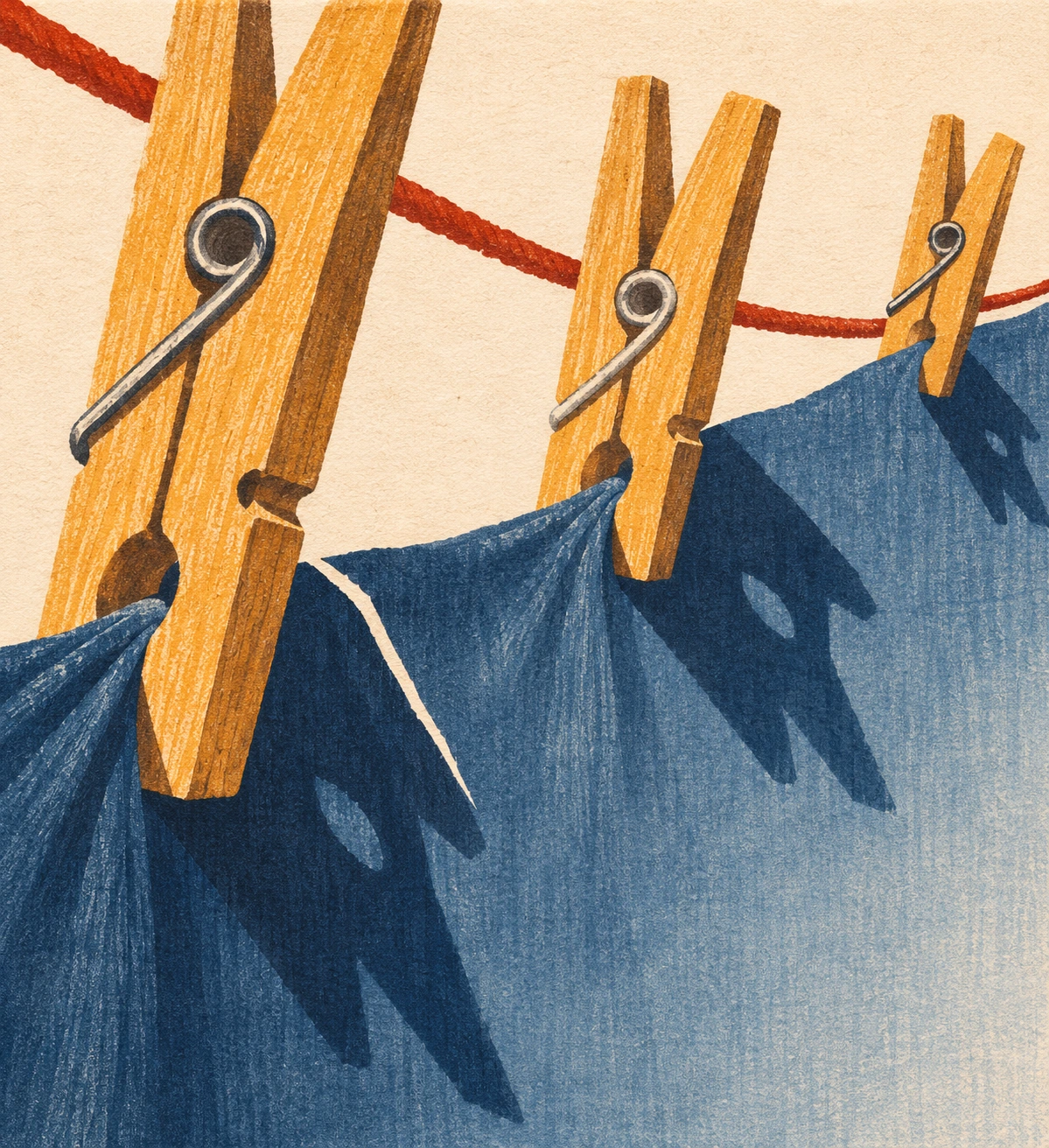
Design three wooden pegs on indigo cloth as a Japanese water-based woodblock interpretation. Use one pale color block, a dark key shape and a limited ochre. Leave a sliver of unprinted paper between touching forms.
Give the tide a gradation
A heron looks down into a tidal channel. Put the bokashi sweep in one blue water block. Hold the bird’s contour with a clear paper reserve and restrict the remaining marks to a few footprints.
Construct the third color
Show market crates in early morning. Let two simple transparent color fields overlap to produce a third. Keep the join legible and use one distinctly carved edge to establish the corner of the nearest crate.
A smile from the studio
Jokes
The printer left a little room for the paper to speak. It took the whole river.