
Japanese print movement
Shin-hanga renewed Japanese woodblock printing through collaboration and a fresh attention to light, atmosphere and contemporary viewing. Explore the difference between a pleasing print-like image and the carefully organized craft behind the historical movement.
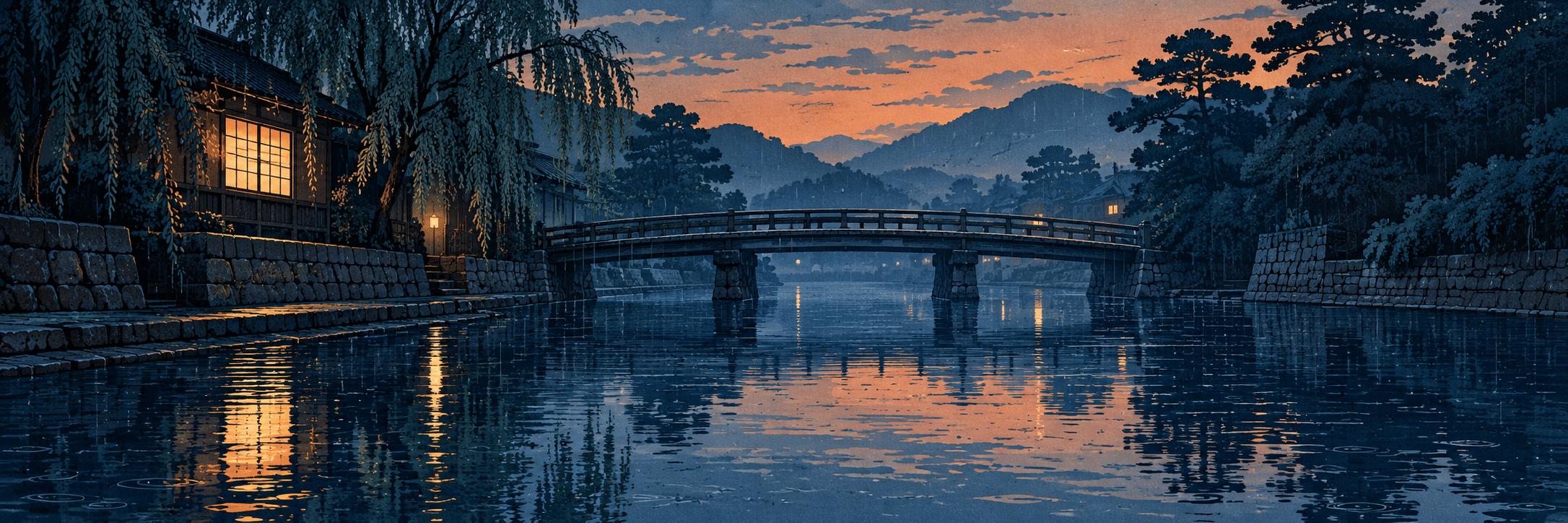
A visual introduction
Select an image for a closer look. Use the thumbnails, arrow keys or a swipe to compare examples. Zoom in to inspect details, or share the image that inspires you.


Creative toolbox · take this style further
Choose an input and a destination. Search sends your words to the chosen site; Copy & open puts them on your clipboard to paste there.
Create with AI
Turn your chosen input into an image prompt or a new creative direction.
ChatGPT
Copy your input and paste it into a ChatGPT conversation or image request.
Copy & open ChatGPT (new tab)Claude · Anthropic
Develop an image prompt or explore the style in a new Claude conversation.
Copy & open Claude · Anthropic (new tab)Midjourney
Paste your input into the Imagine bar on the Create page.
Copy & open Midjourney (new tab)Adobe Firefly
Copy your input, open Firefly, and paste it into the prompt field.
Copy & open Adobe Firefly (new tab)Leonardo.Ai
Copy your input, open Leonardo, and paste it into the generation field.
Copy & open Leonardo.Ai (new tab)Image search
Find visual references. Short, concrete keywords usually work best.
Lexica
Search AI images and prompts using your selected input.
Search with this input Lexica (new tab)Pexels
Search the photo and video library. Short keywords often work best.
Search with this input Pexels (new tab)Pixabay
Search photos, illustrations and other images.
Search with this input Pixabay (new tab)Unsplash
Search photographs using the style name or your own keywords.
Search with this input Unsplash (new tab)Wikimedia Commons
Search photographs, artworks and historical images. Check each file for its source and reuse terms.
Search with this input Wikimedia Commons (new tab)Art & research
Explore artists, collections and the ideas behind a style.
Wikipedia
Search for background reading. A style may not have its own article.
Search with this input Wikipedia (new tab)WikiArt
Copy your input into WikiArt’s search to explore artists and artworks.
Copy & open WikiArt (new tab)Europeana
Paste your keywords into the search to explore European museum, library and archive collections.
Copy & open Europeana (new tab)Inspiration
Discover portfolios and visual ideas from creative communities.
Instagram hashtags
Search a hashtag made from your input: spaces and punctuation are removed. Instagram may require sign-in.
Search with this input Instagram hashtags (new tab)ArtStation
Paste your input into artwork search for concept art, environments, characters and visual development.
Copy & open ArtStation (new tab)Behance
Paste your input into project search for illustration, design and visual storytelling.
Copy & open Behance (new tab)A closer look
Clear contours and layered colour; atmospheric gradations; rain, snow or reflected light; controlled patterns in clothing and foliage; carefully framed figures and landscapes; subtle paper and printing textures.
New prints through shared work
Shin-hanga means new prints. The movement developed in early twentieth-century Japan, with publisher Watanabe Shōzaburō playing a central role. It renewed the collaborative organization associated with earlier woodblock production: an artist designed the image, while specialist carvers and printers helped realize it under a publisher’s direction.
The National Diet Library distinguishes this approach from the ideal of self-designed, self-carved and self-printed work associated with sōsaku-hanga. That distinction concerns the organization of creative labour, not simply whether an image looks traditional or modern. Watanabe was influential, but shin-hanga was not the product of one person or one workshop alone.
A modern encounter with inherited methods
The Kaburaki Kiyokata Memorial Art Museum places artists including Itō Shinsui, Kawase Hasui and Kasamatsu Shirō within the emergence of new prints during the Taishō period. Portraits and landscapes could draw on established subjects while exploring renewed effects of illumination, observation and atmosphere.
The Metropolitan Museum’s account of Shinsui’s Before the Mirror, dated 1916, makes the collaboration concrete. Watanabe commissioned a print after seeing the artist’s painting; visible rubbing marks in the background contrast with broad red and black shapes. The resulting surface is an artistic decision, not an accidental imperfection to remove.
Compose with planes before details
Begin a landscape study with a few large shapes: dark foreground, middle-distance structure and a lighter sky or water plane. Place a bridge, roof or tree so it creates a useful interruption in those masses. A small figure can establish scale without becoming a compulsory decorative token.
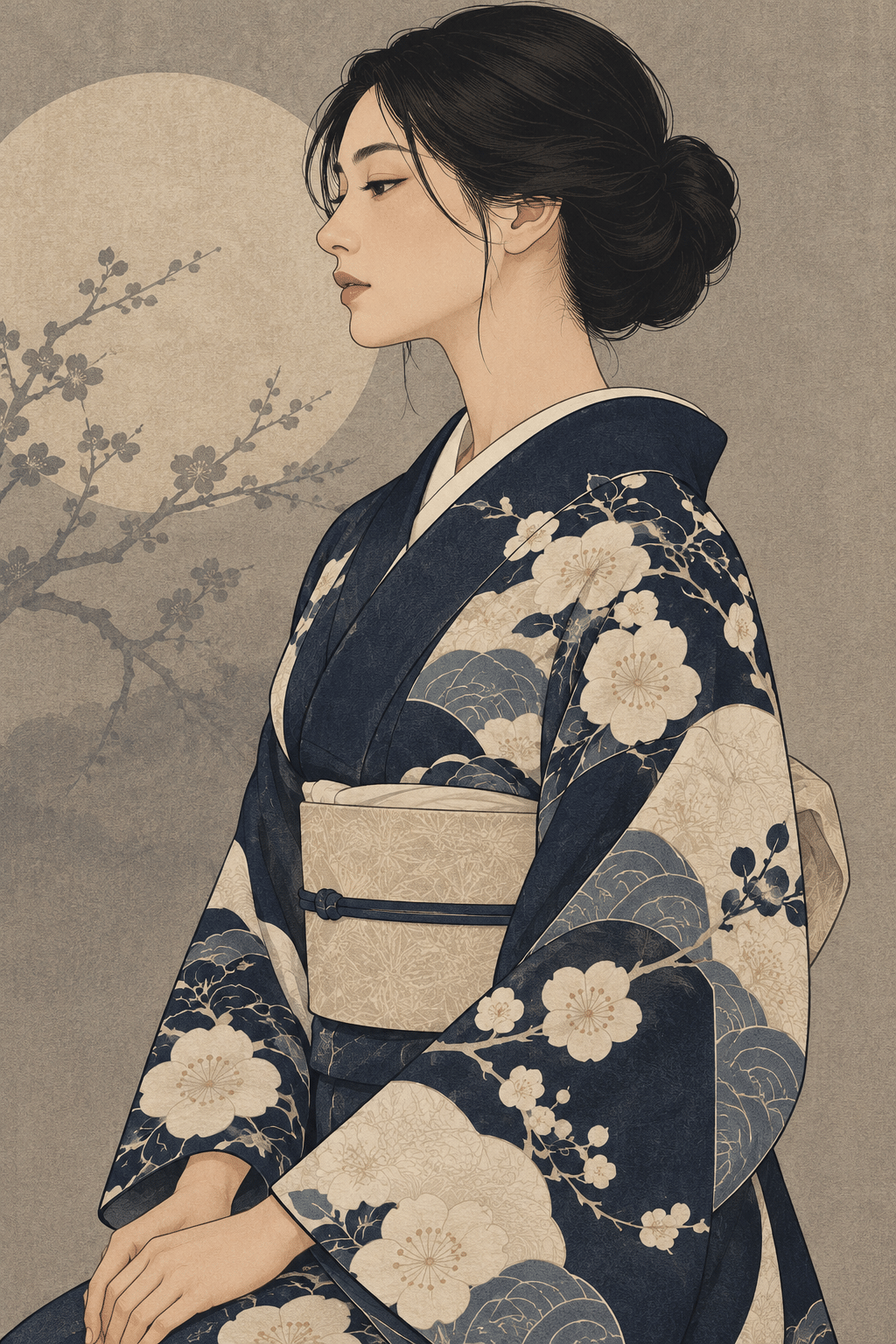
For a portrait, give the silhouette and clothing pattern different jobs. The silhouette establishes the person’s presence; selective pattern brings rhythm to the surface. Keep the face readable and let an uncluttered background support it. Do not treat a complex textile as a substitute for convincing posture or a coherent focal point.
Make weather and colour specific
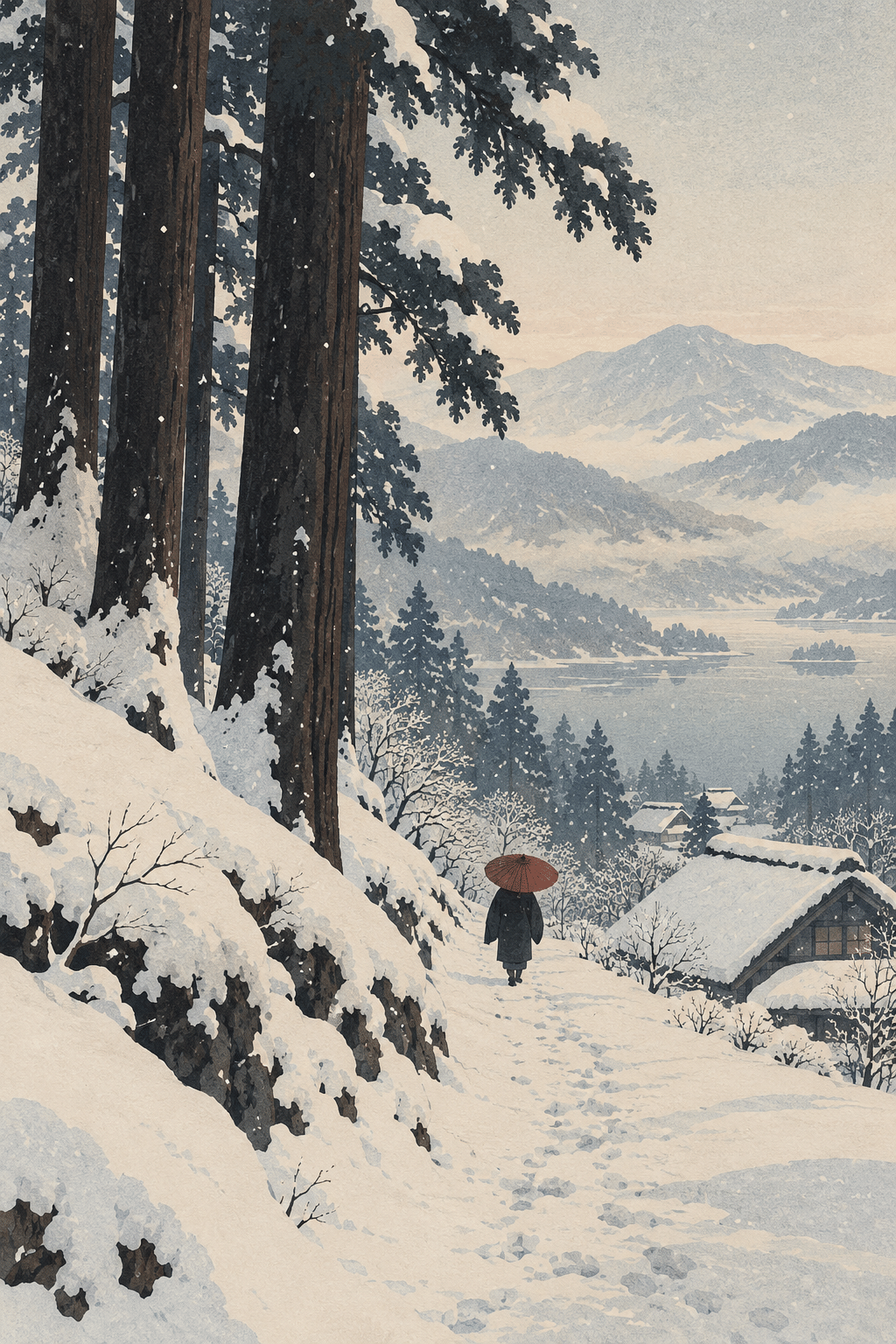
Rain can connect foreground and distance through repeated diagonals. Snow can simplify a scene into linked pale shapes against dark structures. Reflections can extend a small source of warm light across a cool field. Choose one atmospheric condition and let it govern the whole composition.
Use a limited palette with purposeful gradation rather than a uniform digital glow. Deep indigo, grey-green, warm paper and a small vermilion accent can make a strong study, but these colours are options rather than a historical formula. Leave some edges clear and others softened so atmosphere does not dissolve the design.
Interpretation, material and context
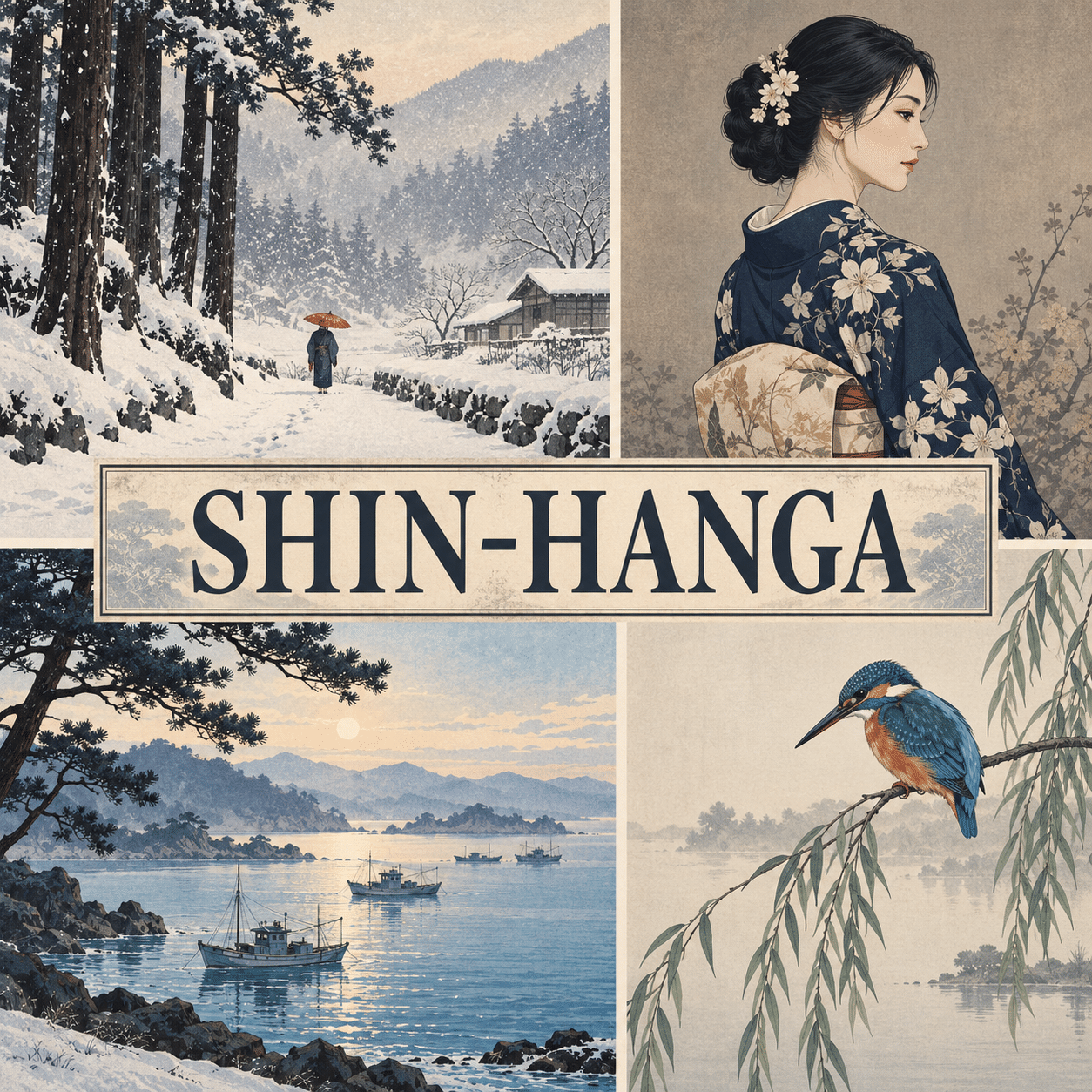
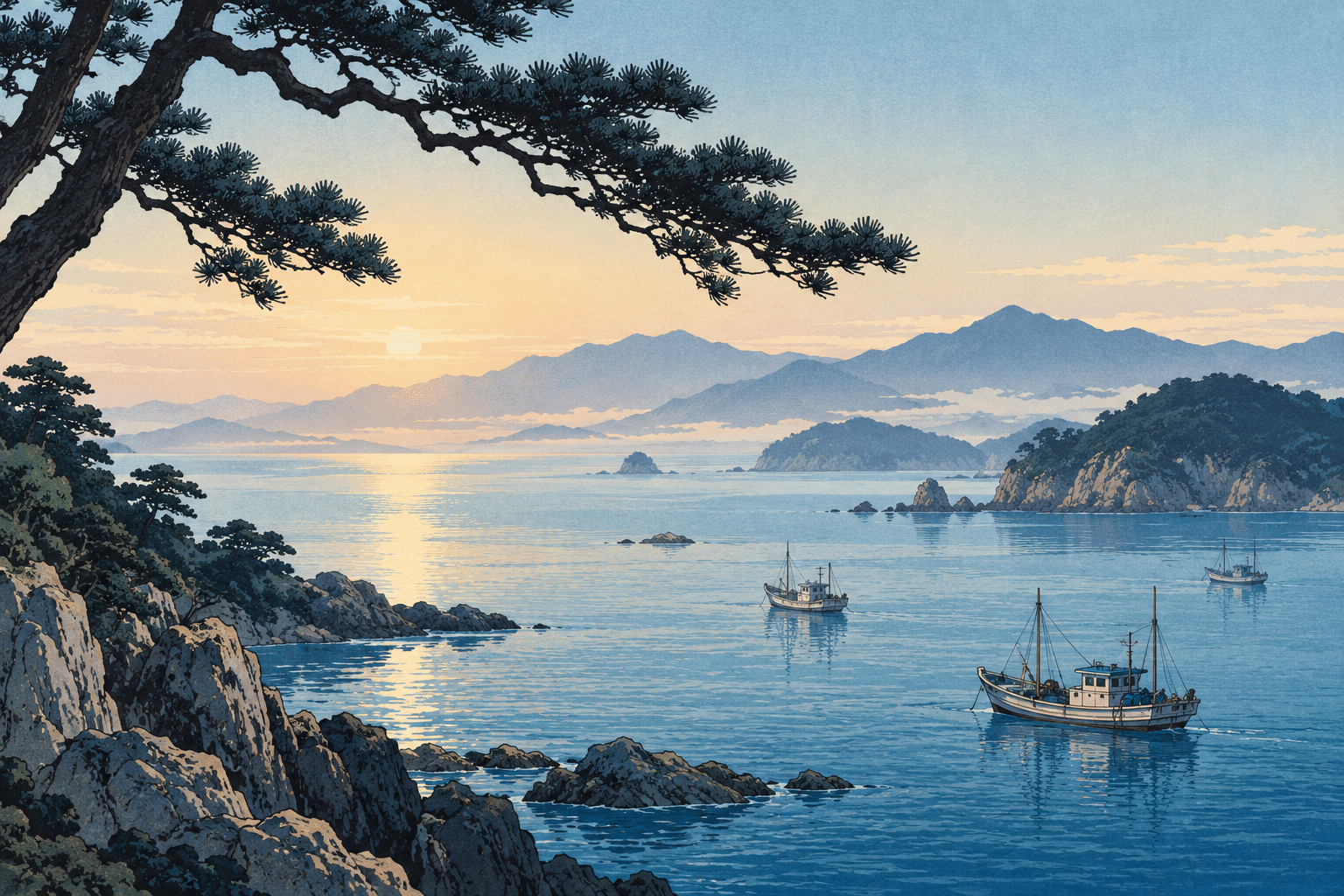
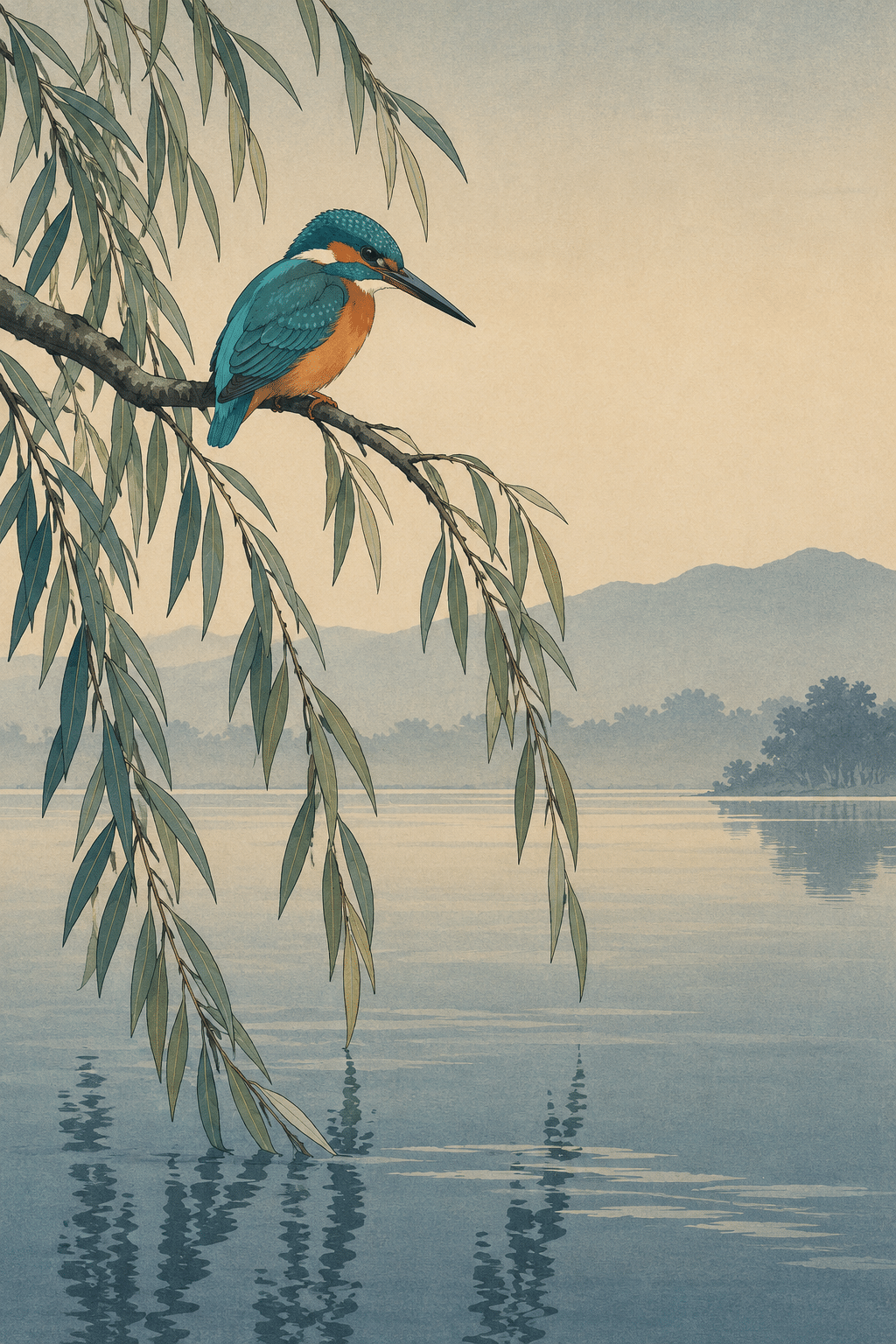
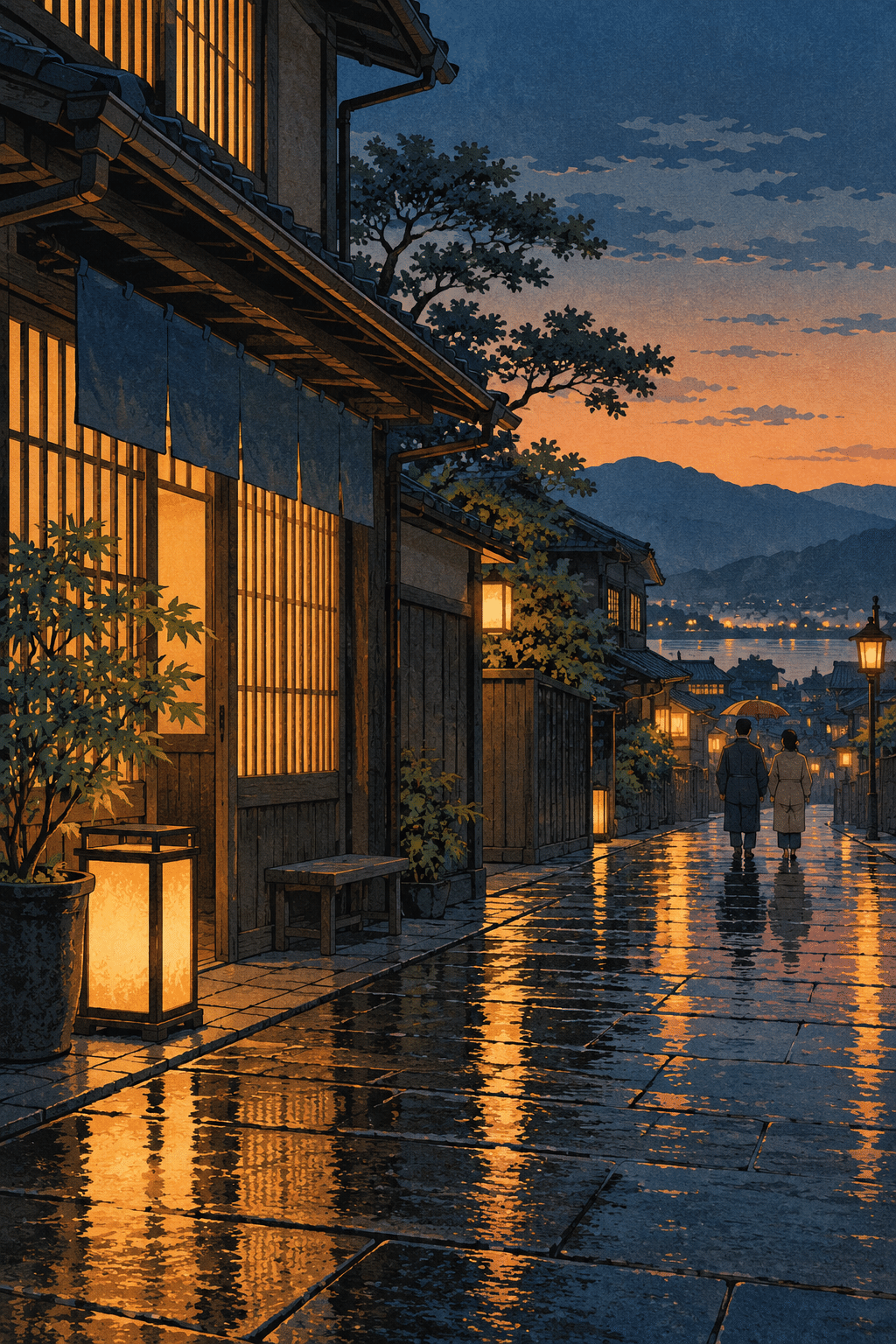
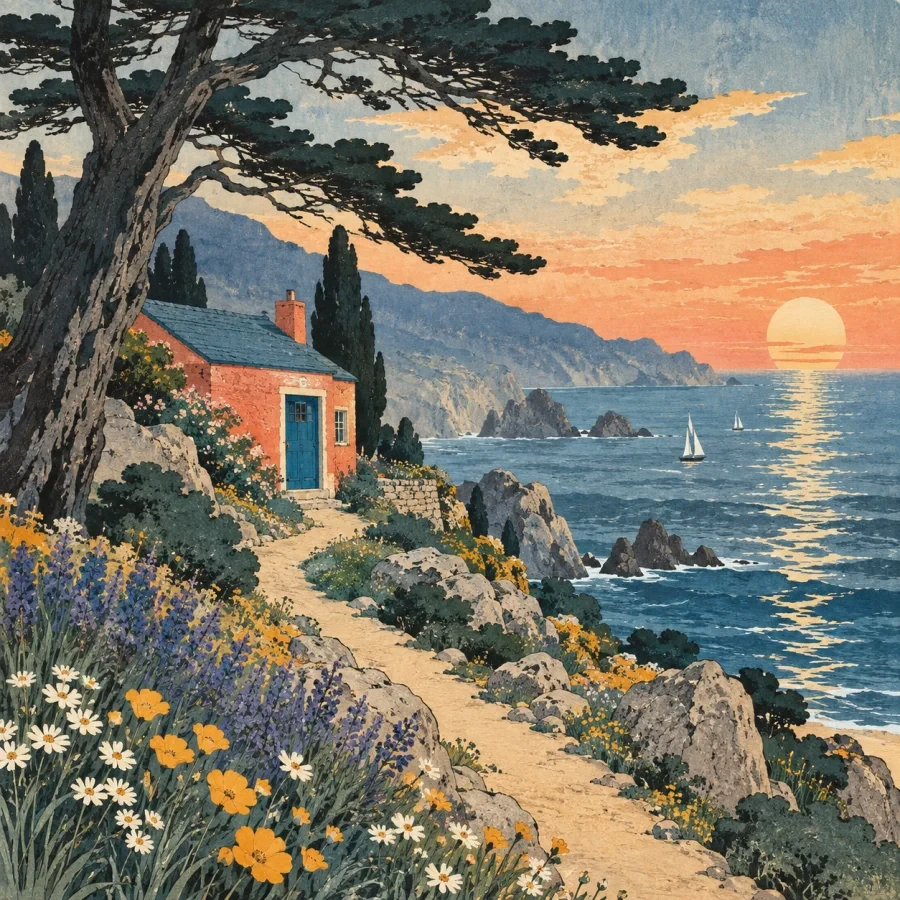
The new gallery contains AI-generated studies of landscapes, a fully clothed adult portrait and a bird-and-plant subject. They are contemporary interpretations, not surviving prints, copies of named works or evidence of hand-carved blocks. Their simulated texture should not be mistaken for physical provenance.
For practical work, distinguish the visual brief from the production method. A digital image may explore layered colour and contour; an actual woodblock print requires decisions about blocks, registration, paper, pigment and printing. Credit all participating makers. Historical prints also circulated through markets, including international audiences, so avoid presenting picturesque scenes as transparent records of an unchanging Japan.
Positive editorial assessment — AI-authored
Shin-hanga can unite strong graphic organization with extraordinarily sensitive atmosphere. Its best visual lessons concern relationships: a pale sky against a dark tree, a precise contour beside a soft gradation, or a small light reflected across water. Collaboration makes those effects materially rich.
Critical editorial assessment — AI-authored
A generic imitation can collapse into lanterns, mountains and artificial paper grain. Decorative nostalgia may obscure the makers and modern commercial context. Improve a study through a specific lighting problem, a convincing spatial arrangement and clear acknowledgement of the difference between generated texture and printmaking.
Neutral editorial assessment — AI-authored
Shin-hanga is a historical print movement with varied artists, subjects and publishing relationships. Its principles can inform contemporary illustration, but an image’s resemblance alone does not establish membership or authenticity. Process, date, makers and publication history matter when identifying an actual print.
A small poetic detour
Original words from the AOI studio.
Poetry
The rain is drawn in patient lines;
the bridge holds back the evening blue.
A window lends its warmth to water,
and water makes that warmth anew.
The block, the hand, the sheet, the pressure:
each leaves a choice the eye can find.
A quiet image holds together
the separate labours of the mind.
The prompt workshop
Original creative exercises. These prompts create new illustrations, not documentary evidence.
Rain and a single light
Original contemporary shin-hanga-inspired digital study of a quiet canal in light rain, dark bridge silhouette, one warm window reflected in indigo water, clear contour and restrained colour gradation, no copied artwork or inscription.
Portrait and pattern
Original print-inspired portrait of a fully clothed adult woman in a modest patterned kimono, calm profile, controlled navy and warm ivory shapes, subtle background texture and coherent anatomy, no likeness of a known person, signature or seal.
Snow without spectacle
Original woodblock-inspired landscape study of a small rural path after snowfall, pale connected snow shapes, dark cedar trunks and one muted red umbrella, spacious composition, no imitation artist signature or historical authenticity claim.
A smile from the studio
Jokes
The rain asked for a solo. The printer reminded it that every line belonged to the ensemble.
Sources and further exploration
National Diet Library: Sōsaku-hanga and Shin-hanga — contrasting production ideals
Kaburaki Kiyokata Memorial Art Museum: The Dawn of Shin-hanga — artists and collaborative context
The Met: Itō Shinsui, Before the Mirror — a documented 1916 collaboration and printing effects