
Animated-series visual reference
Johnny Bravo offers a compact lesson in silhouette, pose and comic overconfidence. Its character design can be studied through shape relationships without treating a television series as an art movement.
A visual introduction
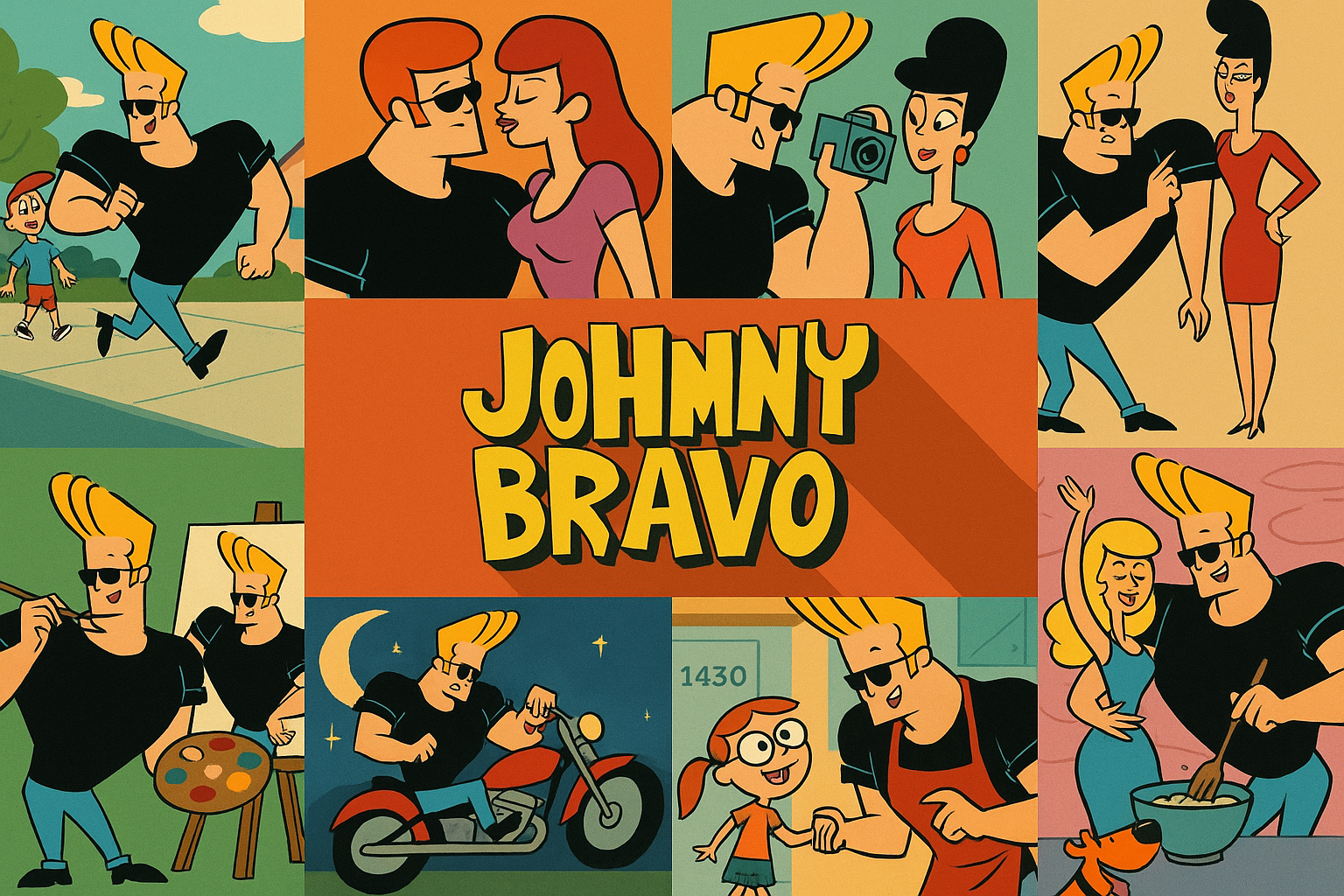
Compare the retained archive studies. The titled collage is modern editorial illustration; its panels are not reproductions of documented works.
Select an image for a closer look. Use the thumbnails, arrow keys or a swipe to compare examples. Zoom in to inspect details, or share the image that inspires you.

Creative toolbox · take this style further
Choose an input and a destination. Search sends your words to the chosen site; Copy & open puts them on your clipboard to paste there.
Create with AI
Turn your chosen input into an image prompt or a new creative direction.
ChatGPT
Copy your input and paste it into a ChatGPT conversation or image request.
Copy & open ChatGPT (new tab)Claude · Anthropic
Develop an image prompt or explore the style in a new Claude conversation.
Copy & open Claude · Anthropic (new tab)Midjourney
Paste your input into the Imagine bar on the Create page.
Copy & open Midjourney (new tab)Adobe Firefly
Copy your input, open Firefly, and paste it into the prompt field.
Copy & open Adobe Firefly (new tab)Leonardo.Ai
Copy your input, open Leonardo, and paste it into the generation field.
Copy & open Leonardo.Ai (new tab)Image search
Find visual references. Short, concrete keywords usually work best.
Lexica
Search AI images and prompts using your selected input.
Search with this input Lexica (new tab)Pexels
Search the photo and video library. Short keywords often work best.
Search with this input Pexels (new tab)Pixabay
Search photos, illustrations and other images.
Search with this input Pixabay (new tab)Unsplash
Search photographs using the style name or your own keywords.
Search with this input Unsplash (new tab)Wikimedia Commons
Search photographs, artworks and historical images. Check each file for its source and reuse terms.
Search with this input Wikimedia Commons (new tab)Art & research
Explore artists, collections and the ideas behind a style.
Wikipedia
Search for background reading. A style may not have its own article.
Search with this input Wikipedia (new tab)WikiArt
Copy your input into WikiArt’s search to explore artists and artworks.
Copy & open WikiArt (new tab)Europeana
Paste your keywords into the search to explore European museum, library and archive collections.
Copy & open Europeana (new tab)Inspiration
Discover portfolios and visual ideas from creative communities.
Instagram hashtags
Search a hashtag made from your input: spaces and punctuation are removed. Instagram may require sign-in.
Search with this input Instagram hashtags (new tab)ArtStation
Paste your input into artwork search for concept art, environments, characters and visual development.
Copy & open ArtStation (new tab)Behance
Paste your input into project search for illustration, design and visual storytelling.
Copy & open Behance (new tab)A closer look
A broad upper-body silhouette, narrow lower body, decisive contours, flat color and poses that communicate before dialogue.
A character built to read quickly
Creator Van Partible describes developing his student project into Johnny Bravo for Hanna-Barbera and Cartoon Network. The series is the reference here; a generic muscular cartoon is not automatically an example of its production art. The AOI archive images are interpretive illustrations rather than authenticated animation cels or model sheets.
Look at the contrast between the large chest and smaller legs, the high sweep of the hair and the dark glasses. These shapes create a recognizable silhouette. The joke is reinforced by how confidently the figure occupies space. A hand on a hip, an extended arm or a backward lean can reveal attitude without elaborate surface texture.
Turn a pose into a story
Begin a new character with three large masses and a clear line of action. Draw the pose as a black silhouette before adding facial detail. Leave a gap between an arm and the torso so that the gesture remains readable. Flat color works best when adjacent shapes already have distinct boundaries; gradients cannot rescue a confusing pose.
For an original comic scene, put the character’s self-image in conflict with an ordinary task: a grand introduction interrupted by a tiny dog, or a heroic stance beside a stubborn vending machine. Make the situation legible in one frame. Avoid simply copying the familiar hairstyle and sunglasses onto every design. Variation in proportions, costume and staging is a better test of what the visual principle can do.
The prompt workshop
Original creative exercises. These prompts create new illustrations, not documentary evidence.
Silhouette first
Create an original flat-color cartoon of an overconfident adult delivery worker with broad shoulders and narrow legs trying to carry one tiny parcel. Use a clear black contour, readable hands, teal background and a comic leaning pose. Invent a new face, hairstyle and costume; no logos or text.
One-frame reversal
Draw an original exaggerated adult cartoon character striking a triumphant pose while a very small dog walks away with a shoe. Use flat warm colors, strong silhouettes and a simple sidewalk setting. Make the action readable without words.
Three poses
Create an original character study with the same adult cartoon person in three clearly separated poses: boastful, surprised and sheepish. Keep proportions consistent and use economical contours and flat colors. No lettering.