
GLASS / REFRACTION / ILLUSION
Matter Madeof Light
Transparent things have a great deal to say.
SIGNE HAIMHOLM / 06 / AOI LOOKBOOKS
Transparency is not the absence of a surface. It is a way for a surface to negotiate with everything behind it. This collection moves from a luminous shell to glass terraces, overlapping vessels and sculptural fins. Most of the titles name original AOI visual concepts. Their images are invitations to imagine material behavior, not demonstrations of optical or physical laws.
AOI database illustration
AOI database illustration
STUDY 02 / Superposition Glass Vessels
Two outlines, one conversation
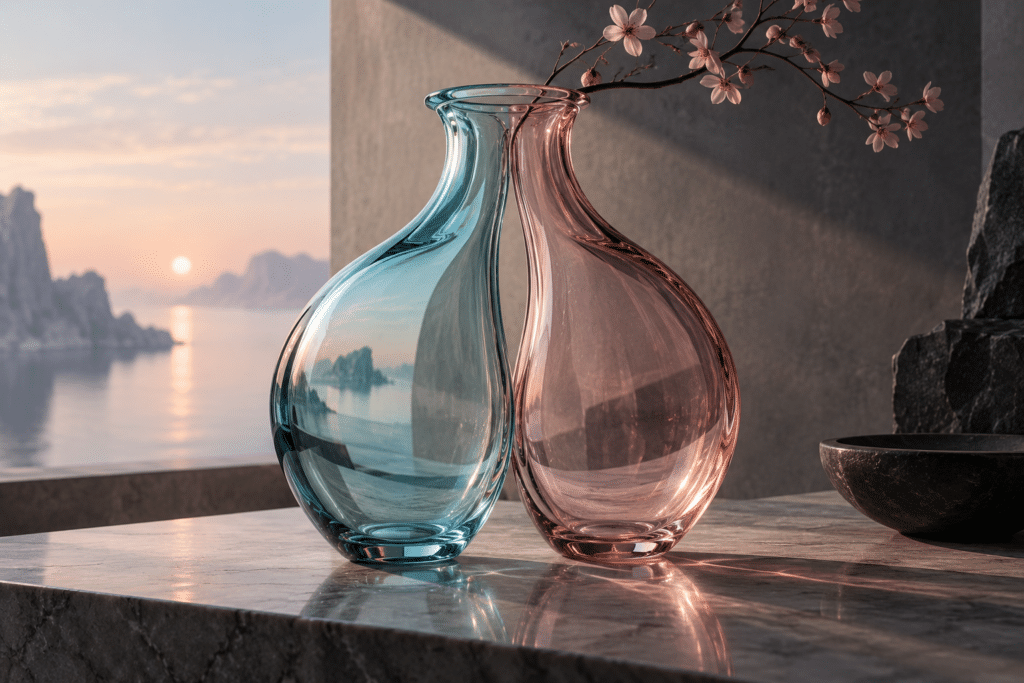
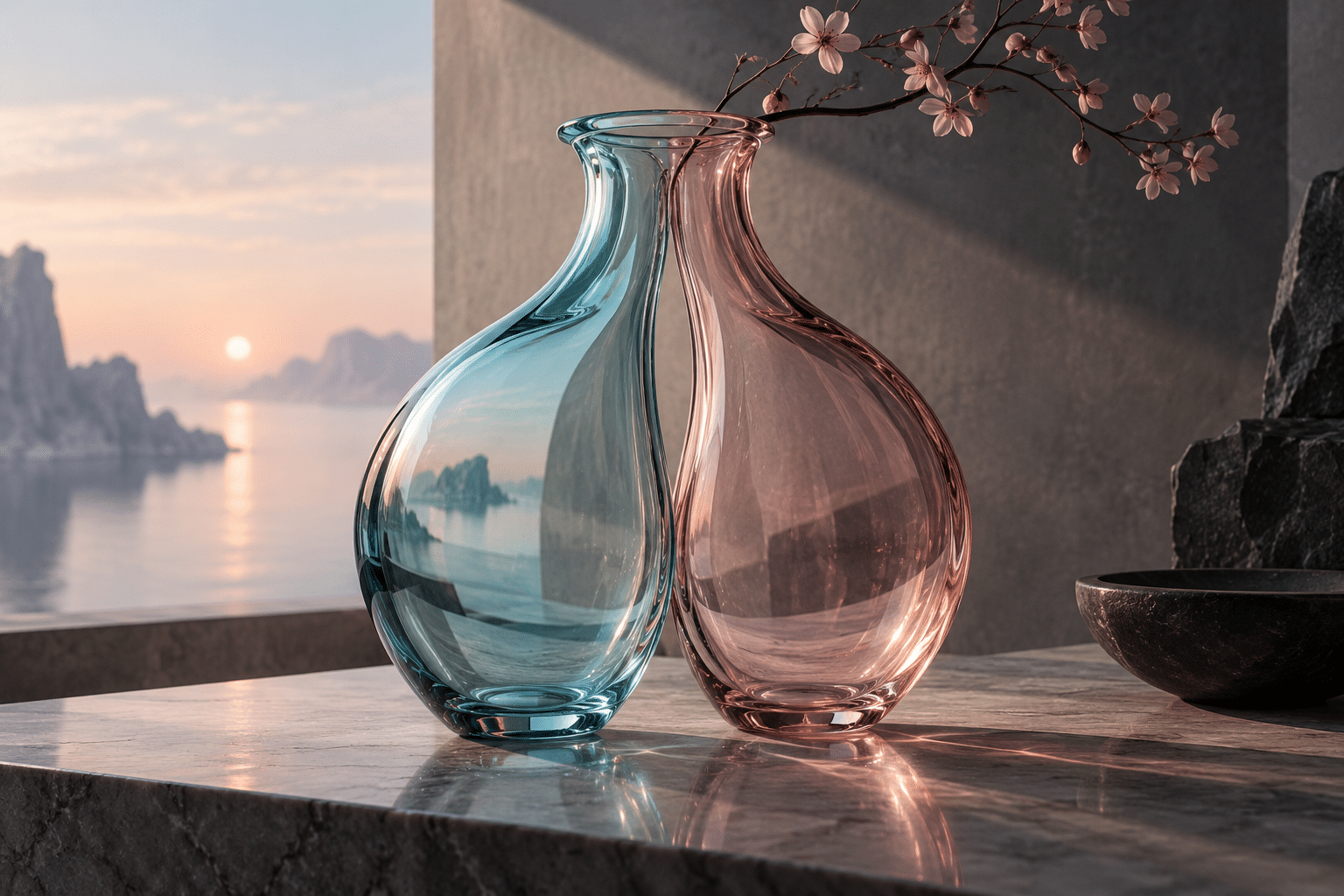
Cyan and blush vessel forms overlap in a calm still life. Superposition Glass Vessels proposes readable, competing silhouettes in shared space. Look closely at the rims and the different routes taken by the lower contours. The scientific-sounding title is a compositional metaphor, not a claim of quantum behavior.
Original AOI concept
Explore Superposition Glass Vessels ↗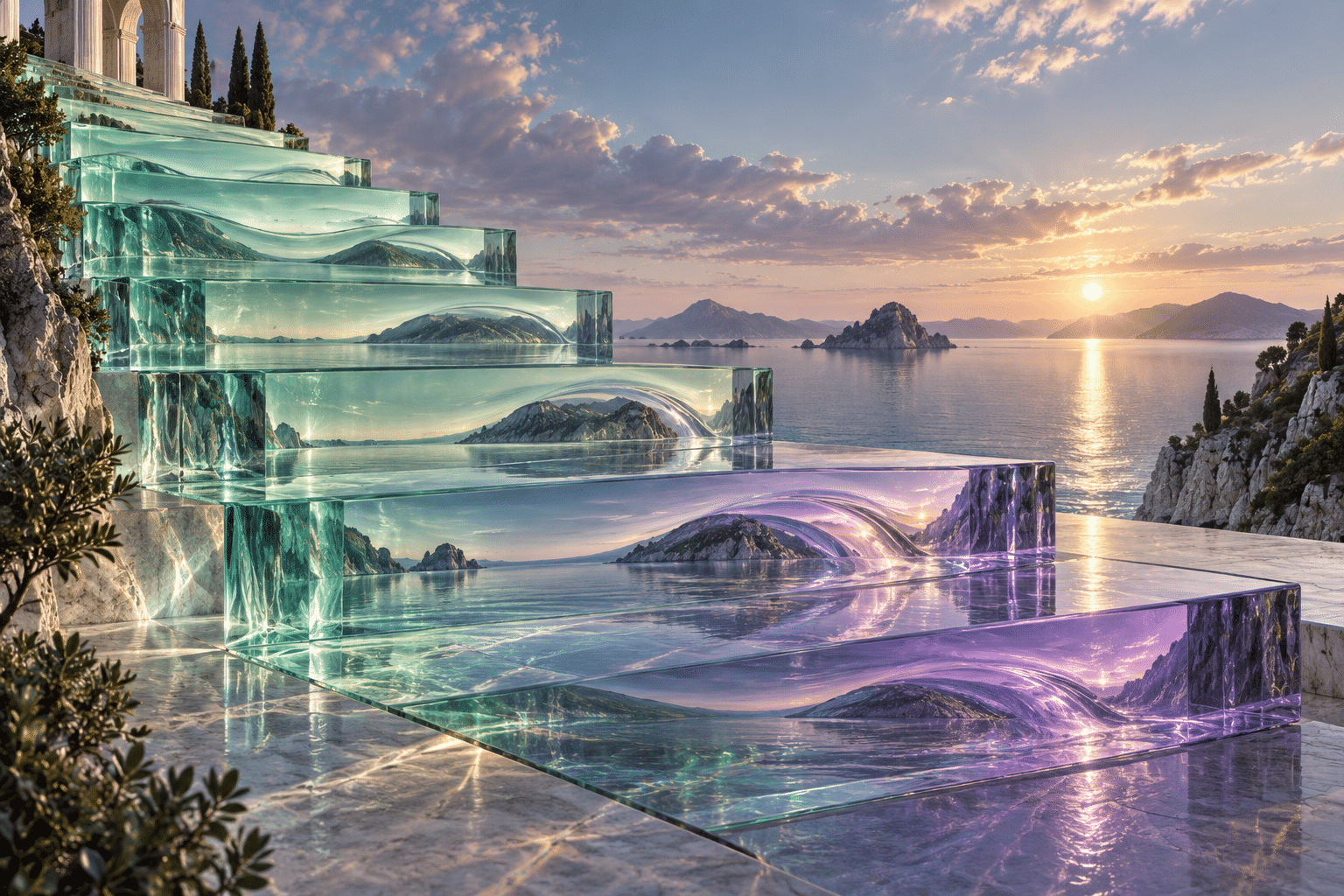
AOI database illustration
STUDY 03 / Gradient Tide Glass
A horizon through terraces
Broad glass steps descend toward a tidal landscape, carrying sea-green and violet color. Gradient Tide Glass asks transparency and changing thickness to organize a scene. The continuous landscape beyond the terraces gives the local distortions something to be measured against, even when the material itself is entirely imagined.
Original AOI concept
Explore Gradient Tide Glass ↗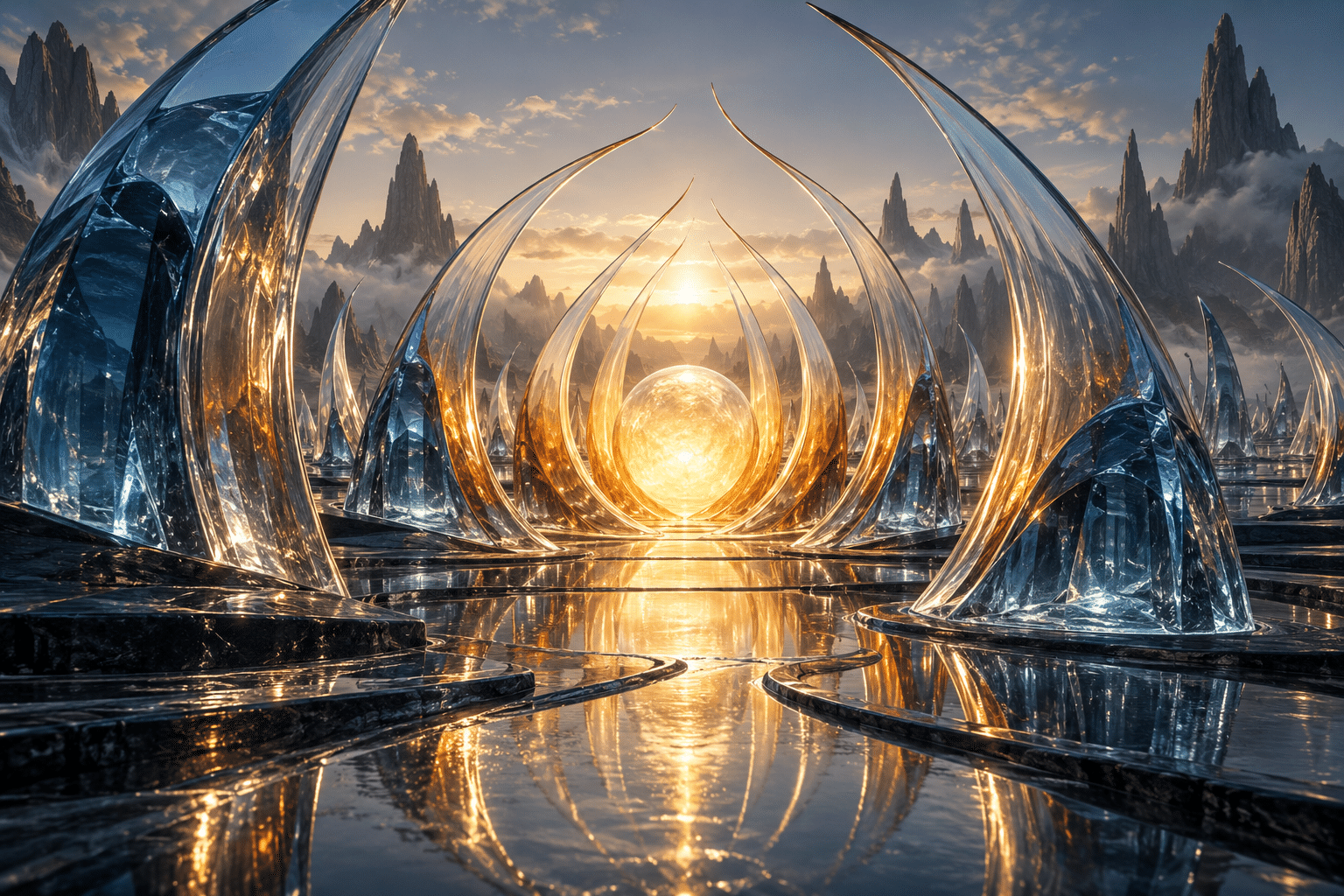
AOI database illustration
STUDY 04 / Energy Gradient Glassworks
A field around a bright center
Curved glass fins gather around warm light, their edges catching reflections across a dark ground. Energy Gradient Glassworks uses a change in apparent material density as an art direction. Read the arrangement as sculpture and illumination; no engineered energy system or validated physical process is being documented.
Original AOI concept
Explore Energy Gradient Glassworks ↗LOOK AGAIN
A question to stay with
Where do you locate the surface of each object? Follow an outline, then follow the background through it. Do those readings agree?
TAKE IT OFF THE SCREEN
A small experiment
Draw a simple room, then place a transparent rectangle over your drawing using tracing paper. Shift or bend only the lines seen through that rectangle. Keep the surrounding room unchanged so the imagined material effect stays readable.
Artwork & reading. Each artwork comes from the linked AOI art-style record. The collection combines contemporary generated studies with archive illustrations. Original AOI concepts, descriptive labels and established references are identified beside the works. The captions and curatorial readings are by Signe Haimholm; these images are not presented as works by historical artists or as technical demonstrations. Published 31 October 2026. Use the style links for the underlying descriptions and sources.
A FEW THINGS WORTH ASKING
Questions,
answered.
Transparent surfaces, overlapping color and imagined material behavior.
What does Matter Made of Light bring together?
Signe selects four approaches to luminous or glass-like forms. The sequence compares how a surface changes what you see behind it, how overlapping objects affect color and how a material can become the main subject of an image.
Are the glass vessels documented physical objects?
They are AOI visual concepts and generated studies in this collection. Their convincing reflections and transparent surfaces do not establish fabricated objects or tested material properties.
Is the holography-inspired image a real hologram?
The selected work is a generated concept inspired by holography. A still image on this page cannot demonstrate the viewing behavior of a physical hologram. Follow the linked entry for the distinction between the reference and its illustrated interpretation.
What should I notice where two transparent objects overlap?
Compare the meeting edges with the unchanged background beside them. Look for shifts in color, apparent depth and the continuity of lines. Those comparisons show how the image persuades you that a surface is transparent.
Does “superposition” describe a scientific experiment here?
Superposition Glass Vessels is the name of an original AOI visual concept. In this lookbook, it frames an imagined arrangement of glass-like forms; it is not evidence of a physics experiment.
Can I explore transparency on paper?
Draw a simple room, then lay a piece of tracing paper over part of it. Shift or bend only the lines seen through that area. Leave the surrounding drawing unchanged so the imagined material effect remains readable.
How can I distinguish transparency from reflection in an artwork?
Look for whether the image appears to continue through a surface or return a view from somewhere else. In these glass-like studies, trace a background edge toward an object and see how it changes. A surface can suggest both effects at once; identifying the cues is more useful than assuming the image obeys a complete physical model.
Why do glass-inspired artworks need a carefully chosen background?
The background gives a transparent-looking object something to reveal, interrupt or tint. Compare an overlap with an adjacent clear area: a small shift in a line or color can make the material legible. For your own drawing, start with a simple background so the effect of the imagined surface is easy to see.
Which collection explores light and space beyond glass-like objects?
The opening chapter of Signe’s Favorites brings Scandinavian Design, Light and Space and other spatial studies into conversation. It broadens the question from the surface of an object to the atmosphere around it. Soft Machines is a closer companion if you want to compare gloss, curves and uncertain materials.
STUDY 01 / Holography in Art: Recorded Light, Moving Viewpoints and Apparent Space
The shell that seems to float
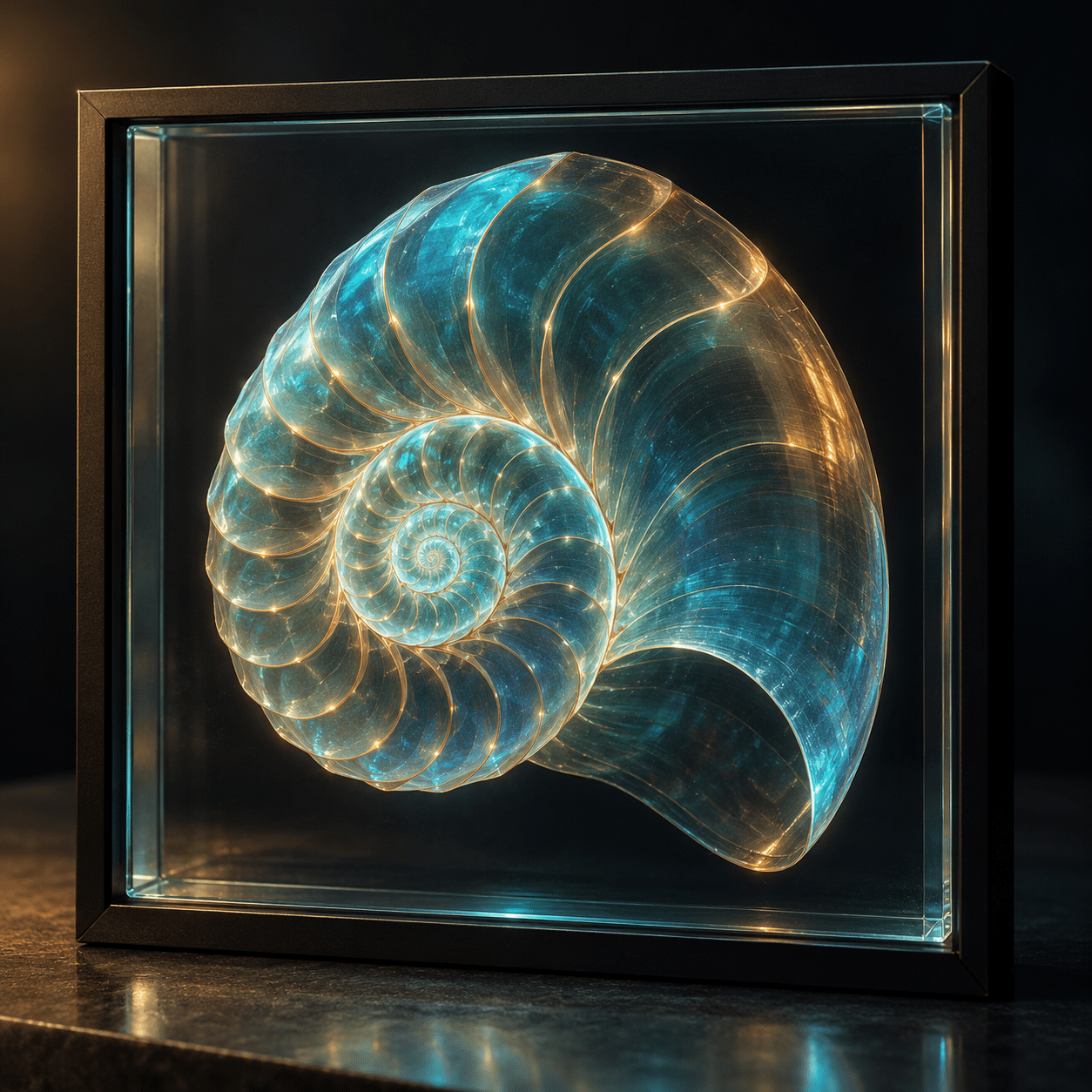
A cyan spiral shell appears against a dark square support, with amber ridges describing its volume. Actual holography involves recorded light and viewing conditions; this generated picture does not reproduce that medium. It offers a visual analogy for apparent depth and an object that seems difficult to locate.
Holography-inspired generated concept
Explore Holography in Art: Recorded Light, Moving Viewpoints and Apparent Space ↗