
Optical imaging medium
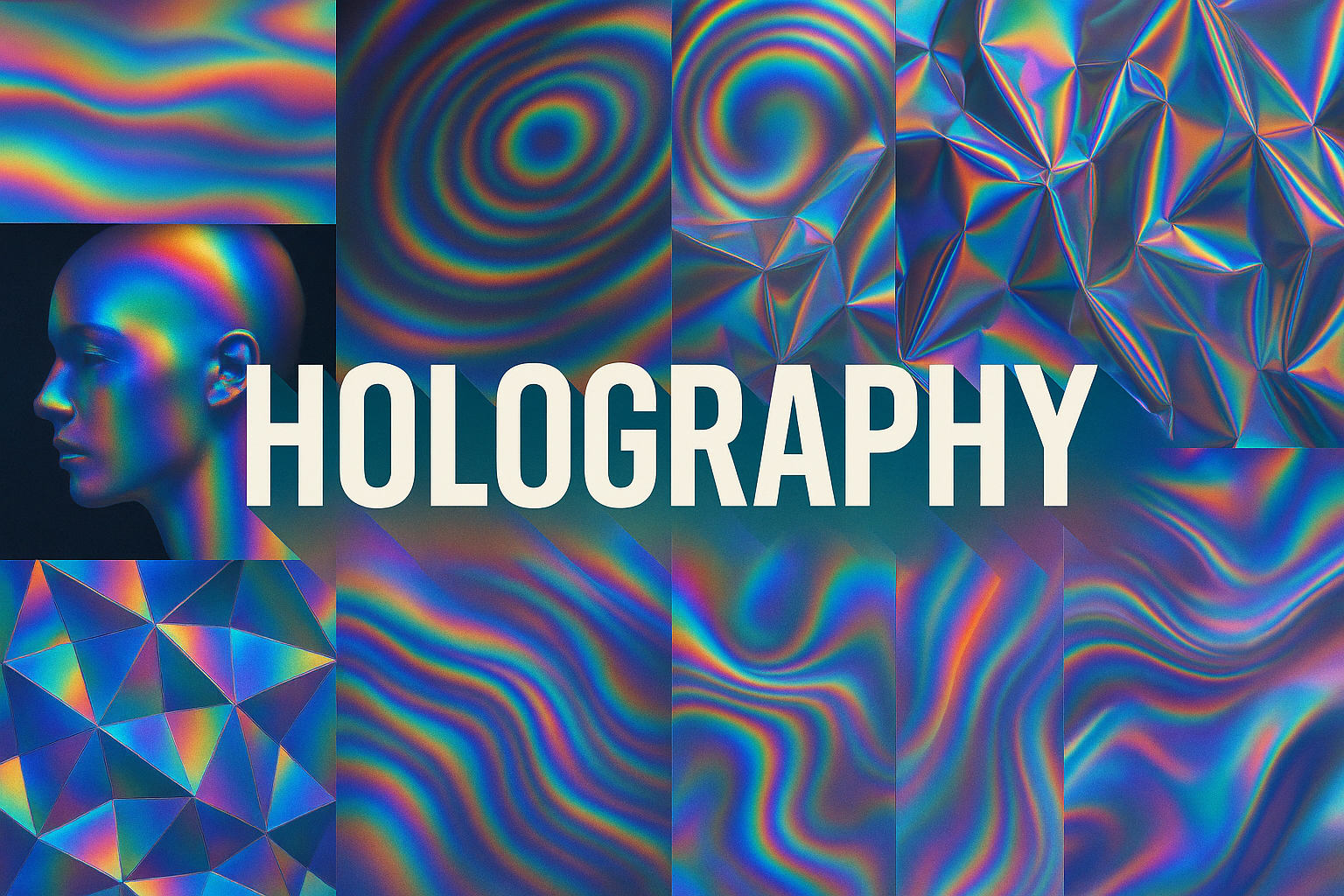
Holography is an optical imaging medium in which light and viewing conditions are essential to the image’s appearance. Artistic holograms should be distinguished from iridescent surfaces, ordinary projections and digital pictures of glowing objects.
A visual introduction
Select an image for a closer look. Use the thumbnails, arrow keys or a swipe to compare examples. Zoom in to inspect details, or share the image that inspires you.

Creative toolbox · take this style further
Choose an input and a destination. Search sends your words to the chosen site; Copy & open puts them on your clipboard to paste there.
Create with AI
Turn your chosen input into an image prompt or a new creative direction.
ChatGPT
Copy your input and paste it into a ChatGPT conversation or image request.
Copy & open ChatGPT (new tab)Claude · Anthropic
Develop an image prompt or explore the style in a new Claude conversation.
Copy & open Claude · Anthropic (new tab)Midjourney
Paste your input into the Imagine bar on the Create page.
Copy & open Midjourney (new tab)Adobe Firefly
Copy your input, open Firefly, and paste it into the prompt field.
Copy & open Adobe Firefly (new tab)Leonardo.Ai
Copy your input, open Leonardo, and paste it into the generation field.
Copy & open Leonardo.Ai (new tab)Image search
Find visual references. Short, concrete keywords usually work best.
Lexica
Search AI images and prompts using your selected input.
Search with this input Lexica (new tab)Pexels
Search the photo and video library. Short keywords often work best.
Search with this input Pexels (new tab)Pixabay
Search photos, illustrations and other images.
Search with this input Pixabay (new tab)Unsplash
Search photographs using the style name or your own keywords.
Search with this input Unsplash (new tab)Wikimedia Commons
Search photographs, artworks and historical images. Check each file for its source and reuse terms.
Search with this input Wikimedia Commons (new tab)Art & research
Explore artists, collections and the ideas behind a style.
Wikipedia
Search for background reading. A style may not have its own article.
Search with this input Wikipedia (new tab)WikiArt
Copy your input into WikiArt’s search to explore artists and artworks.
Copy & open WikiArt (new tab)Europeana
Paste your keywords into the search to explore European museum, library and archive collections.
Copy & open Europeana (new tab)Inspiration
Discover portfolios and visual ideas from creative communities.
Instagram hashtags
Search a hashtag made from your input: spaces and punctuation are removed. Instagram may require sign-in.
Search with this input Instagram hashtags (new tab)ArtStation
Paste your input into artwork search for concept art, environments, characters and visual development.
Copy & open ArtStation (new tab)Behance
Paste your input into project search for illustration, design and visual storytelling.
Copy & open Behance (new tab)A closer look
Apparent depth and changes with viewpoint can shape the encounter; a still photograph captures only one limited view of a work that depends on light and position.
A medium with varied artistic uses
The MIT Museum's collection includes artistic and technical holograms and distinguishes different kinds of holographic work. Its examples show that holography is not one visual style restricted to a floating blue figure or a rainbow sheen.
Begin with the actual medium and display conditions. A digital concept image may illustrate an idea for a holographic installation, but it does not demonstrate that the pictured effect can be produced by a particular holographic system.
The viewer participates through position
MIT's account of photographing holograms explains that the recorded view changes with angle and proximity. This makes movement and position part of interpretation. A single flat reproduction cannot fully document the experience.
For an installation proposal, think about the route by which a viewer approaches and moves past the work. What appears first? What changes? A diagram or sequence of views can communicate that idea more accurately than one spectacular hero image.
Make light part of the design
Specify the relationship between the image, its support and its illumination. Avoid treating a hologram as a self-supporting solid object simply because a render makes it look that way. The optical setup and the apparent image are related but different things.
In a conceptual visualization, control the surrounding brightness and competing reflections so the intended phenomenon remains readable. If every surface is iridescent, the viewer may be unable to identify what is supposed to change with position.
Use precise labels
“Holographic-inspired” is appropriate for a digital illustration of layered luminous forms. “Hologram” should refer to an actual work or supported technical proposal. Similarly, metallic rainbow foil and stage projection effects should not be described as holography solely because they look futuristic.
Study documented works to understand the medium's range, then formulate an original visual question: depth, disappearance, superimposition or a changing relationship between forms. Record which parts are a design intention and which have actually been demonstrated. This keeps the article useful to both image-makers and readers interested in the physical medium.
The prompt workshop
Original creative exercises. These prompts create new illustrations, not documentary evidence.
A clearly labelled concept
Original concept visualization for a holographic art installation exploring layered geometric depth, visible display context and restrained lighting, not documentation of a built device.
Viewpoint sequence
Original three-view conceptual study of luminous forms whose apparent overlap changes with viewpoint, consistent surroundings and no claim of technical validation.
Holographic inspiration
Original digital artwork inspired by shifting optical depth, a few suspended-looking translucent planes and quiet negative space, explicitly an illustration.
Sources and further exploration
MIT Museum — artistic and technical holography collections
MIT ACT — why photographs capture only particular views of holograms