
GROWTH / ROUTING / REPAIR
LivingCircuits
The garden finds a path through the machine.
SIGNE HAIMHOLM / 07 / AOI LOOKBOOKS
Branches and circuits both make connections, but they do not grow in the same way. This collection explores the friction between organic-looking systems and deliberate structures. Roots encounter angular channels, moss inhabits cut stone, and broken copper acquires ceramic growth. These are invented AOI art directions. Their biological and technical vocabulary describes visual ideas, not scientific findings.
AOI database illustration

AOI database illustration
STUDY 02 / BioCircuit Expression
A face becomes a network
A gold face emerges from branching traces on a dark teal field. BioCircuit Expression combines organic suggestion with ordered routing. The near-symmetrical axis makes the eyes readable while the surrounding network expands outward. This is an imagined portrait language, not an illustration of human neural anatomy.
AOI visual concept
Explore BioCircuit Expression ↗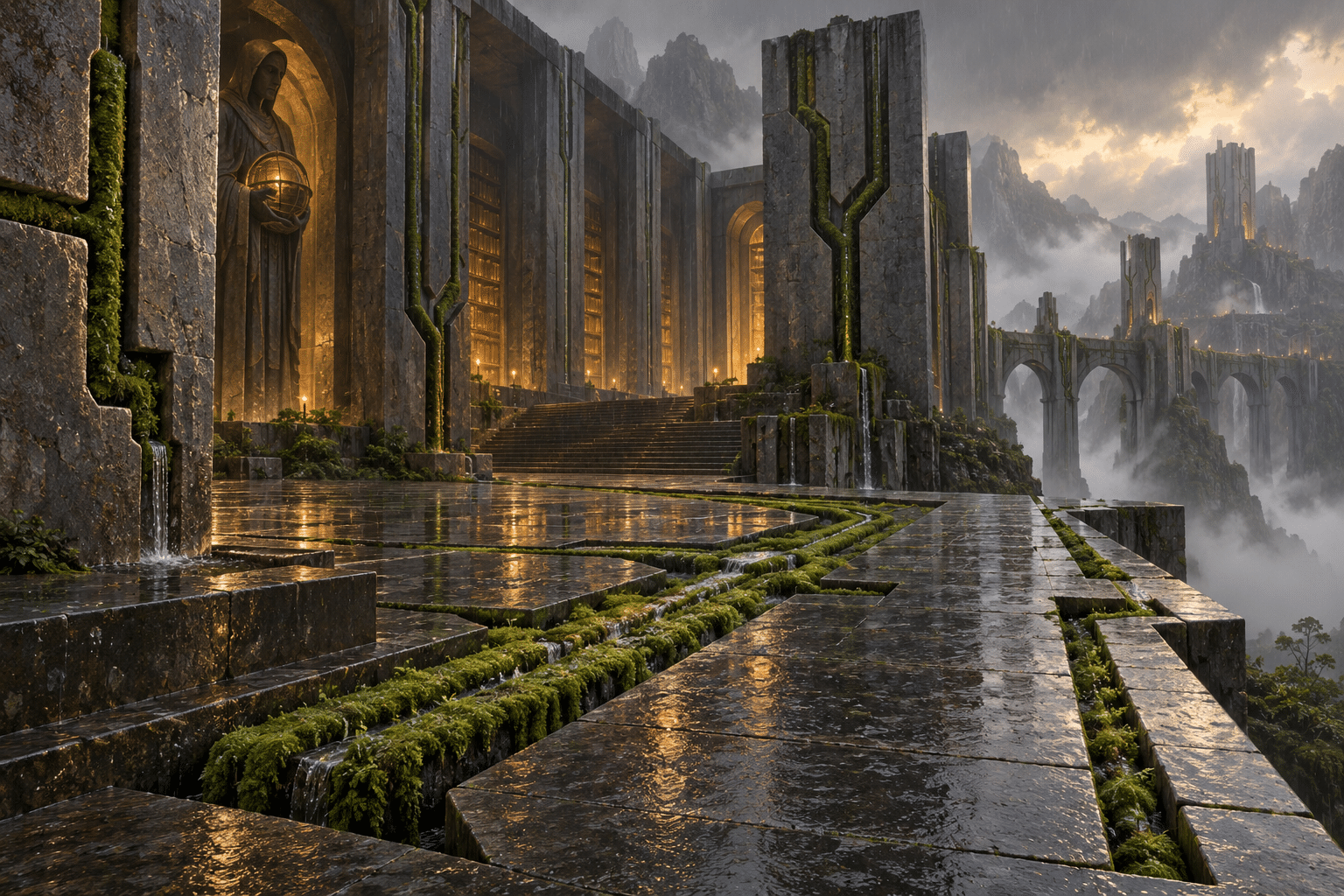
AOI database illustration
STUDY 03 / Archive Moss Circuits
The archive learns to grow
Moss occupies recessed channels through heavy stone, while rain and warm interior light animate the imagined archive. Archive Moss Circuits gives vegetation a structural route rather than scattering it across every surface. The severe geometry remains visible, allowing growth and construction to keep their separate identities.
Original AOI concept
Explore Archive Moss Circuits ↗
AOI database illustration
STUDY 04 / Regenerative Copper Reefs
A different kind of repair
White ceramic branches extend from rough copper forms in shallow water. Regenerative Copper Reefs makes the old-new junction the subject of the image. It is a sculptural fantasy of repair and continuation, not a proposal proven to restore real reefs or a photograph of an ecological intervention.
Original AOI concept
Explore Regenerative Copper Reefs ↗LOOK AGAIN
A question to stay with
Does the organic form seem to follow the structure, resist it or repair it? Find a visible junction that supports your reading.
TAKE IT OFF THE SCREEN
A small experiment
Draw a network of straight paths, then let an imagined plant grow through it. Give the plant one rule it must obey and one place where it can break away. Explain the relationship rather than simply decorating every line with leaves.
Artwork & reading. Each artwork comes from the linked AOI art-style record. The collection combines contemporary generated studies with archive illustrations. Original AOI concepts, descriptive labels and established references are identified beside the works. The captions and curatorial readings are by Signe Haimholm; these images are not presented as works by historical artists or as technical demonstrations. Published 31 October 2026. Use the style links for the underlying descriptions and sources.
A FEW THINGS WORTH ASKING
Questions,
answered.
Organic growth and deliberate structures, seen as competing visual systems.
What is the Living Circuits collection about?
It brings together roots, angular channels, moss, cut stone, copper and ceramic-like growth. Signe’s theme is the friction between an organic-looking network and a deliberately arranged structure.
Are these examples of biological computing?
No scientific finding or functioning biological computer is claimed. The selected works are invented AOI art directions. Their biological and technical vocabulary describes visual ideas in the images.
How do the artworks connect plants and circuitry?
They borrow visible features such as branching, routing, enclosure and repetition. Look at how a root-like path responds to an angular channel, rather than assuming that the two systems work in the same way.
Why are moss and damaged surfaces important to this sequence?
They make time and occupation visible as artistic ideas. Moss appears to inhabit a structure, while the copper-and-ceramic concept lets an interruption remain part of the surface instead of concealing it.
Are Regenerative Copper Reefs real self-repairing materials?
The title names an original AOI concept. The image imagines a relationship between fractured copper and ceramic-like growth; it does not demonstrate a tested repair process or material technology.
How can I try this theme in a drawing?
Start with a network of straight paths, then let an imagined plant grow through it. Give the plant one rule to obey and one place where it can break away. Explain that relationship instead of simply adding leaves to every line.
What makes these images nature-inspired technology art?
They place recognizable cues from growth beside cues from designed systems: roots meet channels, moss occupies ordered surfaces, and branching forms interrupt angular structures. The connection is visual and speculative. Signe’s selection asks how those cues coexist, rather than treating a plant-like pattern as evidence of a working technology.
How can I combine organic and technical forms without simply decorating a machine with leaves?
Give the two systems a relationship. A root might follow a channel, cross a boundary or force a path to change direction. Choose one of those interactions and make it visible in the composition. The moss and fractured-surface studies are useful prompts because occupation and interruption help organize the whole image.
Where can I explore branching and repeated patterns more closely?
The Shape of a Rule offers a companion sequence of flow-like lines, fractal-inspired forms, geometric arrangements and a circuit-like leaf. Compare one path in each collection: where does it split, where does its spacing change, and where does it stop? That makes a focused exercise without needing to infer a scientific process.
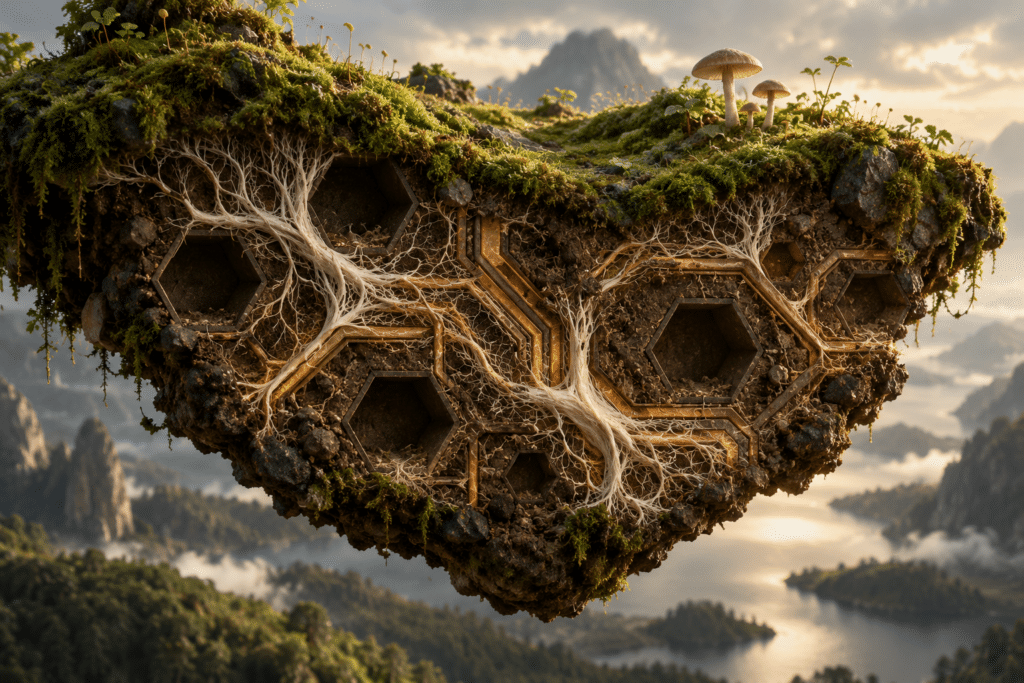
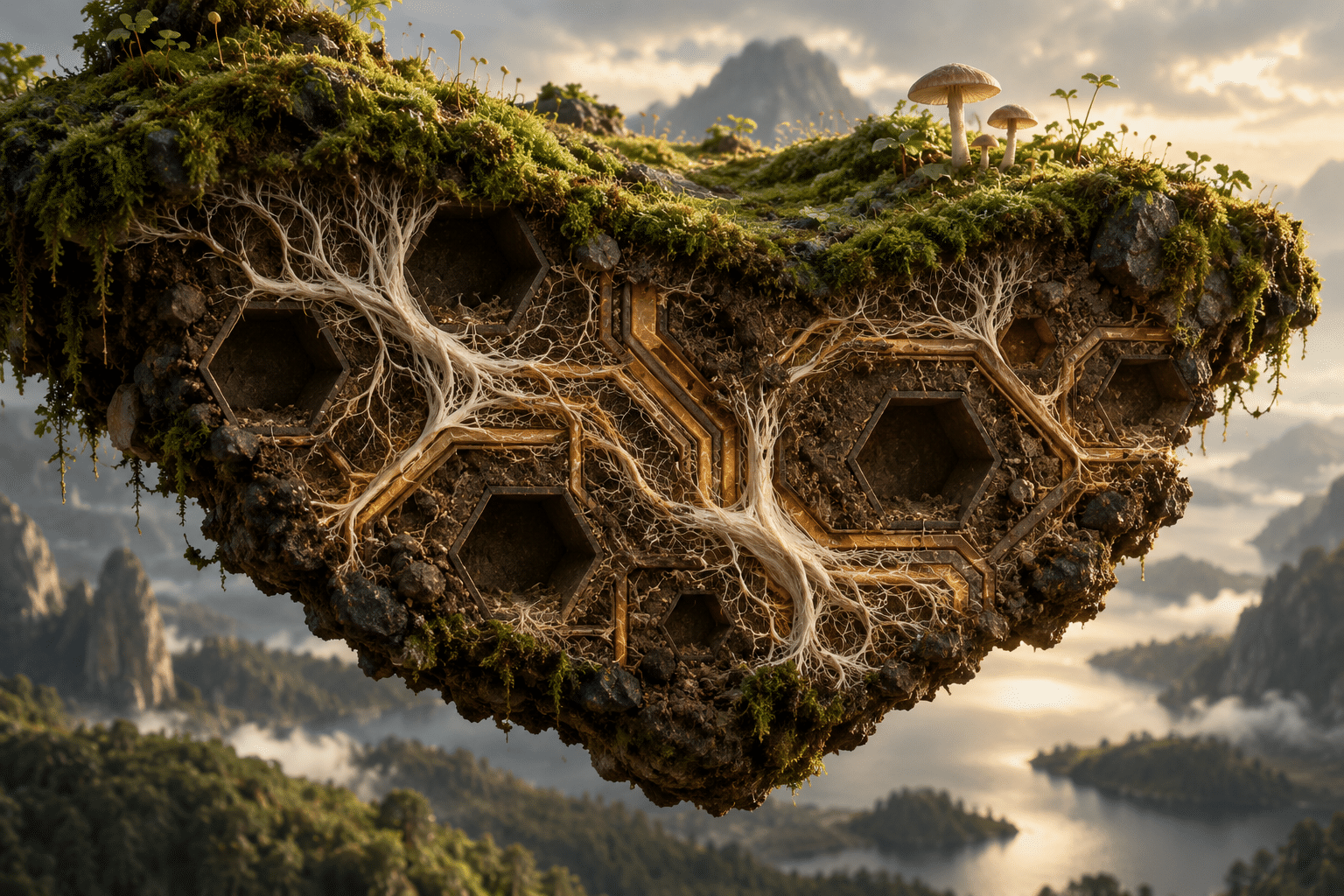
STUDY 01 / Mycelial Circuit Geometrism
Beneath the island
A lifted slice of mossy ground reveals pale fibers, angular channels and open pockets in the soil. Mycelial Circuit Geometrism brings wandering growth into contact with a deliberately routed interior. The image is a speculative environmental sculpture, not a biological cross-section or a working circuit diagram.
Original AOI concept
Explore Mycelial Circuit Geometrism ↗