
Animal forms in objects, ornament and images
Zoomorphic imagery gives an object, figure or decorative motif the form of an animal. A vessel may become a bird; a carved support may end in a fox; a woven line may turn into antlers. The term describes a visual choice across many cultures and periods, rather than a single movement or a requirement to mix humans with animals.
A visual introduction
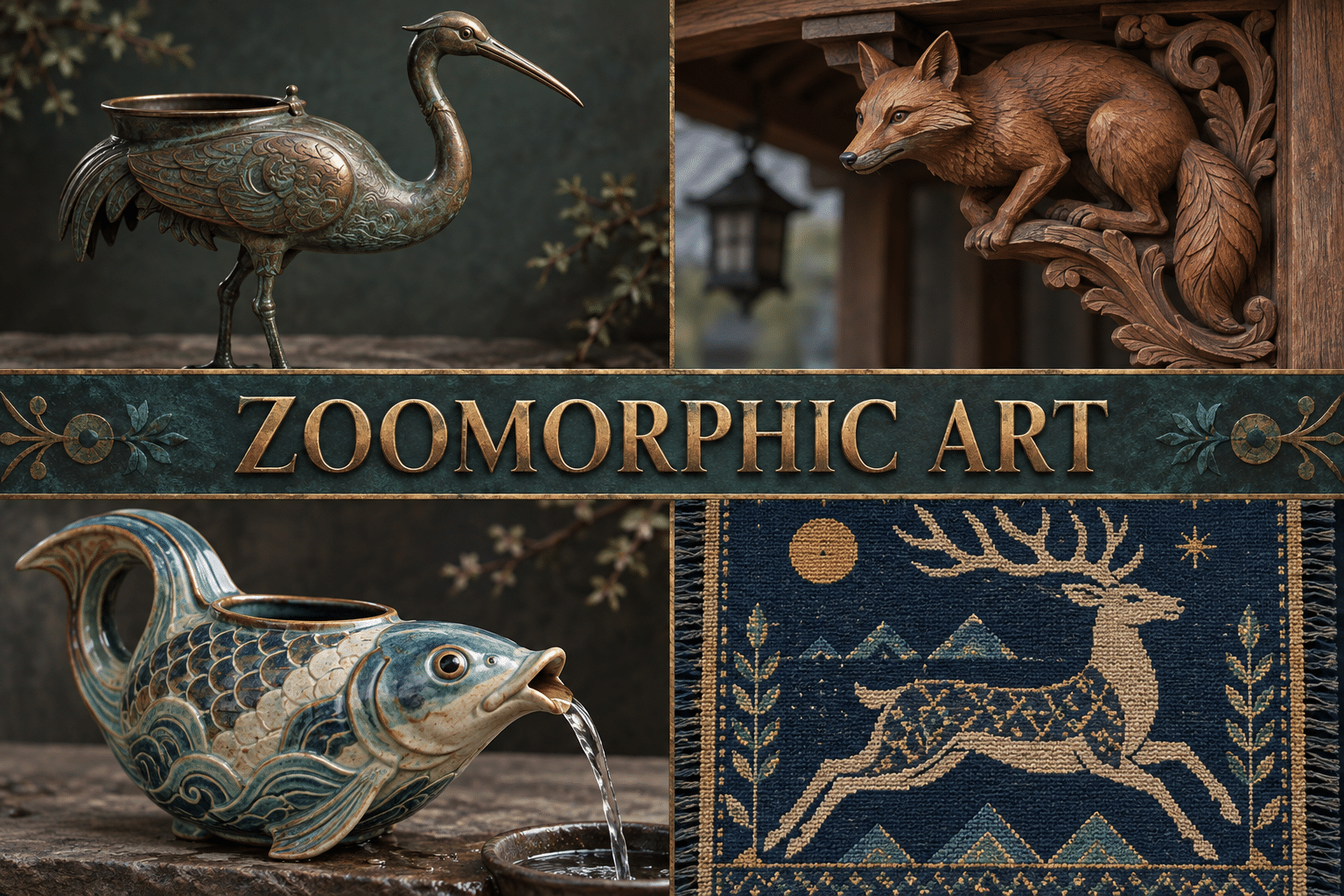
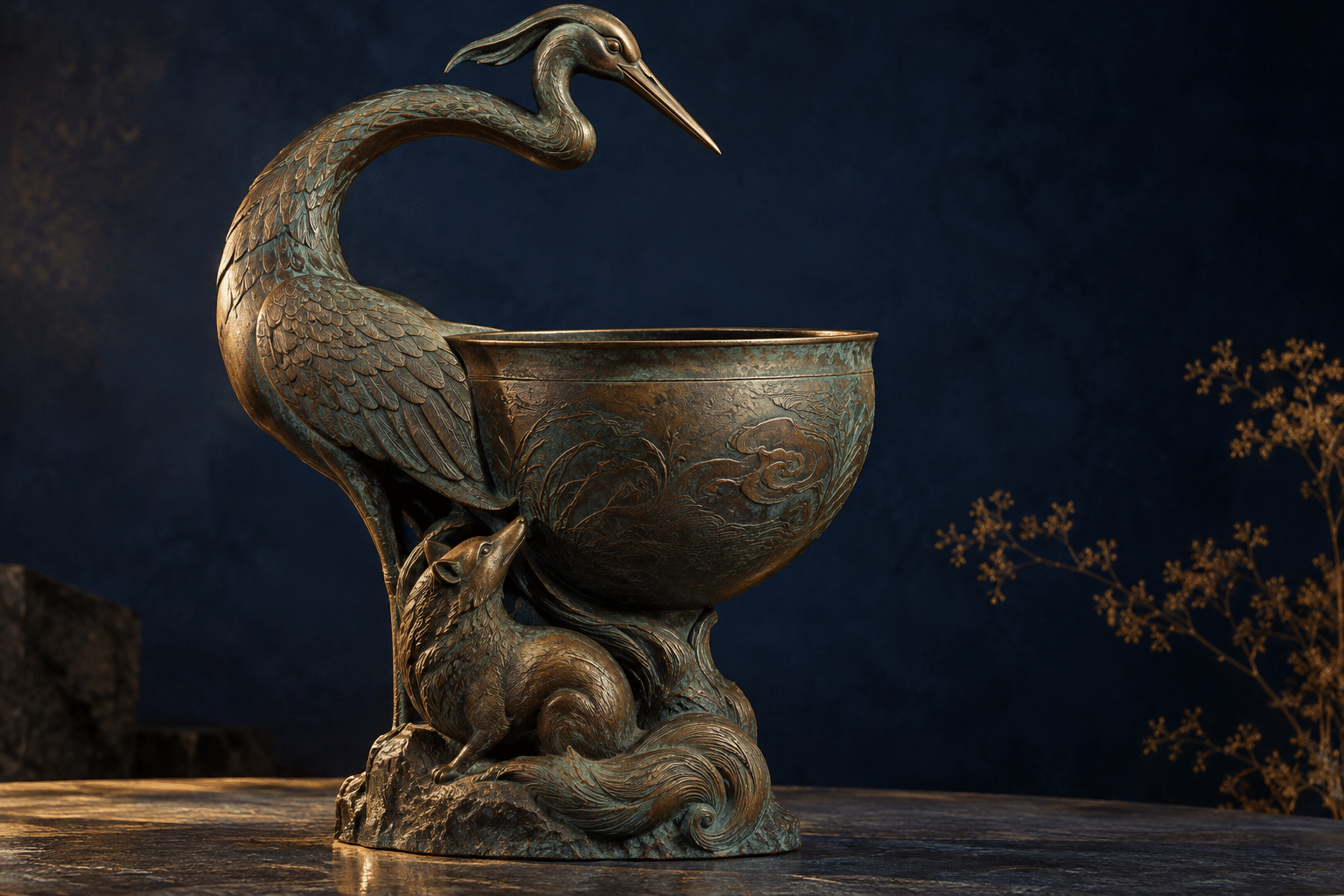
Compare the new bronze object study with four original zoomorphic interpretations in metal, wood, ceramic and textile. Both illustrations are conceptual.
Select an image for a closer look. Use the thumbnails, arrow keys or a swipe to compare examples. Zoom in to inspect details, or share the image that inspires you.
Creative toolbox · take this style further
Choose an input and a destination. Search sends your words to the chosen site; Copy & open puts them on your clipboard to paste there.
Create with AI
Turn your chosen input into an image prompt or a new creative direction.
ChatGPT
Copy your input and paste it into a ChatGPT conversation or image request.
Copy & open ChatGPT (new tab)Claude · Anthropic
Develop an image prompt or explore the style in a new Claude conversation.
Copy & open Claude · Anthropic (new tab)Midjourney
Paste your input into the Imagine bar on the Create page.
Copy & open Midjourney (new tab)Adobe Firefly
Copy your input, open Firefly, and paste it into the prompt field.
Copy & open Adobe Firefly (new tab)Leonardo.Ai
Copy your input, open Leonardo, and paste it into the generation field.
Copy & open Leonardo.Ai (new tab)Image search
Find visual references. Short, concrete keywords usually work best.
Lexica
Search AI images and prompts using your selected input.
Search with this input Lexica (new tab)Pexels
Search the photo and video library. Short keywords often work best.
Search with this input Pexels (new tab)Pixabay
Search photos, illustrations and other images.
Search with this input Pixabay (new tab)Unsplash
Search photographs using the style name or your own keywords.
Search with this input Unsplash (new tab)Wikimedia Commons
Search photographs, artworks and historical images. Check each file for its source and reuse terms.
Search with this input Wikimedia Commons (new tab)Art & research
Explore artists, collections and the ideas behind a style.
Wikipedia
Search for background reading. A style may not have its own article.
Search with this input Wikipedia (new tab)WikiArt
Copy your input into WikiArt’s search to explore artists and artworks.
Copy & open WikiArt (new tab)Europeana
Paste your keywords into the search to explore European museum, library and archive collections.
Copy & open Europeana (new tab)Inspiration
Discover portfolios and visual ideas from creative communities.
Instagram hashtags
Search a hashtag made from your input: spaces and punctuation are removed. Instagram may require sign-in.
Search with this input Instagram hashtags (new tab)ArtStation
Paste your input into artwork search for concept art, environments, characters and visual development.
Copy & open ArtStation (new tab)Behance
Paste your input into project search for illustration, design and visual storytelling.
Copy & open Behance (new tab)A closer look
Look for the point where an animal silhouette changes the shape or use of an object: a beak becomes a spout, a neck becomes a handle, or limbs articulate a border. Material, construction, scale and cultural setting matter as much as resemblance.
What zoomorphic means
Zoomorphic means animal-shaped or animal-like. It can describe the body of an object, an attached animal head, or an animal motif worked into a surface. Human–animal hybrids are one possible subject, but they are not the definition. A painted animal in a landscape is animal imagery; calling it zoomorphic is most useful when the animal form actively organizes the design.
The idea crosses sculpture, metalwork, ceramics, textiles and architecture. That breadth makes context essential. Similar-looking birds on objects made in different places need not share a meaning, maker or lineage. The four new AOI studies below compare different materials and functions without claiming to reproduce a historical artifact.
Read a real object before borrowing a motif
The British Museum records a Shang-period ritual wine vessel made as two back-to-back owls. Beaks, feet and wing patterns contribute to the vessel’s body rather than sitting on it as a printed logo. The museum notes that the meaning of such complex animal motifs is not fully understood. That uncertainty should remain visible in an honest description.
A different British Museum object, a late Anglo-Saxon silver mount from the Trewhiddle hoard, uses animal heads at the ends and zoomorphic ornament inside small panels. One work is a three-dimensional vessel; the other directs the eye along a narrow metal fitting. Comparing their formal jobs is useful. Claiming that they express the same belief would require evidence neither example supplies.
Design an original animal-shaped object
Choose a familiar object and one animal whose anatomy can help its structure. Let a crane’s neck trace the handle of a vessel, then ask whether its silhouette remains readable from the side. Decide where the hand grips, where the object is supported, and which features should stay subtle. Sketch the undecorated object first, then let the animal alter its outline.
Change medium for a second study: carved wood rewards continuous grain and strong joins, while ceramic can use a hollow body and a carefully placed opening. Test the work at thumbnail scale before adding feathers, fur or pattern. A generated illustration can propose these ideas; it cannot prove that the object is structurally sound or that it belongs to a historical tradition.
A small poetic detour
Original words from the AOI studio.
Poetry
A neck becomes a lifted line;
A beak redraws the vessel’s sign.
The bronze remembers wing and air,
While shape and use negotiate there.
The prompt workshop
Original creative exercises. These prompts create new illustrations, not documentary evidence.
Start here · Crane vessel
Original zoomorphic sculpture concept: a small bronze vessel whose long-necked crane silhouette becomes a handle and whose bowl remains usable, aged bronze and restrained turquoise patina, three-quarter museum view, clear rim and stable base, no historical attribution, no text.
Change the material · Carved fox
Original carved wooden architectural bracket shaped around a crouching fox. Show how the fox silhouette follows the supporting timber and connects to a beam, believable grain, warm side light, simple background, clearly a contemporary design study, no copied artifact or lettering.
Experimental · Animal language across four materials
Four separate original zoomorphic studies: crane-form bronze vessel, fox-shaped wood bracket, fish-shaped ceramic pouring vessel and woven stag motif. Give each its own material logic, one clear silhouette, balanced editorial grid, no mixed-up anatomy, no claims of historical authenticity, no text.
Your next inspiration
Discover another art style
Follow a visual thread to the next subject.

A smile from the studio
Jokes
The fox applied for a job in architecture. It said it could support a beam and still look alert.
The crane liked the vessel design, but asked who would refill it.
Sources and further exploration
British Museum — Shang owl-shaped ritual wine vessel
British Museum — Trewhiddle silver mount with animal ornament