
Historical movement · performance and expanded painting
Viennese Actionism emerged in 1960s Vienna through the practices of Günter Brus, Otto Muehl, Hermann Nitsch and Rudolf Schwarzkogler. It moved beyond the conventional painted panel into actions involving bodies, materials, space and time. Its photographs, films, scores and surviving objects require careful interpretation: an image of an action is not the whole event. [1]
A visual introduction
Select an image for a closer look. Use the thumbnails, arrow keys or a swipe to compare examples. Zoom in to inspect details, or share the image that inspires you.


Creative toolbox · take this style further
Choose an input and a destination. Search sends your words to the chosen site; Copy & open puts them on your clipboard to paste there.
Create with AI
Turn your chosen input into an image prompt or a new creative direction.
ChatGPT
Copy your input and paste it into a ChatGPT conversation or image request.
Copy & open ChatGPT (new tab)Claude · Anthropic
Develop an image prompt or explore the style in a new Claude conversation.
Copy & open Claude · Anthropic (new tab)Midjourney
Paste your input into the Imagine bar on the Create page.
Copy & open Midjourney (new tab)Adobe Firefly
Copy your input, open Firefly, and paste it into the prompt field.
Copy & open Adobe Firefly (new tab)Leonardo.Ai
Copy your input, open Leonardo, and paste it into the generation field.
Copy & open Leonardo.Ai (new tab)Image search
Find visual references. Short, concrete keywords usually work best.
Lexica
Search AI images and prompts using your selected input.
Search with this input Lexica (new tab)Pexels
Search the photo and video library. Short keywords often work best.
Search with this input Pexels (new tab)Pixabay
Search photos, illustrations and other images.
Search with this input Pixabay (new tab)Unsplash
Search photographs using the style name or your own keywords.
Search with this input Unsplash (new tab)Wikimedia Commons
Search photographs, artworks and historical images. Check each file for its source and reuse terms.
Search with this input Wikimedia Commons (new tab)Art & research
Explore artists, collections and the ideas behind a style.
Wikipedia
Search for background reading. A style may not have its own article.
Search with this input Wikipedia (new tab)WikiArt
Copy your input into WikiArt’s search to explore artists and artworks.
Copy & open WikiArt (new tab)Europeana
Paste your keywords into the search to explore European museum, library and archive collections.
Copy & open Europeana (new tab)Inspiration
Discover portfolios and visual ideas from creative communities.
Instagram hashtags
Search a hashtag made from your input: spaces and punctuation are removed. Instagram may require sign-in.
Search with this input Instagram hashtags (new tab)ArtStation
Paste your input into artwork search for concept art, environments, characters and visual development.
Copy & open ArtStation (new tab)Behance
Paste your input into project search for illustration, design and visual storytelling.
Copy & open Behance (new tab)A closer look
Look for relationships between a body, a material operation and the frame through which it is seen. Smearing, arranging, pouring, wrapping, duration and residual traces can matter more than a finished object. The new gallery contains contemporary, non-graphic studies of selected formal principles, clearly distinguished from historical documentation.
From the picture surface to an event
The four central artists began as painters, but expanded their practices in different directions. The Vienna Actionism Museum describes Nitsch’s performative painting, Muehl’s emphasis on matter, Brus’s forceful line and Schwarzkogler’s more reduced pictorial organization. [2] Their work should not be compressed into a single splattered-paint appearance.
A useful first question is where the work takes place. Is the significant thing a mark on a surface, the process that made it, an encounter with spectators, or the staged image produced for a camera? Several answers may coexist. This changes what a viewer needs to know before interpreting a photograph.
The camera is part of the problem
Photography was not always a neutral record of an independently existing public event. WAM explains that some actions were conceived for photographic reproduction. Schwarzkogler began his actionist work in 1965; apart from his first action, Wedding, his actions were staged for the camera rather than a public audience. [2]
Read framing, sequence and omission as decisions. A close crop can intensify an object’s relation to a body while hiding the rest of the room. A single photograph can make a short action appear timeless. A series can disclose a change that no one frame explains. Documentation needs its own analysis, not a presumption of transparency.
Material, gesture and residue
Try separating three levels when looking at a work: the material used, the gesture performed and the trace left behind. A fold differs from a tear; a poured mark differs from a placed object. Describe the operation before interpreting its emotional or symbolic force.
A surviving cloth or marked surface is also different from a photograph of that object. Scale, texture, gravity and the viewer’s physical position affect the encounter. WAM notes the continuing importance of pictorial work alongside actions, including relics, collages and sketches. [2]
Do not infer what happened solely from an alarming-looking image. Verify the title, date, participants, medium and available documentation. The most dramatic visual reading may not be the most accurate account of an action.
Transgression needs critical context
The movement challenged established ideas about art and physicality. Its history includes explicit bodily imagery and troubling material that this illustrative gallery does not reproduce. A restrained contemporary study cannot stand in for the full historical record.
Context also includes accountability. mumok discusses Muehl’s authoritarian commune and his 1991 conviction, particularly for sexual abuse of minors and drug-related offences, and calls for contextualized critical reception. [1] Artistic innovation does not erase harm. An assessment should distinguish formal invention, historical claims and the treatment of participants.
When designing a contemporary interpretation, consent and agency are part of the work’s conditions. Ask who directs the situation, who can stop it and what an audience is being invited to witness. These questions are more useful than treating extremity as a measure of artistic seriousness.
How the new gallery works
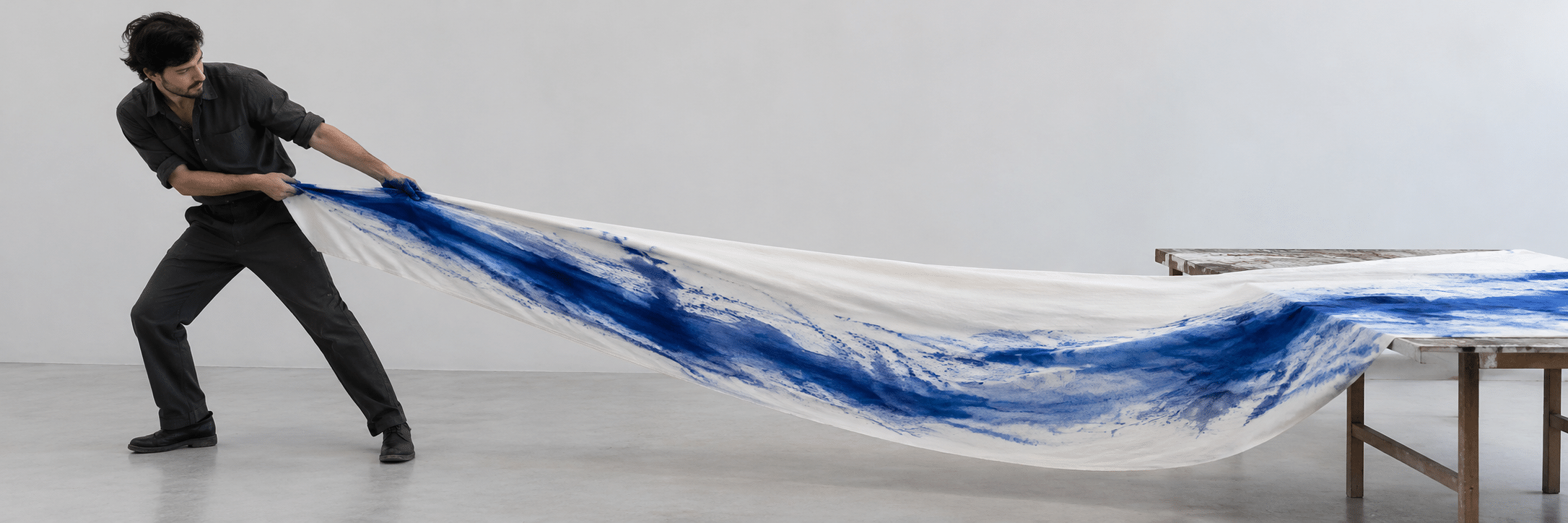
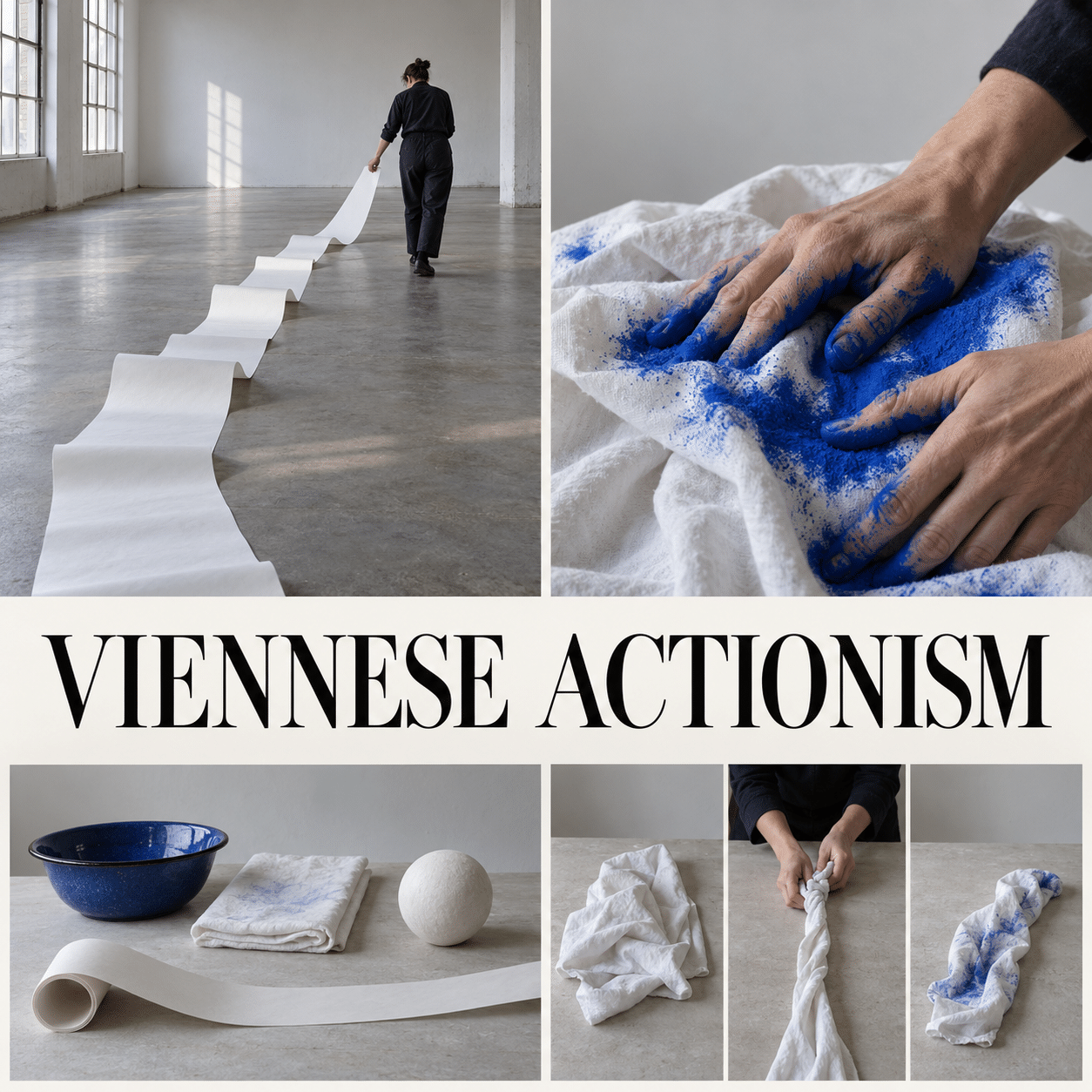
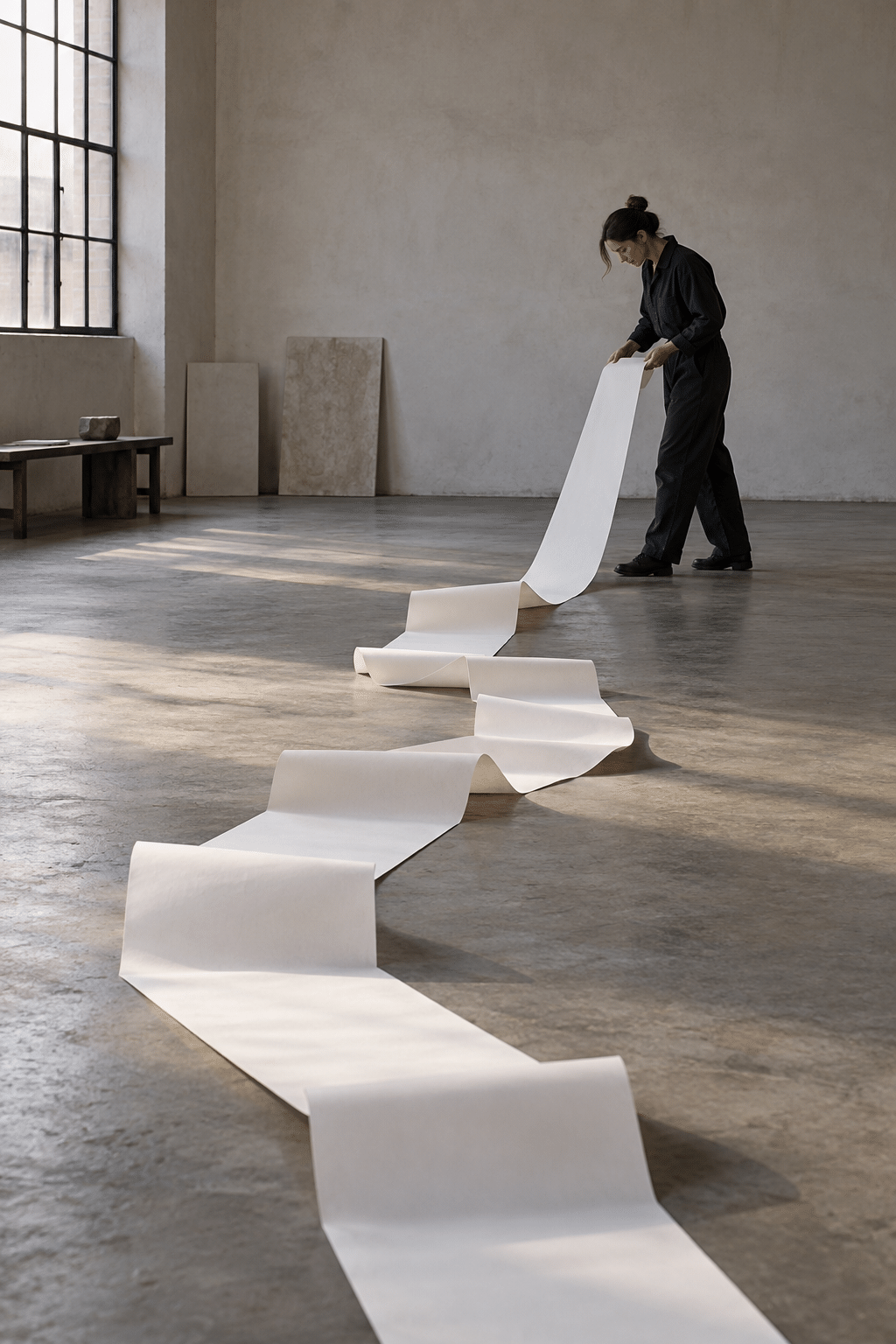
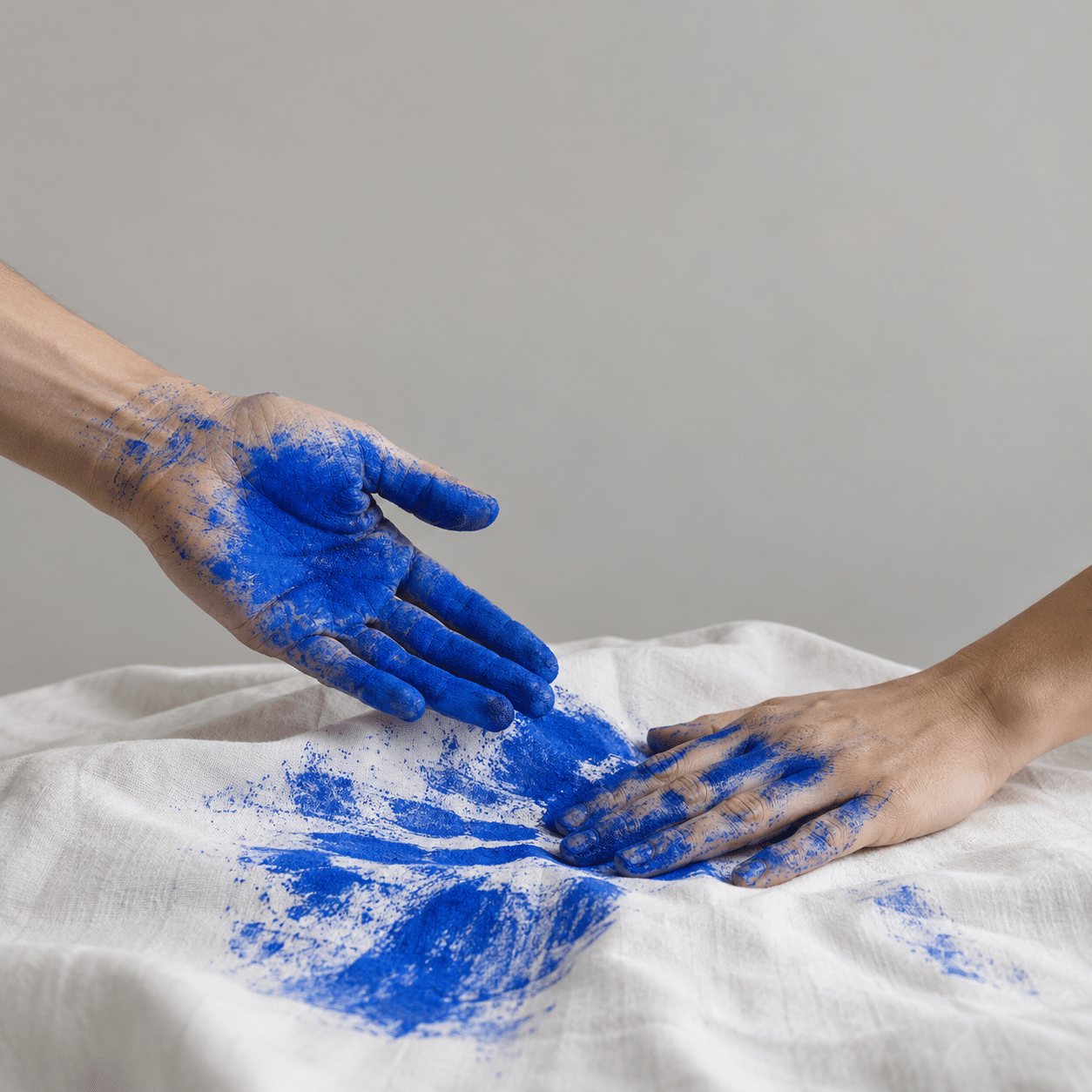
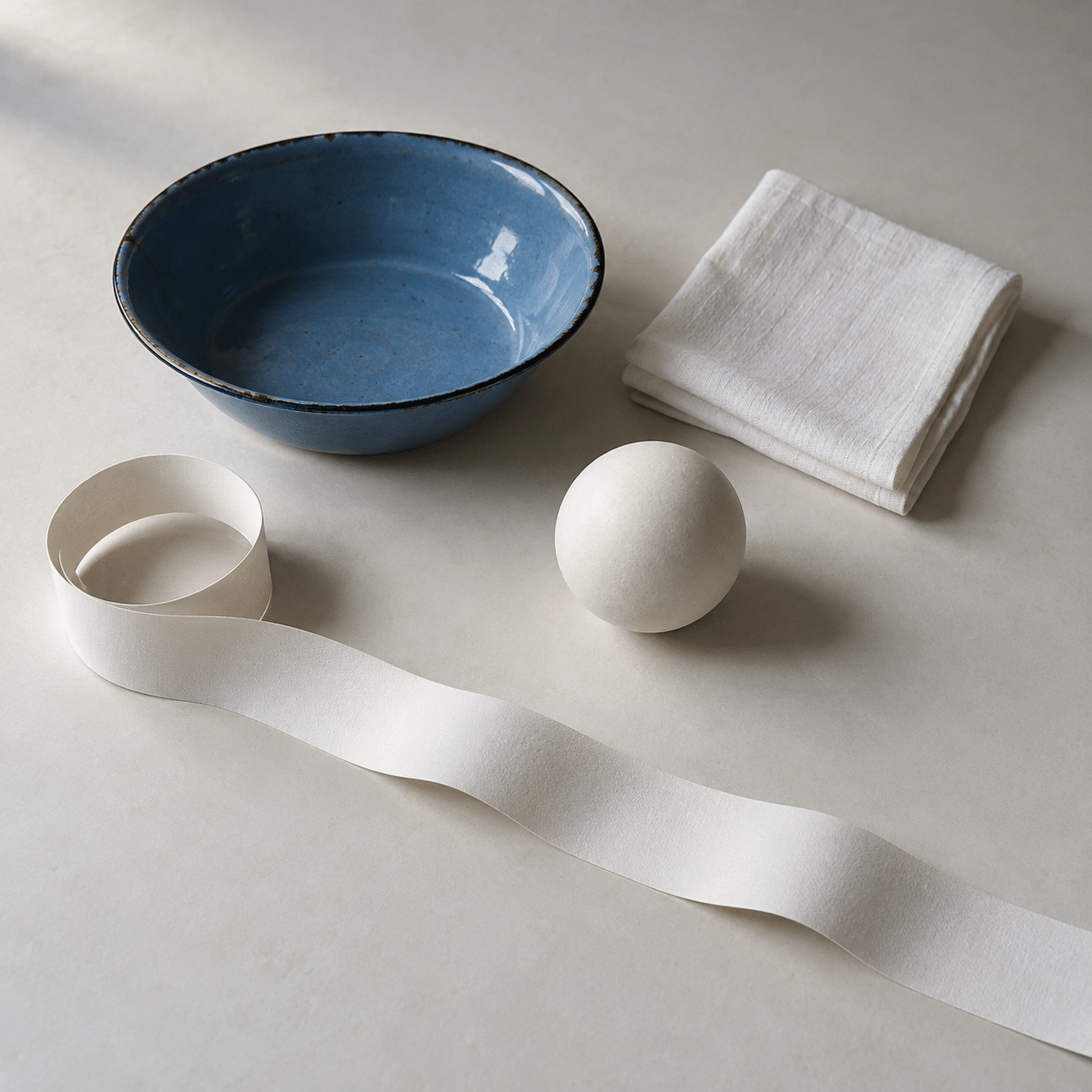
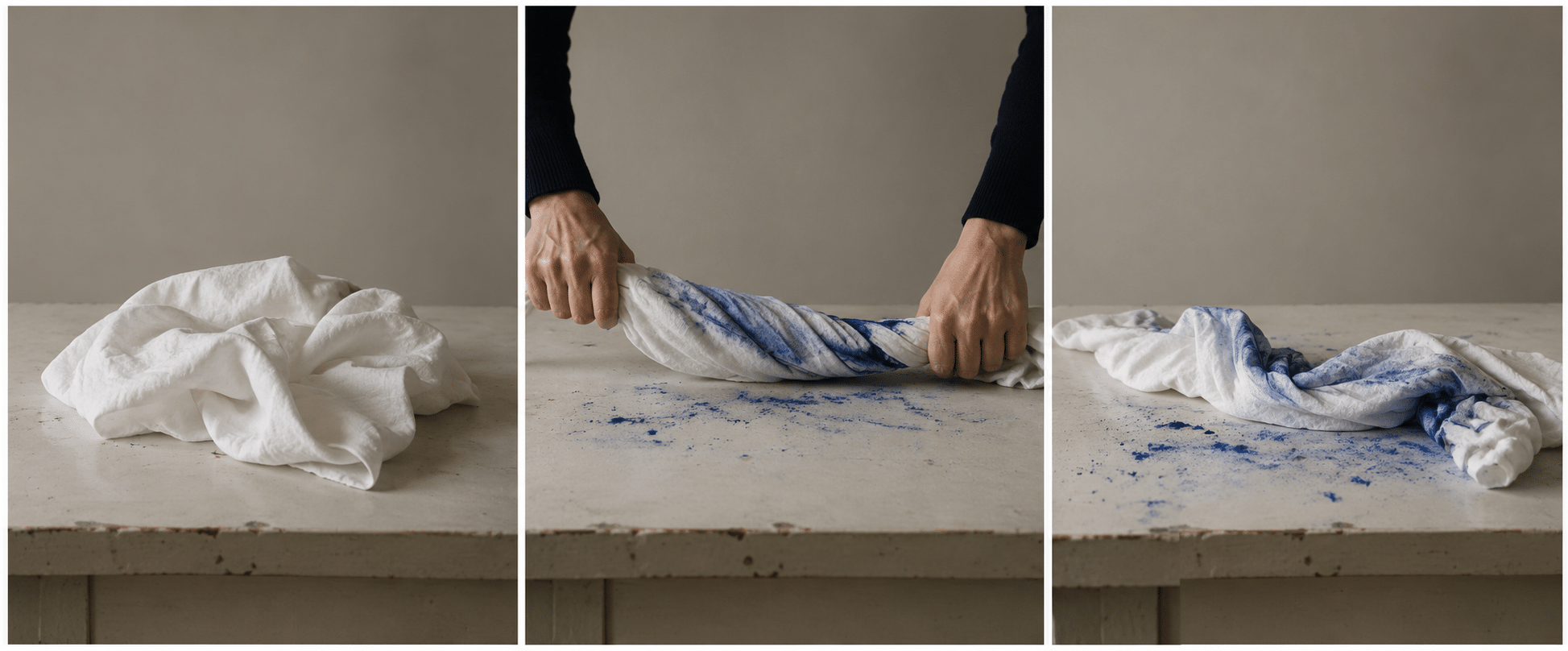
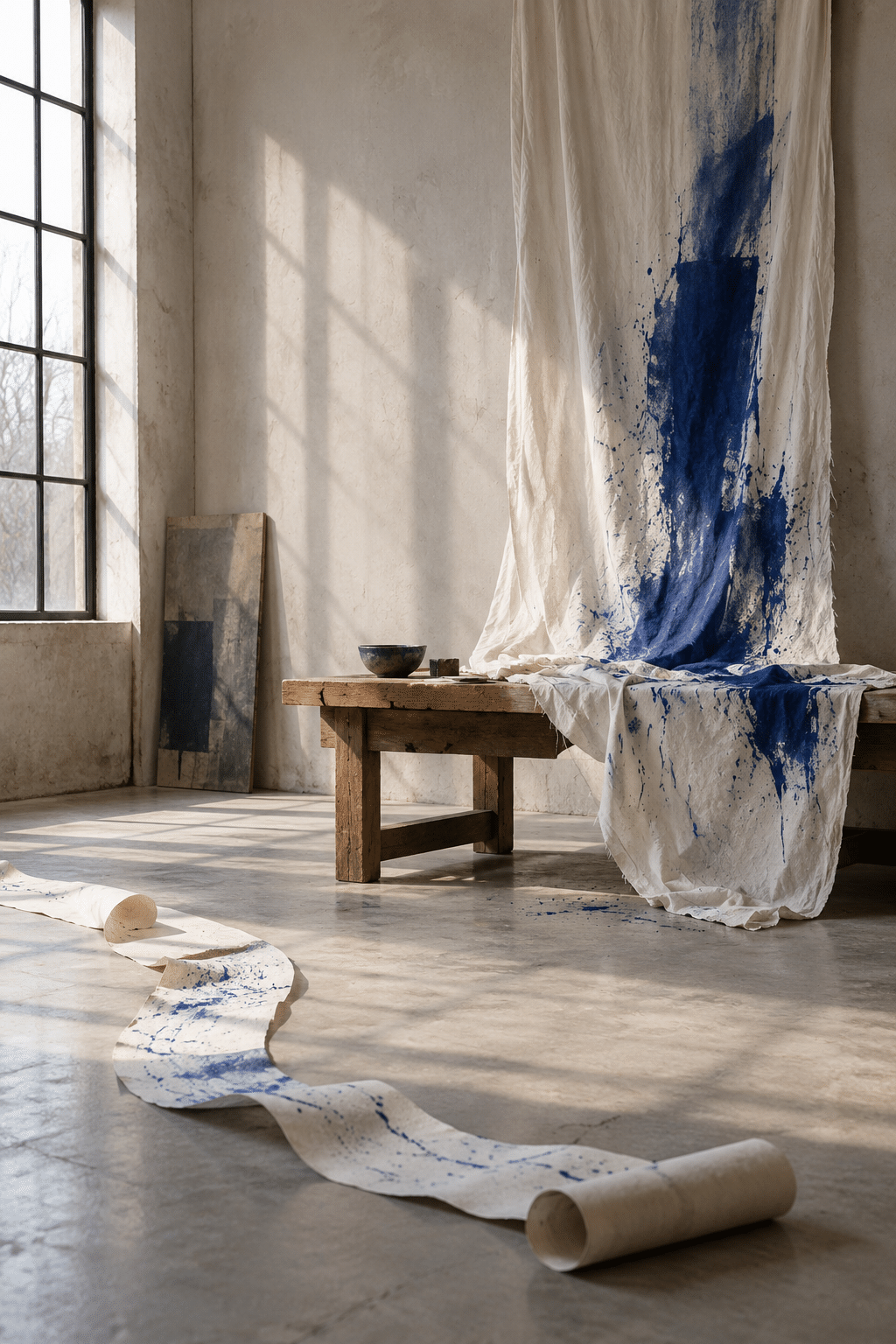
The banner presents an invented studio action involving cloth and blue pigment. The collage compares gesture, arrangement and residue. Five standalone studies examine an adult drawing a long paper strip through a room, hands transferring blue pigment, a sparse tabletop arrangement, successive states of a cloth and an empty space carrying the traces of an action.
All are AI-generated contemporary illustrations. They are not archival photographs, reenactments of named actions or evidence that an event occurred. Their limited purpose is to make selected questions about material, sequence and framing easier to discuss. Consult the institutions below for historical works and their documentation.
Design a study around an operation
Begin with an ordinary material and a precise verb: fold a length of cloth, draw a strip of paper across a floor, transfer colour from a palm to a sheet. Specify a beginning, a change and an end. Keep the action simple enough that the difference between those states is visible.
Choose the camera’s role before composing. A wide view can reveal the performer’s relation to a room; a close view can isolate pressure or contact; a sequence can make duration legible. Avoid a vague distressed-photo effect that supplies atmosphere while concealing what actually changes.
Decide whether the final image emphasizes the gesture or the residue. If both compete equally, the viewer may not know where to look. Use empty space, a limited palette and a clear material contrast to establish a hierarchy. The new examples use these principles without claiming to reproduce the movement’s historical intensity.
What this is not
Action painting, performance art and body art are useful comparisons, but they are not interchangeable names for Viennese Actionism. The latter refers to a particular historical context and set of practices. A paint-splashed portrait or an image of a performer does not acquire that provenance through its appearance.
For prompts, describe the formal experiment and call the result a contemporary interpretation. Keep invented participants anonymous and avoid captions that impersonate an archival record. A persuasive documentary look is precisely why an explicit label matters.
Positive editorial assessment — AI-authored
The movement makes the boundaries of a work unusually visible: surface, gesture, duration, witness and record become questions rather than fixed assumptions. Careful study can sharpen attention to how an image is produced and to what a surviving object or photograph can communicate.
Critical editorial assessment — AI-authored
Spectacle can overpower analysis, and a dramatic photograph can obscure context or participant agency. Formal innovation should not become an excuse for harm. Strong interpretation requires reliable documentation, explicit distinctions between event and image, and a willingness to assess ethics alongside aesthetic claims.
Neutral editorial assessment — AI-authored
Viennese Actionism is a specific historical movement with varied practices extending painting into actions and mediated images. This page combines institutional context with limited contemporary visual exercises. The generated studies illustrate selected formal questions and do not replace historical evidence.
A small poetic detour
Original words from the AOI studio.
Poetry
The room remembers where cloth lay;
a fold retains the weight of hands.
The camera takes one part away
and leaves the rest beyond its bounds.
A mark survives the passing hour,
a frame withholds another view.
We ask what made the image speak,
and what its silence asks us to do.
The prompt workshop
Original creative exercises. These prompts create new illustrations, not documentary evidence.
A gesture and its trace
Create an original contemporary performance-study photograph in a plain studio: a fully clothed adult slowly draws a long unmarked paper strip across the floor, its folds showing the movement. Wide framing, quiet light, a clear relation between body and material; no injury, blood, historical attribution or lettering.
Contact as a composition
Create an original close photographic study of two adult hands transferring washable blue pigment onto white cloth. Make contact, pressure, folds and the resulting marks clear; neutral studio light and restrained framing. A contemporary illustration, no injury or imitation of a named historical action.
Make duration legible
Create a contemporary three-frame photographic study of a white cloth on a simple table: loosely folded, being drawn into a long line by a fully clothed adult, then resting with blue pigment traces. Same camera position and light, coherent material continuity, no text or archival claims.
A smile from the studio
Jokes
The camera said it had captured everything. The empty space just outside the frame asked for a second opinion.