
Tube-based visual style · historical roots and contemporary AOI interpretation
Tubism builds pictures from tubes, cylinders, loops and hollow forms. Explore its connection to Fernand Léger, then see how AOI develops the principle into sculptural portraits, glass gardens and abstract compositions.
A visual introduction
Five original AI-generated AOI studies: a panoramic banner, a centrally titled collage and three standalone artworks exploring portraiture, speculative botany and abstraction.
Select an image for a closer look. Use the thumbnails, arrow keys or a swipe to compare examples. Zoom in to inspect details, or share the image that inspires you.
Creative toolbox · take this style further
Choose an input and a destination. Search sends your words to the chosen site; Copy & open puts them on your clipboard to paste there.
Create with AI
Turn your chosen input into an image prompt or a new creative direction.
ChatGPT
Copy your input and paste it into a ChatGPT conversation or image request.
Copy & open ChatGPT (new tab)Claude · Anthropic
Develop an image prompt or explore the style in a new Claude conversation.
Copy & open Claude · Anthropic (new tab)Midjourney
Paste your input into the Imagine bar on the Create page.
Copy & open Midjourney (new tab)Adobe Firefly
Copy your input, open Firefly, and paste it into the prompt field.
Copy & open Adobe Firefly (new tab)Leonardo.Ai
Copy your input, open Leonardo, and paste it into the generation field.
Copy & open Leonardo.Ai (new tab)Image search
Find visual references. Short, concrete keywords usually work best.
Lexica
Search AI images and prompts using your selected input.
Search with this input Lexica (new tab)Pexels
Search the photo and video library. Short keywords often work best.
Search with this input Pexels (new tab)Pixabay
Search photos, illustrations and other images.
Search with this input Pixabay (new tab)Unsplash
Search photographs using the style name or your own keywords.
Search with this input Unsplash (new tab)Wikimedia Commons
Search photographs, artworks and historical images. Check each file for its source and reuse terms.
Search with this input Wikimedia Commons (new tab)Art & research
Explore artists, collections and the ideas behind a style.
Wikipedia
Search for background reading. A style may not have its own article.
Search with this input Wikipedia (new tab)WikiArt
Copy your input into WikiArt’s search to explore artists and artworks.
Copy & open WikiArt (new tab)Europeana
Paste your keywords into the search to explore European museum, library and archive collections.
Copy & open Europeana (new tab)Inspiration
Discover portfolios and visual ideas from creative communities.
Instagram hashtags
Search a hashtag made from your input: spaces and punctuation are removed. Instagram may require sign-in.
Search with this input Instagram hashtags (new tab)ArtStation
Paste your input into artwork search for concept art, environments, characters and visual development.
Copy & open ArtStation (new tab)Behance
Paste your input into project search for illustration, design and visual storytelling.
Copy & open Behance (new tab)A closer look
A clear tubular route leads the eye. Wide bends contrast with fine channels; selected open ends reveal wall thickness, while carefully shaped gaps give the forms room to breathe. Ceramic, glass, metal or matte paint each change the mood.
What is Tubism?
Tubism is a way of making tubes carry the structure of an image. Cylinders, open mouths, elbows, coils and branching conduits become a vocabulary for bodies, buildings, vegetation or pure abstraction. The important test is structural: if the tubes disappeared, would the composition lose its identity? A conventional scene with a pipe placed in its corner is not enough. In the interpretation developed here, the tube determines the silhouette, the route of the eye and the relationship between matter and empty space.
The name also has an established historical association. It describes the cylindrical emphasis of Fernand Léger’s Cubist work; LaM’s collection presentation notes that Léger was called a tubist in 1911. [1] This entry keeps that context visible while extending the tube principle into contemporary image-making. AOI’s glass gardens, ceramic portraits and imagined infrastructure are original studies, not newly discovered Léger paintings or evidence of a separate historical movement.
A historical connection, not a borrowed biography
Léger’s Contrast of Forms at MoMA, dated 1913, combines geometric cones, cubes and cylinders. The museum explains that the work makes relationships among lines, shapes and colors its subject, rather than anchoring abstraction in an identifiable still life. Its older collection label also draws attention to roughly handled paint and highlights detached from a consistent light source. [2] That is a useful correction to the idea that Tubism must look like immaculately polished plumbing: painted volume can be emphatic without behaving like a photograph.
The Metropolitan Museum’s The Bargeman (1918) offers a different lesson. A boat, city buildings and the worker’s tube-like arms are compressed into overlapping rhythms; the museum relates this structure to motion, technology and life along the Seine. [3] Tubular form can organize recognizable experience as well as abstract shapes. The Guggenheim’s account of its own 1913 Contrast of Forms emphasizes contrasts among cylindrical, cubic and planar units. [4] A strong tube composition therefore benefits from a foil: a flat plane, a sharp rectangle, a small straight interruption. Curves acquire meaning through their neighbors.
These references establish a historical context, not a rule requiring every modern image to imitate one artist. The contemporary studies below deliberately change material, setting and representational depth. Their shared principle is the expressive organization of tubular forms.
The visual grammar: follow the hollow
Start with a dominant route. One broad bend can turn a portrait’s forehead into its nose; a second, narrower route can answer it across a shoulder. In a landscape, an arch or a looping conduit can connect foreground and distance. Give that movement a direction before adding small branches. Repeating the same diameter everywhere usually produces an even texture; a hierarchy of wide, medium and fine tubes creates emphasis.
Show selected openings. A dark elliptical mouth makes thickness and direction immediately legible. A solid cylinder and a hollow tube may share an outline, but the opening changes our sense of what the form can contain, carry or transmit. Too many identical mouths make the picture resemble a product catalog. Reserve the clearest cross-section for a focal point and let some tubes leave the frame.
Treat the spaces between tubes as designed shapes. A narrow gap can suggest a cheek; an open loop can hold the brightest patch of the composition. In a crowded image, these intervals are the first thing to disappear. Pull back until the main void remains visible at thumbnail size. Then decide whether shadows should describe a coherent three-dimensional object or deliberately conflict with the flat painted surface. Both approaches work; an accidental mixture often does not.
Five images, five decisions
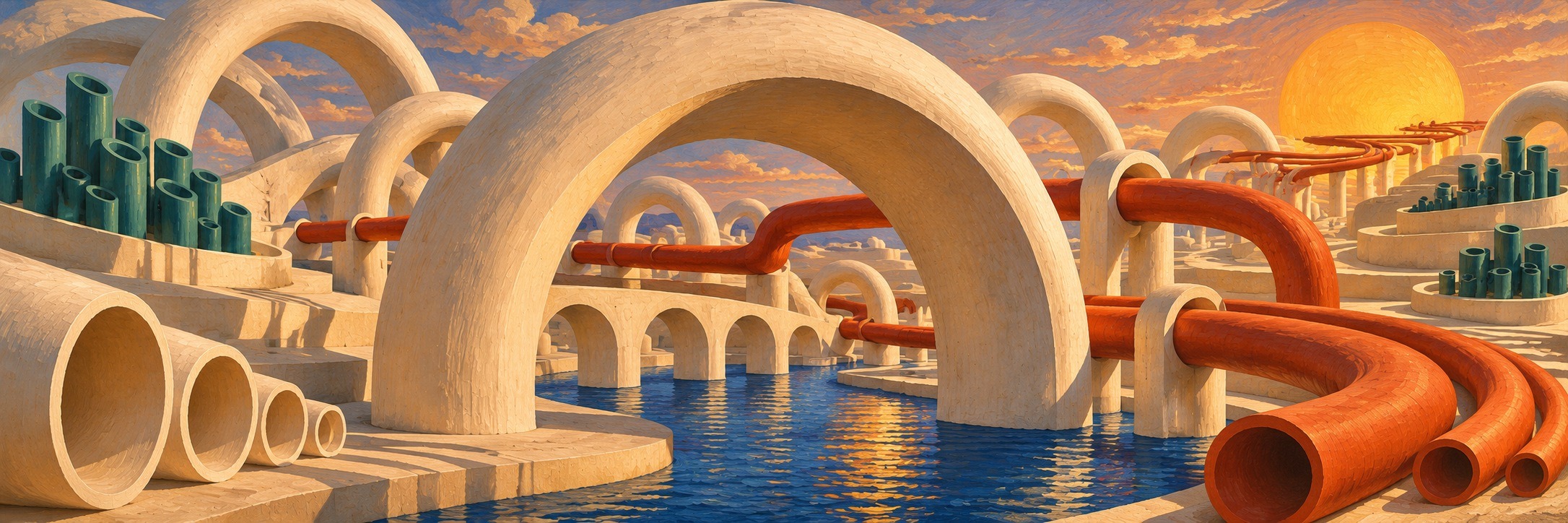
The banner, A City with Room to Breathe, uses large ivory arches to stabilize a panorama while orange conduits carry the eye into the distance. Hollow sections in the foreground announce the material logic; the blue channel creates a pause beneath the repeated curves. Architecture is the subject, but scale and rhythm are the argument.
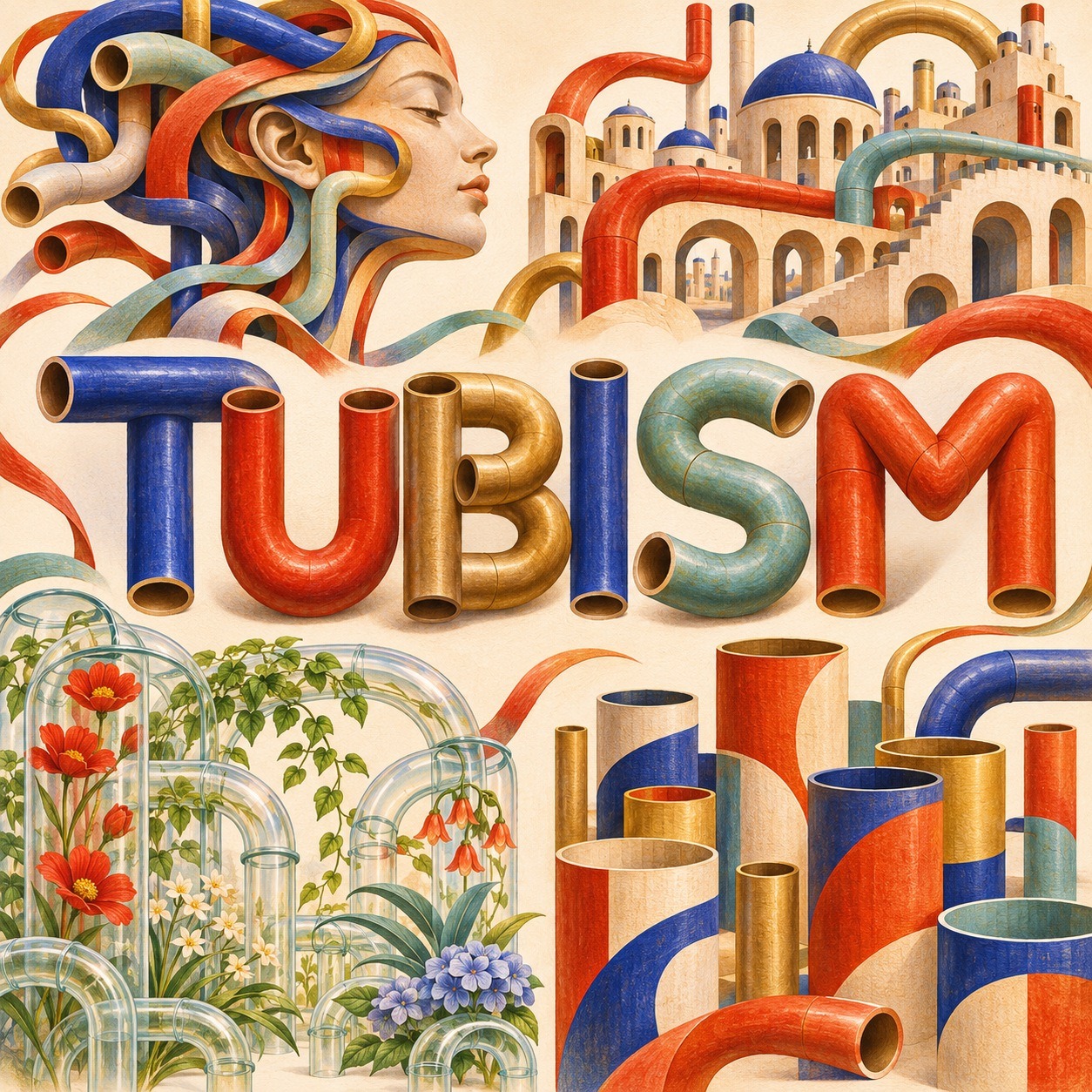
The titled collage introduces four uses of the vocabulary: a profile, a city, a glass garden and an abstract cluster. Its central TUBISM lettering is itself assembled from tubes. It is a visual index rather than a historical survey. Notice how the openings remain recognizable even when the material changes from painted ceramic to glass.
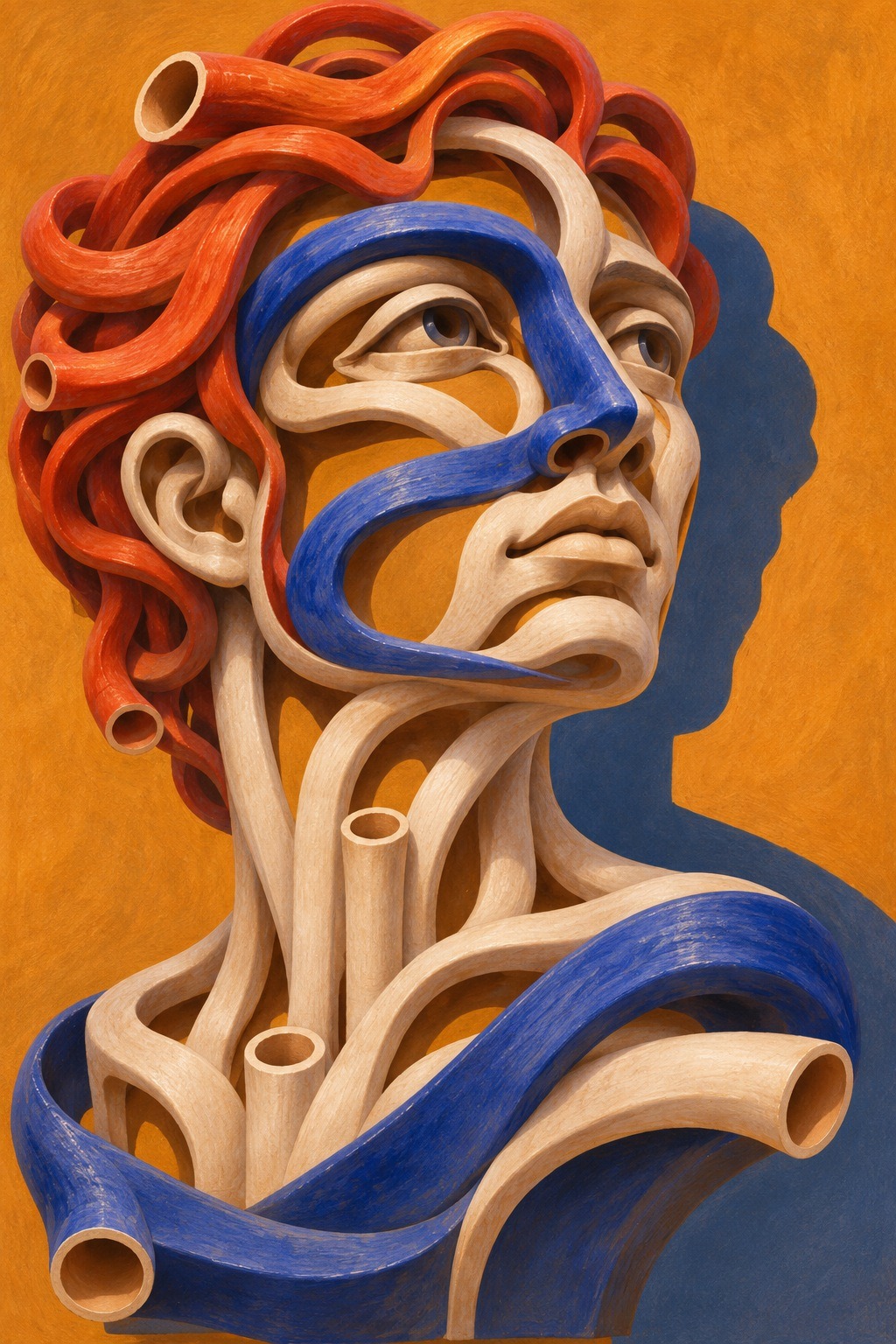
The portrait, The Thought Takes a Bend, combines a readable gaze with a face interrupted by tubular cavities. The strong blue brow-to-nose route anchors the composition; red coils make the upper edge restless. It retains modeled eyes and lips rather than reducing every feature to a pipe. That compromise gives the viewer a human point of contact while making the construction strange.
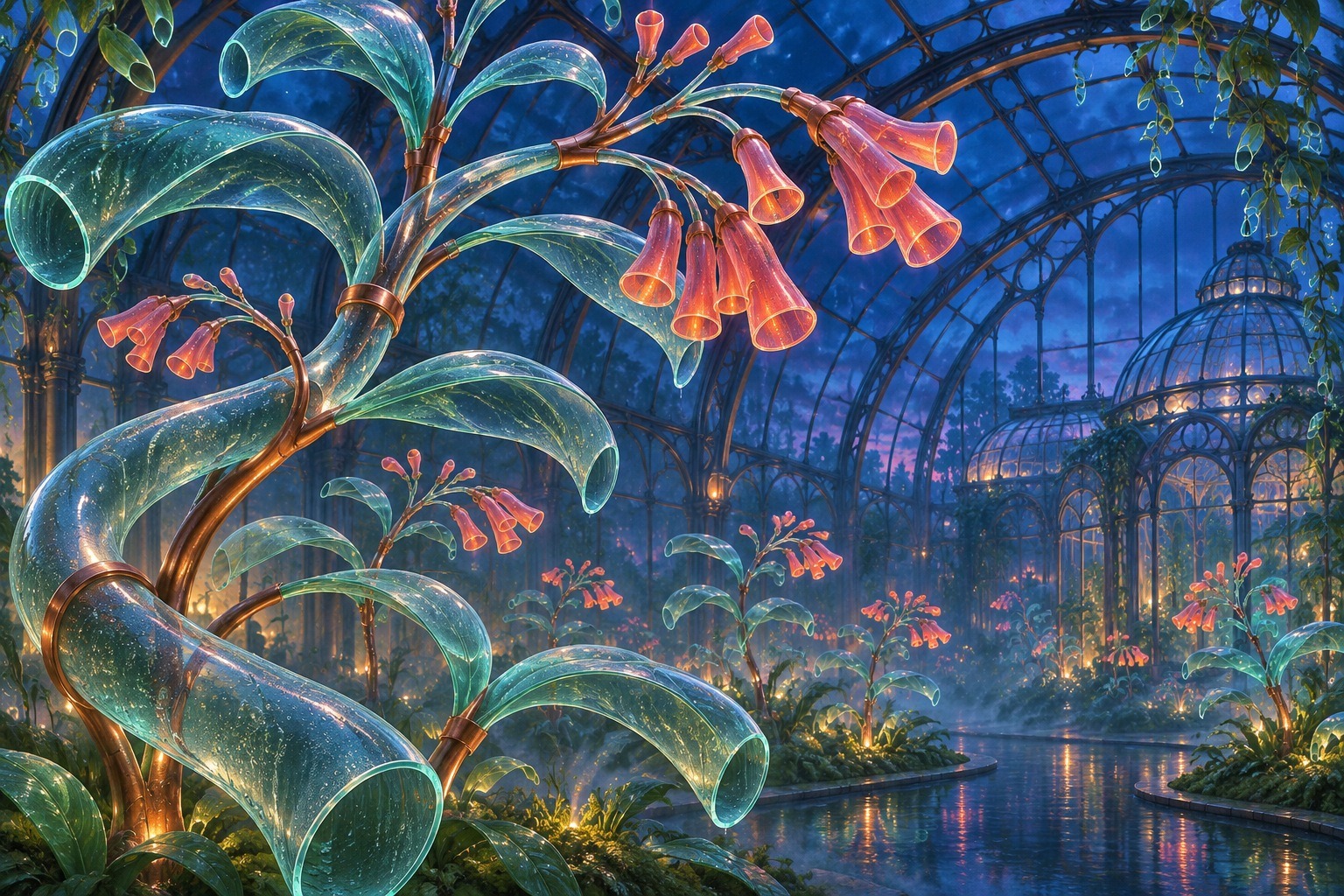
The Greenhouse That Learned to Breathe moves the same principle into speculative botany. Transparent leaves curl into open channels, copper-colored stems join them and coral blossoms glow against a deep blue conservatory. Tubism becomes delicate rather than industrial. The image is a fantasy illustration, not a functioning design for plants, ventilation or glass engineering.
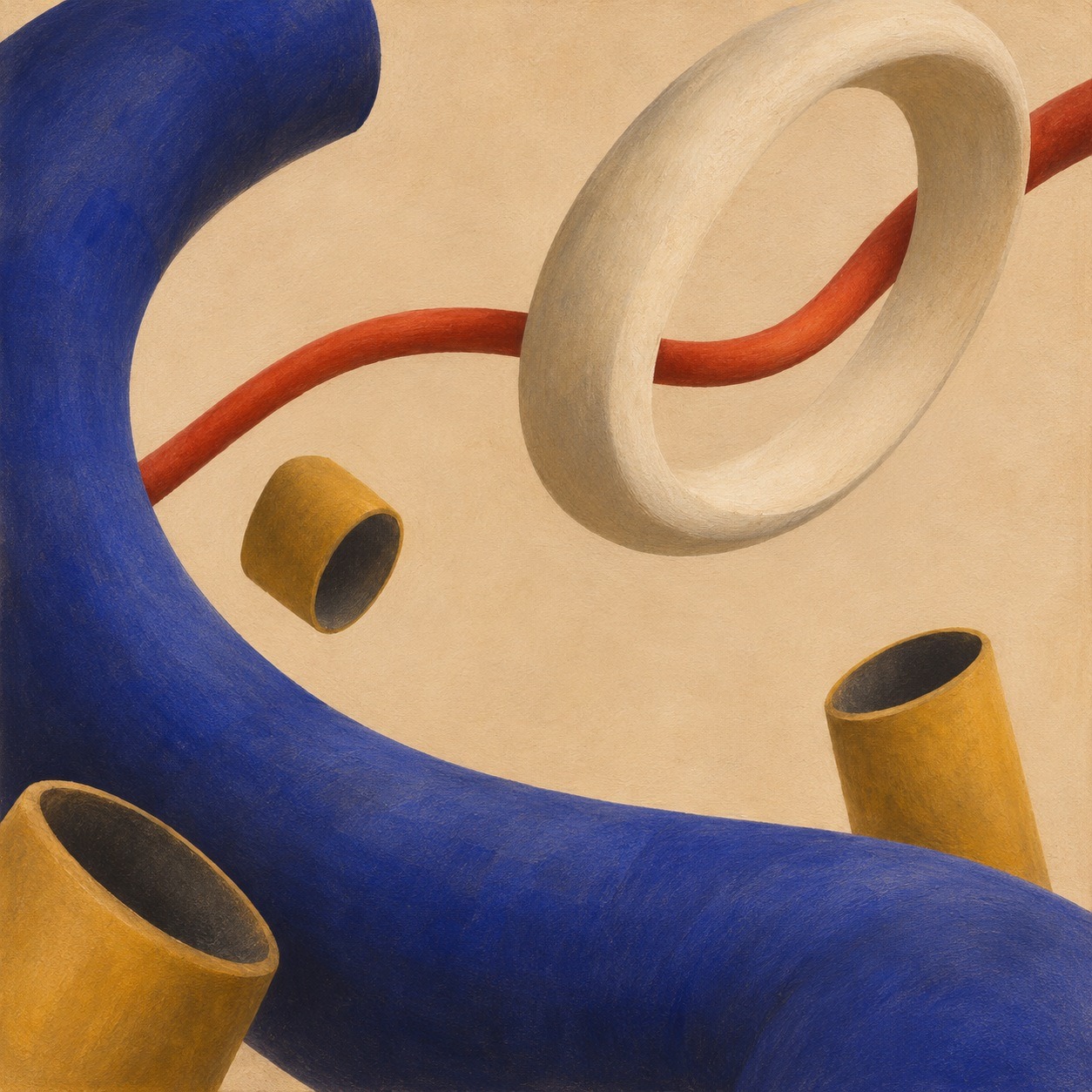
Quiet Pressure removes the recognizable setting. A broad blue sweep, an ivory loop, a thin red line and short ochre cylinders make a compact argument about scale. The empty center matters as much as any object. The paper-like grain also demonstrates that the tube can remain painterly; reflective metal is only one option. All five artworks are original AI-generated AOI interpretations.
Material changes the emotional register
Matte ceramic gives a tube weight, tactility and a slight vulnerability. Glass suggests passage, fragility and light; a glass tube can reveal another form through its wall. Brushed metal pushes a composition toward machines and infrastructure. Soft rubber introduces flexibility and unease. Painted cylinders can refuse believable material altogether, letting bands of color establish volume only long enough to disrupt it.
Choose one material behavior to lead. A glass garden needs a reason for its highlights and transparency, while an opaque painted abstraction can succeed through color contrasts alone. Mixing six materials at once often makes the result look like a sample board. Two contrasting materials usually provide enough difference: a heavy ceramic frame around a delicate glass channel, for example, or a fine copper branch against a broad matte blue loop.
Using Tubism in AI art generation
The word alone is a weak instruction. A model may respond with Cubist fragments, literal plumbing, inflated lettering or a vaguely mechanical portrait. Describe what must become tubular, where the main route begins and ends, which openings should be visible, and how much empty space remains. A subject plus a construction rule is more useful than a long string of quality adjectives.
Work in three passes. First ask for a simple silhouette and one dominant bend. Next specify material and lighting. Finally inspect connections at close range: do tubes merge unintentionally, change thickness without purpose, stop behind an object and resume somewhere impossible, or produce duplicate facial features? Revise the defective junction instead of adding more ornament. A technically impossible form may be welcome in a dream image, but it should read as a deliberate decision.
Compare controlled variations. Keep the subject and composition stable while changing ceramic to glass, or keep the palette stable while changing three large tubes into many narrow ones. The exercise reveals which choice actually creates the mood. Generated images can suggest sculpture or architecture, but convincing surfaces do not establish structural feasibility; fabrication requires a separate technical design.
Useful applications—and where the approach fails
Tubism is useful for editorial illustration about networks, circulation, connection or constrained movement. It also supports sculptural portraits, speculative environments, album imagery and abstract studies. The tube supplies a natural visual metaphor for carrying something: air, water, a signal, a story. Let the composition show whether that passage is open, interrupted or looping back on itself.
Its easiest failure is decorative excess. An attractive tangle can conceal the fact that nothing matters more than anything else. Another is the inflated-toy effect: uniform gloss, rounded ends and saturated colors can make a serious image feel unintentionally weightless. Introduce scale differences, a clear void, a matte surface or an abrupt termination. If every curve is equally charming, remove a few curves.
Do not confuse this vocabulary with a comprehensive account of Cubism, or assume every artwork containing a cylinder belongs to Tubism. Our catalog uses “style” as a practical visual route as well as a historical label. Here the route is specific: tubes organize form. The links below open neighboring approaches so you can compare the rule rather than treat the name as a sealed box.
Penny’s studio note: the bend is the point
I began with a tube and expected an industrial incident. I got a face that appeared to be thinking around a corner. This is inconvenient: I had prepared a perfectly respectable complaint about decorative plumbing, and now I have feelings. The blue bend in the portrait does more work than an entire meeting about visual identity. It moves. It hesitates. It gives the empty space a job.
My practical advice: leave one passage open. For light, for breath, for the thought you have not had yet. [STUDIO NOTE: circulation restored. Destination not disclosed.] Yes, the cat has inspected the opening. No, we are not increasing its diameter to accommodate his management ambitions.
Pocket-sized facts
Historical context: Tubism is associated with the cylindrical emphasis of Fernand Léger’s Cubist work. [1–4]
AOI scope: the contemporary tube-based studies are original interpretations, not historical artworks.
Construction principle: use tube diameter, bend direction, openings and negative space to organize the entire image.
A small poetic detour
Original words from the AOI studio.
Poetry
A curve goes where a straight line cannot.
It carries the blue of a room out of sight,
leaves a small mouth open to morning,
and makes a shelter of its turn.
Inside the hollow: neither absence nor failure,
but space with a direction to choose.
Hold one end to the silence.
The other end is learning to listen.
The prompt workshop
Original creative exercises. These prompts create new illustrations, not documentary evidence.
Start: one bend, one opening
Create an original Tubism abstract painting: one broad cobalt tube bends around a warm ivory void, a short vermilion cylinder points inward, one dark elliptical opening reveals the wall thickness. Matte painted surface, asymmetrical balance, quiet ochre background, generous empty space. No text, signature or logo.
Keep the opening readable before adding more forms.
Compose: a tubular portrait
Create a contemplative portrait built from ceramic tubular forms. One blue continuous curve runs from brow through nose toward cheek; smaller red coils form hair, ivory tubes carry the neck and shoulders. Preserve a readable gaze, selected hollow ends and empty spaces through the construction. Warm ochre ground, soft raking light, tactile paint. No text or logos.
Review the face and each junction; keep only intentional anatomical distortions.
Experiment: a breathing greenhouse
Imagine a blue-hour greenhouse whose plants are made from transparent hollow glass channels, copper stems and coral tubular flowers. A single sweeping foreground branch establishes scale; smaller plants recede into blue negative space. Show openings, controlled transparency and coherent branching. Original Tubism interpretation, atmospheric painterly finish, no text.
Compare a glass version with a matte ceramic version while keeping the composition stable.
People & works to explore
References discussed in this article. Consult the sources below for context.
Artists and practitioners
Fernand Léger — historical context; the contemporary examples are AOI interpretations.
Paintings and other works
Fernand Léger, Contrast of Forms, 1913 — MoMA collection. [2]
Fernand Léger, The Bargeman, 1918 — The Metropolitan Museum of Art. [3]
A smile from the studio
Jokes
The tube applied for a promotion. Management praised its excellent flow, then asked it to think outside the pipe.
Sources and further exploration
[1] LaM — 2026 collection presentation, “Cubismes”: Léger described as tubist in 1911
[3] The Metropolitan Museum of Art — The Bargeman (1918): tubular bodies, machines and city rhythms
[4] Guggenheim — Contrast of Forms (1913): cylinders, cubes, planes and alternating solids and voids