
Abstract art · nature as a source of form
Organic abstraction uses shapes, rhythms and spatial relationships that suggest growth, bodies or natural processes without necessarily depicting an identifiable organism. A swelling contour might recall a seed, a joint or a worn stone while remaining open to several readings. This guide explores that ambiguity through documented painting and sculpture, then tests it in original visual studies.
A visual introduction
Select an image for a closer look. Use the thumbnails, arrow keys or a swipe to compare examples. Zoom in to inspect details, or share the image that inspires you.
Creative toolbox · take this style further
Choose an input and a destination. Search sends your words to the chosen site; Copy & open puts them on your clipboard to paste there.
Create with AI
Turn your chosen input into an image prompt or a new creative direction.
ChatGPT
Copy your input and paste it into a ChatGPT conversation or image request.
Copy & open ChatGPT (new tab)Claude · Anthropic
Develop an image prompt or explore the style in a new Claude conversation.
Copy & open Claude · Anthropic (new tab)Midjourney
Paste your input into the Imagine bar on the Create page.
Copy & open Midjourney (new tab)Adobe Firefly
Copy your input, open Firefly, and paste it into the prompt field.
Copy & open Adobe Firefly (new tab)Leonardo.Ai
Copy your input, open Leonardo, and paste it into the generation field.
Copy & open Leonardo.Ai (new tab)Image search
Find visual references. Short, concrete keywords usually work best.
Lexica
Search AI images and prompts using your selected input.
Search with this input Lexica (new tab)Pexels
Search the photo and video library. Short keywords often work best.
Search with this input Pexels (new tab)Pixabay
Search photos, illustrations and other images.
Search with this input Pixabay (new tab)Unsplash
Search photographs using the style name or your own keywords.
Search with this input Unsplash (new tab)Wikimedia Commons
Search photographs, artworks and historical images. Check each file for its source and reuse terms.
Search with this input Wikimedia Commons (new tab)Art & research
Explore artists, collections and the ideas behind a style.
Wikipedia
Search for background reading. A style may not have its own article.
Search with this input Wikipedia (new tab)WikiArt
Copy your input into WikiArt’s search to explore artists and artworks.
Copy & open WikiArt (new tab)Europeana
Paste your keywords into the search to explore European museum, library and archive collections.
Copy & open Europeana (new tab)Inspiration
Discover portfolios and visual ideas from creative communities.
Instagram hashtags
Search a hashtag made from your input: spaces and punctuation are removed. Instagram may require sign-in.
Search with this input Instagram hashtags (new tab)ArtStation
Paste your input into artwork search for concept art, environments, characters and visual development.
Copy & open ArtStation (new tab)Behance
Paste your input into project search for illustration, design and visual storytelling.
Copy & open Behance (new tab)A closer look
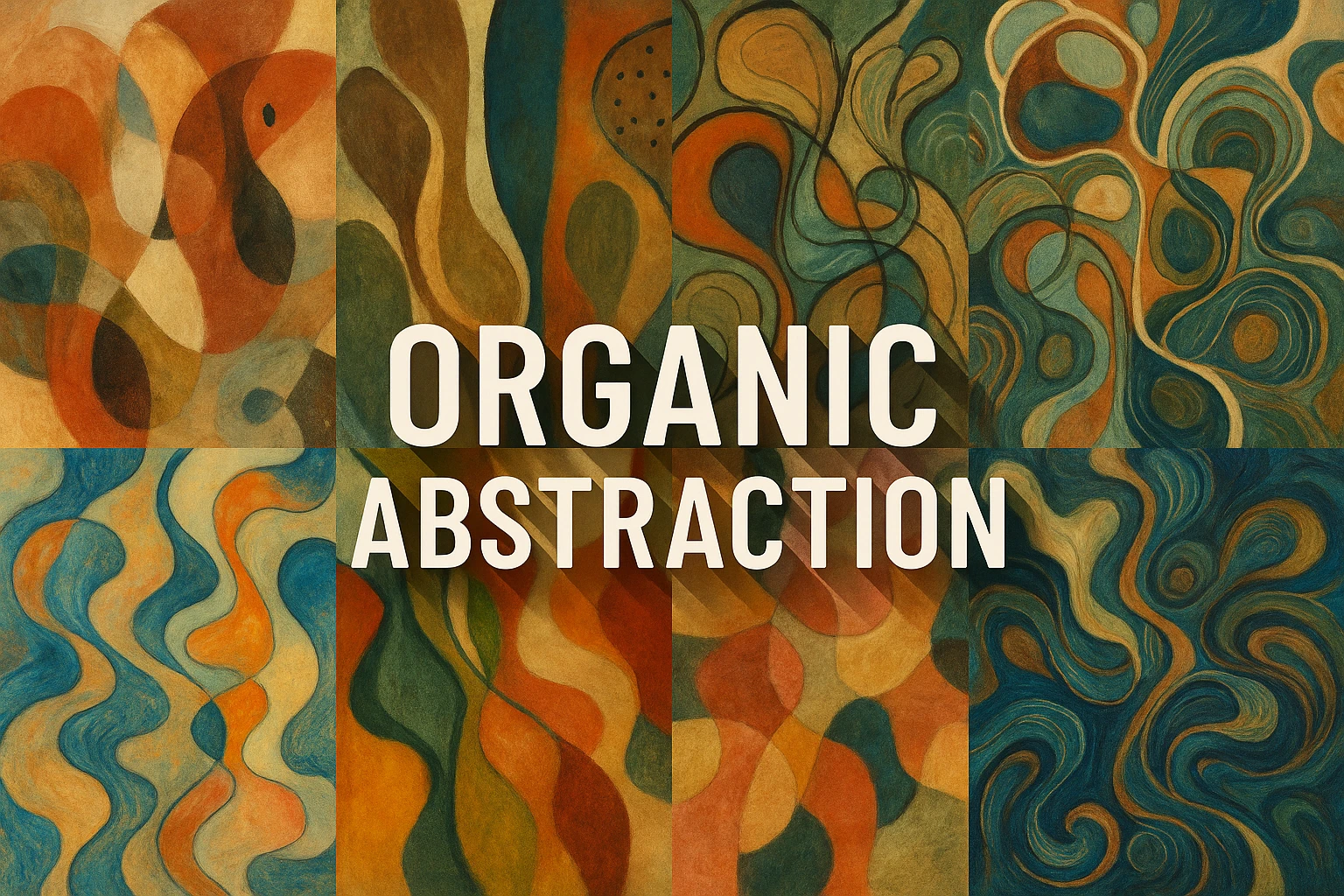
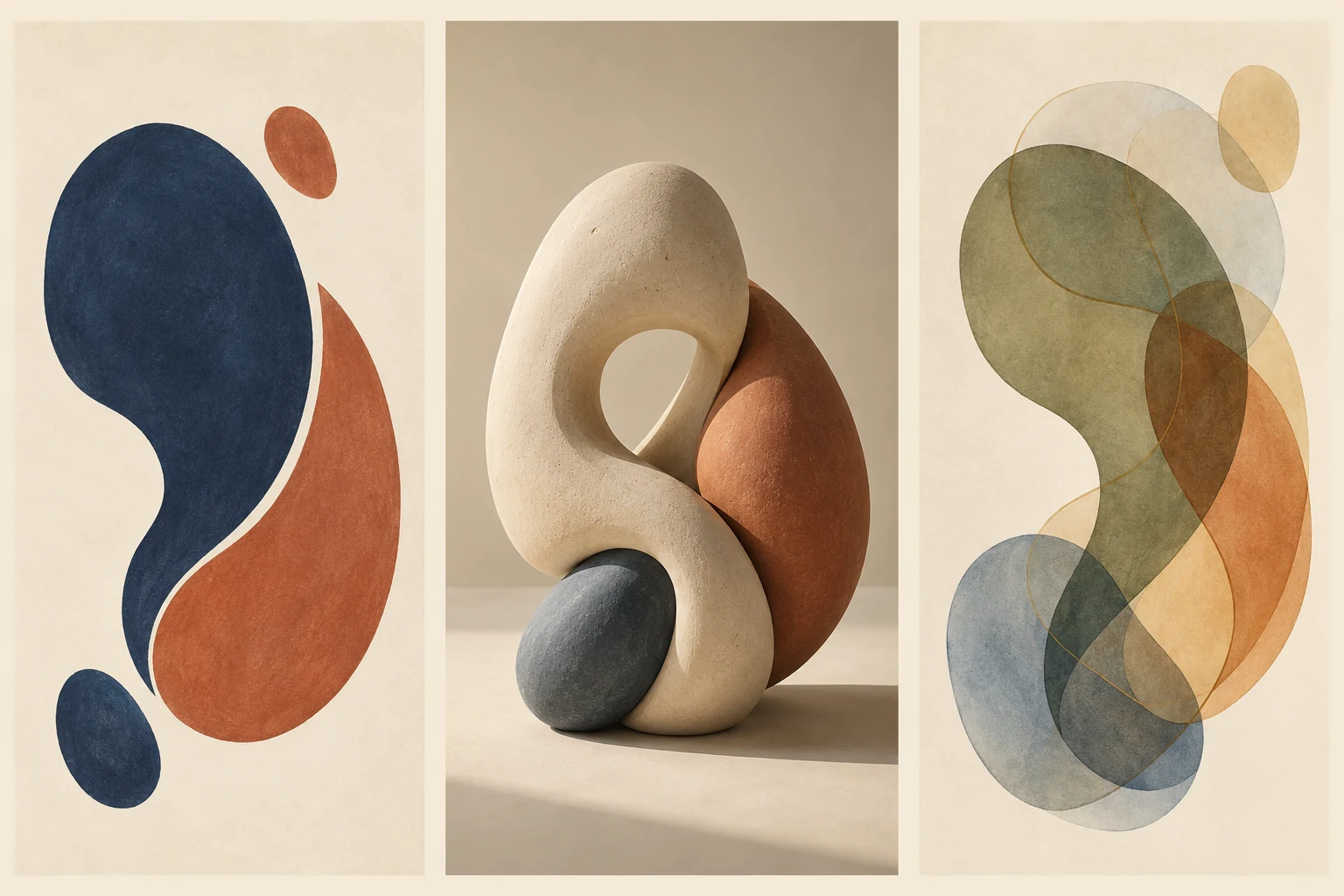
The archive collage uses ochre, teal and rust-coloured shapes that bulge, overlap and curl. The new triptych adds a different comparison: a flat silhouette, an imagined sculptural form with an opening, and translucent layered shapes. Both images are AI studies, not reproductions of the museum works discussed here.
Organic is a relationship, not a colour palette
An organic-looking form can swell, narrow, bend, branch or appear to grow into its neighbour. It need not be green, soft-edged or reassuring. A hard boundary may describe a supple mass; an acidic colour may make it feel unsettled. The term is most useful when it identifies what the shapes are doing, rather than promising a tranquil mood.
Biomorphic is a closely related word for forms that evoke living things without fully representing them. A literal painting of a leaf remains identifiable as a leaf; an abstract contour may preserve its tension or branching without retaining that identity. These are different degrees of transformation, not a contest in how thoroughly the subject can be hidden. The Met’s discussion of Jean Arp offers a concrete example of natural suggestion without direct imitation. [1]
Jean Arp: a form that seems to develop
The Met dates Arp’s Configuration in Serpentine Movements I to 1950 and identifies its material as marble. Its account describes his use of plaster models and forms that evoke nature without specifying a particular natural object. MoMA’s Human Concretion (1935), by contrast, is catalogued as plaster. Those records distinguish two objects and materials; neither is the sculpture shown in our generated triptych. [1][2]
When studying a sculpture, follow the outline from more than one viewpoint if reproductions are available. Notice where a mass broadens, where a narrow passage makes it seem vulnerable, and how the base changes the apparent balance. The surrounding space participates in the reading. An opening can become as distinctive as the solid material around it.
Kandinsky: geometry and living suggestion can coexist
The Guggenheim’s record of Capricious Forms (July 1937), an oil painting, describes curving, biologically suggestive figures alongside circles and squares. It connects the artist’s imagery with his interest in scientific sourcebooks. This is a useful correction to the idea that organic abstraction must reject geometry entirely: different kinds of shape can create tension within the same composition. [3]
Look for differences in scale and behaviour rather than assigning every mark to a species. One shape may seem to float, another to nest inside a boundary, another to point toward an edge. Biological resemblance is a way into the painting, not proof that the picture is a scientific diagram. Nor should one phase of a painter’s work define everything that painter made.
Read the two AOI studies closely
The archive collage groups irregular patches, thin looping contours and larger flowing bands. Its shared palette makes the panels feel related, but the dense curls behave differently from the broad overlapping areas. Cover the lettering mentally and ask which panel has the clearest dominant shape. Repetition is useful only when the parts have relationships worth repeating.
In the new triptych, the left panel treats the contour as a flat coloured boundary. The centre invents an object with volume, contact shadows and a visible opening. The right panel lets overlapping transparent-looking shapes create additional regions. The comparison demonstrates three compositional possibilities. It does not prove that a physical sculpture was made, that plaster behaves exactly as pictured, or that the study follows a historical artist’s process.
Three choices before adding texture
Choose a dominant silhouette, decide how much empty space it needs, and set the direction in which neighbouring forms seem to move. Then make three variations by changing only one of those decisions. A small paper cut-out is enough. If every edge receives a flourish immediately, it becomes difficult to tell which decision is carrying the composition.
For an AI experiment, ask for a limited number of asymmetrical forms and a particular relation between solid shape and open space. Review whether the output preserves that relation when viewed small. If it dissolves into decorative foliage, revise the structural instructions before adding more style adjectives. A convincing abstraction gives the eye something precise to negotiate while leaving the identity of the thing unresolved.
Translate a process rather than trace an object
Choose a natural process such as branching, compression or erosion, then describe its action in three verbs. Draw a family of forms using those verbs without reproducing a recognisable plant or animal. A branching system might divide unevenly and reconnect; a compressed form might bulge where it meets a boundary. The process supplies relationships, not a compulsory motif.
Test the same form as a flat cut-paper silhouette, a shaded volume and a translucent overlap. Each medium changes what the viewer can infer about thickness, weight and continuity. This comparison helps explain why organic abstraction is broader than a collection of rounded blobs.
Where a composition loses its structure
Uniform softness can make every edge equally unimportant. Introduce a deliberate change: a narrow neck between two masses, one angular interruption or a gap that carries as much weight as a solid form. Keep the change connected to the larger rhythm rather than adding an arbitrary decorative accent.
A useful final test is to rotate or mirror the composition and ask what has been lost. If every arrangement works equally well, the relationships may still be too general. Strong abstraction need not depict a named object, but it benefits from specific tensions that make this arrangement feel necessary.
A small poetic detour
Original words from the AOI studio.
Poetry
The shape almost names itself.
A space opens beside it.
I leave the name outside.
The prompt workshop
Original creative exercises. These prompts create new illustrations, not documentary evidence.
Contour and quiet space
An original abstract gouache composition with three asymmetrical seedlike shapes, one large indigo mass and two smaller warm forms, generous ivory negative space, crisp but curving boundaries, no literal leaves, flowers, animals, text or identifiable artwork.
Original AOI exercise; model output varies. Label generated results as synthetic.
Volume and opening
An original imagined biomorphic sculpture with one continuous rounded mass and a clearly visible off-centre opening, matte mineral surface, neutral plinth, single side light, coherent contact shadow, restrained background. A synthetic sculptural study, not a photograph of an existing sculpture.
Original AOI exercise; model output varies. Label generated results as synthetic.
Transparent relationships
An original abstract composition of five translucent curved shapes, olive, amber and slate blue, uneven overlapping regions, one clear area of rest, subtle paper texture, no botanical illustration or text.
Original AOI exercise; model output varies. Label generated results as synthetic.
People & works to explore
References discussed in this article. Consult the sources below for context.
Artists and practitioners
Jean (Hans) Arp — biomorphic sculptural forms
Vasily Kandinsky — biologically suggestive forms in the cited 1937 painting
Paintings and other works
Configuration in Serpentine Movements I (1950), Jean Arp, marble
Human Concretion (1935), Jean Arp, plaster
Capricious Forms (1937), Vasily Kandinsky, oil on canvas