
Color-based abstraction
Synchromism is associated with Morgan Russell and Stanton Macdonald-Wright’s experiments in building form through color. Study how colored areas generate rhythm and spatial relationships, rather than treating every bright spiral as a historical example.
A visual introduction
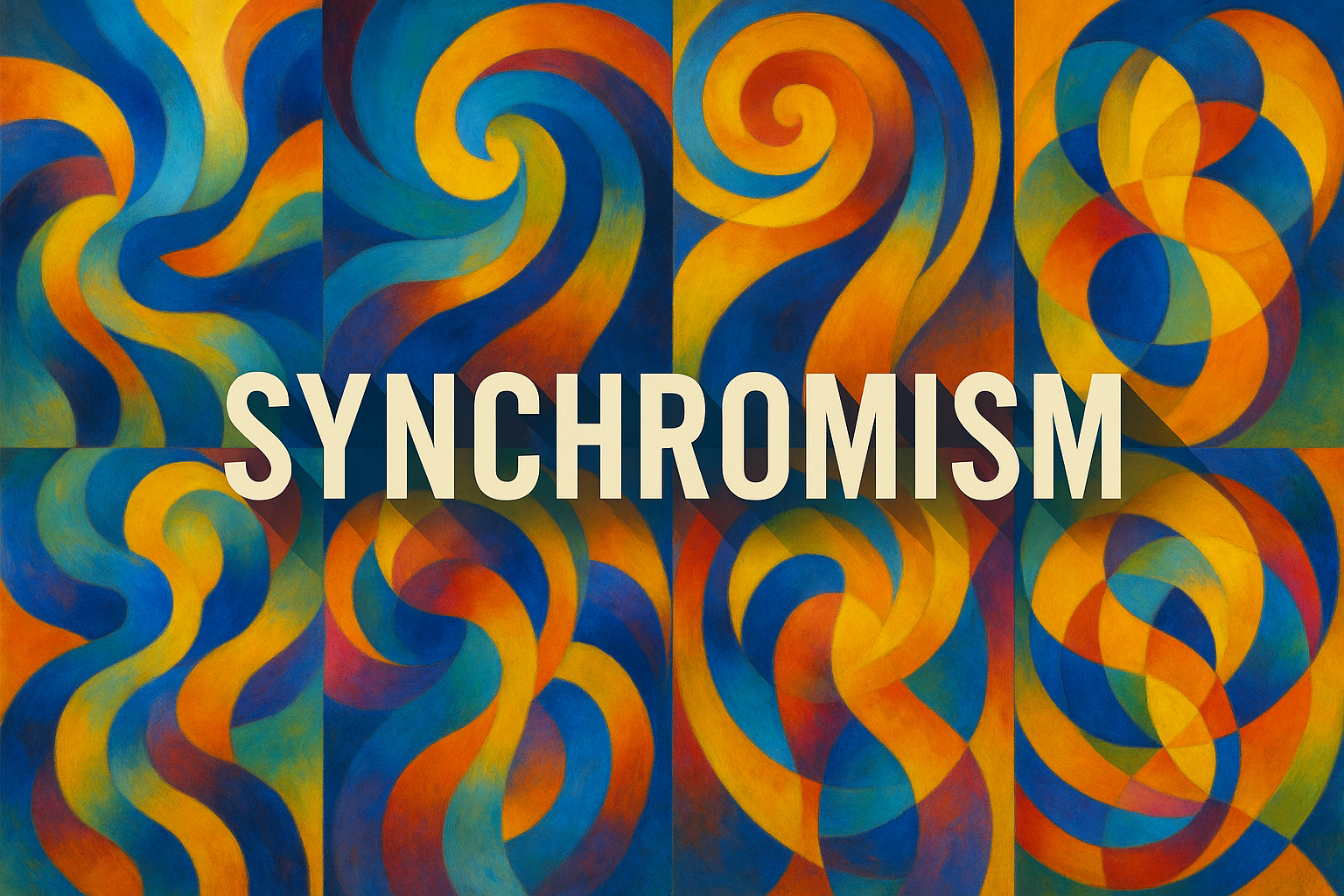
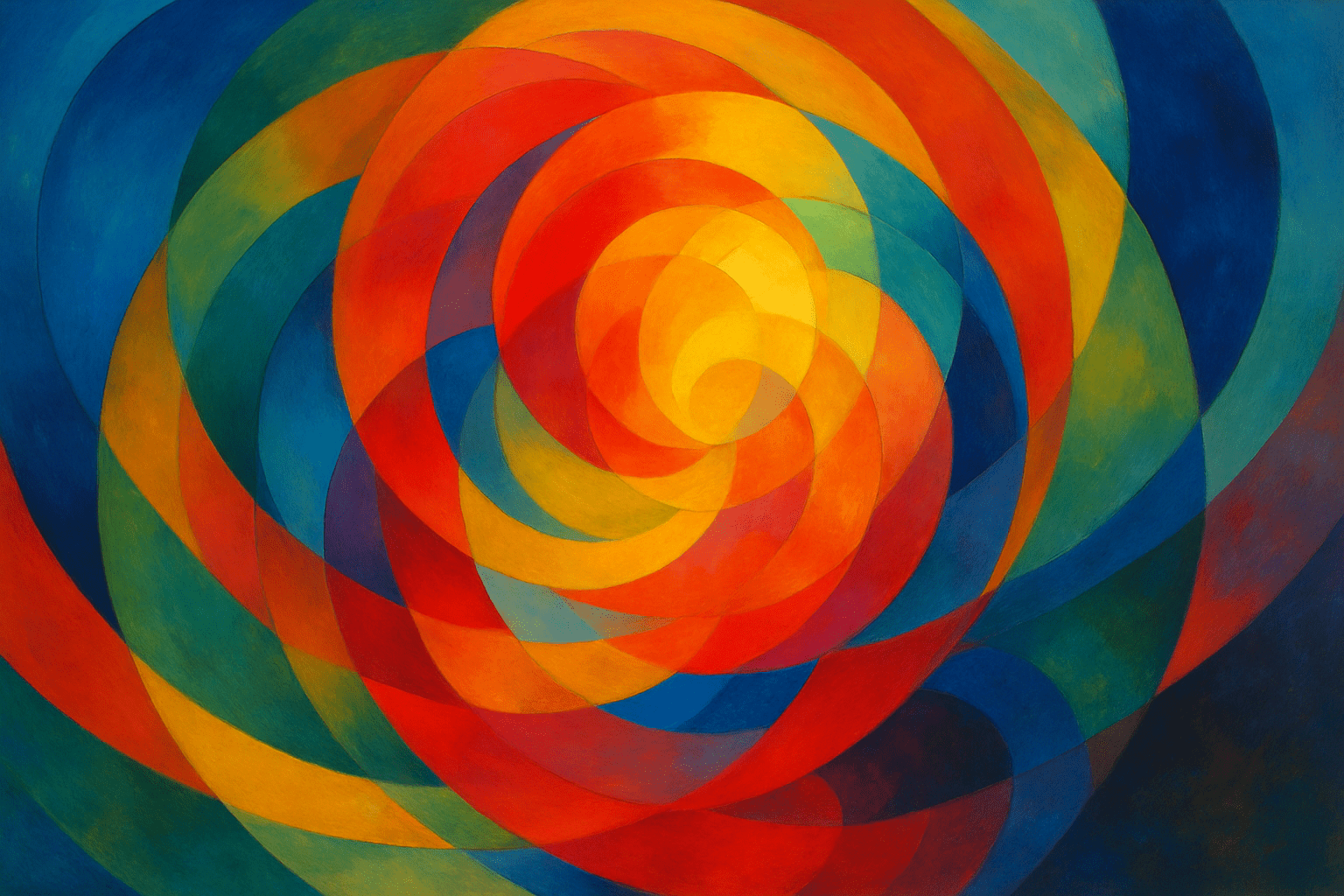
Compare the retained archive illustrations with the practical principles below. These images illustrate ideas; they do not document the cited artists’ works.
Select an image for a closer look. Use the thumbnails, arrow keys or a swipe to compare examples. Zoom in to inspect details, or share the image that inspires you.
Creative toolbox · take this style further
Choose an input and a destination. Search sends your words to the chosen site; Copy & open puts them on your clipboard to paste there.
Create with AI
Turn your chosen input into an image prompt or a new creative direction.
ChatGPT
Copy your input and paste it into a ChatGPT conversation or image request.
Copy & open ChatGPT (new tab)Claude · Anthropic
Develop an image prompt or explore the style in a new Claude conversation.
Copy & open Claude · Anthropic (new tab)Midjourney
Paste your input into the Imagine bar on the Create page.
Copy & open Midjourney (new tab)Adobe Firefly
Copy your input, open Firefly, and paste it into the prompt field.
Copy & open Adobe Firefly (new tab)Leonardo.Ai
Copy your input, open Leonardo, and paste it into the generation field.
Copy & open Leonardo.Ai (new tab)Image search
Find visual references. Short, concrete keywords usually work best.
Lexica
Search AI images and prompts using your selected input.
Search with this input Lexica (new tab)Pexels
Search the photo and video library. Short keywords often work best.
Search with this input Pexels (new tab)Pixabay
Search photos, illustrations and other images.
Search with this input Pixabay (new tab)Unsplash
Search photographs using the style name or your own keywords.
Search with this input Unsplash (new tab)Wikimedia Commons
Search photographs, artworks and historical images. Check each file for its source and reuse terms.
Search with this input Wikimedia Commons (new tab)Art & research
Explore artists, collections and the ideas behind a style.
Wikipedia
Search for background reading. A style may not have its own article.
Search with this input Wikipedia (new tab)WikiArt
Copy your input into WikiArt’s search to explore artists and artworks.
Copy & open WikiArt (new tab)Europeana
Paste your keywords into the search to explore European museum, library and archive collections.
Copy & open Europeana (new tab)Inspiration
Discover portfolios and visual ideas from creative communities.
Instagram hashtags
Search a hashtag made from your input: spaces and punctuation are removed. Instagram may require sign-in.
Search with this input Instagram hashtags (new tab)ArtStation
Paste your input into artwork search for concept art, environments, characters and visual development.
Copy & open ArtStation (new tab)Behance
Paste your input into project search for illustration, design and visual storytelling.
Copy & open Behance (new tab)A closer look
Overlapping color planes, warm-cool intervals, changes of scale and directional rhythms organize form without depending on descriptive outlines.
Color carries the structure
The Whitney Museum identifies Morgan Russell and Stanton Macdonald-Wright as the artists who developed Synchromism, with color generating form. The Museum of Fine Arts, Houston describes their introduction of this mode of abstraction in 1913. These documented associations are more useful than a loose list of any artists who used strong colors.
The musical comparison concerns relationships and rhythm, not a rule that every painting represents a particular song. Look at how one colored area changes the effect of its neighbor. A warm shape may seem to advance against a cooler field, but value, scale and edges also influence that reading. Avoid reducing the approach to a fixed rainbow palette or a required spiral motif.
Build an image from intervals
For an original exercise, select a limited group of warm and cool colors. Arrange broad shapes so the eye moves between large and small intervals. Vary their size and direction while keeping a coherent center of attention. Before adding more colors, check whether the existing relationships already produce a sense of movement and depth.
The retained archive example uses interleaved curves and a bright orange-yellow center against blue and green. Its collage explores related rhythms, but neither is attributed to Russell or Macdonald-Wright. Treat these as contemporary studies, then return to documented works when making historical comparisons. A useful variation replaces the curves with angular planes while keeping the same color relationships. If the composition still feels organized, its structure depends on more than the spiral outline. Leave a few quieter passages so intense color has something to act against.
The prompt workshop
Original creative exercises. These prompts create new illustrations, not documentary evidence.
Color makes a center
Create an original abstract painting of overlapping warm and cool color planes, with a compact orange-yellow focal area balanced by broader blue-green fields. Let color relationships create depth without outlining objects. Varied edges and intervals, no text or signature.
Angular rhythm
Create an original color-based abstraction with angular planes instead of spirals. Alternate a few large quiet shapes with smaller energetic accents. Use a limited warm-cool palette and a clear directional movement; no depicted objects or text.
A quieter interval
Paint an original abstract composition where saturated curved forms surround one calm, low-contrast passage. Use the quiet area to control the rhythm rather than filling every space with equal intensity. Visible painterly surface, no lettering.