
Symbolism · Late nineteenth-century art
Symbolism turns color, setting and unexpected relationships into vehicles for inner experience. Explore its history, key works, expressive examples and AI prompting methods.
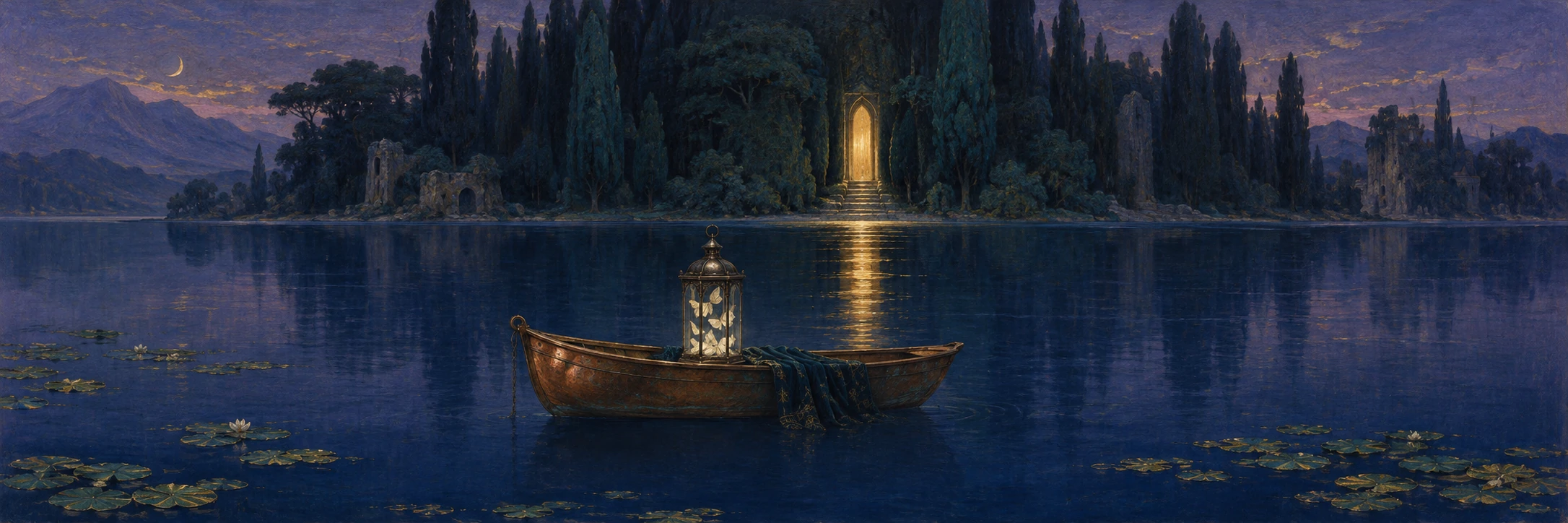
A visual introduction
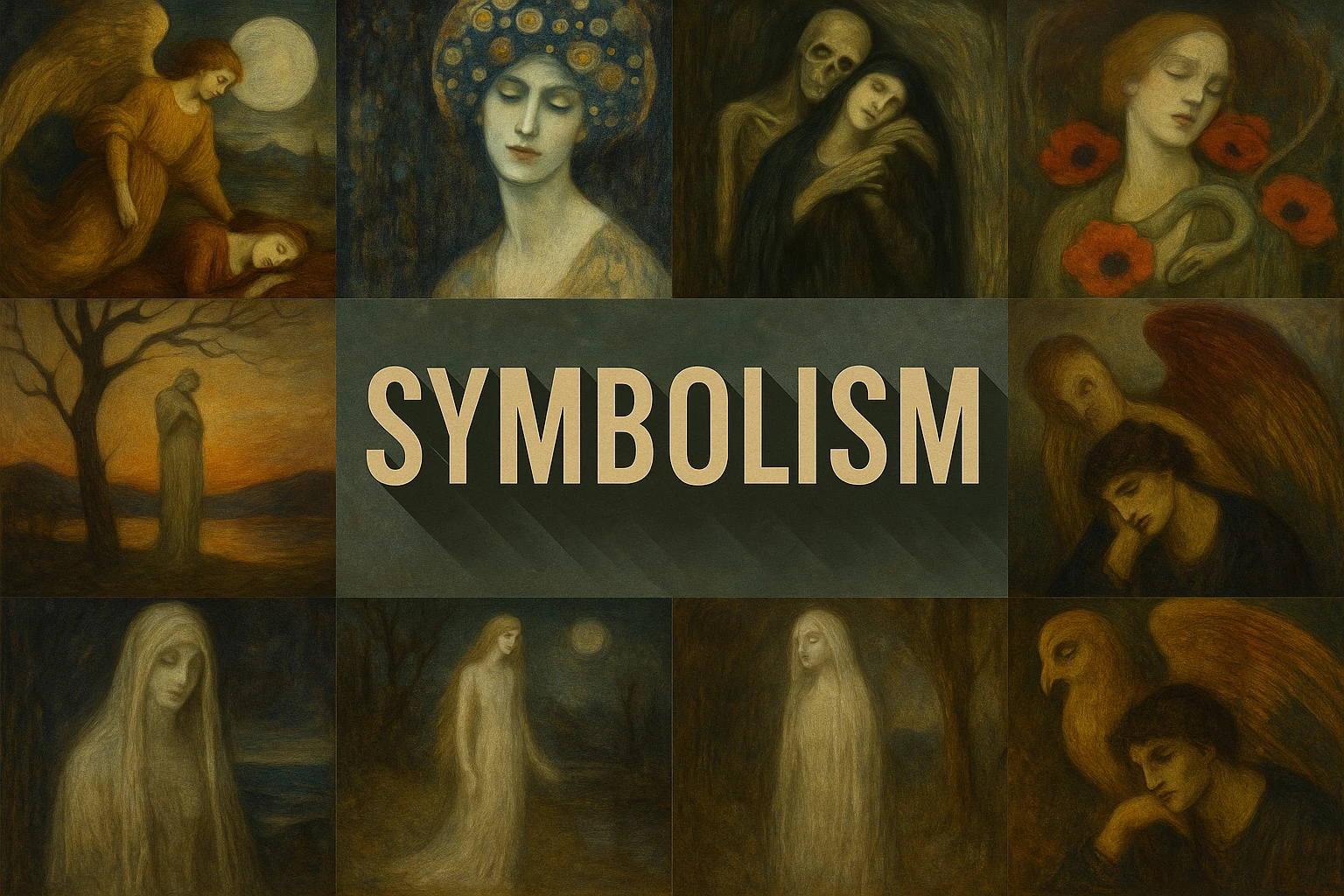
A panoramic header, named collage and three standalone examples. All are AI-generated interpretations; the text explains what to look for and distinguishes them from documented works.
Select an image for a closer look. Use the thumbnails, arrow keys or a swipe to compare examples. Zoom in to inspect details, or share the image that inspires you.
Creative toolbox · take this style further
Choose an input and a destination. Search sends your words to the chosen site; Copy & open puts them on your clipboard to paste there.
Create with AI
Turn your chosen input into an image prompt or a new creative direction.
ChatGPT
Copy your input and paste it into a ChatGPT conversation or image request.
Copy & open ChatGPT (new tab)Claude · Anthropic
Develop an image prompt or explore the style in a new Claude conversation.
Copy & open Claude · Anthropic (new tab)Midjourney
Paste your input into the Imagine bar on the Create page.
Copy & open Midjourney (new tab)Adobe Firefly
Copy your input, open Firefly, and paste it into the prompt field.
Copy & open Adobe Firefly (new tab)Leonardo.Ai
Copy your input, open Leonardo, and paste it into the generation field.
Copy & open Leonardo.Ai (new tab)Image search
Find visual references. Short, concrete keywords usually work best.
Lexica
Search AI images and prompts using your selected input.
Search with this input Lexica (new tab)Pexels
Search the photo and video library. Short keywords often work best.
Search with this input Pexels (new tab)Pixabay
Search photos, illustrations and other images.
Search with this input Pixabay (new tab)Unsplash
Search photographs using the style name or your own keywords.
Search with this input Unsplash (new tab)Wikimedia Commons
Search photographs, artworks and historical images. Check each file for its source and reuse terms.
Search with this input Wikimedia Commons (new tab)Art & research
Explore artists, collections and the ideas behind a style.
Wikipedia
Search for background reading. A style may not have its own article.
Search with this input Wikipedia (new tab)WikiArt
Copy your input into WikiArt’s search to explore artists and artworks.
Copy & open WikiArt (new tab)Europeana
Paste your keywords into the search to explore European museum, library and archive collections.
Copy & open Europeana (new tab)Inspiration
Discover portfolios and visual ideas from creative communities.
Instagram hashtags
Search a hashtag made from your input: spaces and punctuation are removed. Instagram may require sign-in.
Search with this input Instagram hashtags (new tab)ArtStation
Paste your input into artwork search for concept art, environments, characters and visual development.
Copy & open ArtStation (new tab)Behance
Paste your input into project search for illustration, design and visual storytelling.
Copy & open Behance (new tab)A closer look
A Symbolist image may be jewel-bright, velvety black or almost weightless. Its defining force is suggestive meaning, not a compulsory palette or a checklist of moons, eyes and flowers.
More than a picture containing a symbol
A heart on a sign uses a symbol. That alone does not make the sign part of Symbolism. The historical movement is associated with an interest in subjective experience, suggestion and ideas that cannot be exhausted by a literal description. For a reader, the useful question is not simply what an object stands for, but how the whole image makes a thought or feeling possible.
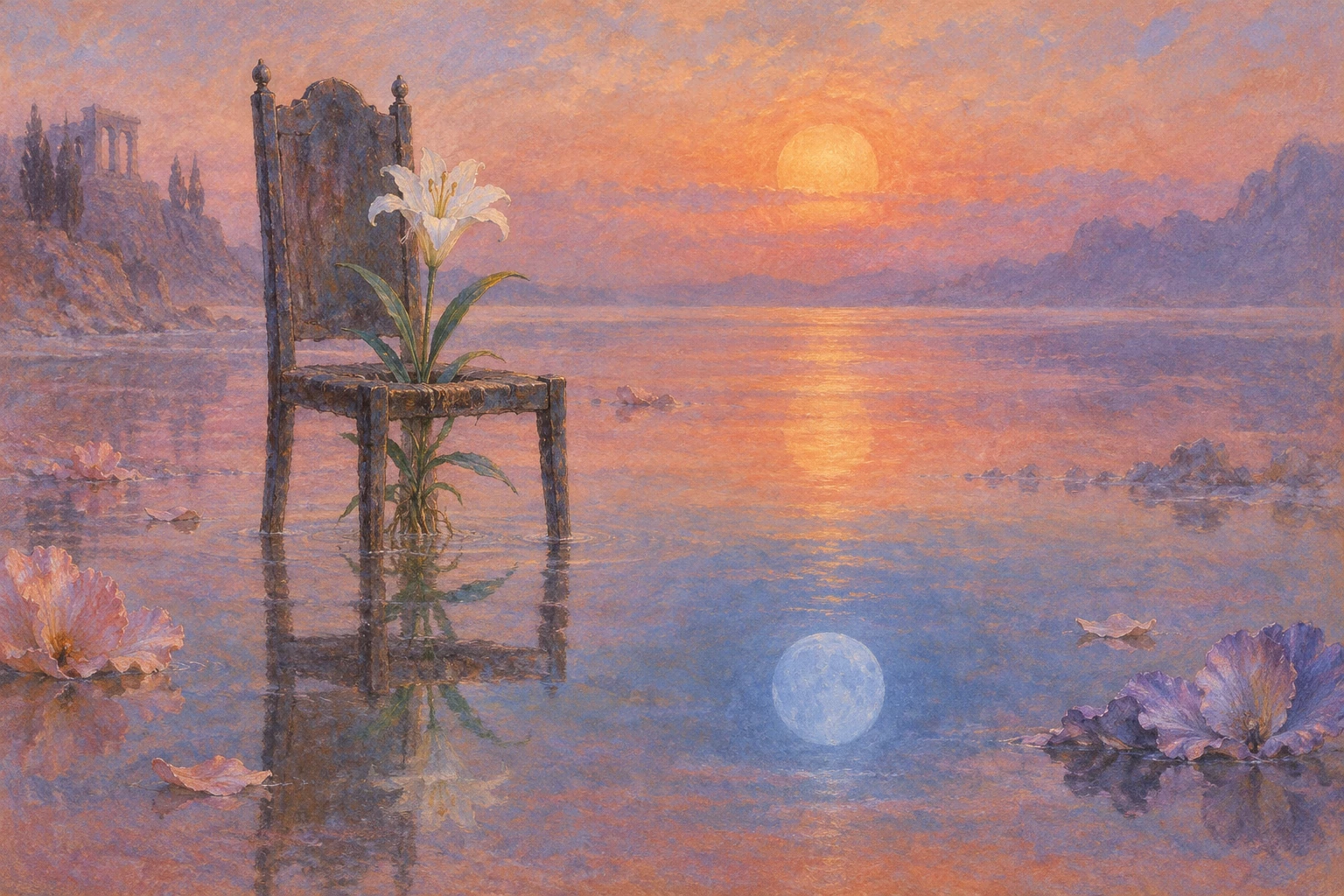
Imagine an empty chair on a luminous shore. Add a flower through the seat and the absence becomes more active. Change the cheerful sunlight to a suspended twilight and the same chair may suggest waiting, grief or renewal. These are possible readings, not a decoding key. Symbolist thinking gives the relationships among objects, colors and intervals as much responsibility as the objects themselves.
A historical anchor without an artificial starting gun
Jean Moréas published his literary Symbolist manifesto in 1886. The Metropolitan Museum’s overview explains that related pictorial approaches were already developing before that date, and that Symbolism spread internationally. Gustave Moreau, Odilon Redon and Arnold Böcklin are important figures to investigate. The date helps orient a reader; it does not mean painters suddenly adopted one style in one year.
Keep the historical category distinct from the wider practice of making symbolic images. Religious art, allegory and visual metaphor have much longer histories. Later Surrealism also explored dreams and unexpected relationships, but it arose in a different context. Calling every enigmatic painting Symbolist erases useful differences. This guide concentrates on late nineteenth-century approaches while using new illustrations to explore their possibilities.
Three works, three ways of thinking through an image
Moreau’s Oedipus and the Sphinx (1864), held by the Metropolitan Museum, stages a mythic confrontation as an intense encounter between bodies and gazes. The museum records its appearance at the Paris Salon of 1864. For close looking, notice how a fixed stare can hold more tension than obvious action. Detailed finish need not make an image straightforward; it can make uncertainty feel exceptionally tangible.
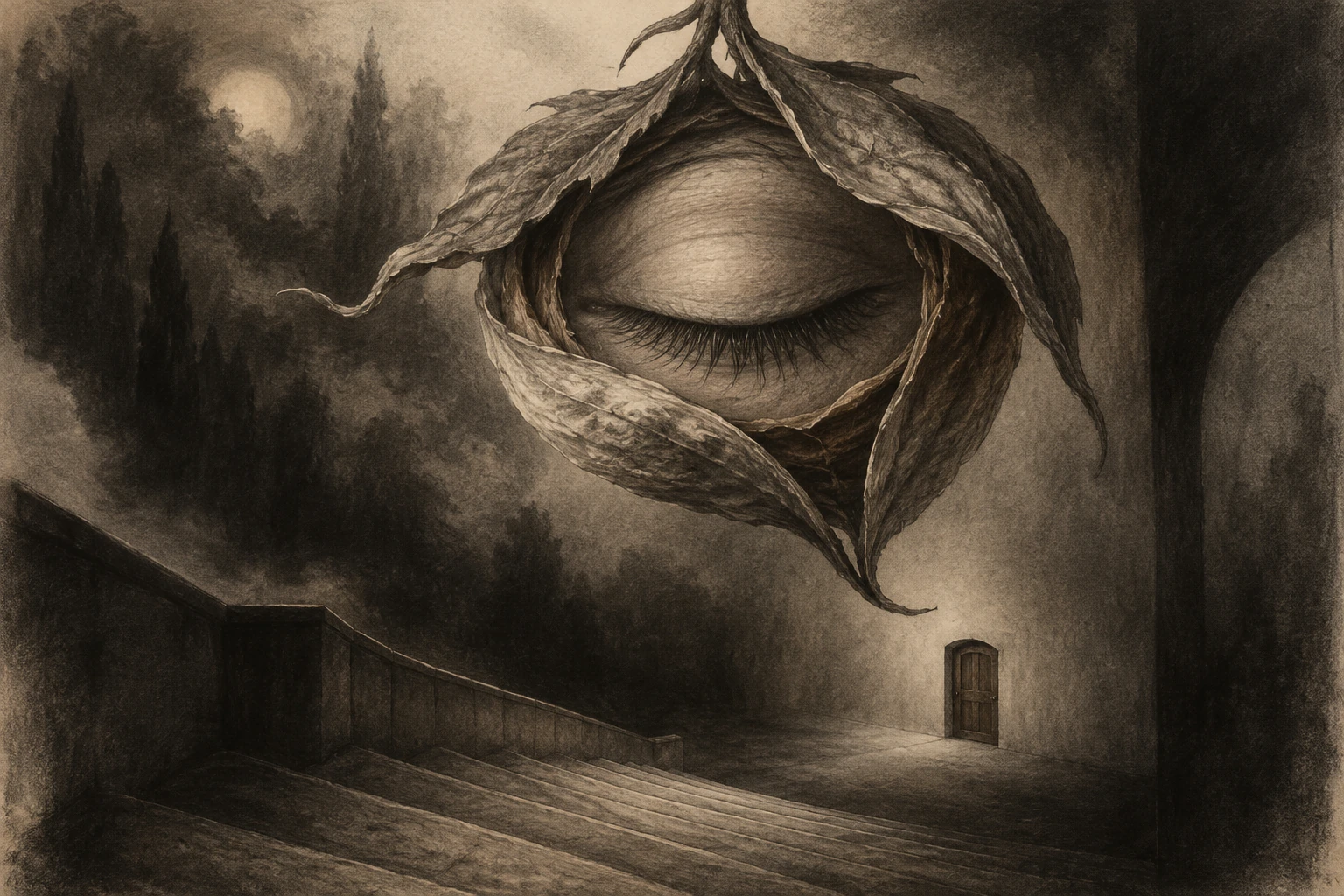
Redon’s The Eye like a Strange Balloon Mounts toward Infinity (1882) is a lithograph, as MoMA’s object record makes clear. The startling idea does not require jewel-like color. Its strange body and atmosphere demonstrate the imaginative possibilities of black and white. Our new eye-in-a-pod study uses a different invented arrangement to test the same broad question: how can an ordinary bodily feature become an impossible, suggestive presence?
Gauguin’s Vision of the Sermon (1888), in the National Galleries of Scotland, gives a further route. The museum describes a biblical struggle imagined by women after a sermon. A bold red field and compressed space help separate vision from ordinary observation. The lesson for a new composition is that color can establish a mental condition rather than report the local color of grass or sky.
Let the image keep more than one meaning
A useful motif should not shut the picture down after a one-word translation. A moth may evoke attraction, fragility or a dangerous search for light; its meaning changes when placed inside an unlit lantern. An empty scale pan can suggest absence, but the weight implied by its position makes that absence contradictory. Ambiguity grows from a specific relationship, not from adding random mysterious objects.
Symbols also belong to contexts. There is no reliable universal dictionary in which every flower, animal or color has one meaning for every viewer. If a work draws on a religious or cultural tradition, research that context rather than assuming a familiar internet association is authoritative. You can invent a personal visual language, but describe it as your invention. Mystery and inaccurate attribution are different things.
Beauty can carry difficult assumptions
The Met’s history discusses the recurring virgin and femme-fatale figures in Symbolist imagery. When borrowing from that visual world, ask whose inner life the image allows us to see. An elaborately painted woman can still be reduced to a convenient sign for someone else’s desire or fear. Formal beauty does not settle that question.
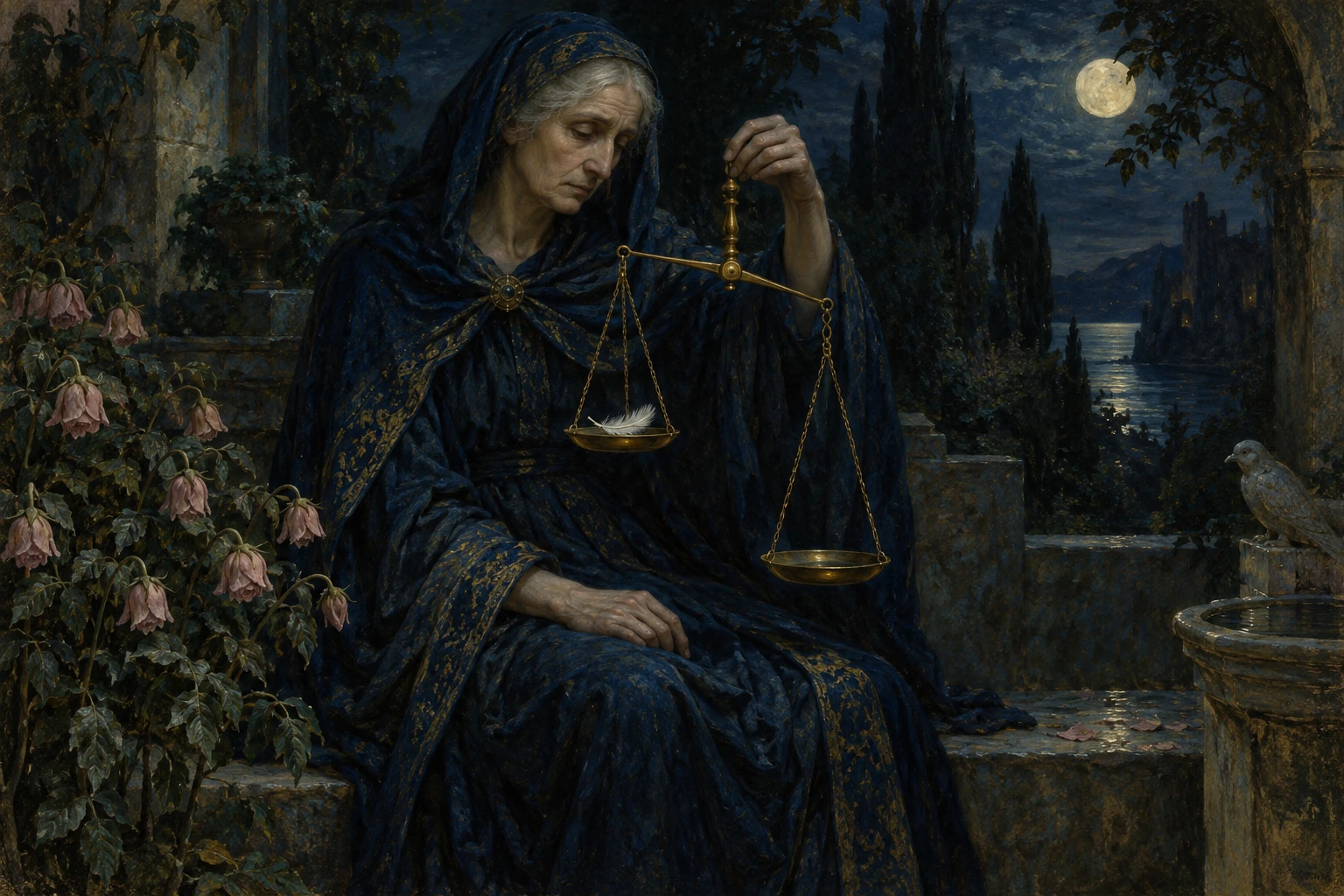
A contemporary interpretation can redirect the structure. Give a figure an action, a specific attention or an age rarely seen in decorative fantasy. Use an empty place or an ordinary tool to carry an idea instead of assigning it automatically to a body. The new balance-scale example centers an older woman absorbed in a task; it invites a reading of thought and loss without pretending that this is the only possible interpretation.
Reading our new examples
In The Unlit Crossing, the panoramic header, a boat carries a lantern filled with pale moths toward a distant opening. The warm vertical light binds the two sides of the image while the dark lake slows the journey. The point is not to announce which afterlife the boat has entered. A threshold and a fragile enclosed light are enough to sustain the scene.
The Weight of a Feather uses an uneven balance: an apparently empty pan hangs lower than the one containing a feather. Dormant Witness changes medium, wrapping a closed eye in a seed-like form above a staircase. A Place Kept Open uses soft color, an empty chair and a lily, with an incompatible sun-and-moon relationship in the water. The three examples show that emotional pressure can survive changes of medium, brightness and subject.
Usability in AI art generation
Begin with an emotion or unresolved idea, then translate it into one visual relationship. Add a medium, a palette and a spatial rule. Grief becomes more concrete as an empty place that changes the balance of a room; uncertainty becomes a doorway whose light disagrees with its surroundings. Limit the number of motifs so the result can develop an internal logic.
Models can deliver polished fantasy while missing the relationship that makes a prompt meaningful. Inspect whether the empty pan is actually lower, whether the intended eye is closed and whether the reflection differs in the way you requested. Avoid praising a failed instruction simply because the picture is attractive. Treat prompts as starting hypotheses. The generated examples are new interpretations, not recovered Symbolist works, and their captions make that distinction explicit.
Looking again after the explanation
Read an image once without a title, once with its title, then again after a short account of its context. Which details continue to resist the explanation? That residue is worth attending to. An interpretation should help you see more, not replace the act of seeing with a solved riddle.
Penny’s note: I like the empty scale pan because it makes an absence behave badly. [Weight recorded. Object missing.] It is possible to understand the arrangement and still feel uncertain about it. That is a generous kind of picture: it leaves the viewer room to arrive with a different memory.
A small poetic detour
Original words from the AOI studio.
Poetry
The empty pan falls.
A feather waits on the other.
No answer balances.
The prompt workshop
Original creative exercises. These prompts create new illustrations, not documentary evidence.
Study 1
Create one extraordinary 3:2 Symbolist oil painting, original allegory titled internally The Weight of a Feather, no actual text: a fully clothed solitary elderly woman in a deep blue robe holds a delicate brass balance in a silent nocturnal garden. On one pan a tiny white feather, the other pan empty yet hanging dramatically lower. Still pink flowers turn away from the moon, hands realistic and unexaggerated. Jewel-like blue-green shadows, restrained gold, translucent paint glazes, archaic solemn spatial compression, tactile canvas, intimate emotion of unmeasurable loss. Ambiguous and quietly powerful, museum-quality painting, no lettering or copies of existing art.
Original AOI exercise. Compare the generated result with the visual criteria above; the prompt is an intention, not proof of execution.
Study 2
Create a beautiful unsettling 3:2 Symbolist charcoal and lithographic fine-art image on warm textured paper. Original vision: one enormous closed human eye appears inside an unfurling seed pod suspended above a deserted staircase; soft drifting charcoal darkness, pale paper left untouched for light, a tiny ordinary closed door at foot of stairs. Precise velvety blacks, rubbed atmospheric middle tones, organic drawing, contemplative ambiguity of dormant knowledge and fear, luminous yet monochromatic. The pod cradles the eye naturally, no gore, no grotesque body horror, no text or signature, no copying any known artwork.
Original AOI exercise. Compare the generated result with the visual criteria above; the prompt is an intention, not proof of execution.
Study 3
Create a luminous 3:2 original Symbolist pastel painting: an empty high-backed chair on a shallow rose-colored shore, a white lily grows through its seat, above it a warm orange sun is mirrored as a cool blue moon in perfectly still water. Strange soft flowers float at edges without clutter. Powdery pastel grain, apricot, rose, luminous cobalt and violet, softly defined shapes, an exquisite dream of waiting after someone has left. Compelling carefully spaced composition, no obvious narrative explanation, symbolism through relationships rather than decorative icons. Not digital concept art, no text, no logo, no imitation of a specific existing painting.
Original AOI exercise. Compare the generated result with the visual criteria above; the prompt is an intention, not proof of execution.
Your next inspiration
Discover another art style
Follow a visual thread to the next subject.

People & works to explore
References discussed in this article. Consult the sources below for context.
Artists and practitioners
Gustave Moreau — mythological and imagined encounters.
Odilon Redon — drawings, prints and color works.
Arnold Böcklin — evocative imagined settings.
Paul Gauguin — a related Symbolist and Synthetist direction.
Paintings and other works
Gustave Moreau, Oedipus and the Sphinx (1864).
Odilon Redon, The Eye like a Strange Balloon Mounts toward Infinity (1882), lithograph.
Paul Gauguin, Vision of the Sermon (1888).
Sources and further exploration
The Metropolitan Museum — Symbolism, Nicole Myers
The Metropolitan Museum — Moreau, Oedipus and the Sphinx
MoMA — Redon, The Eye like a Strange Balloon Mounts toward Infinity
Creative studies to try
Explore these collected prompts as creative interpretations. They are starting points for image-making, not reproductions of historical artworks or evidence about a tradition.
Visual cues: charged color, emotional contour, symbolic compression
Study 1 — Symbolism
Ultra-wide panoramic banner, a human hand and a sleek robotic hand reaching toward each other, fingertips almost touching, a bright luminous spark of intelligence between them, a subtle world map behind them with global data network lines, symbolizing human-AI collaboration and digital transformation, rendered in Symbolism style, with refined composition, distinctive materials, elegant lighting, high-detail artistic finish, high quality, high detail, balanced composition, no text, no logo, no watermark, exact aspect ratio 1584:396
Prompt source: 1001 Art Styles. Select the text to copy, then adapt the subject and composition.