
Late nineteenth-century painting · Pont-Aven and symbolic form
Synthetism brings the observed subject, the artist’s response and the organization of colour and form into one constructed image. Associated especially with Paul Gauguin and Émile Bernard in late-1880s Brittany, it uses simplified shapes and expressive colour to move beyond a merely descriptive account of appearances. [1][2]
A visual introduction
Select an image for a closer look. Use the thumbnails, arrow keys or a swipe to compare examples. Zoom in to inspect details, or share the image that inspires you.

Creative toolbox · take this style further
Choose an input and a destination. Search sends your words to the chosen site; Copy & open puts them on your clipboard to paste there.
Create with AI
Turn your chosen input into an image prompt or a new creative direction.
ChatGPT
Copy your input and paste it into a ChatGPT conversation or image request.
Copy & open ChatGPT (new tab)Claude · Anthropic
Develop an image prompt or explore the style in a new Claude conversation.
Copy & open Claude · Anthropic (new tab)Midjourney
Paste your input into the Imagine bar on the Create page.
Copy & open Midjourney (new tab)Adobe Firefly
Copy your input, open Firefly, and paste it into the prompt field.
Copy & open Adobe Firefly (new tab)Leonardo.Ai
Copy your input, open Leonardo, and paste it into the generation field.
Copy & open Leonardo.Ai (new tab)Image search
Find visual references. Short, concrete keywords usually work best.
Lexica
Search AI images and prompts using your selected input.
Search with this input Lexica (new tab)Pexels
Search the photo and video library. Short keywords often work best.
Search with this input Pexels (new tab)Pixabay
Search photos, illustrations and other images.
Search with this input Pixabay (new tab)Unsplash
Search photographs using the style name or your own keywords.
Search with this input Unsplash (new tab)Wikimedia Commons
Search photographs, artworks and historical images. Check each file for its source and reuse terms.
Search with this input Wikimedia Commons (new tab)Art & research
Explore artists, collections and the ideas behind a style.
Wikipedia
Search for background reading. A style may not have its own article.
Search with this input Wikipedia (new tab)WikiArt
Copy your input into WikiArt’s search to explore artists and artworks.
Copy & open WikiArt (new tab)Europeana
Paste your keywords into the search to explore European museum, library and archive collections.
Copy & open Europeana (new tab)Inspiration
Discover portfolios and visual ideas from creative communities.
Instagram hashtags
Search a hashtag made from your input: spaces and punctuation are removed. Instagram may require sign-in.
Search with this input Instagram hashtags (new tab)ArtStation
Paste your input into artwork search for concept art, environments, characters and visual development.
Copy & open ArtStation (new tab)Behance
Paste your input into project search for illustration, design and visual storytelling.
Copy & open Behance (new tab)A closer look
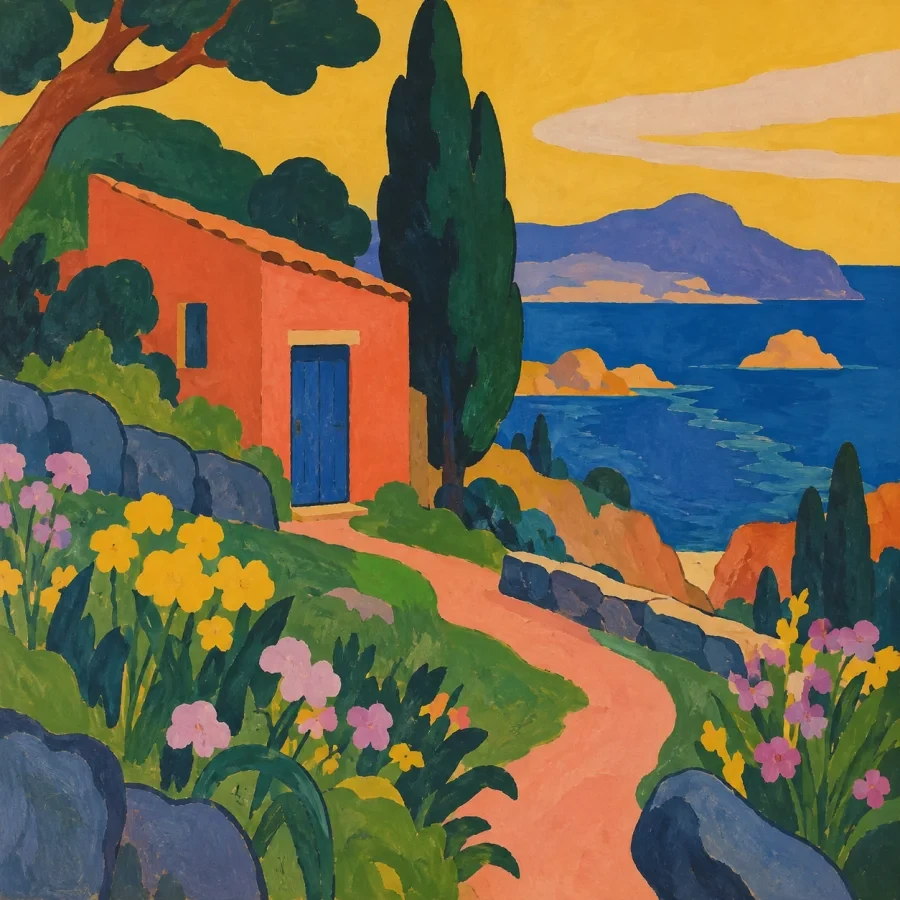
Broad colour areas, decisive contours, compressed depth and deliberate distortions make the image read as an arrangement before it reads as an illusion. The strongest result keeps a recognizable subject while giving its shapes and colours an expressive purpose.
What is being synthesized?
The Museum of Pont-Aven explains the approach through three interacting concerns: the appearance of a subject, the painter’s feeling about it, and the formal relationships within the picture. [1] This is more useful than defining Synthetism as a filter that adds black outlines. The contour matters because it helps organize the whole, not because every edge must receive the same stroke.
A tree may remain a tree while its trunk becomes the principal diagonal, its foliage a dark mass and the ground beneath it an unexpected red. The image retains contact with experience but changes that experience into a deliberate pictorial statement. Ask what has been selected, exaggerated or omitted, and how each decision changes the feeling of the subject.
Pont-Aven: collaboration and exchange
The Musée de Pont-Aven traces the crucial collaboration between Bernard and Gauguin to 1888. It identifies Bernard’s Breton Women in the Meadow and Gauguin’s Vision of the Sermon as emblematic works. Its chronology also connects Paul Sérusier’s experience at Pont-Aven with the later Nabi circle and records the Impressionist and Synthetist group exhibition at the Café Volpini in 1889. [2]
This was an exchange among artists, not a single isolated invention by one heroic painter. Keep the geographical network, the stylistic approach and later developments distinct. Pont-Aven names a place and artistic milieu; Synthetism describes a way of constructing pictures; the Nabis formed a related but separate grouping. The connections are important without making the terms interchangeable.
A painting to study closely
Gauguin’s Vision of the Sermon (Jacob Wrestling with the Angel), 1888, is in the National Galleries of Scotland. The museum explains that Breton women who have heard a sermon imagine the biblical struggle. A diagonal tree divides the composition, and the wrestling figures occupy an emphatic red field. The work is oil on canvas, not a stained-glass object. [3]
Follow the diagonal before studying individual faces. Notice how the broad field unifies a large area and how the repeated pale head coverings establish a foreground rhythm. The image does not need continuous naturalistic depth to make its relationship between observers and imagined event legible. This is a useful lesson in organizing a complex subject through a few strong decisions.
Synthetism, Cloisonnism and Symbolism
Cloisonnism is closely connected: the Pont-Aven museum describes Bernard and Louis Anquetin’s earlier organization of areas in a manner compared with stained glass. [2] Bold enclosing contours can be a practical means of separating colour zones. Synthetism’s broader question is what the selected appearance, feeling and arrangement do together.
Symbolism concerns the world of ideas and suggestion; a Synthetist painting can participate in that concern without turning every shape into a code. Post-Impressionism is a wider historical frame. Avoid using these names as synonyms or treating Fauvism, which developed later, as simply another spelling for the same approach. A shared taste for nonliteral colour does not erase different contexts.
Shape first: a practical composition method
Reduce a subject to five or six large masses. Give one the largest area, another the strongest directional force and a third the clearest contrast. These are workshop constraints, not historical laws. They help expose whether the picture has an underlying structure before texture and detail make it look finished.
Compress depth intentionally. A tilted tabletop, raised horizon or stacked landscape can bring distant and nearby forms into a strong surface relationship. Check overlaps and silhouettes so the result remains legible. A flattened image is not necessarily a careless one: every interval between shapes becomes more conspicuous when atmospheric depth no longer disguises it.
Colour as a decision, not a report
Choose colours for their relationships as well as for their descriptive role. An ochre sky can intensify a violet shore; a red field can make a quiet group feel charged; a pale table can hold a dark jug in place. Limit the strongest contrast to the region that carries the image’s central feeling.
Large colour areas need subtle handling to avoid looking mechanically filled. A lightly varied painted surface can preserve the unity of a plane while keeping it alive. Vary the contour’s pressure and colour where useful. A dark blue edge may belong more naturally to a palette than pure black everywhere. Keep gradients subordinate to the shape rather than modelling every form into glossy volume.
Five original studies
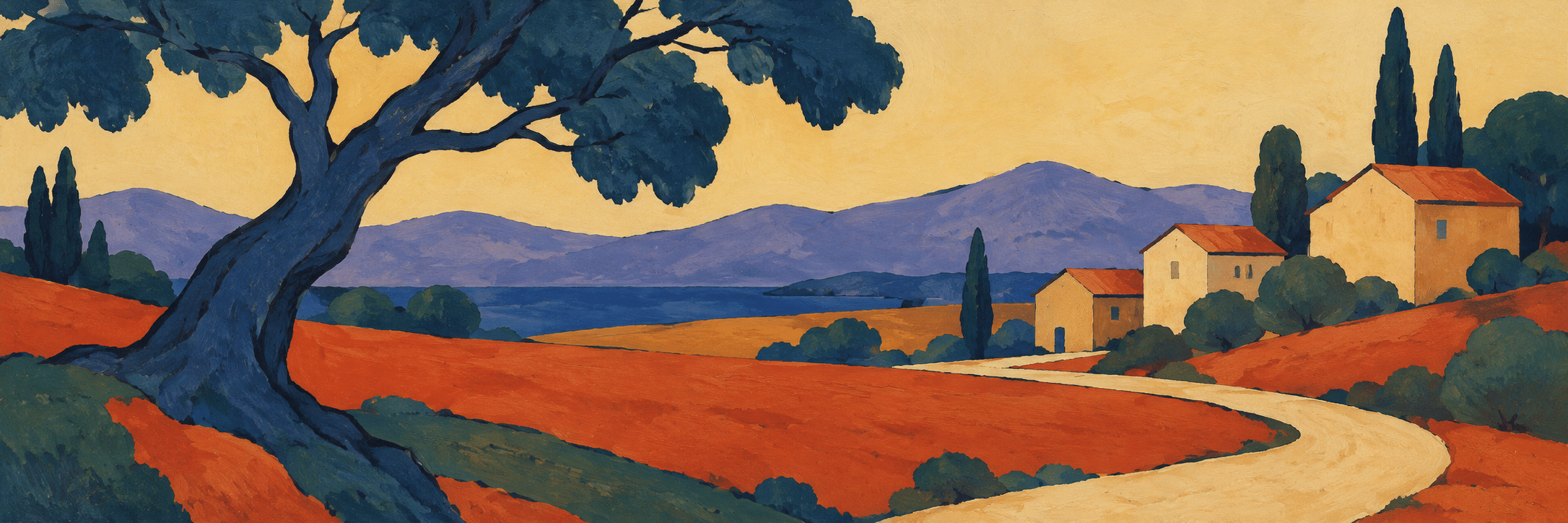
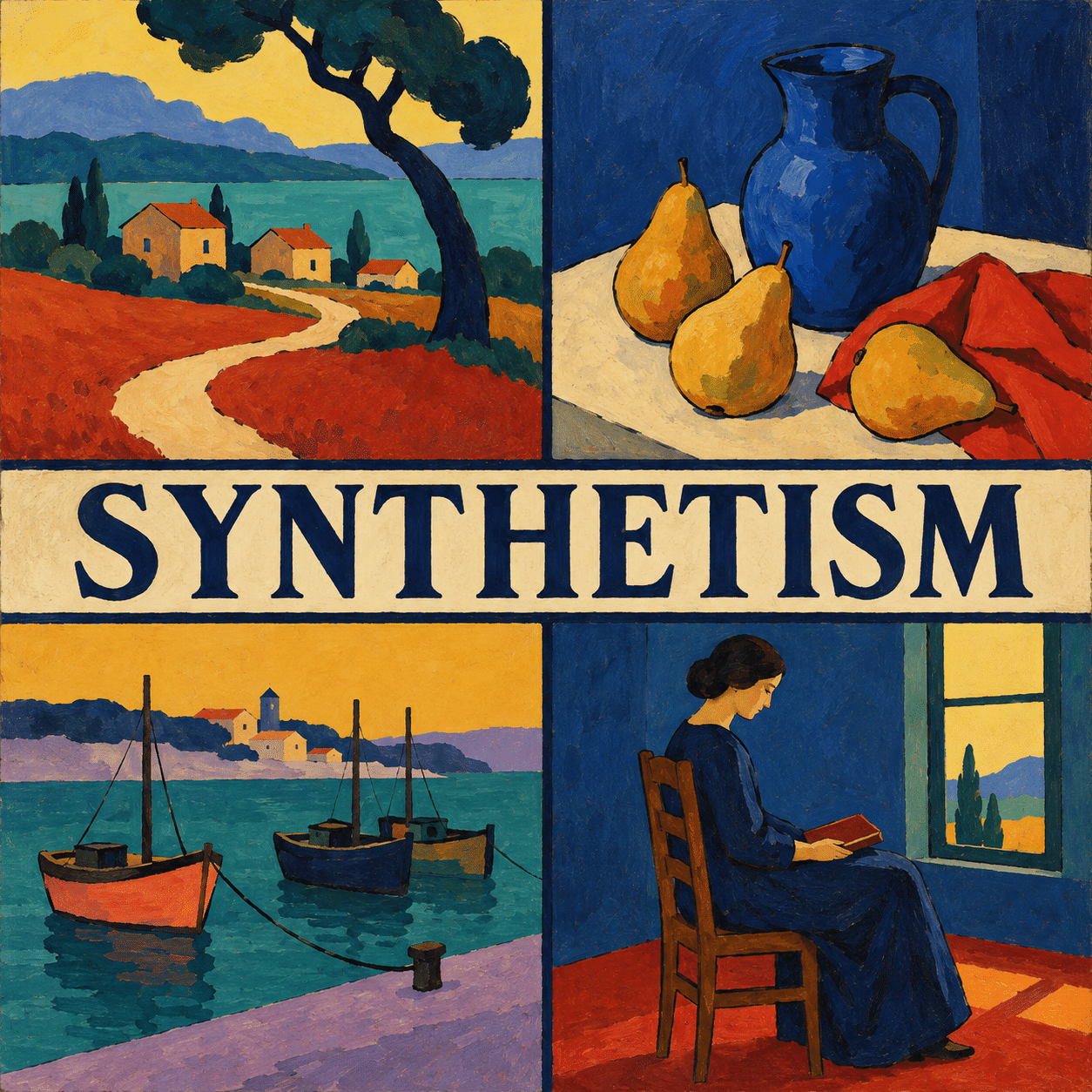
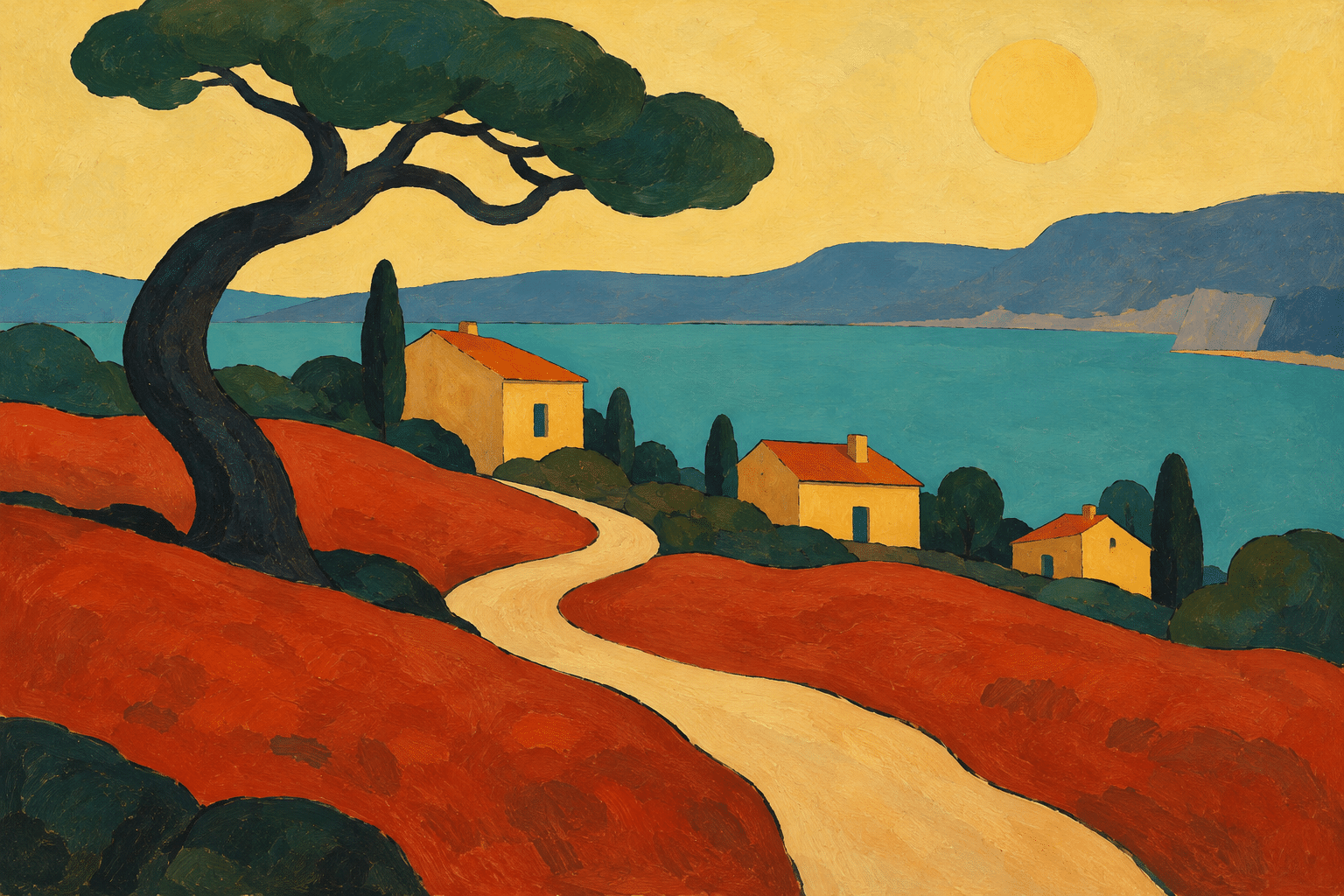
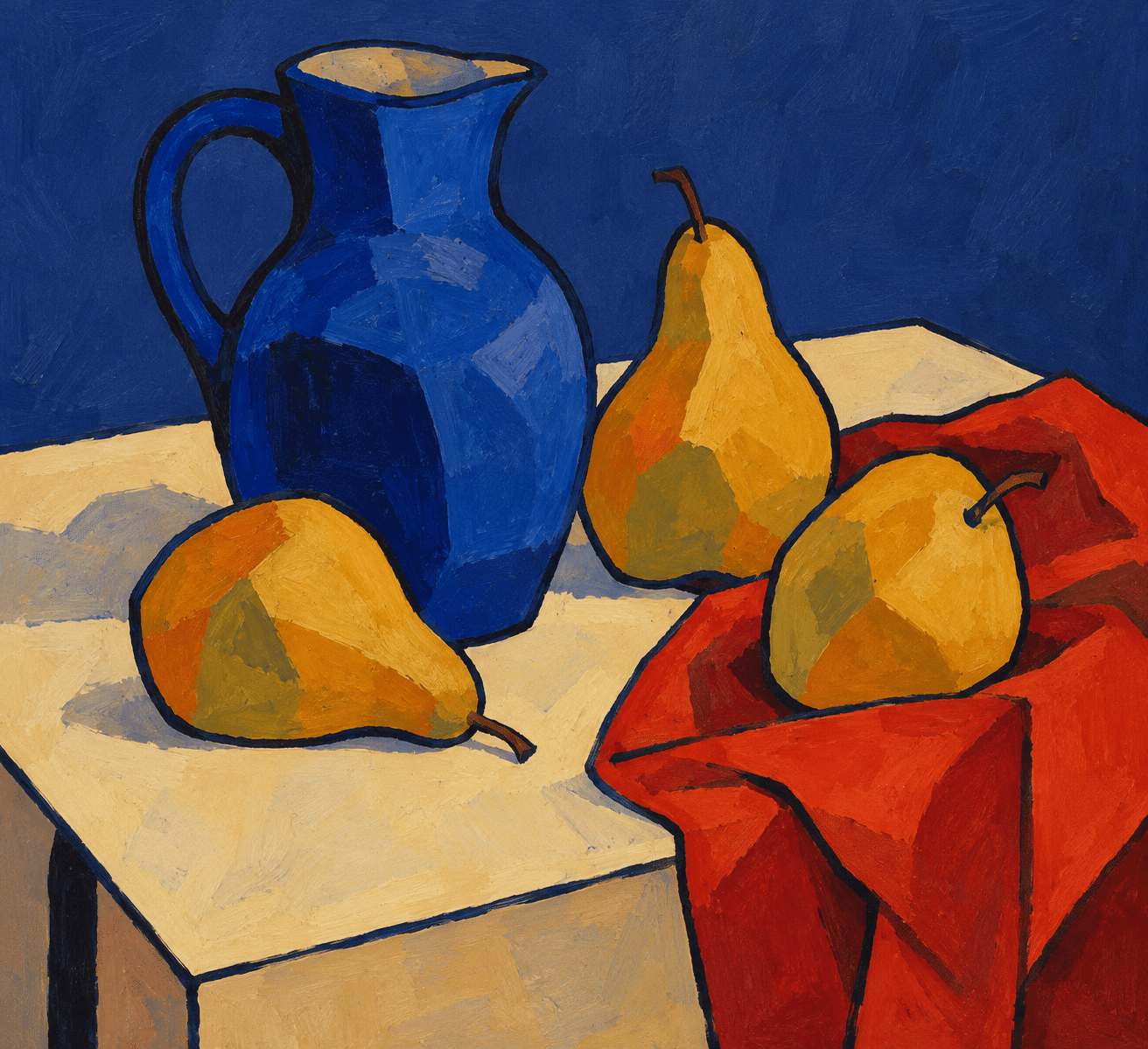
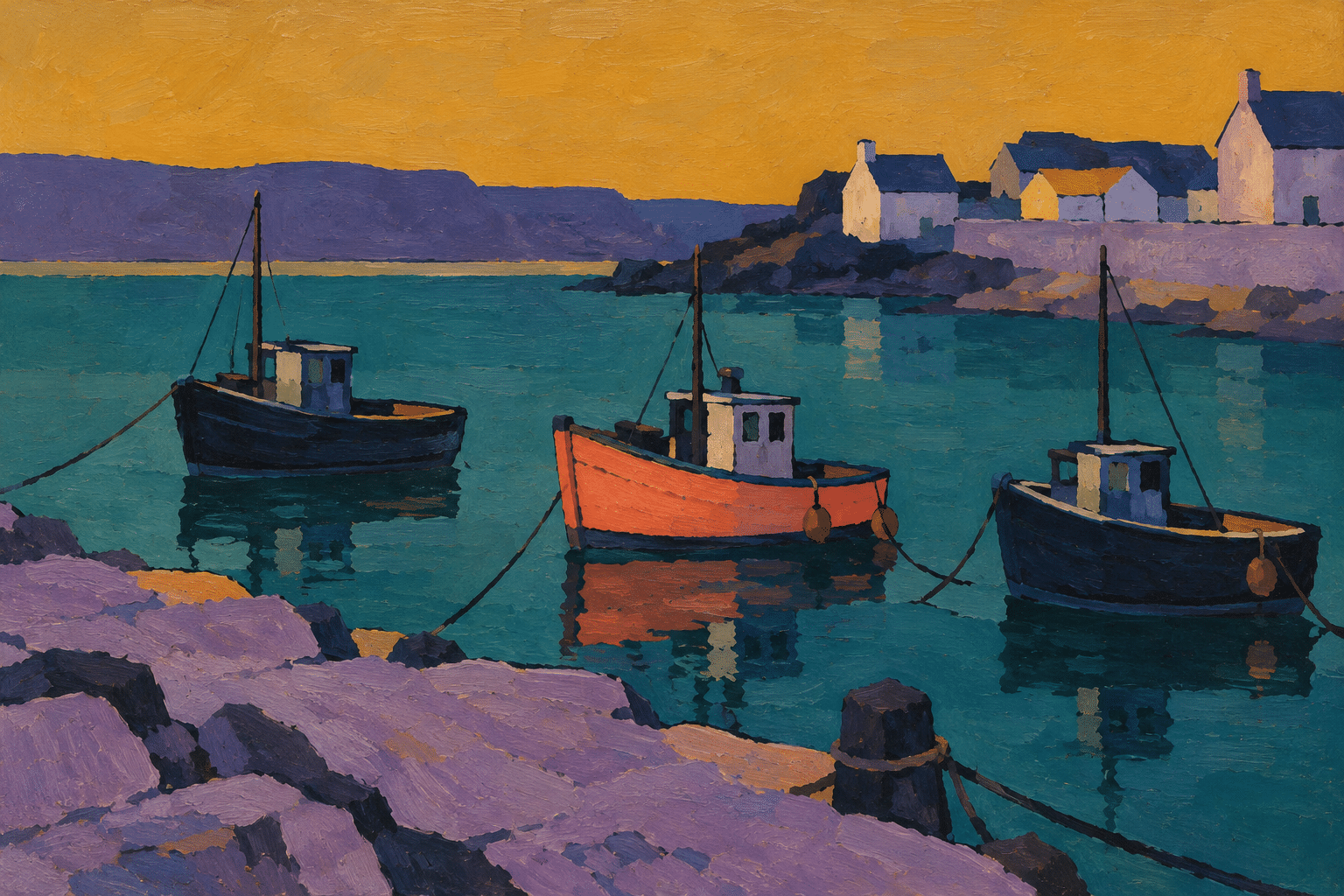
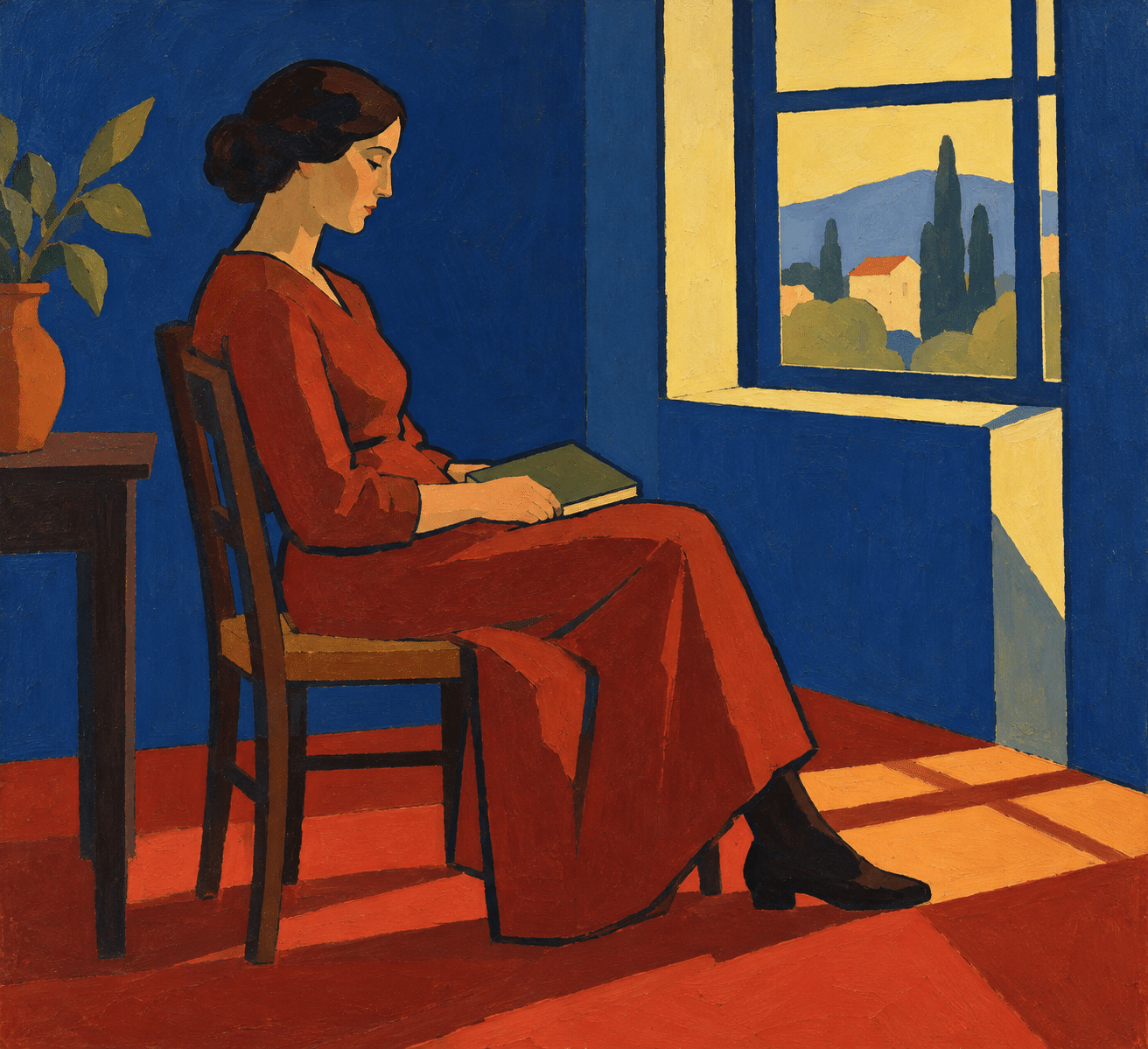
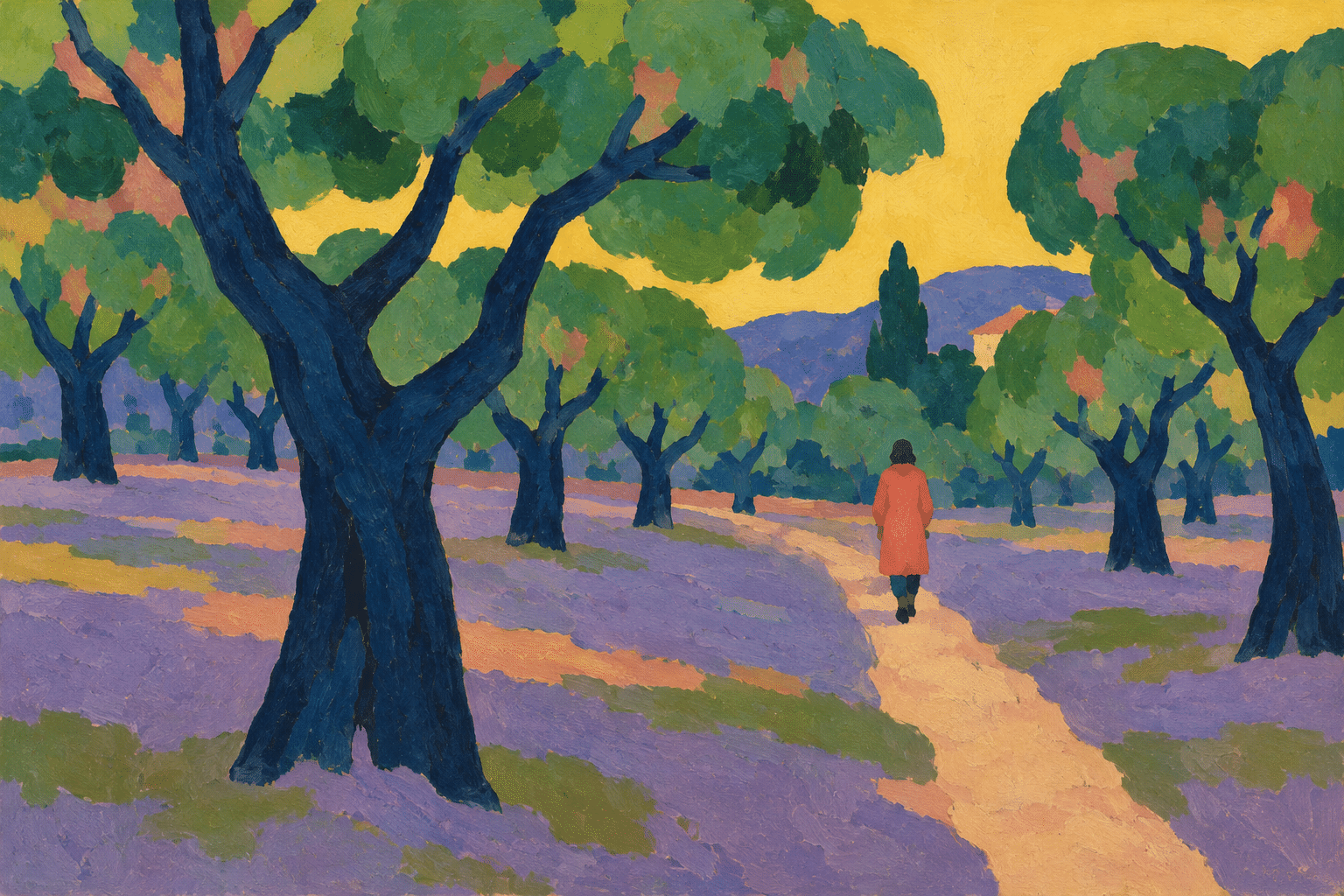
The landscape study uses an unexpected ground colour and a dark tree to organize a path and houses. A still life tests the same principle with a tipped tabletop, jug and pears. A harbour scene compresses boats, shore and horizon into stacked bands. An interior brings a seated adult and a window into a quiet arrangement. The final orchard scene uses repeated trees and a single walking figure to carry a mood.
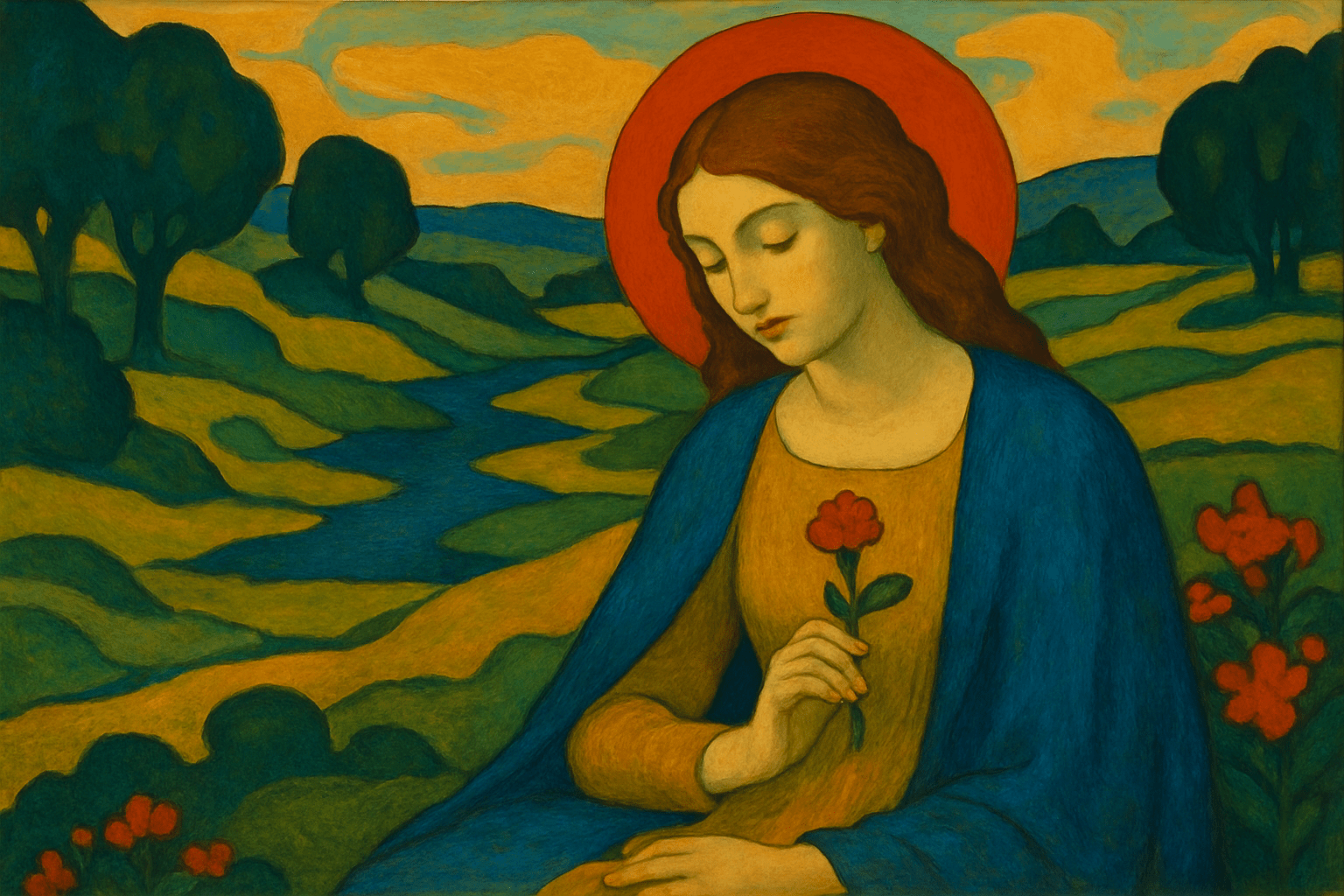
The wide banner and centrally titled collage introduce these decisions at a glance. All new images are AI-generated educational interpretations, not lost paintings, reproductions or authenticated works by historical artists. Their subjects are deliberately varied: Synthetism is a method of selecting and organizing, not a requirement to repeat Breton costumes or a particular famous composition.
History without romantic shortcuts
Do not describe Brittany or any other place as timeless, primitive or outside modern life because a painter chose to represent it that way. An artist’s search for simplicity is a constructed perspective. Ask whose experience is being depicted, who selected the symbols and what the image leaves out. Formal innovation does not make every historical assumption behind a work reliable.
For a contemporary study, use a place or object you can describe specifically. Decide what you want its shapes to express, then test whether a viewer can sense that relationship without an elaborate caption. The productive question is not whether the picture looks old enough. It is whether observation, feeling and formal organization reinforce one another.
Positive editorial assessment — AI-authored
Synthetism makes selection itself expressive. A decisive diagonal, a simplified figure and one unexpected field of colour can turn a familiar subject into a coherent emotional image. Its lessons remain useful because they concern relationships rather than a fixed inventory of motifs.
Critical editorial assessment — AI-authored
The approach becomes a costume when dark outlines and arbitrary saturated colour replace a reasoned composition. Flattening can also make people into decorative tokens. Improve the work by deciding what each alteration contributes and by retaining meaningful differences among figures, objects and places.
Neutral editorial assessment — AI-authored
Synthetism is a historically situated approach associated with the Pont-Aven circle and the late nineteenth century. It offers practical methods for expressive simplification across landscapes, figures and still lifes. These new exercises demonstrate selected principles without claiming historical authorship.
A small poetic detour
Original words from the AOI studio.
Poetry
The field remembers more than green,
the tree becomes a turning line;
a colour holds what has been seen
and what the heart would redesign.
Three pears, a jug, a tilted plane,
a shore reduced to dark and gold;
the world comes back to us again,
selected, felt, and newly told.
The prompt workshop
Original creative exercises. These prompts create new illustrations, not documentary evidence.
Starting point: a remembered landscape
An original Synthetist-inspired painting of a small village path beneath a dark curving tree. Broad terracotta ground, pale ochre sky, three simplified cream houses, deep blue contours and very little modelling. Let the tree diagonal and path express a quiet sense of departure. Matte painted surface, no signature or lettering.
Richer composition: a still life in planes
Original Synthetist-inspired still life of a cobalt jug, three ochre pears and a folded red cloth on a deliberately tipped pale table. Organize the scene as interlocking colour masses with varied dark contours, compressed depth and subtle brush texture. Make the jug the dominant silhouette; avoid photographic shading and glossy rendering.
Experiment: change the feeling, keep the subject
Paint one adult walking through an orchard as broad simplified colour shapes. Keep the trees recognizable but make the ground muted violet and the sky warm yellow. Use repeated dark trunks to create a slow rhythm and one small coral accent on the figure. An original educational interpretation, not a copy of a named artwork.
Your next inspiration
Discover another art style
Follow a visual thread to the next subject.
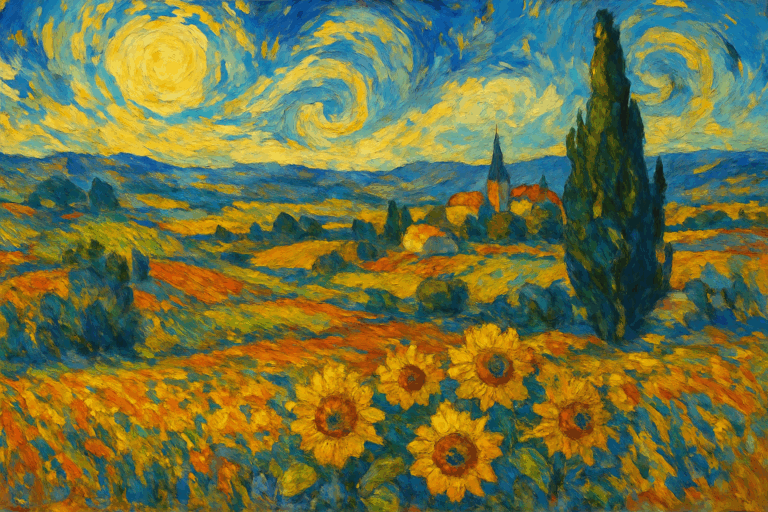
Post-impressionism :.
Compare related formal decisions while preserving the distinct historical context.
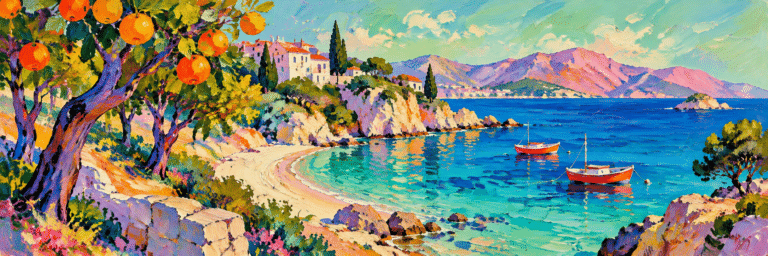
Fauvism: Colour That Builds the Picture
Compare related formal decisions while preserving the distinct historical context.
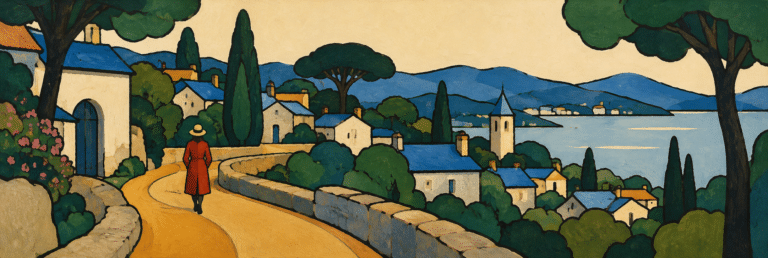
Cloisonnism: Colour Held by the Contour
Compare related formal decisions while preserving the distinct historical context.
A smile from the studio
Jokes
The pear objected to becoming ochre. The painter explained that it was now part of a larger arrangement.