
Camera viewpoint and recording aesthetic
The camera has been watching the floor all night. At last, someone pauses in the corner of the frame. Surveillance Camera turns fixed viewpoints, practical light and small unexplained events into a language of attention, tension and quiet absurdity.
A visual introduction
Five original AI-generated interpretations explore fixed viewpoints, practical illumination and quiet narrative. Every scene is invented. Documentary artwork references are identified separately in the sources.
Select an image for a closer look. Use the thumbnails, arrow keys or a swipe to compare examples. Zoom in to inspect details, or share the image that inspires you.
Creative toolbox · take this style further
Choose an input and a destination. Search sends your words to the chosen site; Copy & open puts them on your clipboard to paste there.
Create with AI
Turn your chosen input into an image prompt or a new creative direction.
ChatGPT
Copy your input and paste it into a ChatGPT conversation or image request.
Copy & open ChatGPT (new tab)Claude · Anthropic
Develop an image prompt or explore the style in a new Claude conversation.
Copy & open Claude · Anthropic (new tab)Midjourney
Paste your input into the Imagine bar on the Create page.
Copy & open Midjourney (new tab)Adobe Firefly
Copy your input, open Firefly, and paste it into the prompt field.
Copy & open Adobe Firefly (new tab)Leonardo.Ai
Copy your input, open Leonardo, and paste it into the generation field.
Copy & open Leonardo.Ai (new tab)Image search
Find visual references. Short, concrete keywords usually work best.
Lexica
Search AI images and prompts using your selected input.
Search with this input Lexica (new tab)Pexels
Search the photo and video library. Short keywords often work best.
Search with this input Pexels (new tab)Pixabay
Search photos, illustrations and other images.
Search with this input Pixabay (new tab)Unsplash
Search photographs using the style name or your own keywords.
Search with this input Unsplash (new tab)Wikimedia Commons
Search photographs, artworks and historical images. Check each file for its source and reuse terms.
Search with this input Wikimedia Commons (new tab)Art & research
Explore artists, collections and the ideas behind a style.
Wikipedia
Search for background reading. A style may not have its own article.
Search with this input Wikipedia (new tab)WikiArt
Copy your input into WikiArt’s search to explore artists and artworks.
Copy & open WikiArt (new tab)Europeana
Paste your keywords into the search to explore European museum, library and archive collections.
Copy & open Europeana (new tab)Inspiration
Discover portfolios and visual ideas from creative communities.
Instagram hashtags
Search a hashtag made from your input: spaces and punctuation are removed. Instagram may require sign-in.
Search with this input Instagram hashtags (new tab)ArtStation
Paste your input into artwork search for concept art, environments, characters and visual development.
Copy & open ArtStation (new tab)Behance
Paste your input into project search for illustration, design and visual storytelling.
Copy & open Behance (new tab)A closer look
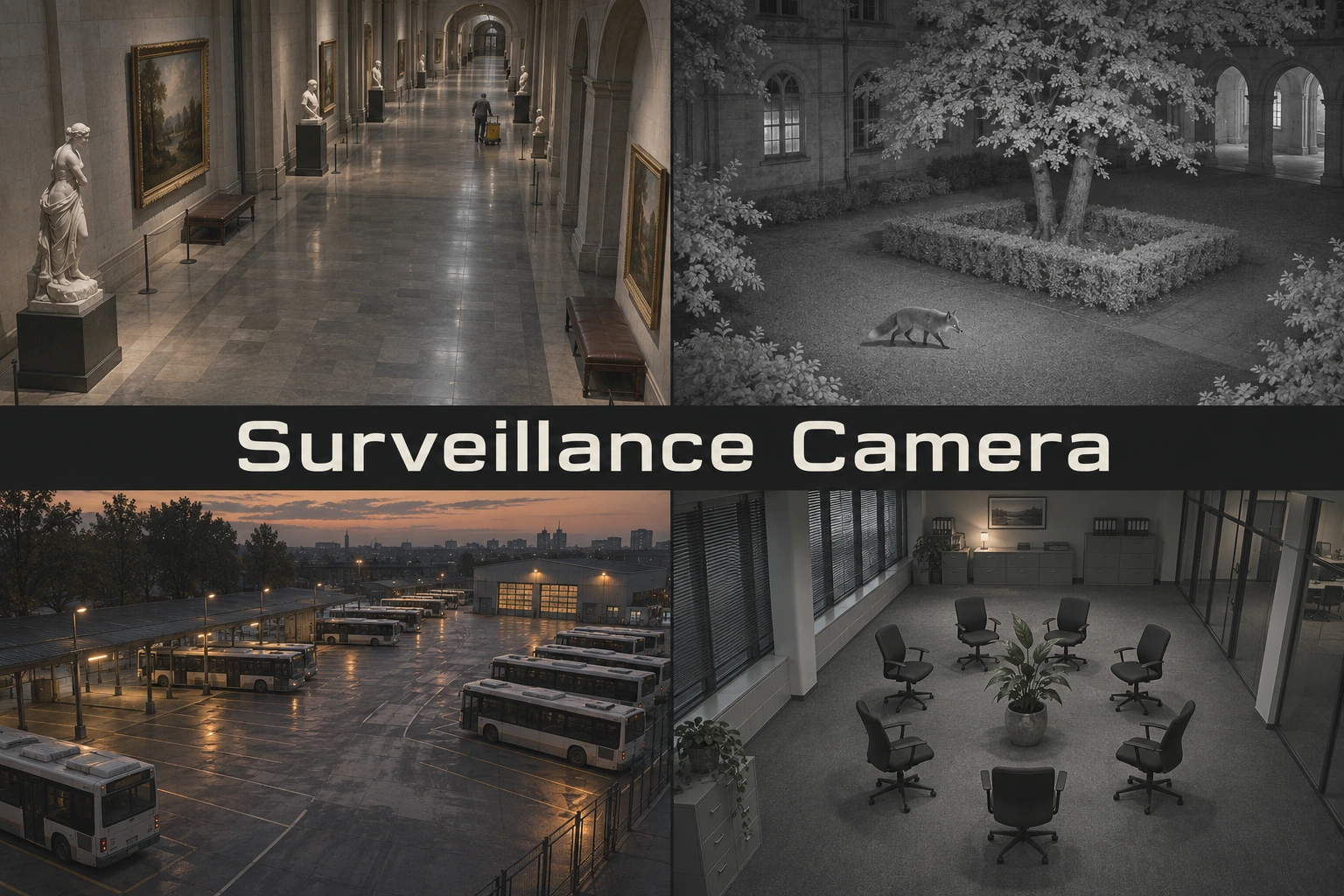
High or otherwise fixed viewpoints, wide spatial coverage, deep focus, repeated architecture and a modestly sized event shape the image. Colour video, monochrome near-infrared looks and older recording treatments offer distinct variations.
The camera keeps its position
Surveillance Camera is a visual reference for images that appear to have been recorded by an observing system. It covers a family of camera positions, lighting conditions and recording appearances. This guide asks how a fixed, apparently indifferent viewpoint can make an ordinary space feel watchful, lonely, comic or strange. The broader Photography entry introduces the medium; here the camera's relationship to the space is the subject.
Begin with a camera that has somewhere specific to stand: a ceiling corner, a loading-bay wall, the top of a stairwell. It sees an area and waits. The figure or event occupies only part of that area. Much of the expressive force comes from the surrounding floor, the empty doorway and the parts of the scene the camera cannot see. A reader starts inspecting those margins for a reason to keep looking.
A recording system can become an artwork
Artists have made the act of watching part of the work itself. MoMA's account of Bruce Nauman's Corridor Installation (Nick Wilder Installation), 1970, describes cameras observing visitors inside narrow passages, with the monitors offering an experience that differs from being physically present. The installation provides a useful historical reference for the tension between a body, a space and its mediated image.
MoMA documents Julia Scher's Information America (1995) as a work connecting live gallery video with a data-collection console. SFMOMA's Predictive Engineering records describe another evolving investigation of surveillance within the museum. Its 1998 exhibition account connects that installation to an earlier 1993 version. These are specific practices and works to study, rather than evidence that every grainy overhead picture belongs to one historical movement.
The new AOI studies are invented still images. They use a recording aesthetic to build visual stories. They do not reproduce these installations, document an actual incident or demonstrate a functioning surveillance system. The museum records supply the historical evidence.
Let the space stay larger than the event
Use enough room for the viewer to discover the action. A long empty floor can make a small pause feel consequential. Repeated washers, desks or pillars establish an ordinary rhythm, allowing one unusual arrangement to interrupt it. The subject need not be centered, and an inconvenient obstruction may be part of the image's logic.
Keep the perspective consistent with the chosen mounting position. Walls, floor tiles and furniture should agree about where the camera is. A wide field of view can spread foreground objects toward the edges, but a fisheye effect is one lens choice, not a universal requirement. Describe the camera height and viewing direction before adding distortion.
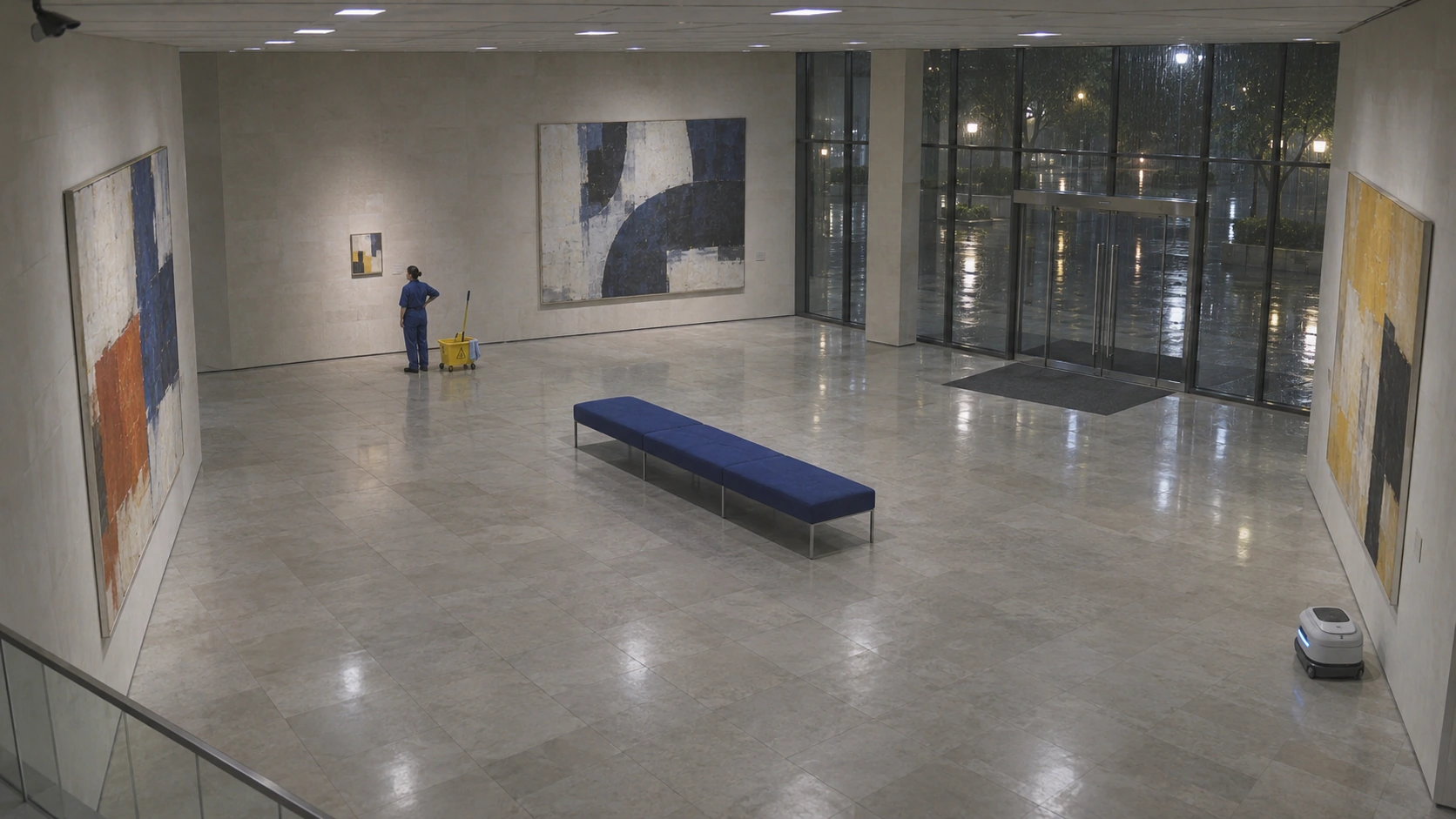
The museum banner sets a small human moment inside a large, practical view. Its important contrast is between the scale of the gallery and the scale of the person. The camera does not move closer to explain the encounter. That restraint gives the viewer room to supply a story.
Choose a particular recording appearance
A surveillance image can be clear and in colour. It need not resemble a damaged VHS tape. Decide whether the study evokes an older analog installation, a compressed digital recording, a contemporary colour view or a monochrome night camera. Each choice has different implications for edges, noise and tonal range. Combining every familiar defect can obscure the scene without making its camera more convincing.
Axis Communications explains that day/night cameras can remove an infrared-cut filter as light falls, using visible and near-infrared light to produce grayscale video. Infrared illumination can support the view in darkness. This is different from thermal imaging, which detects emitted heat. The distinction matters visually: a grayscale night scene, a green display convention and a coloured thermal palette are separate choices.
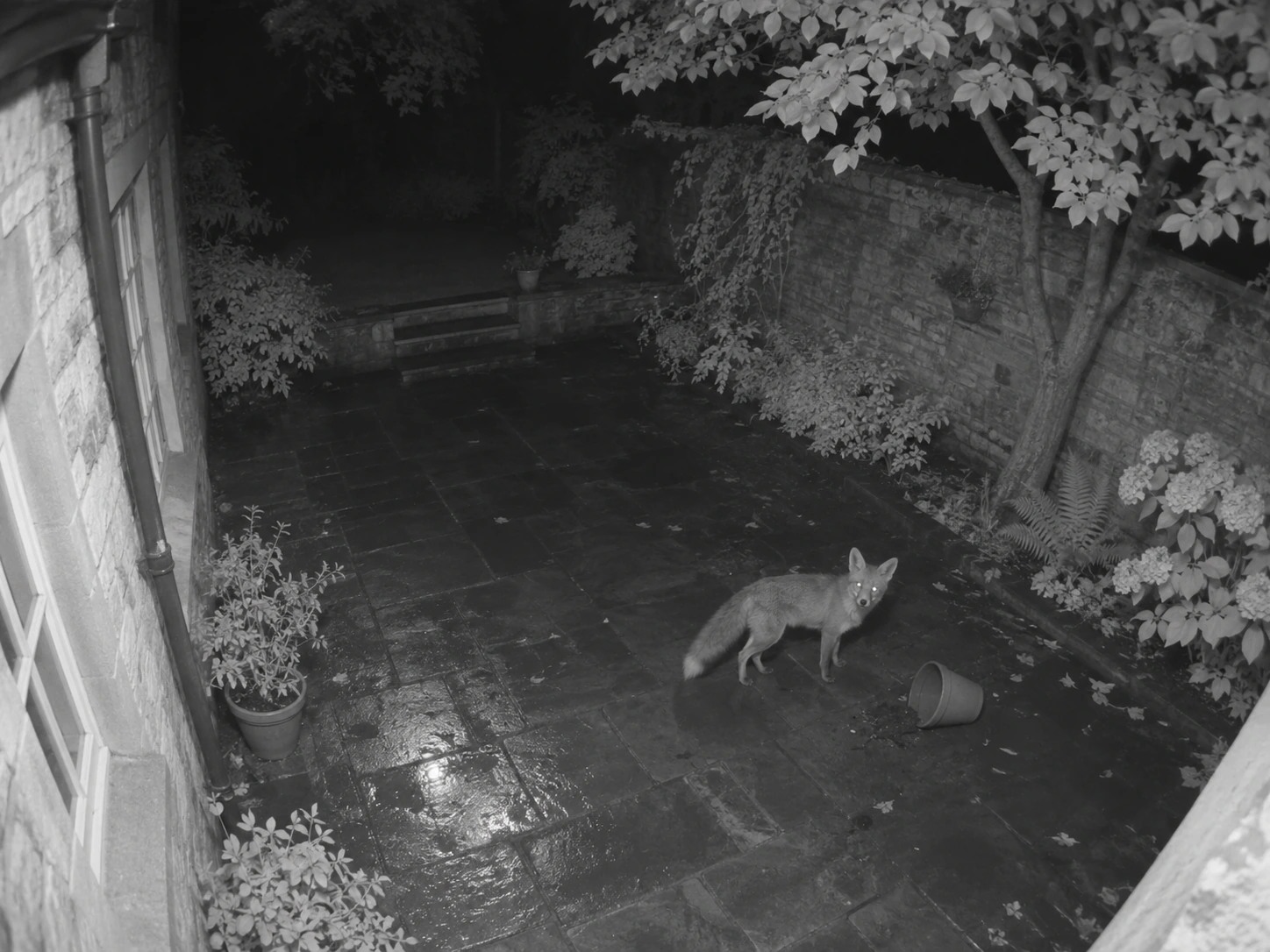
The courtyard study explores an imagined near-infrared appearance through pale foliage, bright reflected eyes and uneven illumination. It remains an illustration of a look, not a measured sensor simulation. Material brightness in infrared does not simply repeat a surface's visible colour.
Make ambiguity do something
A single frame can suggest a before and an after without proving either. A chair moved into the middle of an office could be an accident, a meeting or a joke. Ask which visible relationship supports the story and which part remains an inference. The image becomes more interesting when that uncertainty is deliberate.
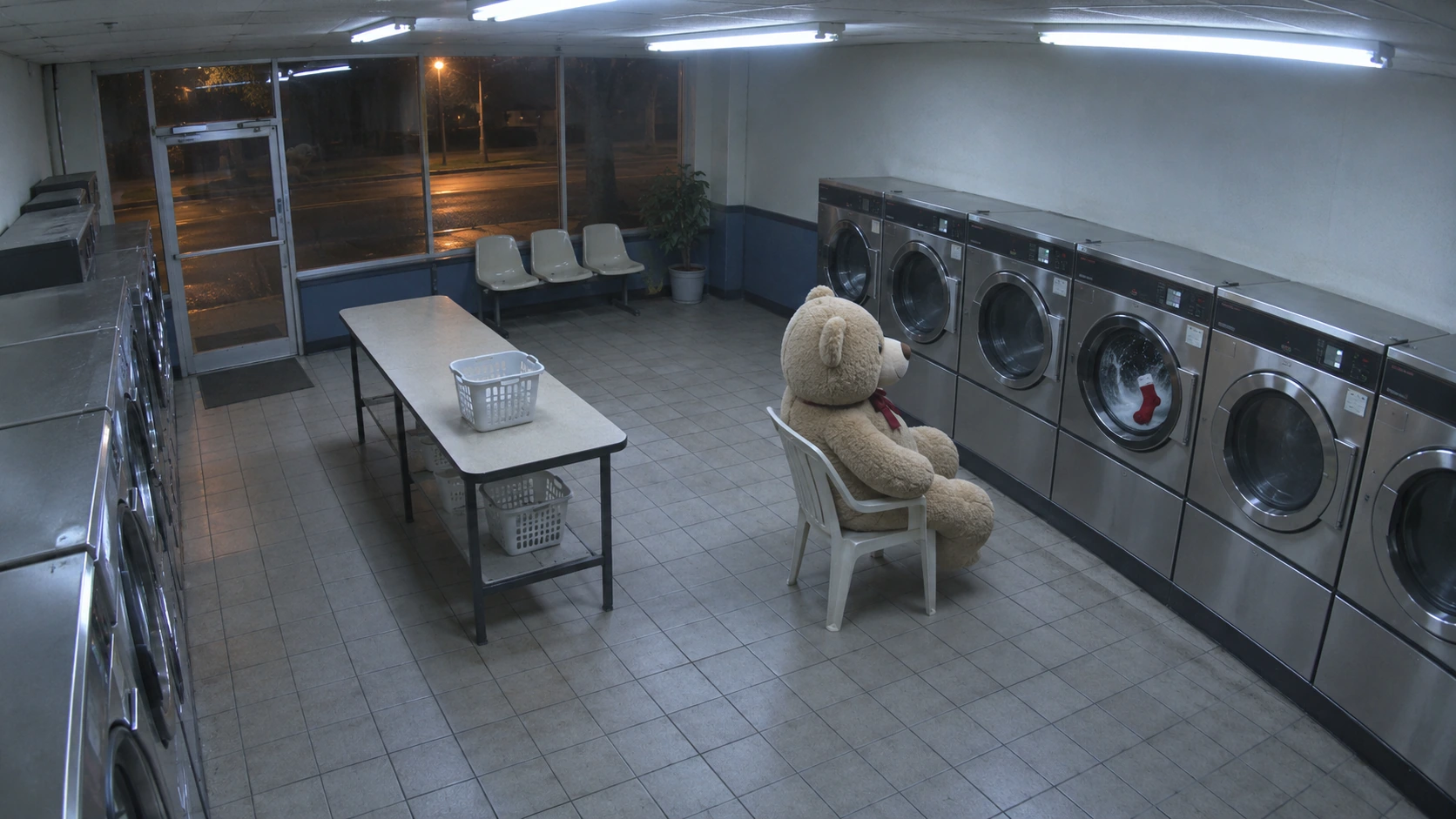
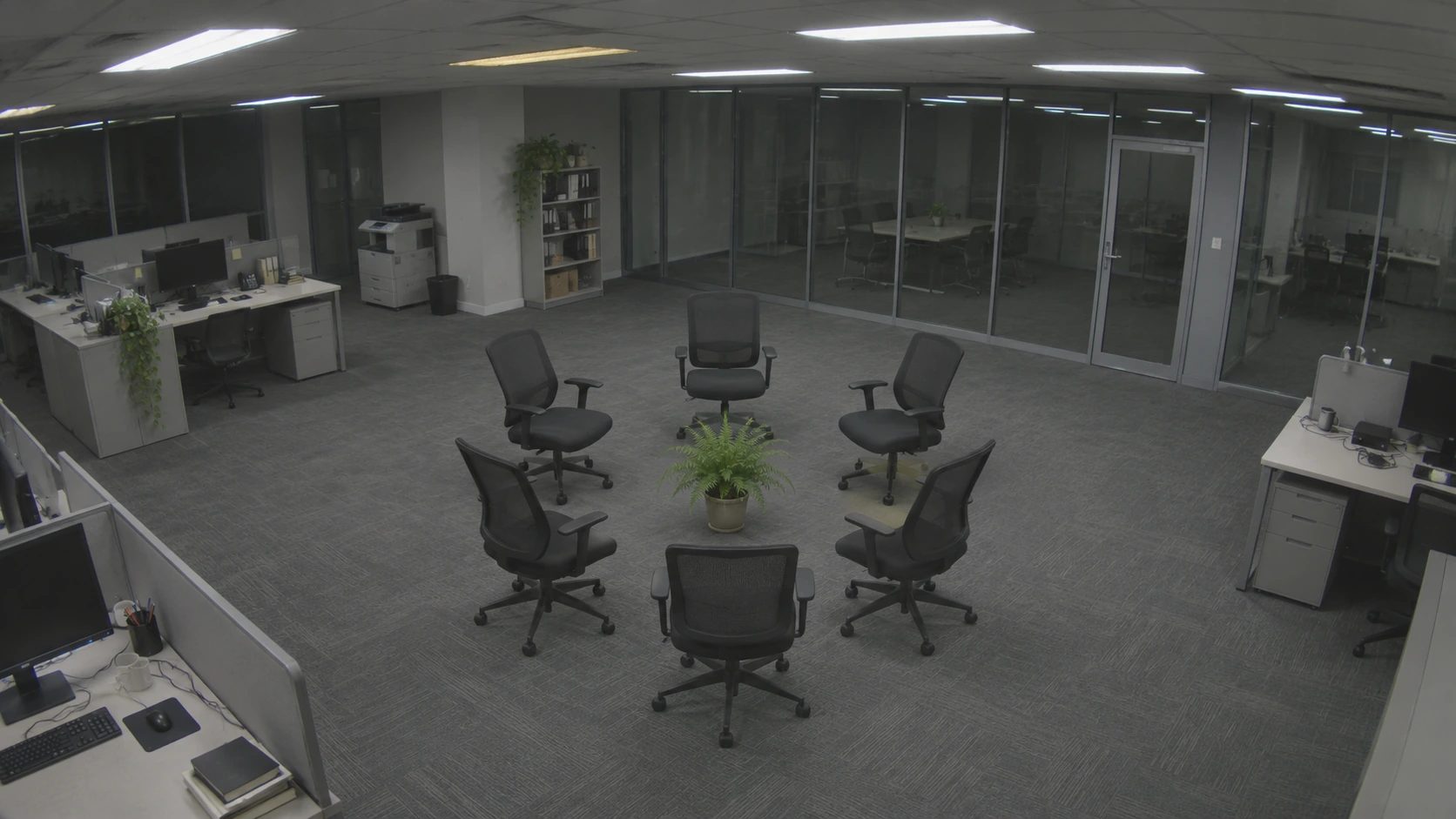
Comedy benefits from the camera's refusal to react. A toy patiently waiting in a laundromat or an office arranged for an impossible meeting can sit inside the same neutral geometry as any routine event. Let one thing break the pattern. Three unrelated absurdities may compete until the central joke becomes difficult to find.
For a more unsettling variation, leave the action just outside the frame and show its effect: an open door, a moving reflection or an empty chair. The Noir guide explores another way light and withheld information can create tension. The fixed-camera approach adds the feeling that an apparatus is present even when no observer is visible.
Build the image, then judge its claims
A useful prompt specifies the room, mounting position, field of view, light source and small event. Add a particular recording treatment only after those relationships are clear. Ask for the view recorded by the camera; otherwise a generator may give you a photograph of the camera hardware or a wall of monitors.
Inspect the result first as architecture, then as a story. Check floor lines, doors, repeated objects and the size of the subject. Look for dramatic portrait lighting or shallow focus that contradicts the intended detached view. Keep enough detail for the event to read without turning the camera into an implausibly perfect witness.
Timestamps, camera names and warning graphics are optional design elements. If they are needed, give them deliberate fictional values and check the typography separately. Captions should identify invented AI scenes. A recording appearance can imply authority very quickly; thoughtful work makes clear what the picture actually represents.
A small poetic detour
Original words from the AOI studio.
Poetry
The lens keeps watch on empty tiles.
The doorway holds a square of rain.
A mop stands still beside a coat;
the night goes back to work again.
One small, unrecorded thought
passes through the recorded room.
The prompt workshop
Original creative exercises. These prompts create new illustrations, not documentary evidence.
An ordinary room, a small event
Create a fictional surveillance-camera-style still from a fixed high corner of a quiet museum. An adult cleaner pauses beside a mop bucket to look at a small painting. Use a wide view, deep focus, practical overhead light and muted colour. Let the empty floor and repeated architectural lines dominate. Show the recorded view itself, with no camera hardware, timestamp or logo.
Study a night-camera appearance
Create an invented black-and-white near-infrared-style courtyard scene from a high fixed camera. A fox stands on wet paving beside a tipped flowerpot. Use pale foliage, restrained eyeshine and illumination that weakens toward the background. Keep the architecture and animal coherent. No green tint, thermal colour map or claim of a real sighting.
Let the room deliver a quiet joke
Show a fictional after-hours office from a fixed ceiling-corner surveillance viewpoint. Ordinary swivel chairs form a serious circle around one small potted plant. Keep desks, cables and practical lighting mundane. Let the single impossible meeting carry the comedy, with no faces on furniture, text or theatrical spotlight.
People & works to explore
References discussed in this article. Consult the sources below for context.
Artists and practitioners
Bruce Nauman — camera-mediated installations documented by MoMA
Julia Scher — surveillance-based installations documented by MoMA and SFMOMA
Paintings and other works
Corridor Installation (Nick Wilder Installation), 1970 — Bruce Nauman
Information America, 1995 — Julia Scher
Predictive Engineering³, 1993–present — Julia Scher, SFMOMA record
A smile from the studio
Jokes
The office camera caught six chairs holding a meeting around a fern. Management praised the attendance and asked the fern to circulate the minutes.