
Television animation companion and original scale-comedy study
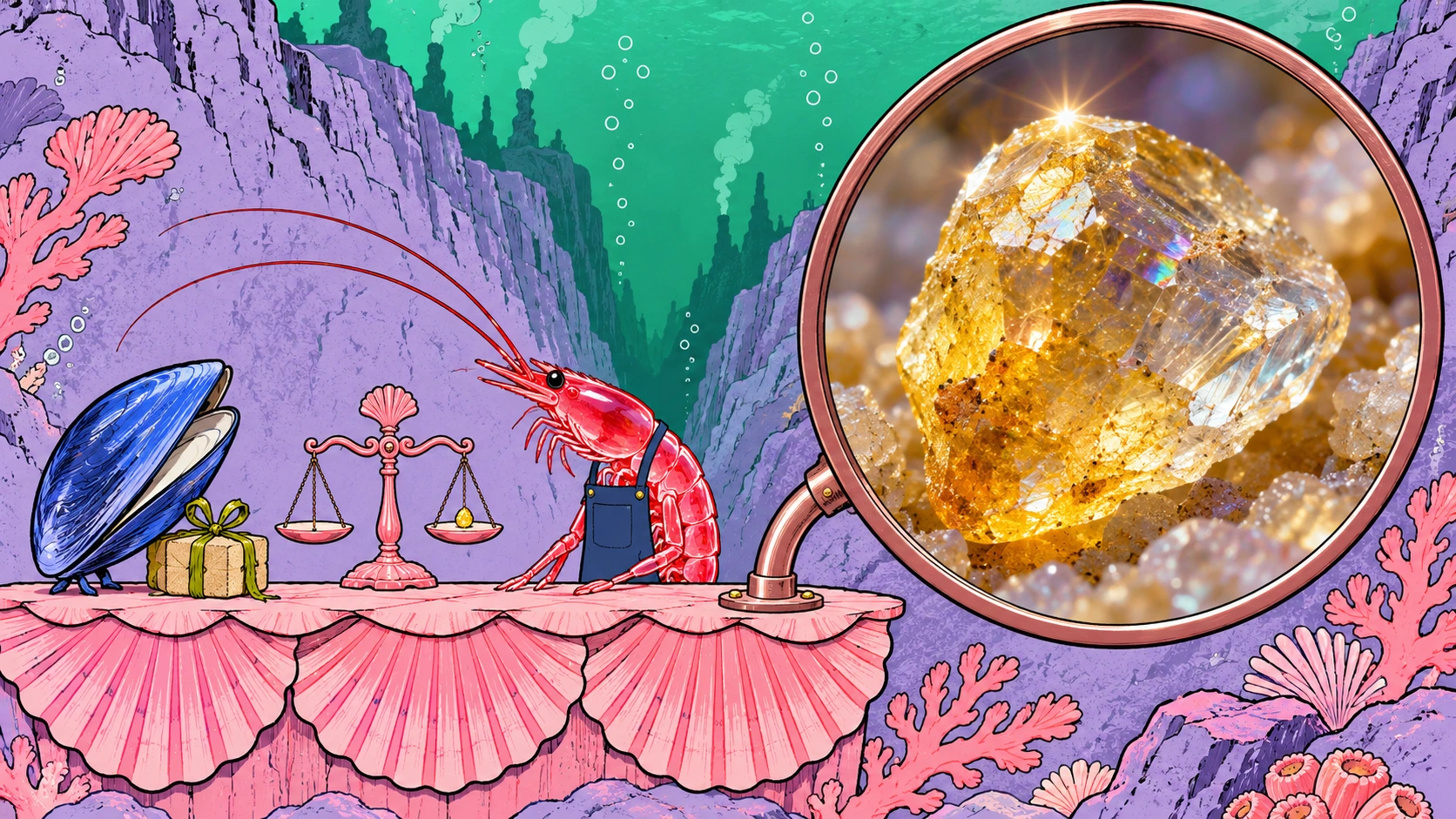
The customer has brought a parcel to be weighed. The clerk has discovered a grain of sand on the balance. This could take all morning. At the invented Hadal Parcel Weigh Station, the question is how far a drawing can change scale and texture while two very serious sea creatures keep the joke together.
A visual introduction
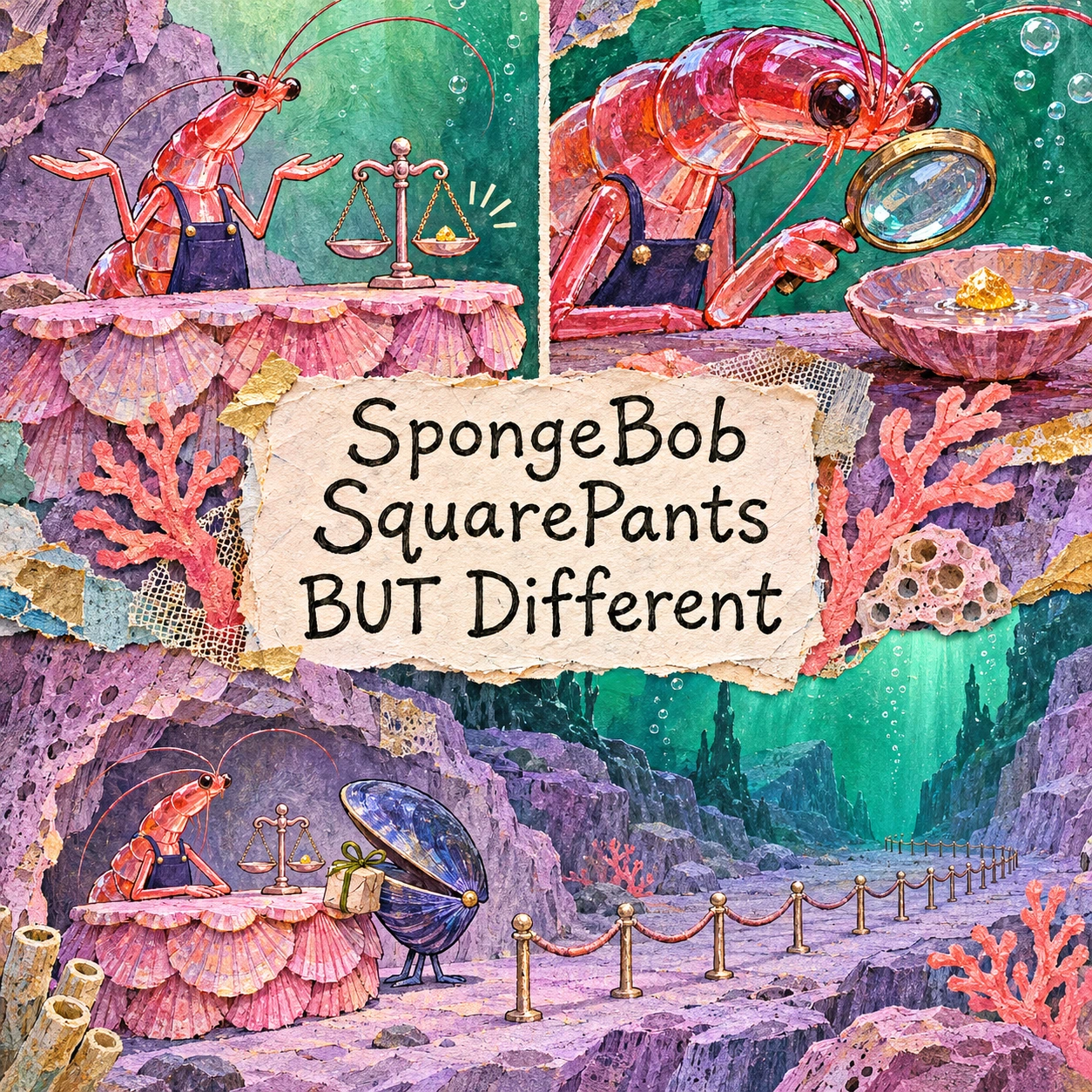
Seven original AI interpretations visit the Hadal Parcel Weigh Station. The shell counter, shrimp, mussel and parcels are inventions. The named interviews and institutions document the television reference.
Select an image for a closer look. Use the thumbnails, arrow keys or a swipe to compare examples. Zoom in to inspect details, or share the image that inspires you.
Creative toolbox · take this style further
Choose an input and a destination. Search sends your words to the chosen site; Copy & open puts them on your clipboard to paste there.
Create with AI
Turn your chosen input into an image prompt or a new creative direction.
ChatGPT
Copy your input and paste it into a ChatGPT conversation or image request.
Copy & open ChatGPT (new tab)Claude · Anthropic
Develop an image prompt or explore the style in a new Claude conversation.
Copy & open Claude · Anthropic (new tab)Midjourney
Paste your input into the Imagine bar on the Create page.
Copy & open Midjourney (new tab)Adobe Firefly
Copy your input, open Firefly, and paste it into the prompt field.
Copy & open Adobe Firefly (new tab)Leonardo.Ai
Copy your input, open Leonardo, and paste it into the generation field.
Copy & open Leonardo.Ai (new tab)Image search
Find visual references. Short, concrete keywords usually work best.
Lexica
Search AI images and prompts using your selected input.
Search with this input Lexica (new tab)Pexels
Search the photo and video library. Short keywords often work best.
Search with this input Pexels (new tab)Pixabay
Search photos, illustrations and other images.
Search with this input Pixabay (new tab)Unsplash
Search photographs using the style name or your own keywords.
Search with this input Unsplash (new tab)Wikimedia Commons
Search photographs, artworks and historical images. Check each file for its source and reuse terms.
Search with this input Wikimedia Commons (new tab)Art & research
Explore artists, collections and the ideas behind a style.
Wikipedia
Search for background reading. A style may not have its own article.
Search with this input Wikipedia (new tab)WikiArt
Copy your input into WikiArt’s search to explore artists and artworks.
Copy & open WikiArt (new tab)Europeana
Paste your keywords into the search to explore European museum, library and archive collections.
Copy & open Europeana (new tab)Inspiration
Discover portfolios and visual ideas from creative communities.
Instagram hashtags
Search a hashtag made from your input: spaces and punctuation are removed. Instagram may require sign-in.
Search with this input Instagram hashtags (new tab)ArtStation
Paste your input into artwork search for concept art, environments, characters and visual development.
Copy & open ArtStation (new tab)Behance
Paste your input into project search for illustration, design and visual storytelling.
Copy & open Behance (new tab)A closer look
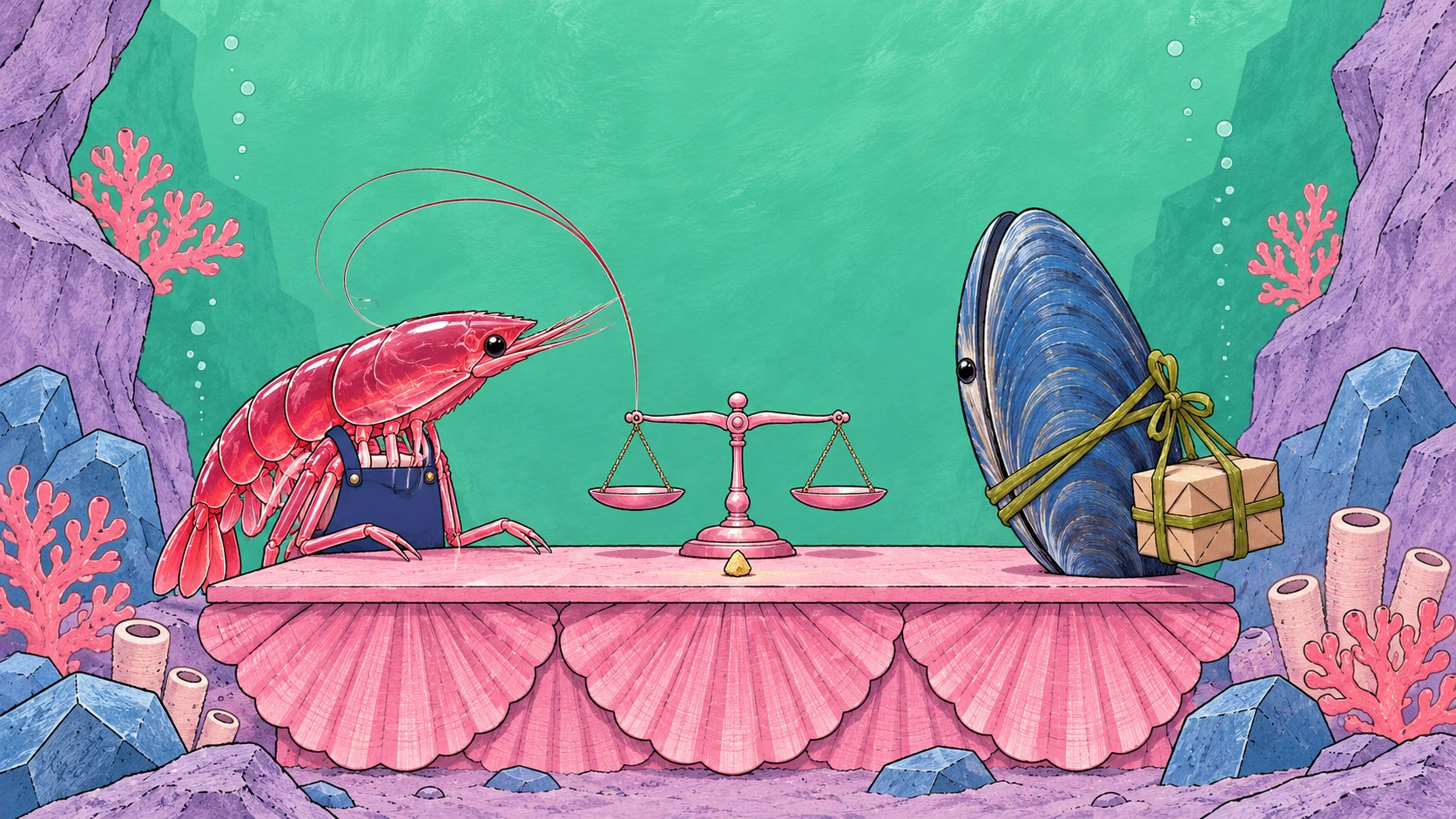
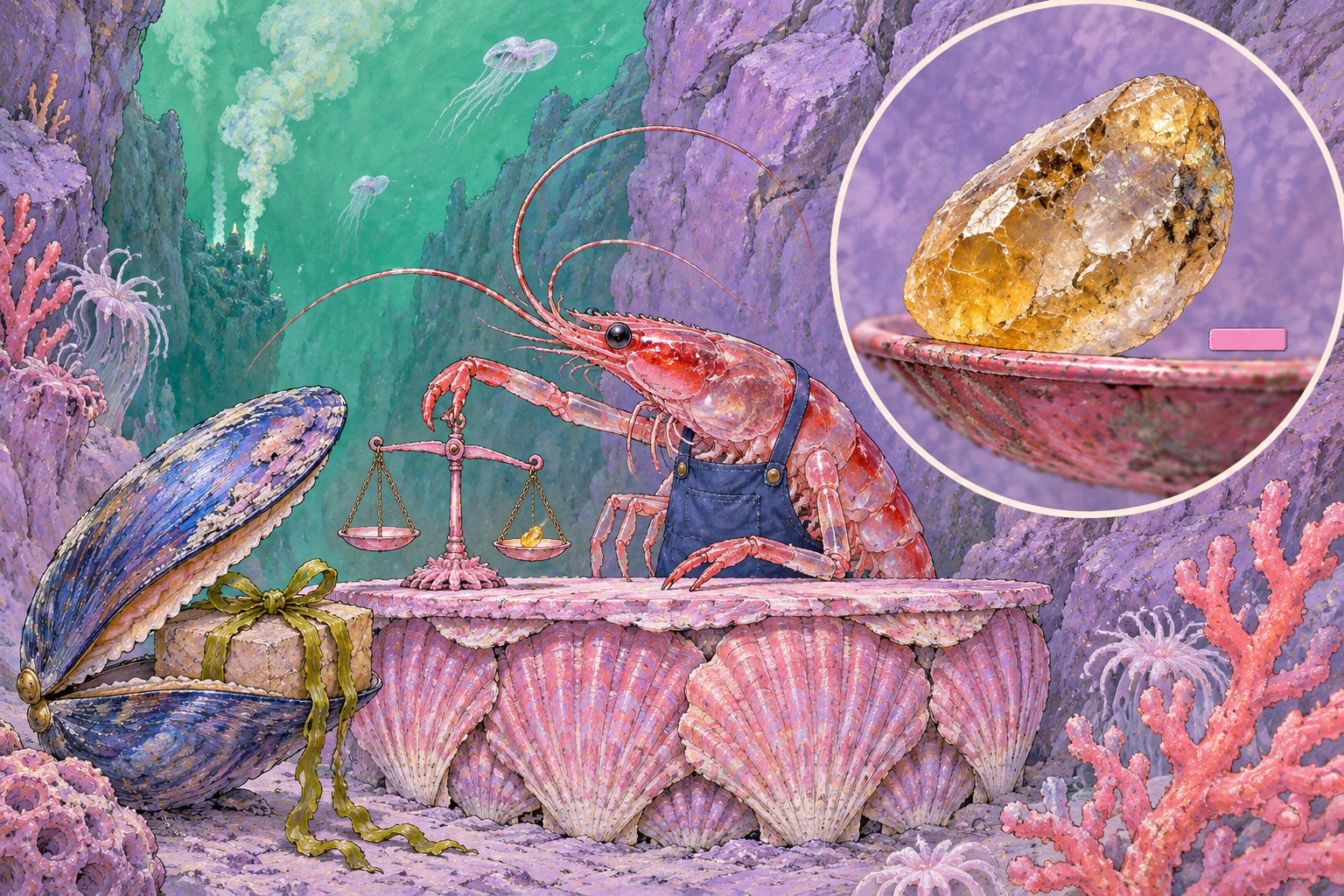
A cherry-red shrimp and a blue mussel make clear, flat shapes against a lavender trench. Then a single mineral grain suddenly receives the attention usually afforded a crown jewel. A repeated pink scale pan is the clue that the two sorts of drawing belong to the same transaction.
Give the shrimp a professional opinion
CalArts recalls that Stephen Hillenburg drew The Intertidal Zone to teach students at the Orange County Marine Institute. In the Hogan’s Alley oral history, background designer Kenny Pittenger remembers Hillenburg building comedy out of what the characters would do. Pittenger also describes occasions when surface settings used photographs or live action. That change of visual register opens a question for an illustrator working on paper.
I gave this shrimp a responsibility. It must certify the weight of every parcel that crosses the counter. The blue mussel can close its shell and wait as long as it likes. Once you know that about the staff and customers, a grain of grit becomes a dispute between two ideas of how to spend a morning. The Cartoon Drawing guide gives the broader grounding in exaggeration and timing.
Keep one edge when you change scale
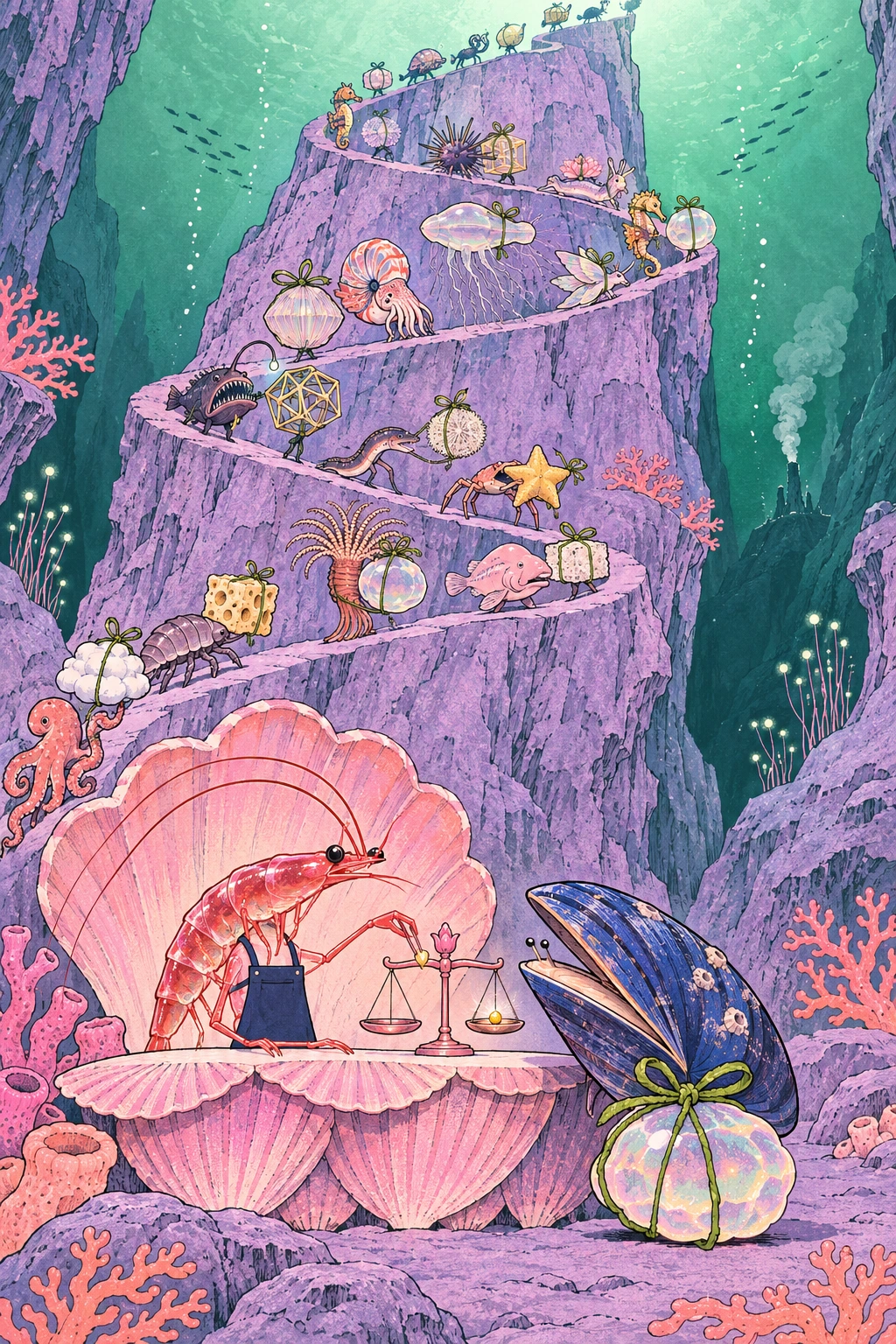
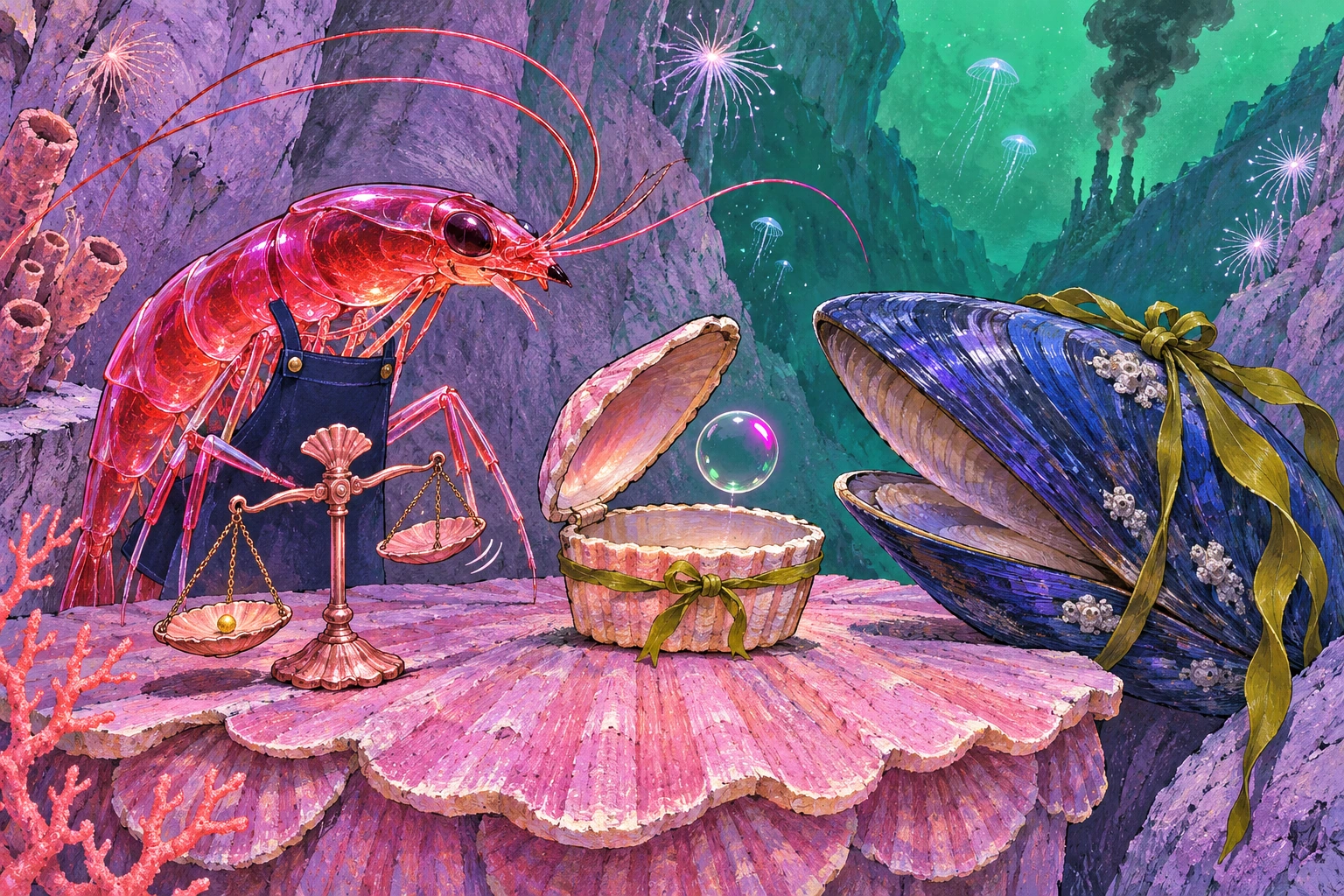
Make the first image cheap in the best sense. Two clear bodies, a counter and a pink scale pan are enough. Put the pan on the same side in the next view and preserve a nick in its paint. Then let the world turn extravagant. Give every fracture in the grain a plane and every plane a different little reflection. The eye can take an immense leap if it recognises the place it landed.
There are two separate controls here. One is magnification, the ratio between the grain and the frame. The other is the time your drawing asks a reader to spend. A tiny delicate patch in an otherwise simple frame can slow a reader down without enlarging it at all. The painted insert lets you turn up both controls together.
Return to the counter in time to see nothing happen
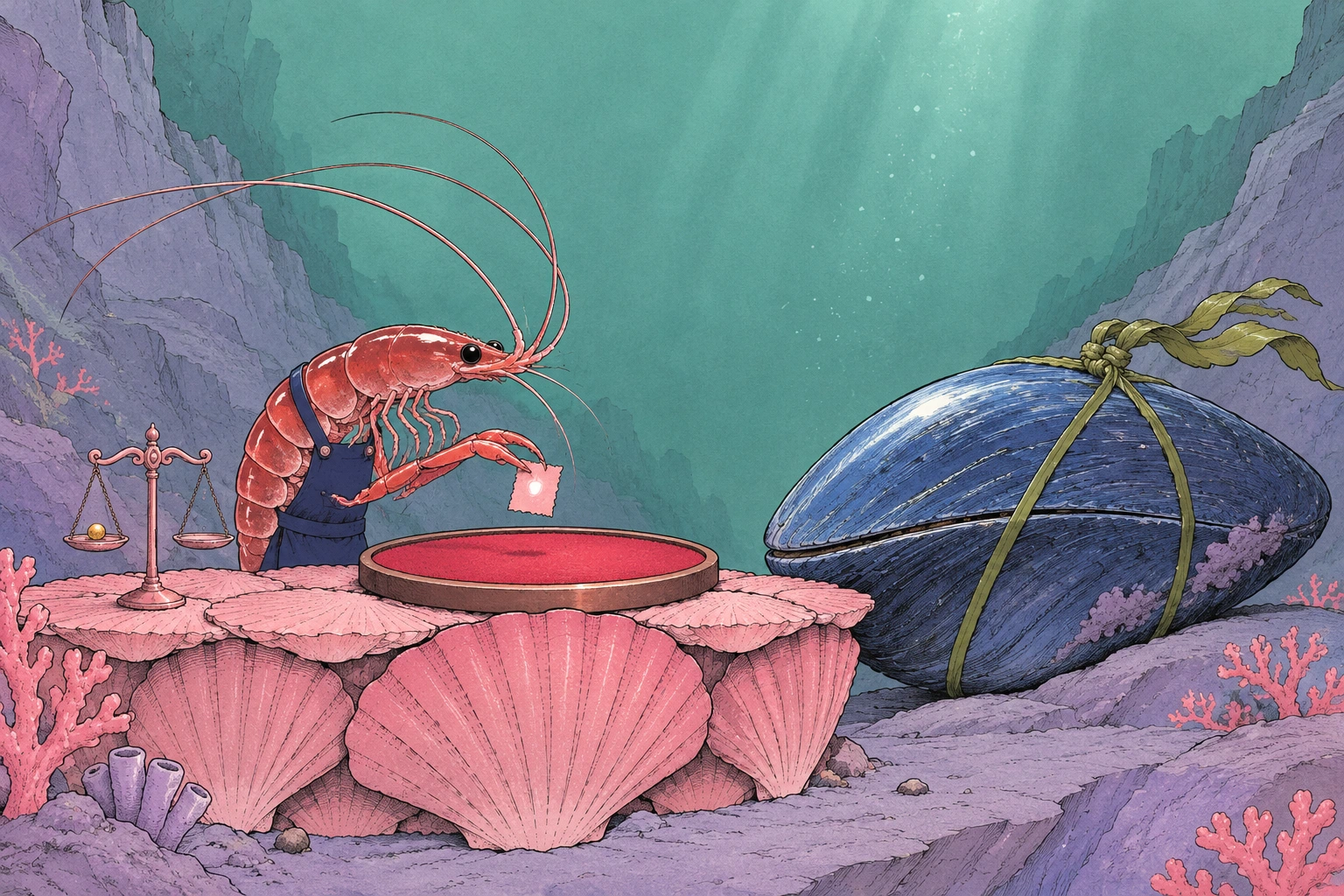
The temptation is to make the clerk jump after so impressive a close-up. Try the scene with no reaction beyond an antenna changing angle. The clerk’s calm gives us permission to laugh at the grand importance we have just assigned to a speck. The mussel, it must be admitted, has an excellent face for waiting.
For a very different arrangement, make the queue climb a wall. The postage problem stays down at the bottom while the consequences extend out of sight above. In the Family Guy companion a cutaway invents a different social occasion. Here the interruption looks more closely at precisely what was in front of us all along.
Three readings from Penny’s desk
Positive review. The costly-looking portrait of a nearly worthless grain makes me laugh precisely because the clerk has a good reason to inspect it. The practical stakes survive the change in medium.
Negative review. If every background stone sparkles, the insert has nothing left to spend. I would give the surrounding trench one broad wash and keep the mineral glints for their single appearance.
Neutral review. The vertical queue and the close-up stretch time in opposite ways. One adds customers and the other enlarges the delay facing the first customer. They make a useful pair for a storyboard exercise.
A small poetic detour
Original words from the AOI studio.
Poetry
The pan dips down. A grain of gold
has tipped the business of the deep.
The mussel folds its little shop.
The clerk has one more weight to keep.
The prompt workshop
Original creative exercises. These prompts create new illustrations, not documentary evidence.
Establish the counter
Give a translucent red shrimp and a hinged blue mussel a practical reason to wait at an underwater scale. Keep the counter frontal, the gestures tiny and one pink pan easy to recognise.
Spend the whole budget on grit
Draw a single grain on the same pink pan at extreme magnification. Hand-paint cracks and wet glints with unreasonable solemnity. Use the chipped edge of the pan as the bridge back to the simple cartoon.
Return one beat later
Go back to the original viewpoint after the inquiry. The shrimp raises a tiny slip of paper while the mussel remains closed. Leave a generous interval of plain water over their heads.
A smile from the studio
Jokes
The parcel went by sea mail. The single grain of sand requested a private courier.