
Television animation companion and original ensemble-comedy study
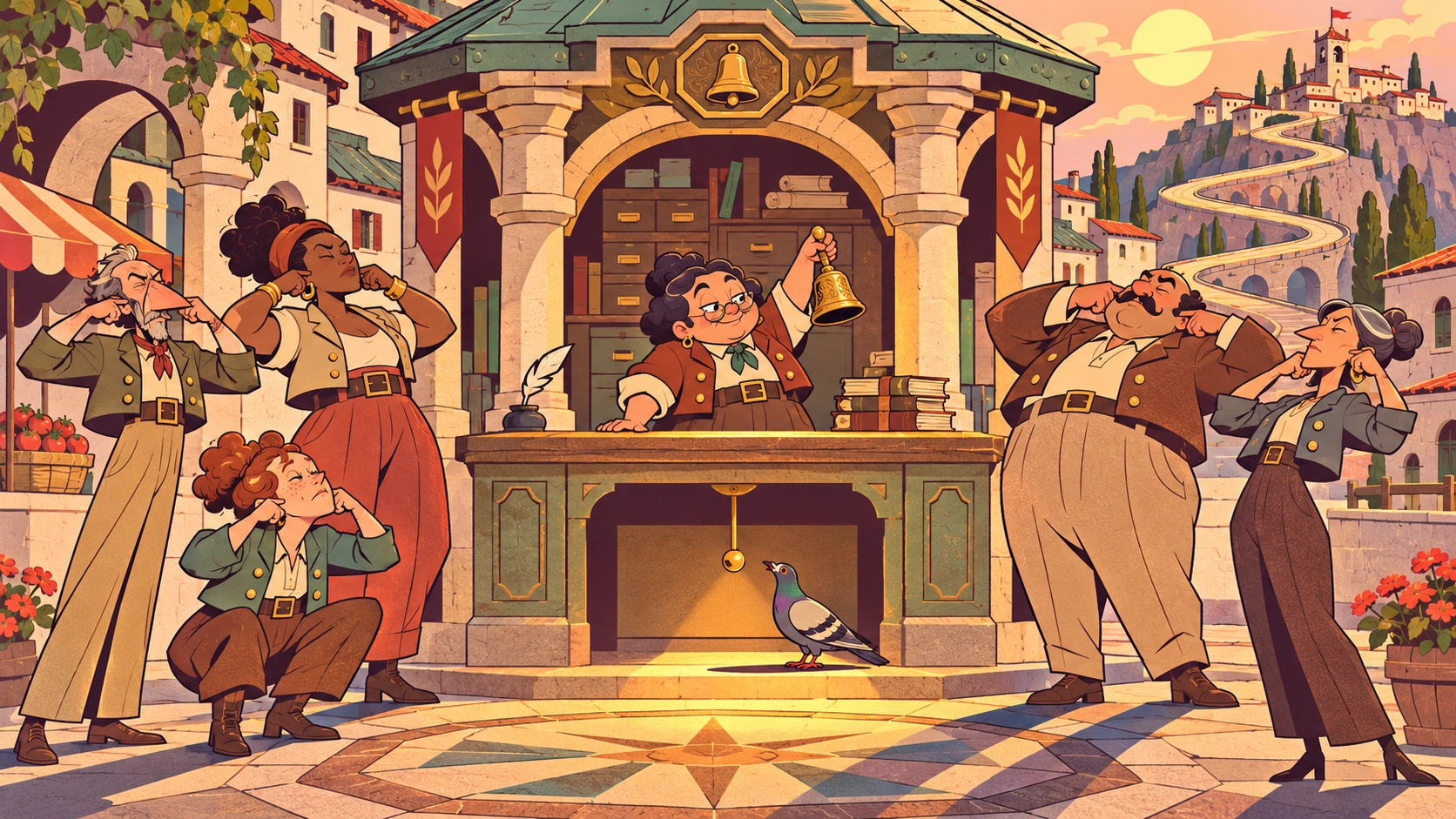
Everybody in Switchback covers an ear for the noon bell. The bell has lost its clapper. My favourite citizen is the one who checks. This companion to The Simpsons asks how to draw a town in which the audience sees a joke travel from person to person before anyone has spoken.
A visual introduction
Seven original AI interpretations visit the fictional Bell Office of Switchback. Notice which characters can see the source of a sound and which can only see their neighbours.
Select an image for a closer look. Use the thumbnails, arrow keys or a swipe to compare examples. Zoom in to inspect details, or share the image that inspires you.
Creative toolbox · take this style further
Choose an input and a destination. Search sends your words to the chosen site; Copy & open puts them on your clipboard to paste there.
Create with AI
Turn your chosen input into an image prompt or a new creative direction.
ChatGPT
Copy your input and paste it into a ChatGPT conversation or image request.
Copy & open ChatGPT (new tab)Claude · Anthropic
Develop an image prompt or explore the style in a new Claude conversation.
Copy & open Claude · Anthropic (new tab)Midjourney
Paste your input into the Imagine bar on the Create page.
Copy & open Midjourney (new tab)Adobe Firefly
Copy your input, open Firefly, and paste it into the prompt field.
Copy & open Adobe Firefly (new tab)Leonardo.Ai
Copy your input, open Leonardo, and paste it into the generation field.
Copy & open Leonardo.Ai (new tab)Image search
Find visual references. Short, concrete keywords usually work best.
Lexica
Search AI images and prompts using your selected input.
Search with this input Lexica (new tab)Pexels
Search the photo and video library. Short keywords often work best.
Search with this input Pexels (new tab)Pixabay
Search photos, illustrations and other images.
Search with this input Pixabay (new tab)Unsplash
Search photographs using the style name or your own keywords.
Search with this input Unsplash (new tab)Wikimedia Commons
Search photographs, artworks and historical images. Check each file for its source and reuse terms.
Search with this input Wikimedia Commons (new tab)Art & research
Explore artists, collections and the ideas behind a style.
Wikipedia
Search for background reading. A style may not have its own article.
Search with this input Wikipedia (new tab)WikiArt
Copy your input into WikiArt’s search to explore artists and artworks.
Copy & open WikiArt (new tab)Europeana
Paste your keywords into the search to explore European museum, library and archive collections.
Copy & open Europeana (new tab)Inspiration
Discover portfolios and visual ideas from creative communities.
Instagram hashtags
Search a hashtag made from your input: spaces and punctuation are removed. Instagram may require sign-in.
Search with this input Instagram hashtags (new tab)ArtStation
Paste your input into artwork search for concept art, environments, characters and visual development.
Copy & open ArtStation (new tab)Behance
Paste your input into project search for illustration, design and visual storytelling.
Copy & open Behance (new tab)A closer look
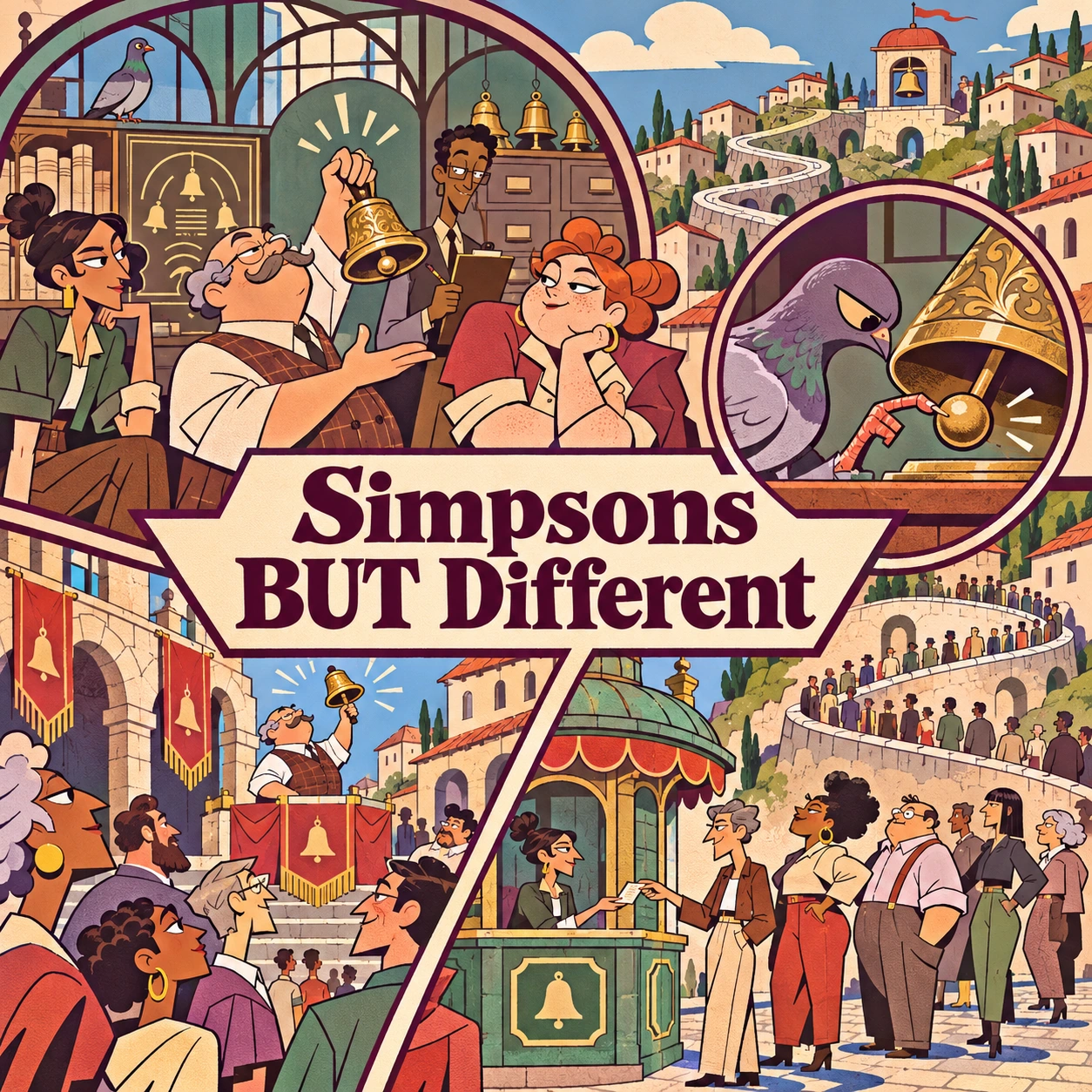
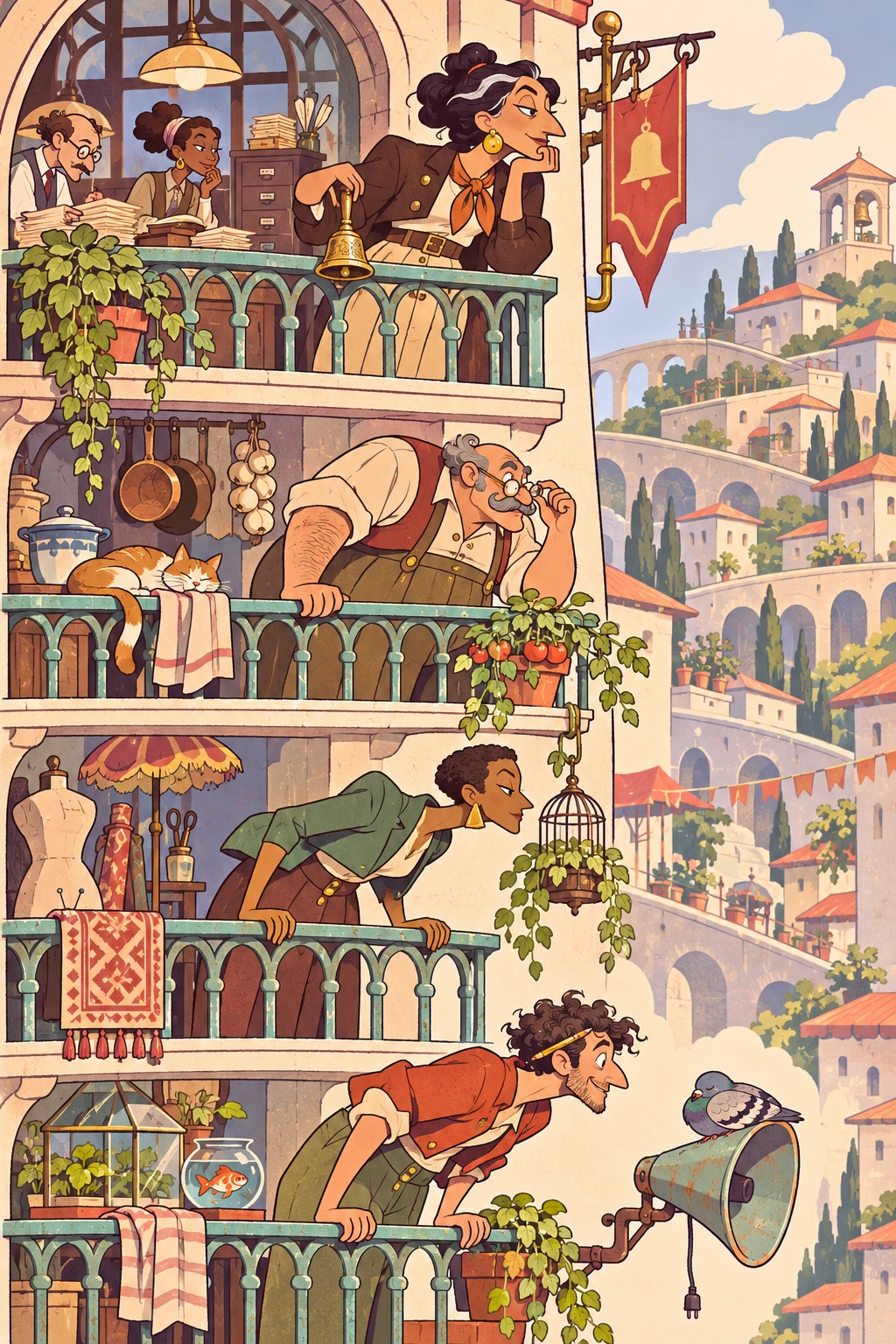
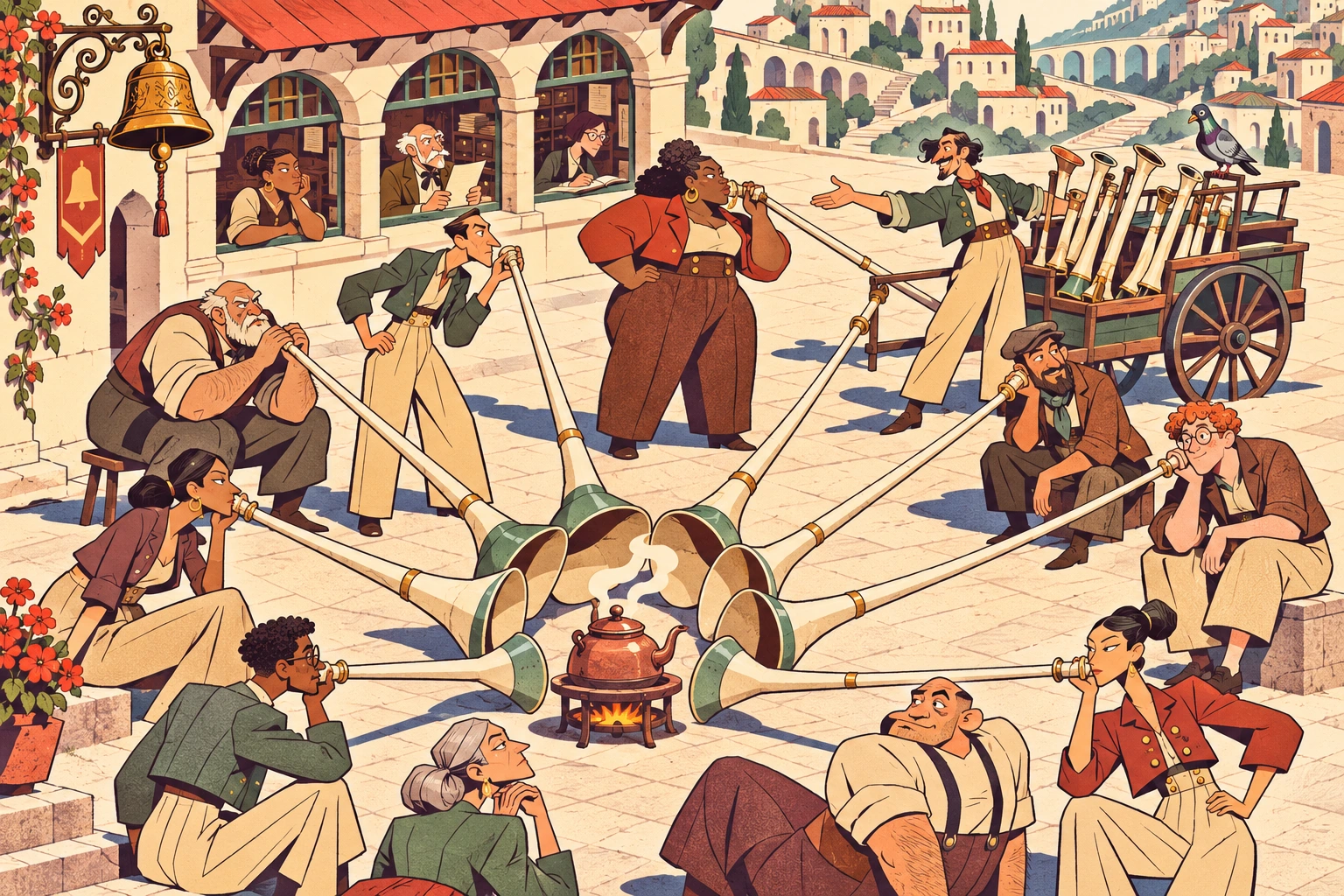
Plum outlines hold the clerks apart from the terracotta buildings. A bent queue, a leaning torso or the gap beneath a bell supplies a reading order. The town can look perfectly sensible to somebody walking through it. From where the viewer stands, its error is plain.
Who gets to understand first?
When Michael Idato interviewed Matt Groening, the creator of The Simpsons spoke about recognising a cartoon character in silhouette. Director David Silverman recalls the same concern in an interview about Playdate with Destiny. He also describes putting an idea onto a story reel and returning to the writers after they had seen it play. An outline answers who. A succession of reactions can change what that person knows.
The broader Simpsons guide introduces the television reference. Here I have traded the household for a municipal office and given its employees a problem of their own. A clerk can know the ringing procedure, an apprentice can believe the ring is coming, and a bystander can know why it cannot possibly happen. Give all three the same expression and you lose an entire town’s worth of comedy.
Draw the public square as a seating plan
Start with the bell, its operator and one person with a clear view under the counter. At the size of a postage stamp you should be able to trace those three positions with a finger. Now add two residents who can see their neighbours covering their ears but cannot see the bell. They have every reason to follow suit. The crowd has acquired a cause, a direction and a timing.
A window frame can hide the operator’s hand from the queue while leaving it visible to us. A hat brim can point to the next face. Save one clean interval between bodies for the part that explains the mistake. Filling that interval with amusing street furniture is an excellent way to hide your best joke.
Two experiments with the same queue
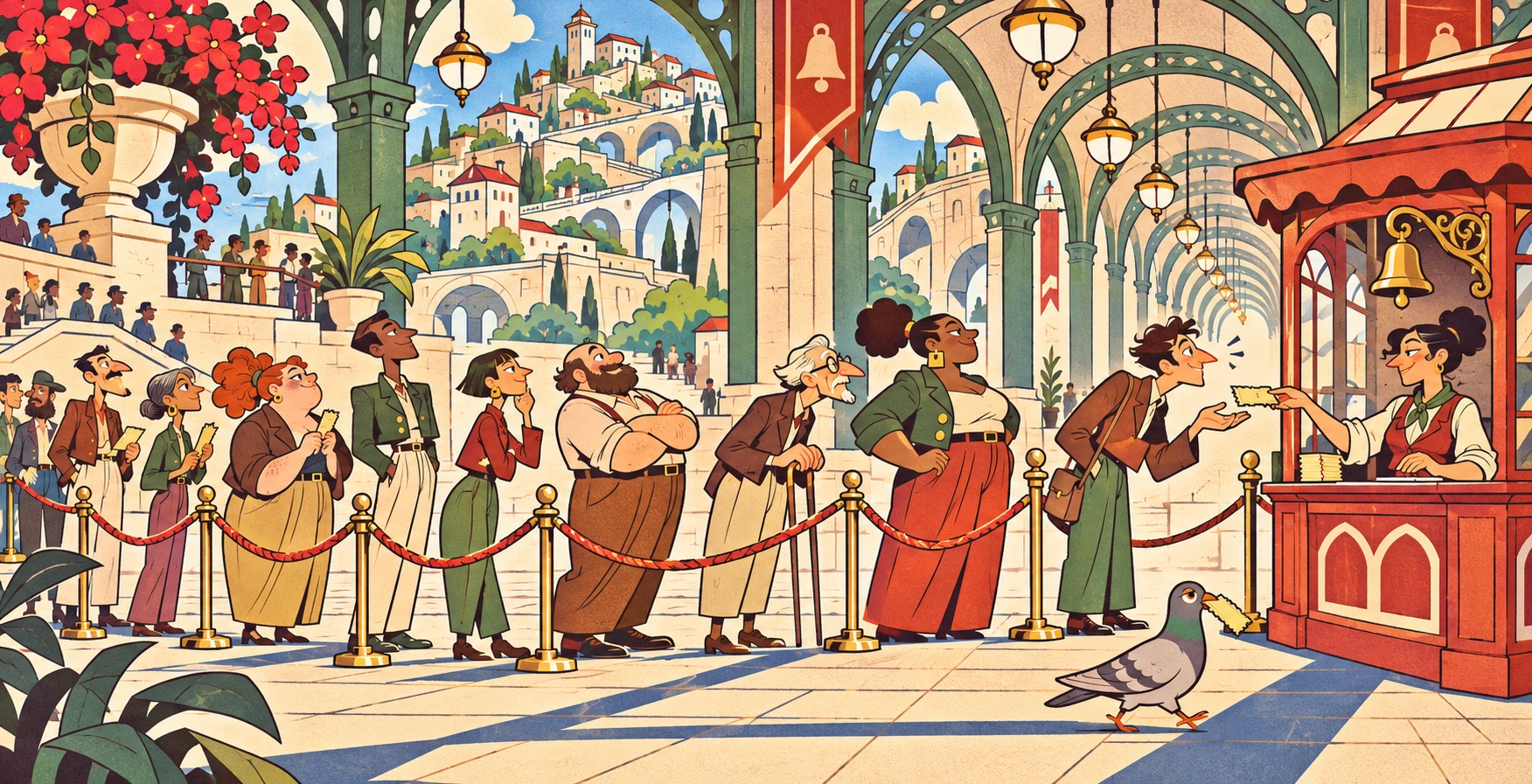
First draw the line from down among the elbows. We see coats ahead, one clenched ticket and the clerk’s expectant face. Then put the camera up in the arcade roof. The rope describes a handsome circuit straight back to the issuing desk. The people have behaved exactly the same way in both pictures. The second camera lets us audit their instructions.
Try covering the pigeon with your thumb. A good ensemble should still have an intelligible problem and several plausible reactions. Return the bird and it can supply an extra opinion. Contrast the Family Guy companion’s excursion into an imaginary coronation with this shot, in which leaving everyone in the room is the point.
Three readings from Penny’s desk
Positive review. The joke works especially well when a resident has good local evidence for a decision the whole crowd gets wrong. I can sympathise with the last person in line and still laugh at the plan.
Negative review. An overbusy crowd turns into a search puzzle. I would sacrifice two witty hats to recover the little interval between a raised hand and the silent bell.
Neutral review. A poster lets a reader choose when to discover the clapper. In a storyboard the artist chooses that instant. The same staging can support appreciably different jokes.
A small poetic detour
Original words from the AOI studio.
Poetry
A hand goes up. A sleeve goes up.
Five elbows blot the square.
The bell bestows a minute’s peace.
One pigeon spends it there.
The prompt workshop
Original creative exercises. These prompts create new illustrations, not documentary evidence.
Build the sightline
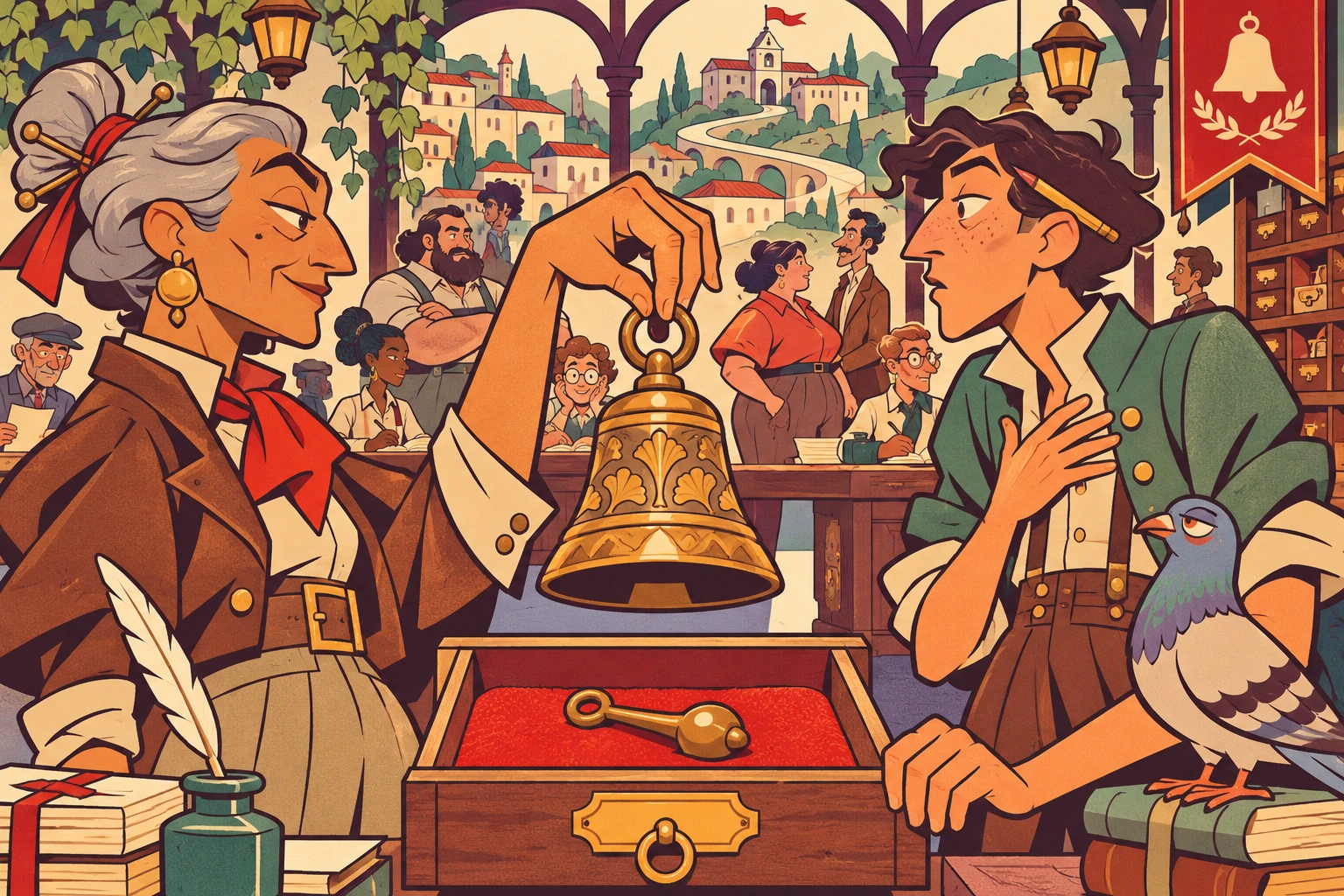
Draw a hill-town noon ceremony with three adults, a bell and its detached clapper. Put the viewer where both pieces are visible. Let one resident see the operator and a second resident see only the first.
Turn the camera
Stage one municipal queue twice. At eye height frame the dutiful next person in line. From a high arcade show the rope returning to the same counter. Preserve the counter and the order of the people in both compositions.
Give the last person a job
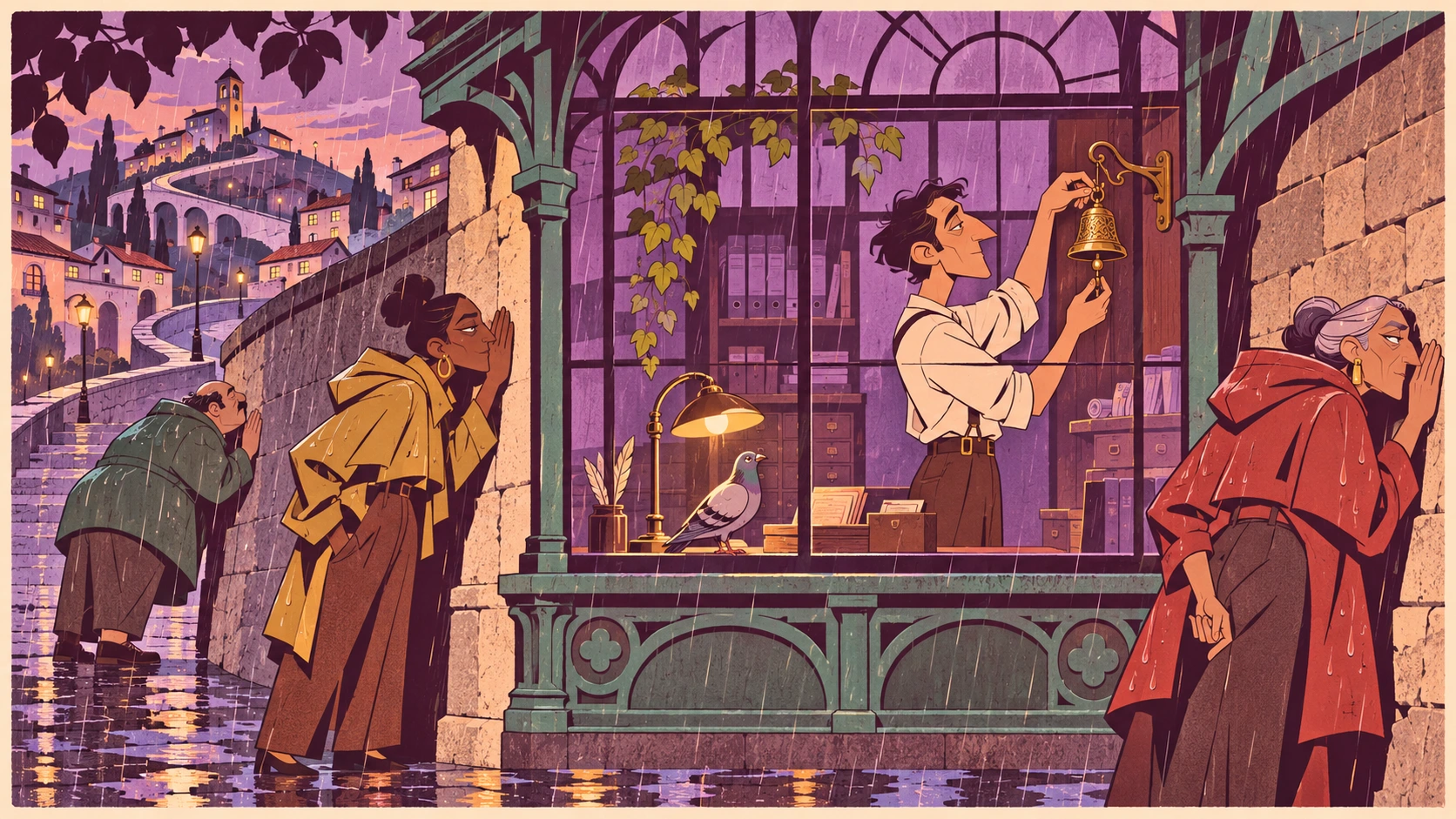
Draw a silent after-hours scene in a glass-fronted bell office. Outside, three neighbours try to hear through different walls. Inside, a worker puts one small brass part away. Give the smallest gesture the warmest light.
A smile from the studio
Jokes
The committee agreed the silent bell had excellent coverage. They could hear it equally well from every street.