
Photographic technique
A mangrove root looks like an arch from the bank. At water level you can see the fish sheltering between its feet. Split level underwater photography, also called over-under or split-shot photography, puts the camera at the surface to show both views in one frame.
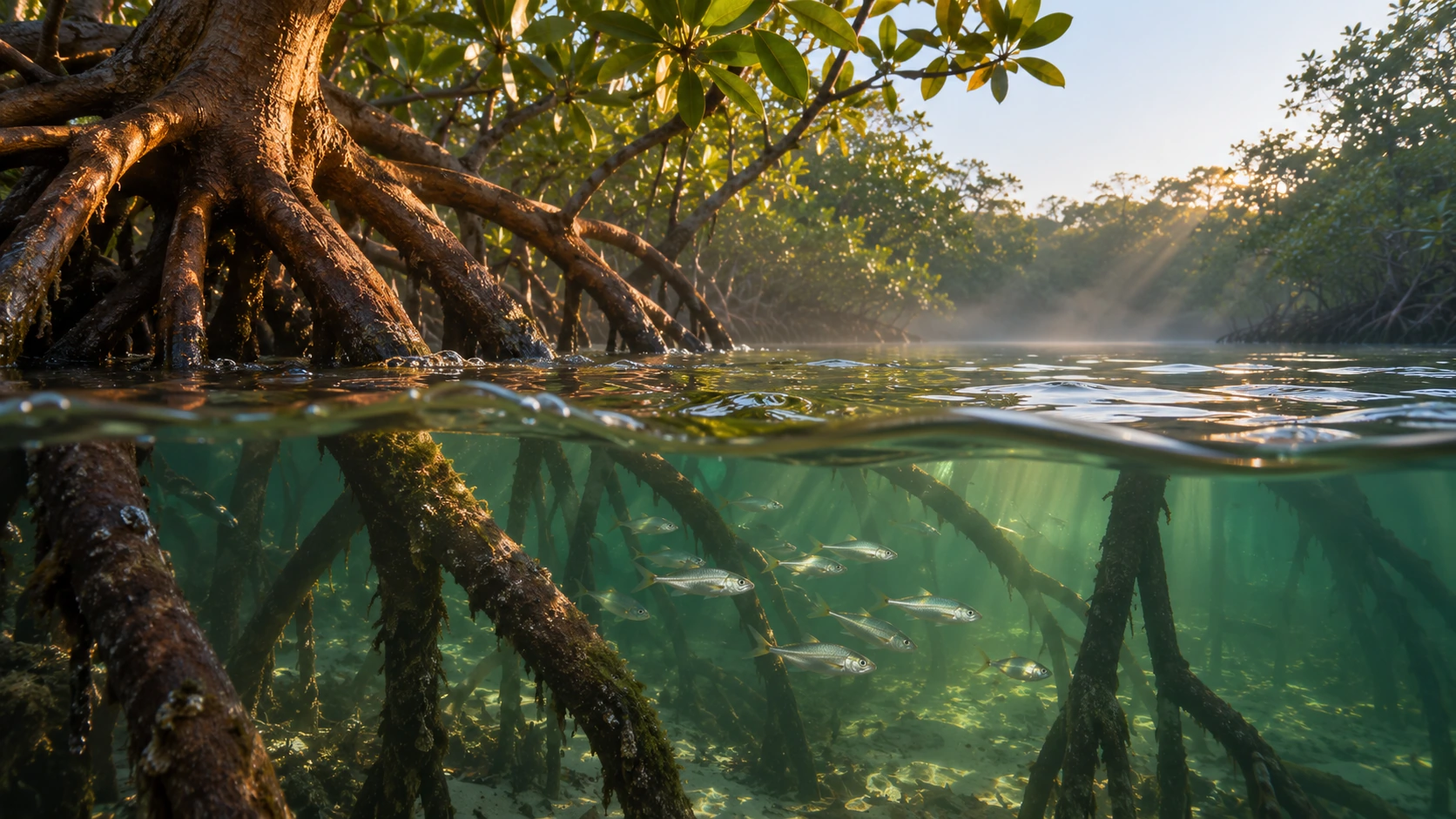
A visual introduction
Five original AI-generated illustrations explore the waterline in mangrove, alpine, pond and harbor settings, including a comparative collage.
Select an image for a closer look. Use the thumbnails, arrow keys or a swipe to compare examples. Zoom in to inspect details, or share the image that inspires you.
Creative toolbox · take this style further
Choose an input and a destination. Search sends your words to the chosen site; Copy & open puts them on your clipboard to paste there.
Create with AI
Turn your chosen input into an image prompt or a new creative direction.
ChatGPT
Copy your input and paste it into a ChatGPT conversation or image request.
Copy & open ChatGPT (new tab)Claude · Anthropic
Develop an image prompt or explore the style in a new Claude conversation.
Copy & open Claude · Anthropic (new tab)Midjourney
Paste your input into the Imagine bar on the Create page.
Copy & open Midjourney (new tab)Adobe Firefly
Copy your input, open Firefly, and paste it into the prompt field.
Copy & open Adobe Firefly (new tab)Leonardo.Ai
Copy your input, open Leonardo, and paste it into the generation field.
Copy & open Leonardo.Ai (new tab)Image search
Find visual references. Short, concrete keywords usually work best.
Lexica
Search AI images and prompts using your selected input.
Search with this input Lexica (new tab)Pexels
Search the photo and video library. Short keywords often work best.
Search with this input Pexels (new tab)Pixabay
Search photos, illustrations and other images.
Search with this input Pixabay (new tab)Unsplash
Search photographs using the style name or your own keywords.
Search with this input Unsplash (new tab)Wikimedia Commons
Search photographs, artworks and historical images. Check each file for its source and reuse terms.
Search with this input Wikimedia Commons (new tab)Art & research
Explore artists, collections and the ideas behind a style.
Wikipedia
Search for background reading. A style may not have its own article.
Search with this input Wikipedia (new tab)WikiArt
Copy your input into WikiArt’s search to explore artists and artworks.
Copy & open WikiArt (new tab)Europeana
Paste your keywords into the search to explore European museum, library and archive collections.
Copy & open Europeana (new tab)Inspiration
Discover portfolios and visual ideas from creative communities.
Instagram hashtags
Search a hashtag made from your input: spaces and punctuation are removed. Instagram may require sign-in.
Search with this input Instagram hashtags (new tab)ArtStation
Paste your input into artwork search for concept art, environments, characters and visual development.
Copy & open ArtStation (new tab)Behance
Paste your input into project search for illustration, design and visual storytelling.
Copy & open Behance (new tab)A closer look
Look for a near waterline and a far horizon. The first can rise, dip or blur right across the lens while the second stays level in the distance. An object that crosses the surface makes the connection easy to read. In the banner, try following one root past the ripple and into the green shade.
Where to put the waterline
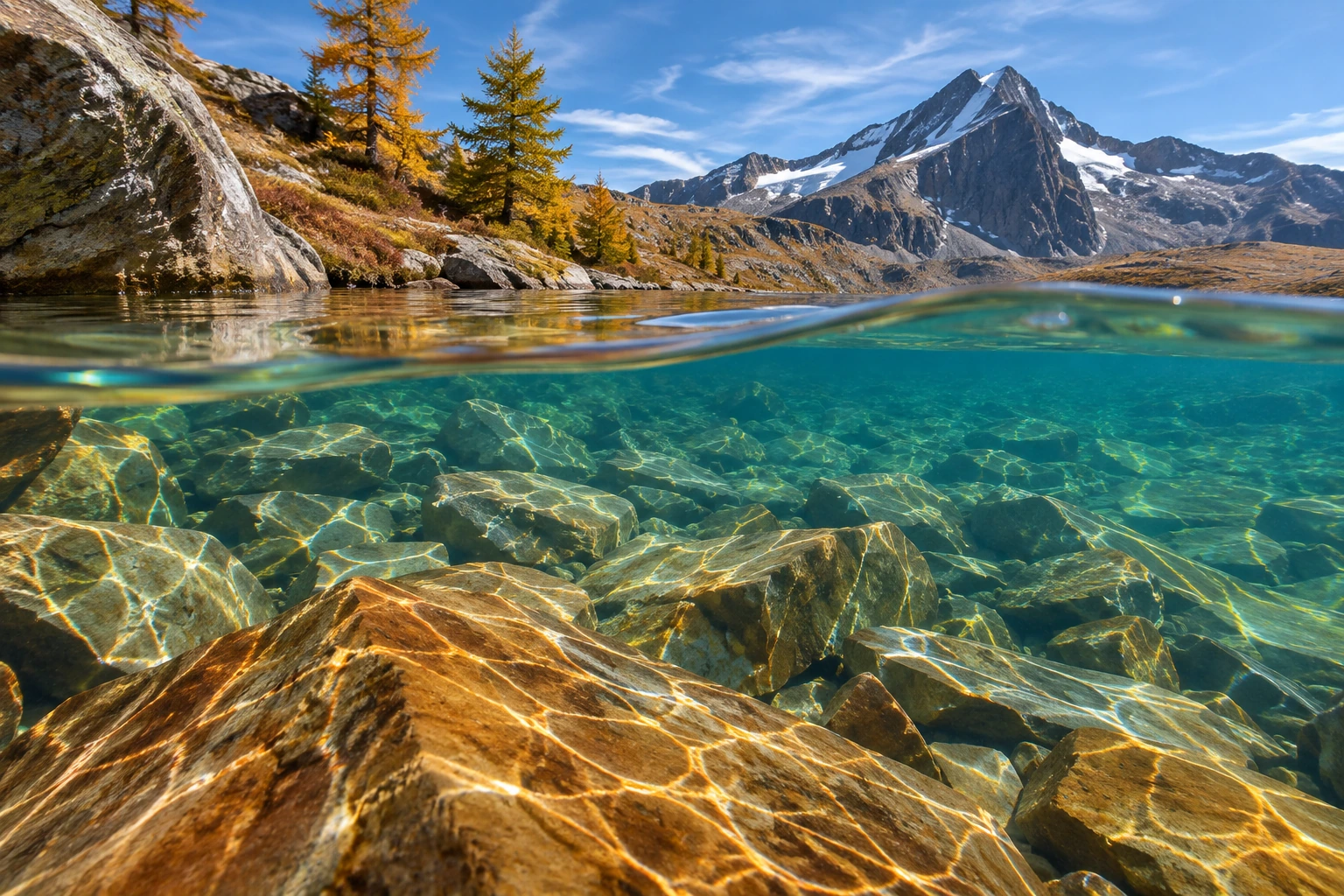
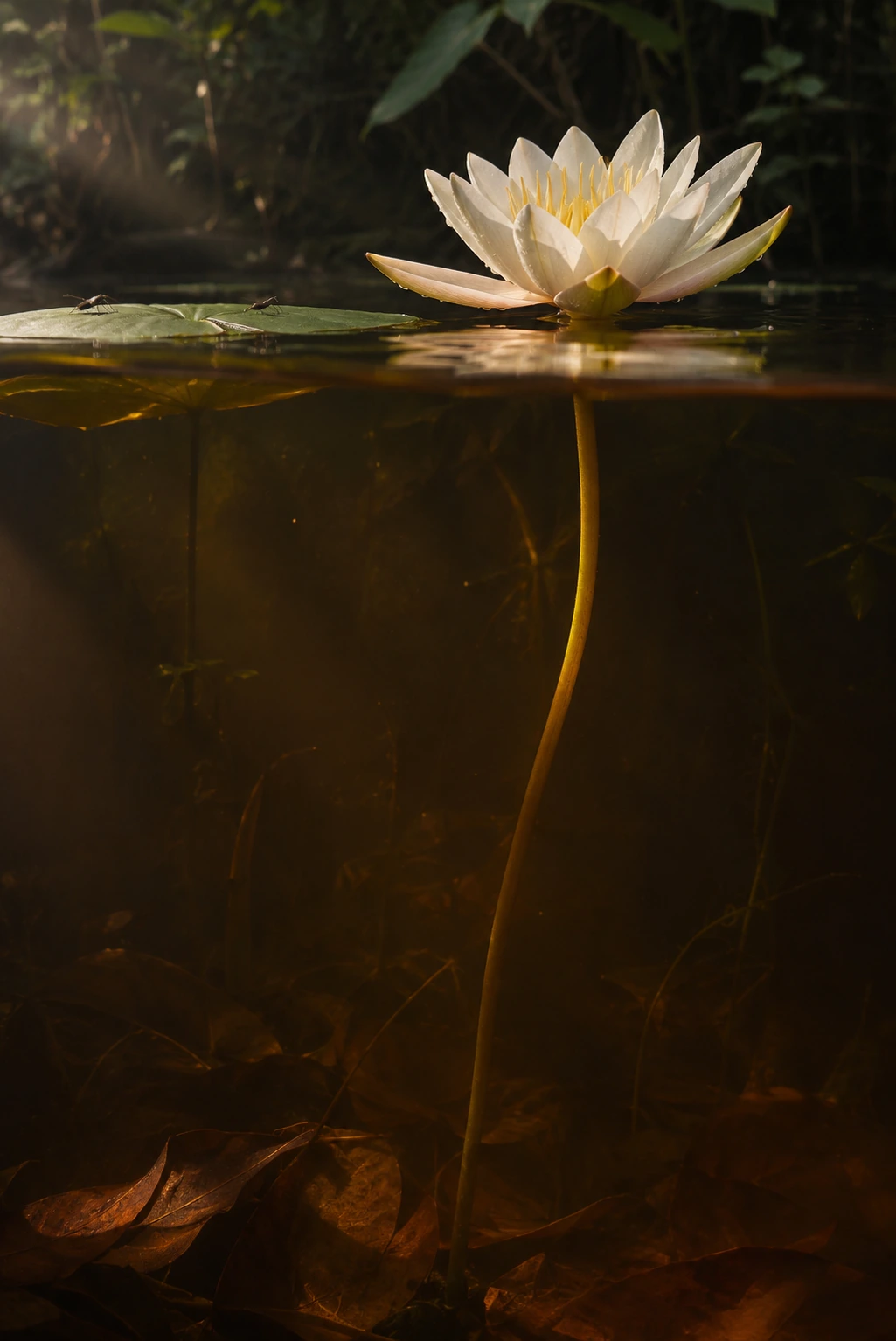
The water touching the housing is surprisingly close to the viewer. It can become the thickest mark in the picture. Before deciding how much space to give it, choose what the viewer should discover below. A single flower and its long stem suit a vertical frame. A mountain lake invites a wider view with plenty of room for a rock near the camera.
Cover the lower part of the mangrove image with your hand. The bank and creek still make a landscape. Uncover the fish and the very same roots become a shelter. Try the same exercise on a split shot of your own. What does the second view tell you that the first could only hint at?
A dome, two focus distances and one exposure
For a physical split shot, a photographer places part of a housing’s dome port in the water. A large dome gives a small wave more surface to move across. A close-focusing wide-angle lens can take in a submerged foreground and a distant shore. Viewed through the dome, the underwater scene appears optically close. A smaller aperture helps keep both it and the shore acceptably sharp when the available light permits. Check fine detail on each side separately.
Bright sky and shaded water can exceed the tonal range of a single exposure. Ikelite’s Steve Miller suggests starting in the shallows, where sunlight reflected from a pale bottom can ease that difference. For a sunset he exposes for the sky and uses submerged strobes on nearby subjects. A strobe can pick out scales on a fish close to the dome. The distant channel will still take its color from the ambient light.
A moving edge can change the story
In a short sequence, one wave may hide the place where the root enters the creek. The next may leave the joint clear or briefly turn it into a bright, curved lens. Compare the crossings before choosing the most dramatic wave. A quicker shutter can hold the ripple’s outline. A longer exposure can turn it into a soft band, especially effective against a still piling.
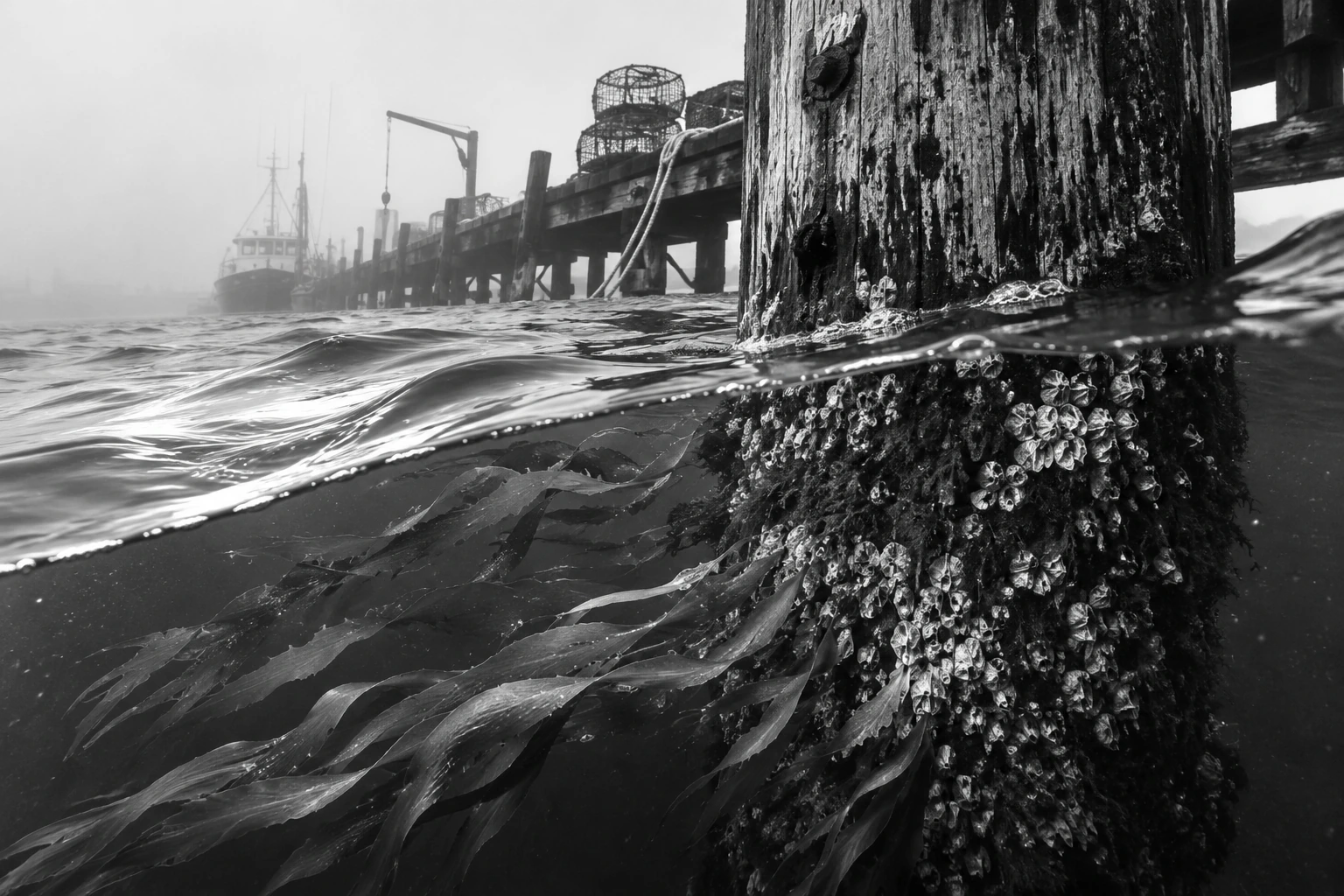
The monochrome harbor study makes a useful test. The weathered timber, rim of bubbles and pale barnacles identify three different surfaces even after the color is gone. If the line disappears in a small print, check which neighboring tones have merged before reaching for more contrast across the whole picture.
Reading a split shot as evidence
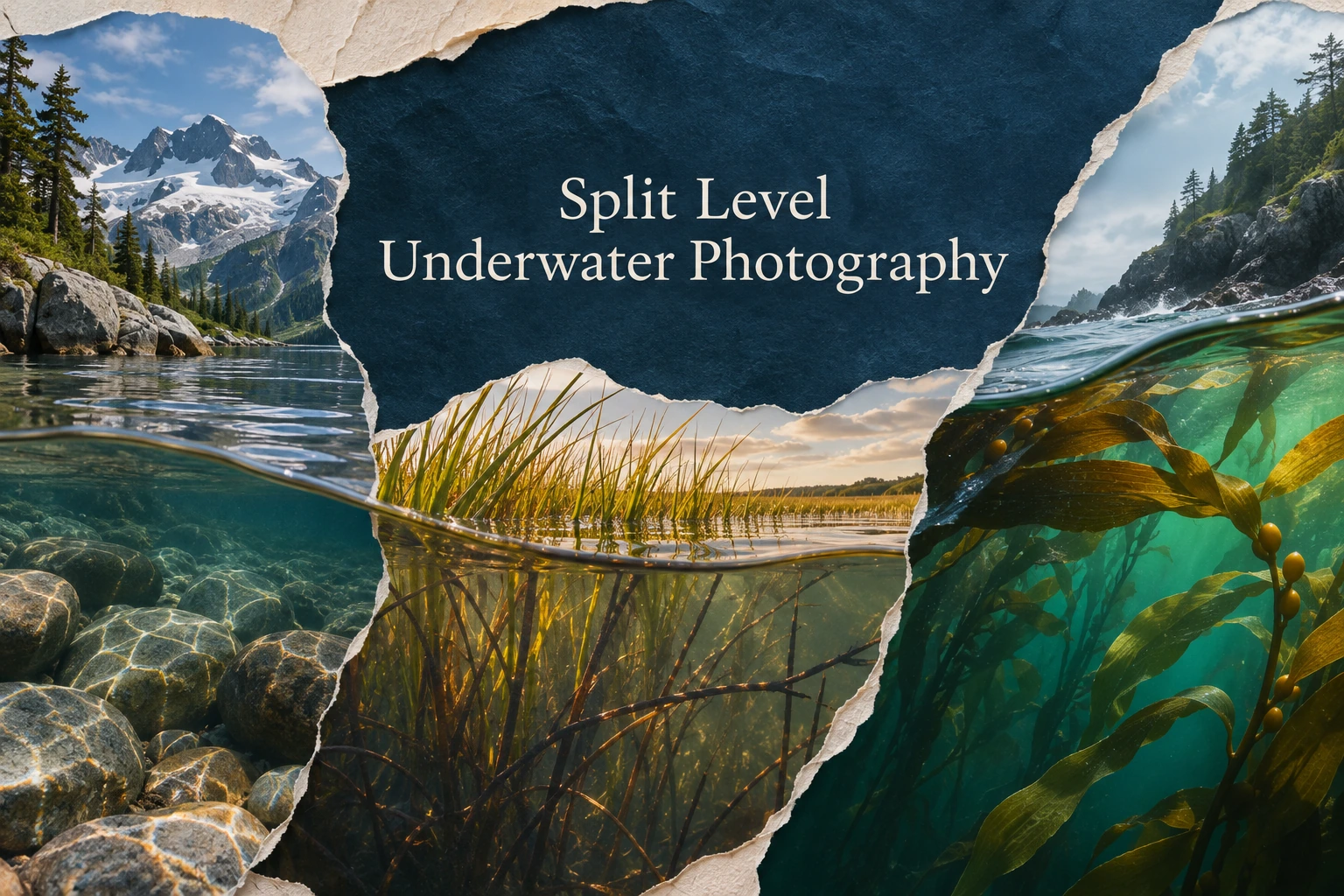
An over-under can be made in one exposure. An artist can also assemble separately exposed views, or imagine an entire scene. With a composite, name how the perspectives were combined when that matters to the viewer. The five works here are AI-generated interpretations, and the collage deliberately shows its paper joins. None documents a particular habitat or encounter.
For an invented scene, choose one object you can trace across the surface. A flower stalk should meet its blossom at a plausible point. The upper and lower parts of a piling should belong to the same pier. Allow ripples and refraction to disturb the edge, then look again at what the image asks the viewer to believe.
A small poetic detour
Original words from the AOI studio.
Poetry
The fish turns under a copper root.
Above it, one leaf takes the sun.
A ripple lifts the whole brown bank
for half a blink, then lets it down.
On a stone no walker sees,
light ties a net and pulls it loose.
The prompt workshop
Original creative exercises. These prompts create new illustrations, not documentary evidence.
Follow one stem
Create a vertical over-under view of one water lily. Give the flower the top quarter of the frame and use a single curved stem to lead into amber water. Show a little reflected sky on the pad.
Give the shore a foreground
Picture a mountain lake from a half-submerged dome. Frame a low ridge above a near ochre boulder. Let the ridge stay level as one passing ripple climbs to the right. Give the boulder the sharpest light.
Describe a tide without color
Make a black-and-white split shot beneath a working jetty. Follow one wooden piling from dry grain to wet barnacles. Let a single silvery wave divide those textures and leave distant pilings in fog.
Your next inspiration
Discover another art style
Follow a visual thread to the next subject.
A smile from the studio
Jokes
The photographer asked the harbor master who had moved the horizon halfway through the shoot. “The horizon hasn’t moved in forty years,” he said. “You’re looking for the tide. She works shifts.”