
Photographic technique
Fisheye photography turns a very wide field of view into a strongly curved image. Learn the difference between circular and frame-filling views, how placement changes the effect and when exaggeration strengthens a photograph.
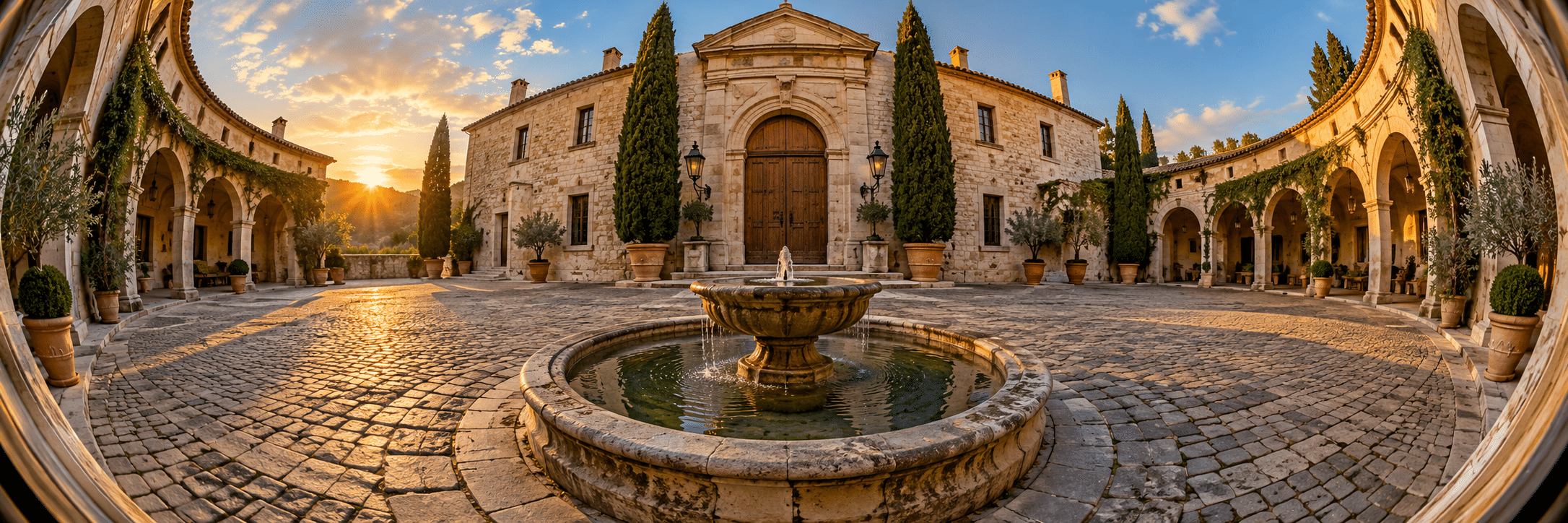
A visual introduction
Select an image for a closer look. Use the thumbnails, arrow keys or a swipe to compare examples. Zoom in to inspect details, or share the image that inspires you.
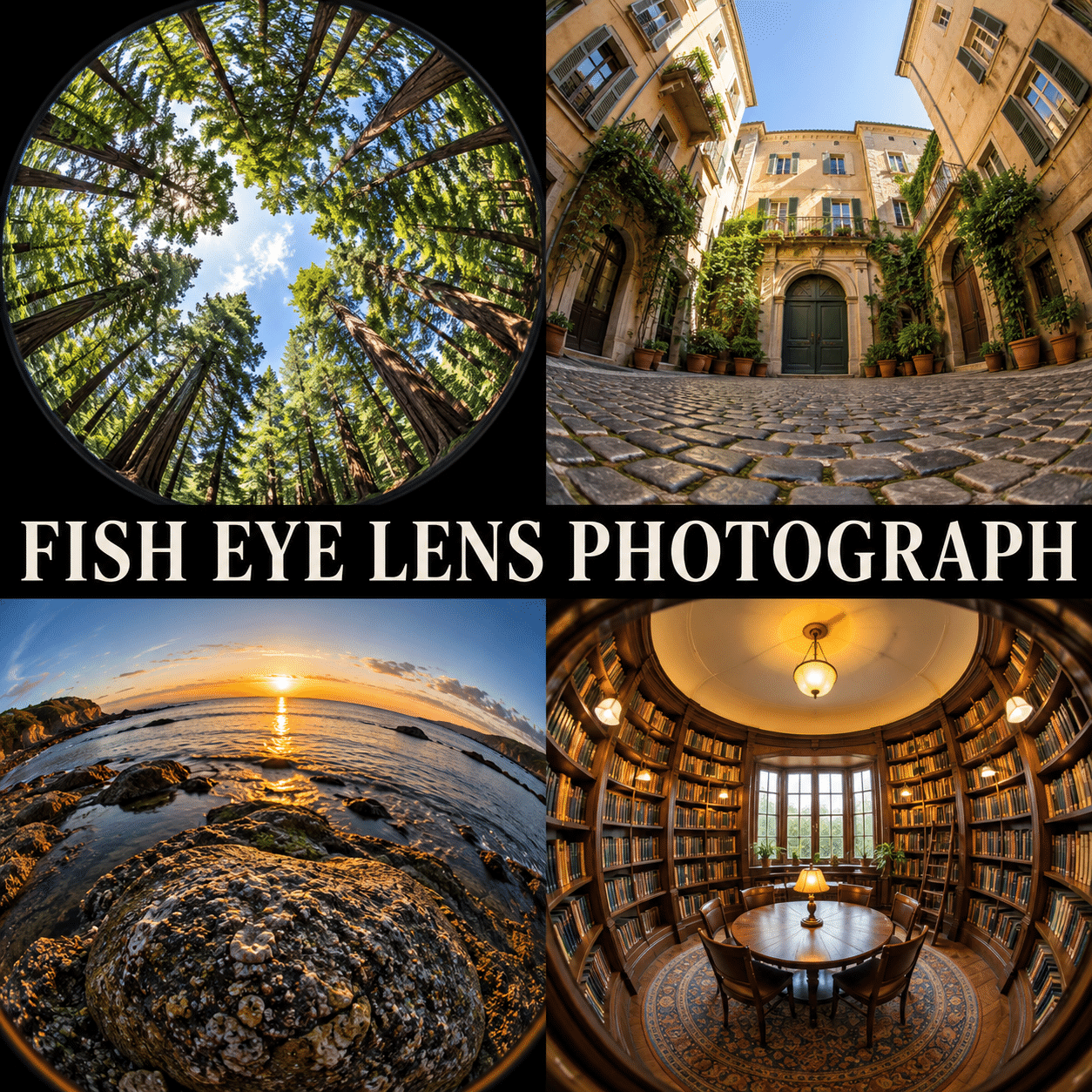


Creative toolbox · take this style further
Choose an input and a destination. Search sends your words to the chosen site; Copy & open puts them on your clipboard to paste there.
Create with AI
Turn your chosen input into an image prompt or a new creative direction.
ChatGPT
Copy your input and paste it into a ChatGPT conversation or image request.
Copy & open ChatGPT (new tab)Claude · Anthropic
Develop an image prompt or explore the style in a new Claude conversation.
Copy & open Claude · Anthropic (new tab)Midjourney
Paste your input into the Imagine bar on the Create page.
Copy & open Midjourney (new tab)Adobe Firefly
Copy your input, open Firefly, and paste it into the prompt field.
Copy & open Adobe Firefly (new tab)Leonardo.Ai
Copy your input, open Leonardo, and paste it into the generation field.
Copy & open Leonardo.Ai (new tab)Image search
Find visual references. Short, concrete keywords usually work best.
Lexica
Search AI images and prompts using your selected input.
Search with this input Lexica (new tab)Pexels
Search the photo and video library. Short keywords often work best.
Search with this input Pexels (new tab)Pixabay
Search photos, illustrations and other images.
Search with this input Pixabay (new tab)Unsplash
Search photographs using the style name or your own keywords.
Search with this input Unsplash (new tab)Wikimedia Commons
Search photographs, artworks and historical images. Check each file for its source and reuse terms.
Search with this input Wikimedia Commons (new tab)Art & research
Explore artists, collections and the ideas behind a style.
Wikipedia
Search for background reading. A style may not have its own article.
Search with this input Wikipedia (new tab)WikiArt
Copy your input into WikiArt’s search to explore artists and artworks.
Copy & open WikiArt (new tab)Europeana
Paste your keywords into the search to explore European museum, library and archive collections.
Copy & open Europeana (new tab)Inspiration
Discover portfolios and visual ideas from creative communities.
Instagram hashtags
Search a hashtag made from your input: spaces and punctuation are removed. Instagram may require sign-in.
Search with this input Instagram hashtags (new tab)ArtStation
Paste your input into artwork search for concept art, environments, characters and visual development.
Copy & open ArtStation (new tab)Behance
Paste your input into project search for illustration, design and visual storytelling.
Copy & open Behance (new tab)A closer look
Very wide coverage; pronounced curvature away from the image centre; enlarged nearby subjects; strong foreground-to-background relationships; circular or rectangular framing; purposeful placement of horizons and edges.
A way of mapping space
A fisheye lens uses a projection that admits an exceptionally wide view while allowing straight lines away from the image centre to curve. This differs from a rectilinear wide-angle lens, which aims to keep straight lines straight. Fisheye is therefore a photographic technique and optical character, not a historical art movement or a synonym for any wide photograph.
The exact field of view depends on the lens and camera format. Nikon’s technical explanation distinguishes circular images contained within the frame from full-frame fisheye images that fill it. In this context, “full-frame fisheye” describes coverage of the picture area; it should not be confused with the name of a sensor format.
Circular and diagonal views make different compositions
A circular fisheye presents the scene as a disc, often surrounded by black. A frame-filling or diagonal fisheye uses the rectangular picture area. Many familiar designs reach about 180 degrees along the relevant dimension, but this is not a universal fixed limit: Canon documents a circular design reaching 190 degrees.
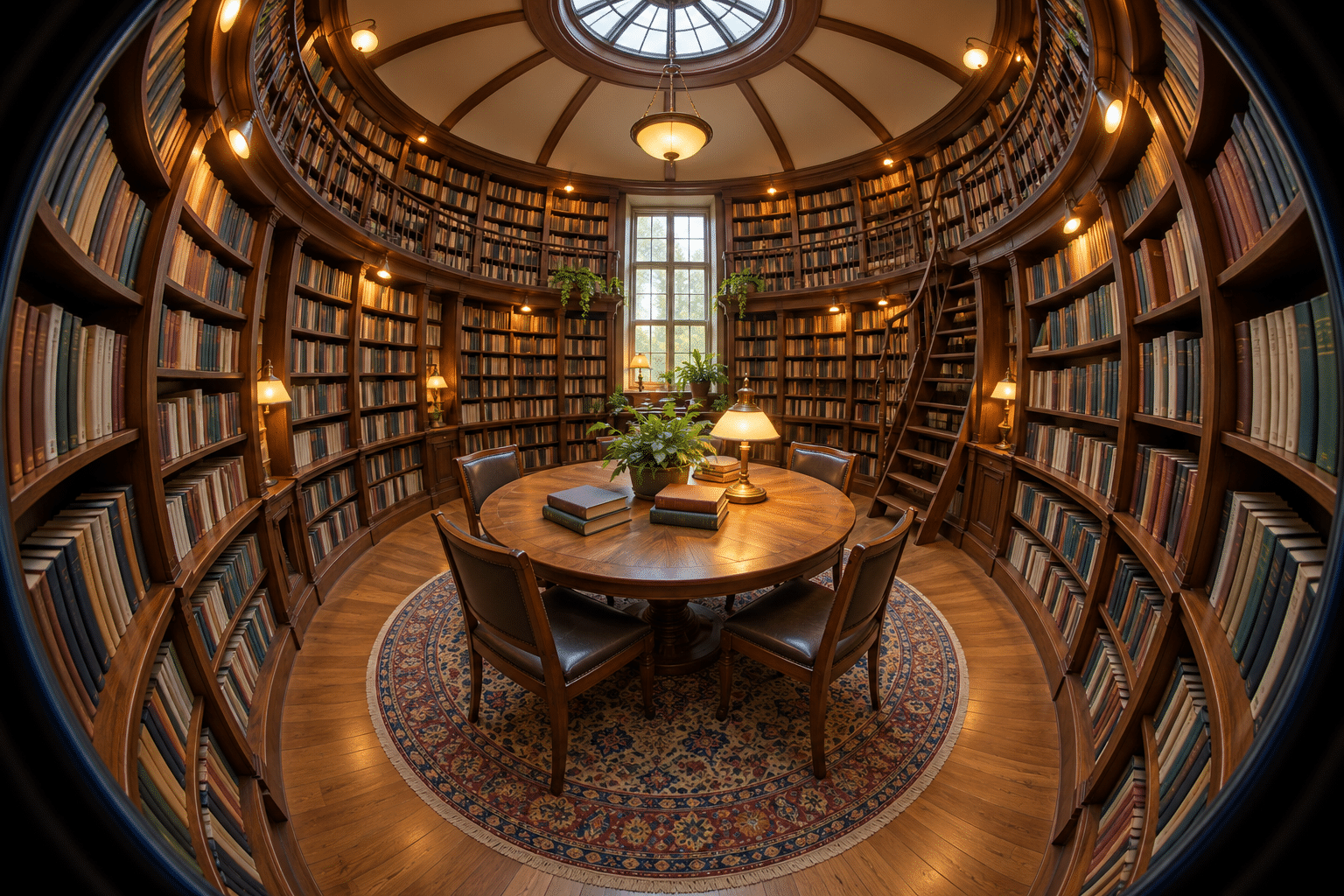
Choose the frame shape for a reason. The circle can make an overhead forest or enclosed space feel like a complete visual world. A rectangular view can connect a close foreground subject with an expansive setting more naturally within a page. Cropping a circular image is possible, but the crop changes the composition and does not make it equivalent to a different optical capture.
Placement matters more than a distortion slider
Move the camera and watch the relationships change. Nearby objects become visually dominant because of the close viewpoint, while the lens’s projection curves the wider scene. These are related effects in the photograph, but proximity and optical mapping are not the same thing. A small move can alter which object feels important.
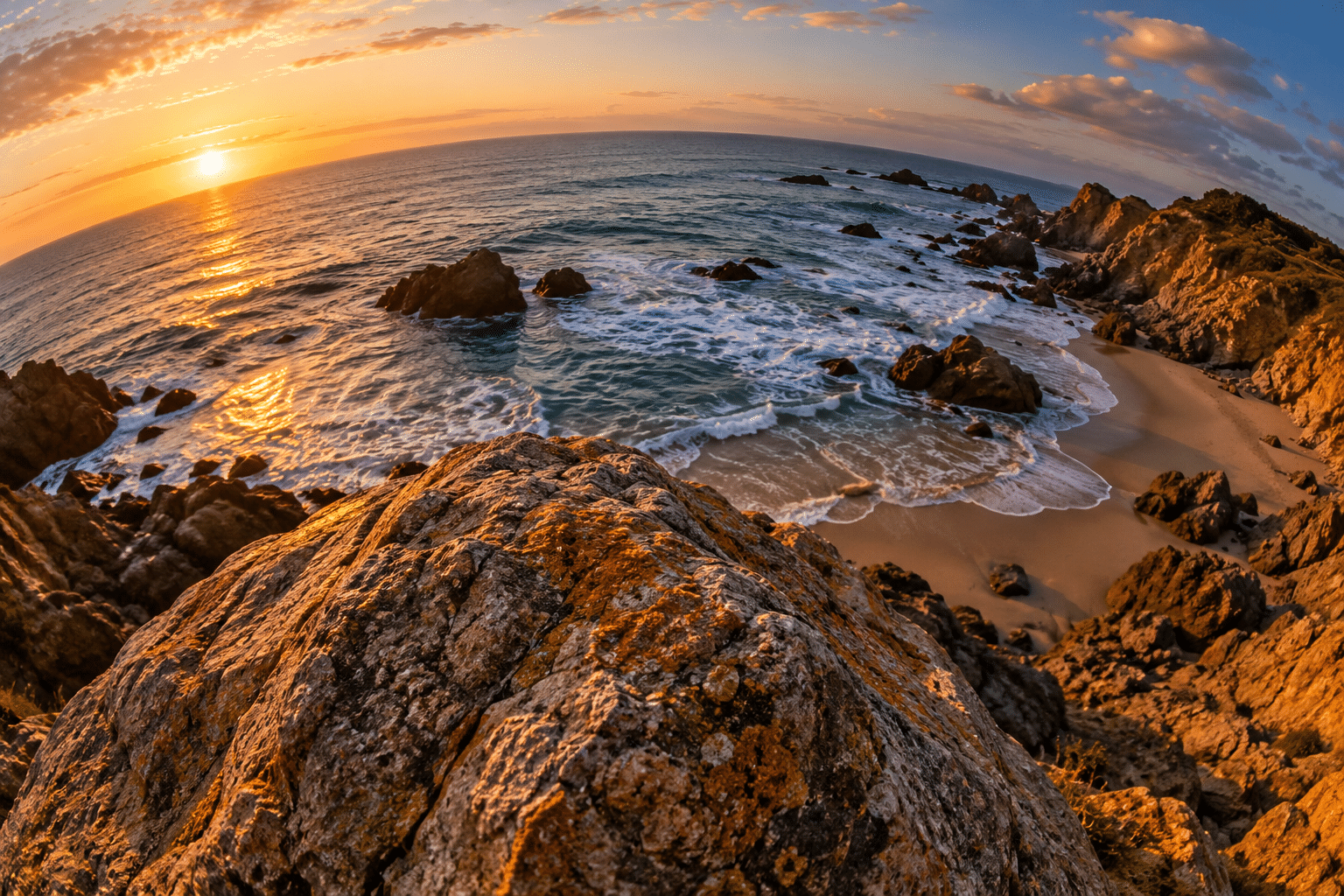
Keep a subject near the centre when you want its shape to remain comparatively restrained. Move it outward when stretching and curvature contribute to the idea. A horizon through the centre can appear relatively straight; tilting the camera to move it away from the centre makes its bow more prominent. Treat that curve as a compositional element rather than an accidental defect.
Build an image around a relationship
A fisheye photograph needs more than spectacle. A foreground rock can anchor a broad landscape; a close performer can connect to the surrounding venue; a courtyard can wrap around the viewer. Nikon’s photographer feature demonstrates the lens across natural and urban settings, showing that its usefulness extends beyond a single novelty effect.
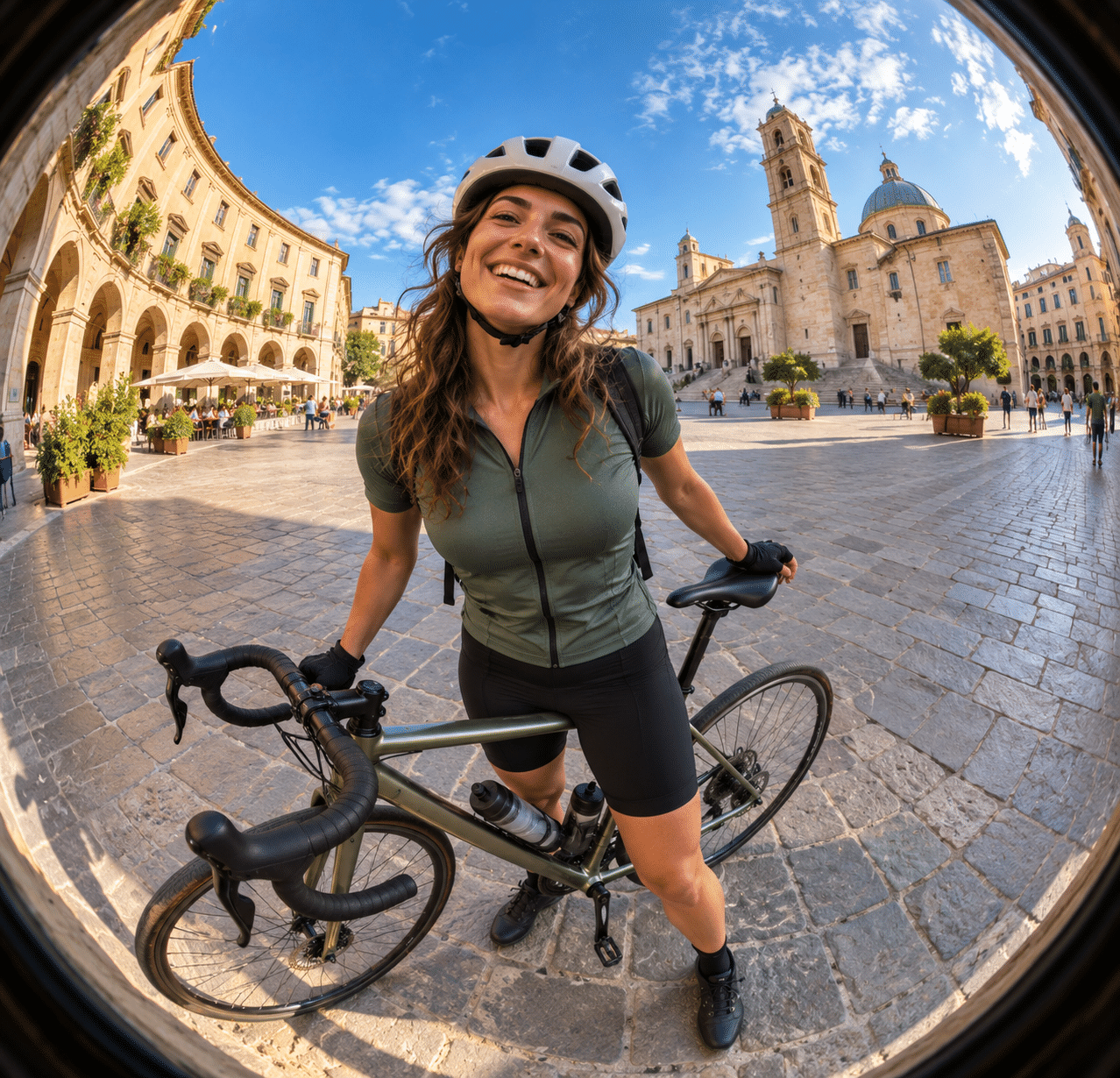
Inspect the entire frame, especially the edges. An enormous angle of view easily includes feet, equipment or distracting fragments. In a portrait, decide whether exaggerated proportions serve the person and the intended mood. In architecture, acknowledge that the image is expressive rather than a neutral record of straight walls and measured dimensions.
Prompting and evaluating generated interpretations
The new AI-generated gallery explores a circular woodland canopy, a rectangular urban court, a close foreground landscape, an interior and a playful environmental portrait. These images simulate fisheye visual behaviour; they are not camera tests and have no genuine lens, exposure or location metadata. A generated picture cannot establish a product’s optical performance.
Specify circular or frame-filling coverage, camera position, the nearest object and the intended horizon placement. Then describe a coherent scene. Avoid asking for random warping: good fisheye imagery maintains a consistent spatial logic. Compare the result at small size to see whether the main relationship survives, rather than judging success only by the strength of the curves.
Positive editorial assessment — AI-authored
Fisheye photography can make spatial relationships immediate and energetic. It connects a close subject to an unusually broad setting and turns architecture or landscape into a rhythmic field. The strongest examples make curvature support an encounter, viewpoint or atmosphere that a conventional frame would express differently.
Critical editorial assessment — AI-authored
The effect becomes tiring when every image relies on exaggerated noses, bowed horizons or empty spectacle. Improve the composition by choosing a clear foreground anchor and controlling edge distractions. Strong distortion cannot rescue weak light, an unclear subject or a viewpoint chosen without purpose.
Neutral editorial assessment — AI-authored
Fisheye is a specialized optical approach useful across action, interiors, landscapes and expressive portraiture. It is less suited to work requiring neutral geometric representation. Its value depends on how projection, viewpoint and subject work together, rather than on maximum coverage alone.
A small poetic detour
Original words from the AOI studio.
Poetry
The street bends round a nearer stone;
the branches gather into sky.
A doorway keeps its place alone
while walls lean outward as we try
to hold the edges of a day
inside one wide and curious glance.
The world has not been moved away;
we chose a different way to dance.
The prompt workshop
Original creative exercises. These prompts create new illustrations, not documentary evidence.
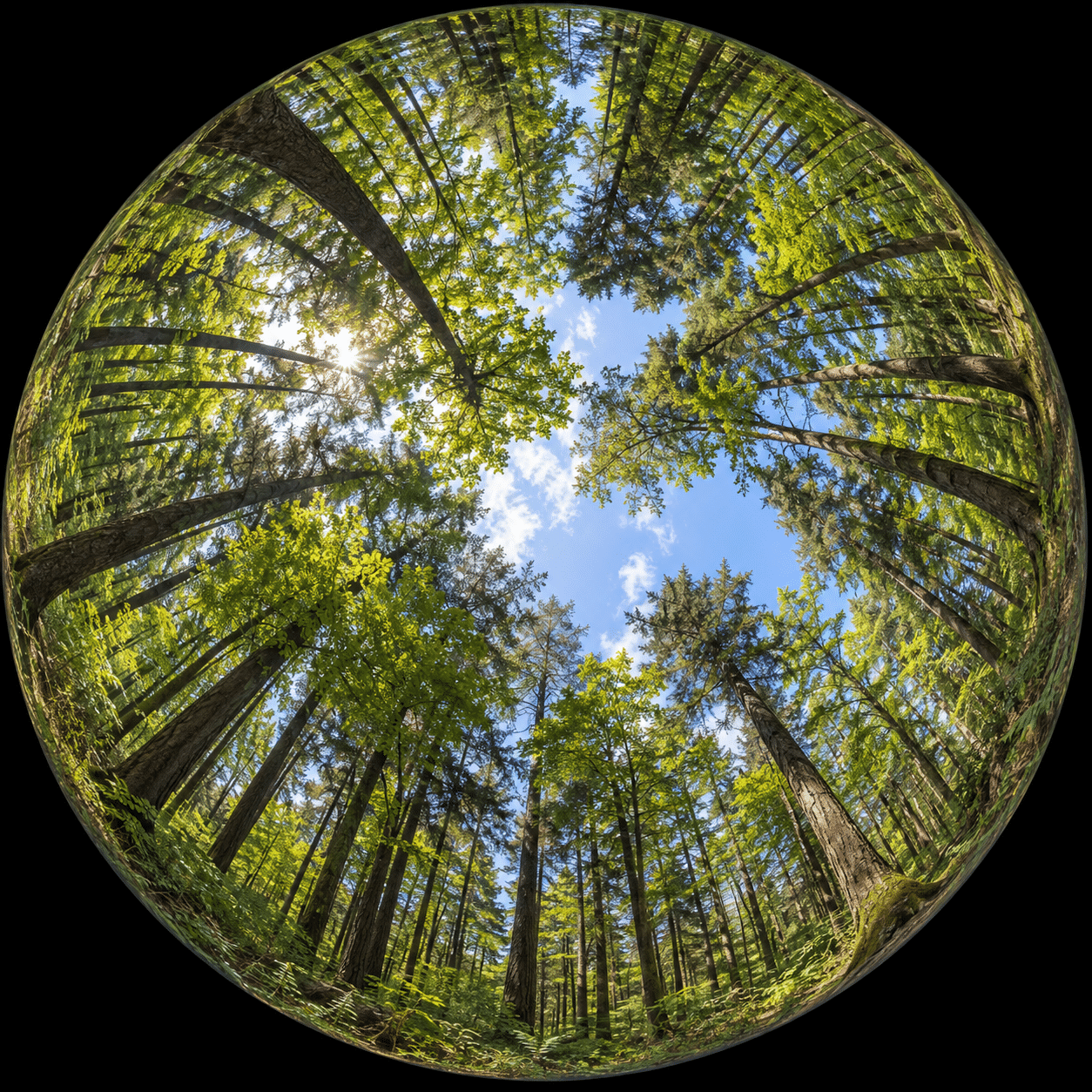
A complete canopy
Original AI-generated photographic interpretation of a circular fisheye view looking upward through a woodland canopy, a complete circular image surrounded by black, trees curving toward the edge and a luminous opening at the centre. Coherent spatial mapping, no camera metadata or location claim.
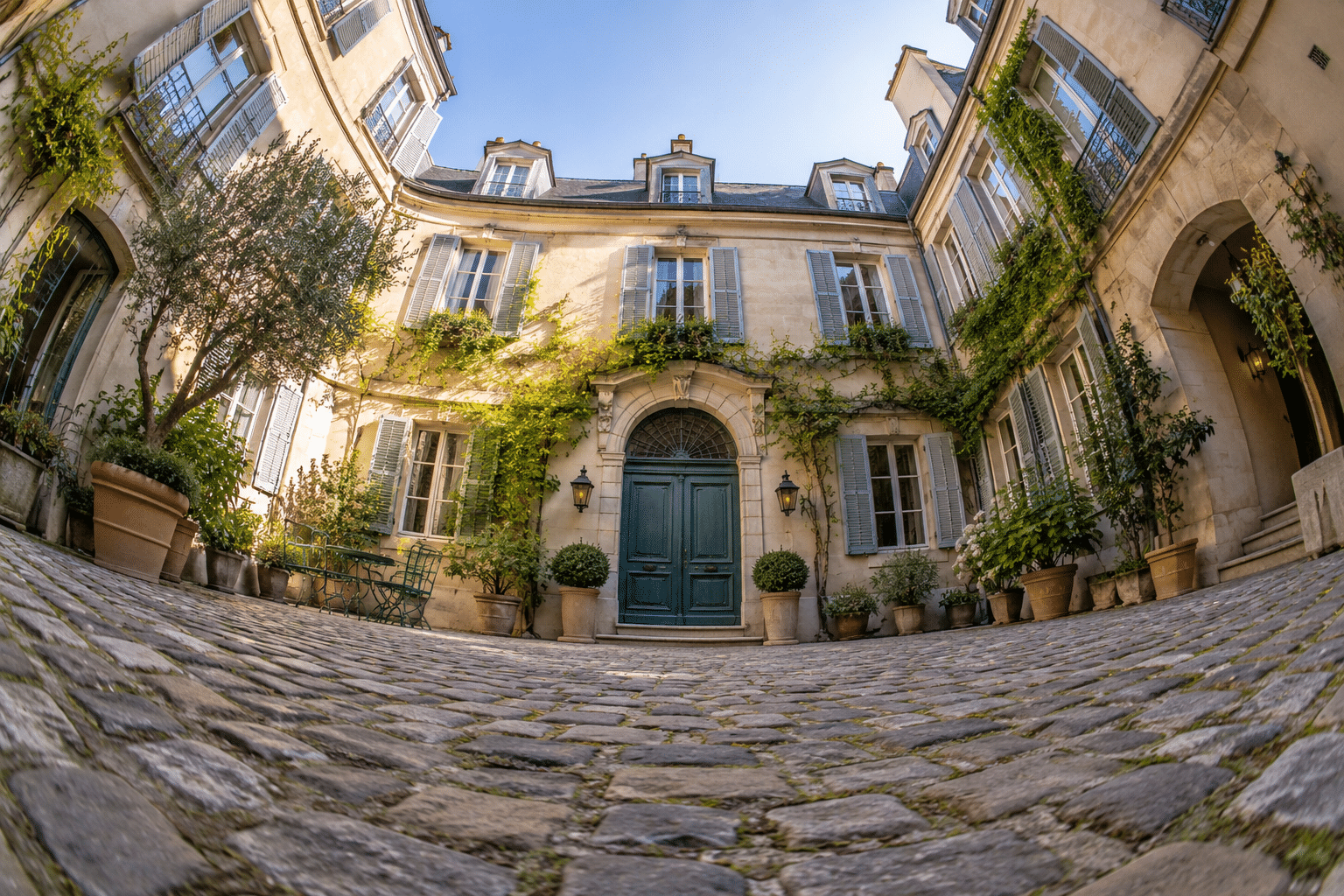
A court around the viewer
Original AI-generated frame-filling fisheye interpretation of a quiet urban courtyard, low central viewpoint, strongly curved peripheral walls, one clear doorway as focal point and coherent daylight. Rectangular image without a black circle, no text.
Foreground and distance
Original AI-generated frame-filling fisheye landscape with one close textured rock anchoring a broad coastal view, deliberate bowed horizon and coherent spatial curvature, soft evening light. No random warped objects, invented camera specifications or real-location claim.
Your next inspiration
Discover another art style
Follow a visual thread to the next subject.
Tilt-Shift Photography: Focus Planes, Upright Buildings and Miniature Effects
Compare very different optical transformations.
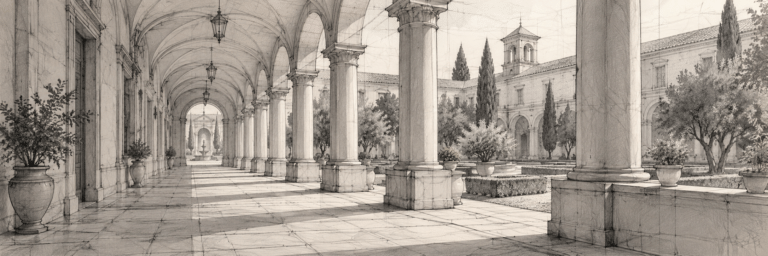
Perspective Drawing: A Coherent View into Space
Separate photographic projection from drawn perspective.
A smile from the studio
Jokes
The horizon complained about the curve. The photographer suggested a seat in the centre of the frame.